


Choosing a Prop Firm: Why Pipstone Capital

Entering the world of proprietary trading is exciting, but choosing the right prop firm can make the difference between steady growth and constant frustration. Today, traders have dozens of options, each promising funding, flexibility, and fast payouts. The challenge isn’t finding a prop firm anymore; it’s finding one that actually supports how traders operate in real market conditions.
Before starting a challenge, traders should look beyond marketing claims and focus on rules, payout structure, and overall trading freedom. This is where many firms fall short, and where Pipstone Capital has positioned itself differently.
This guide breaks down what to look for when choosing a prop firm and why Pipstone Capital stands out for traders preparing to scale in 2026.
What Traders Should Look for When Choosing a Prop Firm
Most traders initially focus on account size or pricing, but experienced traders know those are only surface-level factors. The real difference lies in trading conditions and rule design.
A strong prop firm should offer:
Fair risk parameters that match real trading behavior
Flexible rules that don’t punish profitable strategies
Transparent payout systems
Realistic evaluation models
Trader-first execution conditions
Many challenges fail not because traders lack skill, but because restrictive rules make consistency nearly impossible. Choosing a firm aligned with how markets actually move is critical. Traders still learning the landscape can first understand what prop trading is before comparing challenge structures.

Why Trading Rules Matter More Than Pricing
Cheap challenges often come with hidden limitations. Some firms enforce strict consistency rules, unrealistic profit targets, or payout restrictions that delay withdrawals even after traders become profitable.
Professional traders look for firms that remove unnecessary friction. The goal of a prop firm should be simple: reward disciplined profitability, not force traders into artificial trading behavior.
Pipstone Capital has built its model around this principle, which is why many traders researching proprietary firms vs brokers begin considering funded trading as a scalable alternative.
Pipstone Capital Challenges and Key Advantages
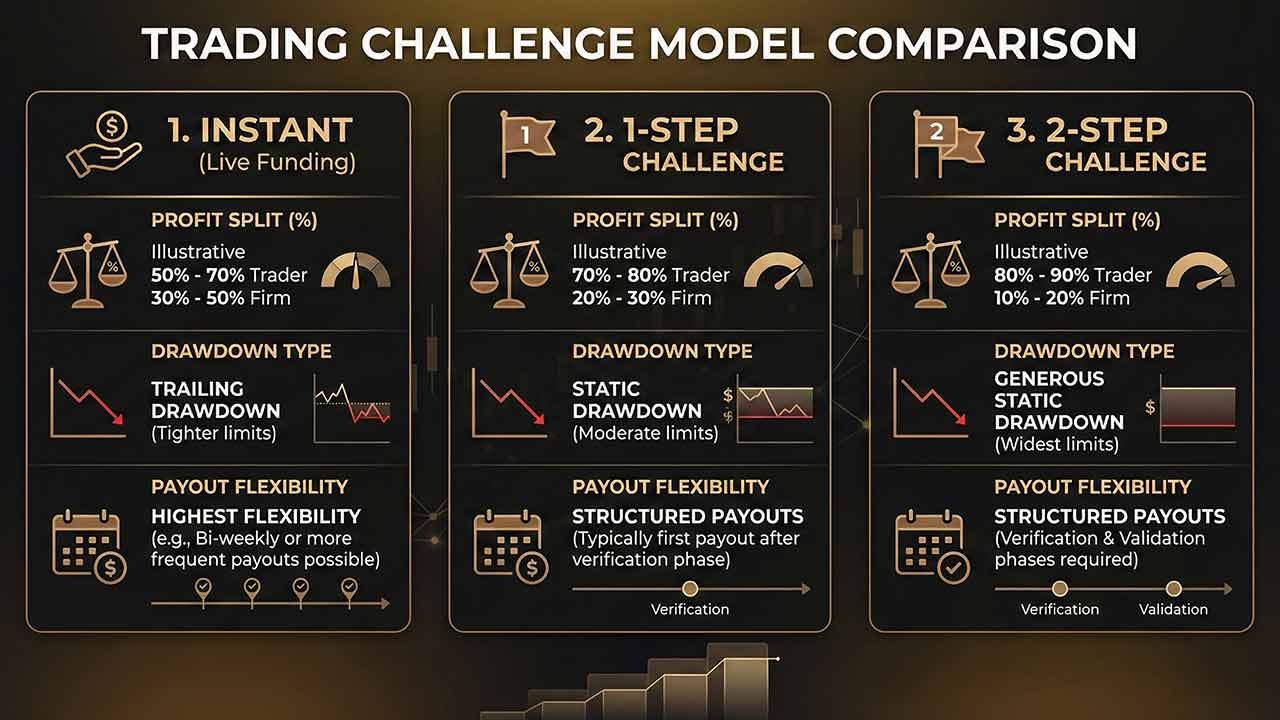
Pipstone Capital’s challenge structure is designed to give traders flexibility while keeping risk parameters clear and realistic. Instead of forcing traders into rigid evaluation paths, the firm offers multiple models — including Instant funding, 1‑Step, and 2‑Step challenges, allowing traders to choose an approach that fits their experience level and trading style.
Account sizes range from smaller starter accounts to larger funding options, making it accessible for both developing traders and experienced professionals looking to scale. Across models, traders benefit from rules built around sustainability rather than pressure-driven performance.
Some of the core advantages include:
No consistency rules, allowing profits to come from real market opportunities rather than forced daily trading
Unlimited trading days, removing time pressure during evaluations
Up to 100% profit split depending on selected add-ons
Weekly or bi‑weekly payouts with fast processing times
Refund on first payout, helping reduce initial risk
Static drawdown structure designed for clearer risk management
Access to the cTrader platform for stable execution and strategy flexibility
Pipstone Capital also emphasizes payout reliability, with rewards processed quickly and compensation policies in place if delays occur. Combined with flexible evaluation paths and trader‑focused rules, the challenge system is built to reward disciplined performance instead of short‑term luck.
A Trader-First Approach at Pipstone Capital
Rather than designing rules that limit traders, Pipstone Capital focuses on flexibility while maintaining responsible risk management.
The structure encourages traders to trade naturally instead of adjusting strategies just to pass an evaluation.
Key advantages include:
Clear risk parameters
Flexible trading styles allowed
Straightforward evaluation logic
Faster access to payouts
This approach reduces psychological pressure - something many traders underestimate when entering funded challenges. Traders preparing beforehand often follow a structured trading plan for funded accounts to improve evaluation outcomes.
No Consistency Rule - Trade Based on Opportunity
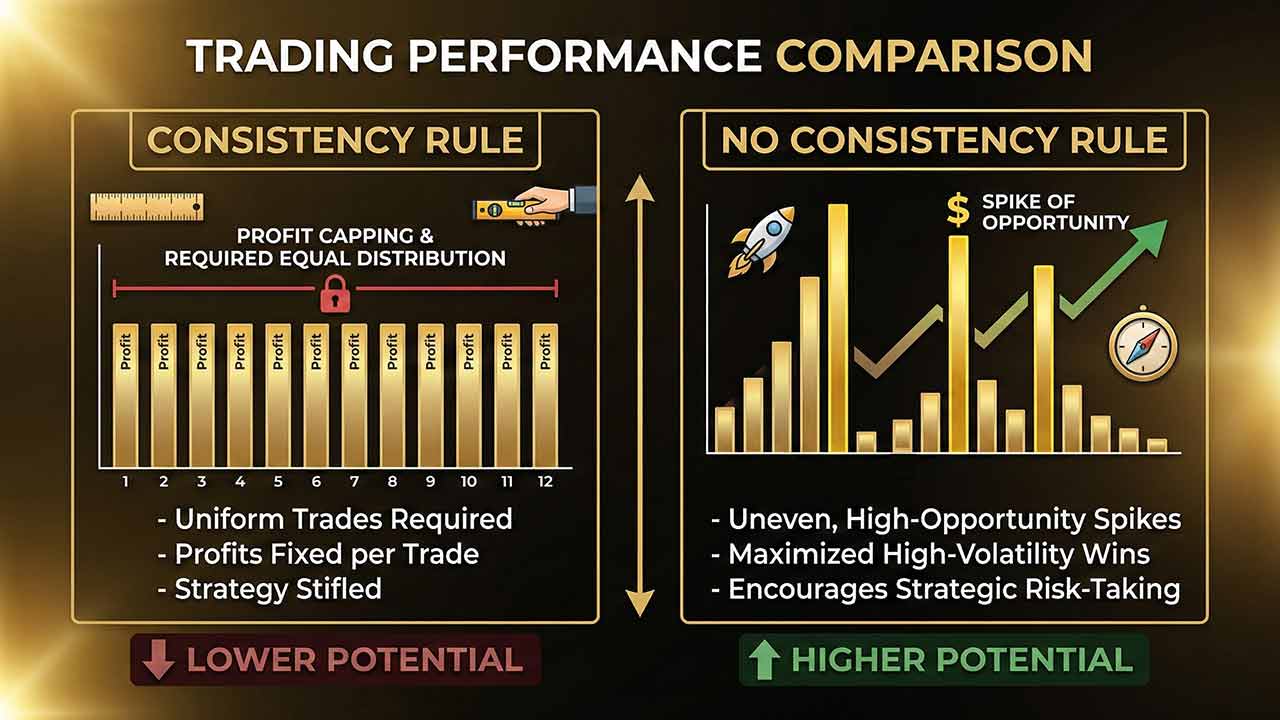
One of Pipstone Capital’s biggest differentiators is the absence of a consistency rule.
Many prop firms require traders to maintain identical lot sizes or evenly distributed profits across trading days. While this may sound reasonable, it often conflicts with real market behavior. Markets don’t provide equal opportunities every day.
Professional traders typically wait for high-probability setups and scale positions when conditions align. Consistency rules punish this natural approach by limiting profitable days, which is why many traders actively look for proprietary firms with no consistency rule when comparing funding providers.
At Pipstone Capital, traders are free to:
Capitalize on strong setups
Scale positions when conviction is higher
Reduce activity during slow market periods
This allows performance to reflect actual trading skill rather than rule management.
Request Payouts After Just 7 Profitable Days
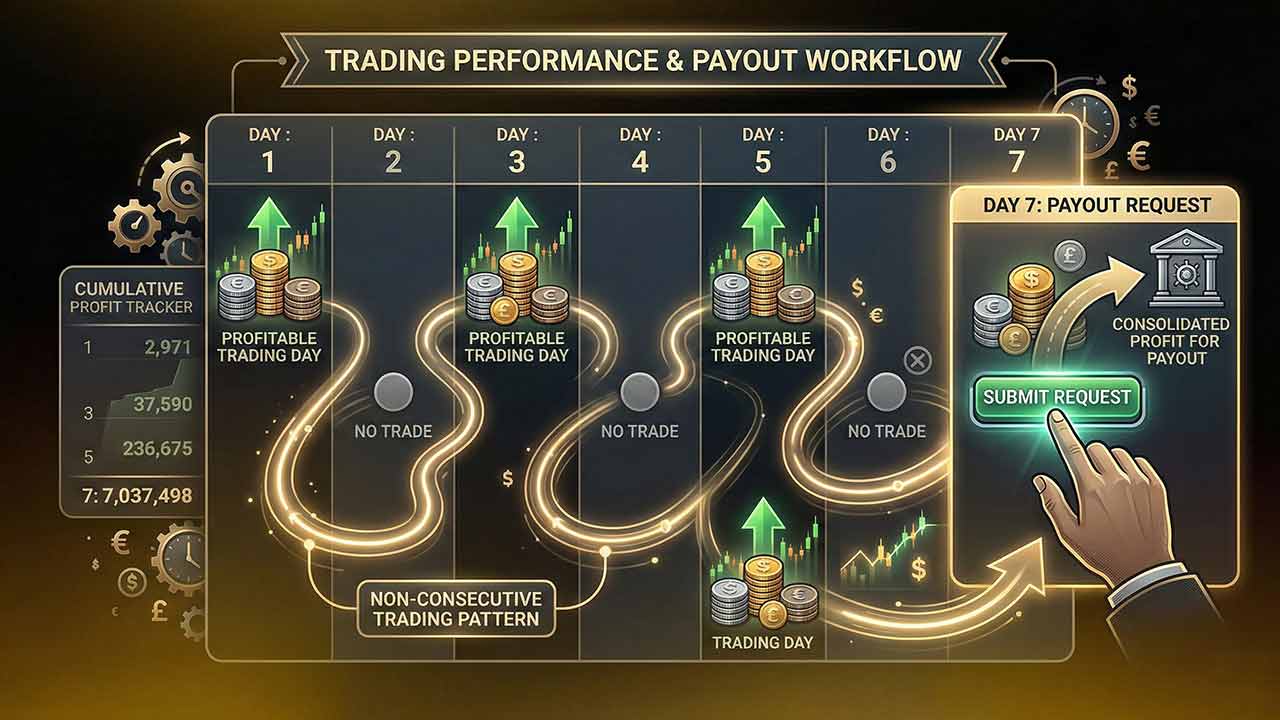
Another major advantage is Pipstone Capital’s payout structure.
Instead of forcing traders to wait long cycles or meet complicated milestones, traders can request a payout after just 7 profitable trading days.
This matters for two reasons:
Cash flow confidence – traders see results faster. Traders don’t need seven winning days in a row or perfectly balanced performance. As long as you reach your seventh profitable trading day, a payout can be requested, whether those profitable days happen within one week or over a longer period. This removes pressure to force trades just to stay "consistent" and allows traders to wait for quality setups.
Motivation and trust – early payouts reinforce disciplined behavior.
For traders transitioning from personal accounts or brokers, faster reward cycles reduce pressure and help maintain consistency over time. Many traders reaching this stage have already learned how to qualify a prop firm challenge by focusing on controlled execution.
The system aligns incentives between trader success and firm growth, a sign of a mature prop firm model.
Evaluation Models Designed for Real Traders
Pipstone Capital offers multiple challenge structures to suit different trading personalities.
Some traders prefer gradual evaluation, while others want faster access to funding. Instead of forcing a one-size-fits-all approach, Pipstone provides models that balance risk limits with trading flexibility.
Key characteristics include:
Realistic drawdown limits
Clear daily and overall risk parameters
Flexible trading strategies allowed
No unnecessary trading restrictions
This makes the evaluation feel closer to managing a real trading account rather than passing an exam. Traders comparing models often start by learning how to choose a funded account based on risk tolerance and strategy style.
Trading Conditions That Support Strategy Execution
Even strong traders struggle when execution costs work against them. Tight spreads and reliable execution are essential, especially for intraday and short-term strategies.
Pipstone Capital emphasizes trading environments that allow strategies to perform as intended, helping traders focus on decision-making rather than platform limitations.
For traders using:
price action strategies
gold or index trading
swing or intraday setups
execution quality becomes a meaningful edge over time, especially when paired with strong risk management in proprietary trading practices.
Psychological Advantage: Less Rule Stress, Better Decisions
One overlooked factor when choosing a prop firm is psychological pressure.
Complex rules create hesitation. Traders begin managing restrictions instead of managing risk. This often leads to missed opportunities or forced trades.
By removing unnecessary constraints like consistency requirements and offering faster payout eligibility, Pipstone Capital helps traders stay focused on what actually matters:
risk management
patience
execution quality
When rules align with trading psychology, performance tends to improve naturally. Many traders also explore one step evaluation models as a faster route toward funding.
How Pipstone Capital Compares to Typical Prop Firms
Many firms emphasize evaluation difficulty as a filtering mechanism. Pipstone Capital instead emphasizes trader sustainability.
Typical limitations elsewhere include:
Long payout waiting periods
Strict profit distribution rules
Overly restrictive trading conditions
Pipstone’s model focuses on rewarding disciplined profitability rather than testing endurance against artificial constraints.
This difference becomes especially noticeable after funding, where long-term scalability matters more than simply passing a challenge.
Is Pipstone Capital Right for You?
Pipstone Capital tends to suit traders who:
Prefer flexibility over rigid rule systems
Trade selectively instead of daily
Want faster payout access
Focus on risk-managed growth rather than aggressive trading
Beginners benefit from clearer rules, while experienced traders appreciate the freedom to execute strategies without unnecessary interference. Understanding how a forex funded account works helps traders decide if funded trading aligns with their goals.
Final Thoughts
Choosing a prop firm is ultimately about alignment. The best firm isn’t the one with the loudest marketing, it’s the one whose structure supports how you actually trade.
Pipstone Capital stands out by simplifying the funded trading experience. The removal of the consistency rule allows traders to follow real market opportunities, while the ability to request payouts after just seven profitable days provides faster reward and confidence.
For traders looking to move into funded trading in 2026, the decision should come down to sustainability. A prop firm should help traders grow, not force them to adapt to unrealistic systems.
When flexibility, fair rules, and trader-focused design matter, Pipstone Capital becomes a strong contender worth serious consideration.



Choosing a Prop Firm: Why Pipstone Capital
Entering the world of proprietary trading is exciting, but choosing the right prop firm can make the difference between steady growth and constant frustration. Today, traders have dozens of options, each promising funding, flexibility, and fast payouts. The challenge isn’t finding a prop firm anymore; it’s finding one that actually supports how traders operate in real market conditions.
Before starting a challenge, traders should look beyond marketing claims and focus on rules, payout structure, and overall trading freedom. This is where many firms fall short, and where Pipstone Capital has positioned itself differently.
This guide breaks down what to look for when choosing a prop firm and why Pipstone Capital stands out for traders preparing to scale in 2026.
What Traders Should Look for When Choosing a Prop Firm
Most traders initially focus on account size or pricing, but experienced traders know those are only surface-level factors. The real difference lies in trading conditions and rule design.
A strong prop firm should offer:
Fair risk parameters that match real trading behavior
Flexible rules that don’t punish profitable strategies
Transparent payout systems
Realistic evaluation models
Trader-first execution conditions
Many challenges fail not because traders lack skill, but because restrictive rules make consistency nearly impossible. Choosing a firm aligned with how markets actually move is critical. Traders still learning the landscape can first understand what prop trading is before comparing challenge structures.
Why Trading Rules Matter More Than Pricing
Cheap challenges often come with hidden limitations. Some firms enforce strict consistency rules, unrealistic profit targets, or payout restrictions that delay withdrawals even after traders become profitable.
Professional traders look for firms that remove unnecessary friction. The goal of a prop firm should be simple: reward disciplined profitability, not force traders into artificial trading behavior.
Pipstone Capital has built its model around this principle, which is why many traders researching proprietary firms vs brokers begin considering funded trading as a scalable alternative.
Pipstone Capital Challenges and Key Advantages
Pipstone Capital’s challenge structure is designed to give traders flexibility while keeping risk parameters clear and realistic. Instead of forcing traders into rigid evaluation paths, the firm offers multiple models — including Instant funding, 1‑Step, and 2‑Step challenges, allowing traders to choose an approach that fits their experience level and trading style.
Account sizes range from smaller starter accounts to larger funding options, making it accessible for both developing traders and experienced professionals looking to scale. Across models, traders benefit from rules built around sustainability rather than pressure-driven performance.
Some of the core advantages include:
No consistency rules, allowing profits to come from real market opportunities rather than forced daily trading
Unlimited trading days, removing time pressure during evaluations
Up to 100% profit split depending on selected add-ons
Weekly or bi‑weekly payouts with fast processing times
Refund on first payout, helping reduce initial risk
Static drawdown structure designed for clearer risk management
Access to the cTrader platform for stable execution and strategy flexibility
Pipstone Capital also emphasizes payout reliability, with rewards processed quickly and compensation policies in place if delays occur. Combined with flexible evaluation paths and trader‑focused rules, the challenge system is built to reward disciplined performance instead of short‑term luck.
A Trader-First Approach at Pipstone Capital
Rather than designing rules that limit traders, Pipstone Capital focuses on flexibility while maintaining responsible risk management.
The structure encourages traders to trade naturally instead of adjusting strategies just to pass an evaluation.
Key advantages include:
Clear risk parameters
Flexible trading styles allowed
Straightforward evaluation logic
Faster access to payouts
This approach reduces psychological pressure - something many traders underestimate when entering funded challenges. Traders preparing beforehand often follow a structured trading plan for funded accounts to improve evaluation outcomes.
No Consistency Rule - Trade Based on Opportunity
One of Pipstone Capital’s biggest differentiators is the absence of a consistency rule.
Many prop firms require traders to maintain identical lot sizes or evenly distributed profits across trading days. While this may sound reasonable, it often conflicts with real market behavior. Markets don’t provide equal opportunities every day.
Professional traders typically wait for high-probability setups and scale positions when conditions align. Consistency rules punish this natural approach by limiting profitable days, which is why many traders actively look for proprietary firms with no consistency rule when comparing funding providers.
At Pipstone Capital, traders are free to:
Capitalize on strong setups
Scale positions when conviction is higher
Reduce activity during slow market periods
This allows performance to reflect actual trading skill rather than rule management.
Request Payouts After Just 7 Profitable Days
Another major advantage is Pipstone Capital’s payout structure.
Instead of forcing traders to wait long cycles or meet complicated milestones, traders can request a payout after just 7 profitable trading days.
This matters for two reasons:
Cash flow confidence – traders see results faster. Traders don’t need seven winning days in a row or perfectly balanced performance. As long as you reach your seventh profitable trading day, a payout can be requested, whether those profitable days happen within one week or over a longer period. This removes pressure to force trades just to stay "consistent" and allows traders to wait for quality setups.
Motivation and trust – early payouts reinforce disciplined behavior.
For traders transitioning from personal accounts or brokers, faster reward cycles reduce pressure and help maintain consistency over time. Many traders reaching this stage have already learned how to qualify a prop firm challenge by focusing on controlled execution.
The system aligns incentives between trader success and firm growth, a sign of a mature prop firm model.
Evaluation Models Designed for Real Traders
Pipstone Capital offers multiple challenge structures to suit different trading personalities.
Some traders prefer gradual evaluation, while others want faster access to funding. Instead of forcing a one-size-fits-all approach, Pipstone provides models that balance risk limits with trading flexibility.
Key characteristics include:
Realistic drawdown limits
Clear daily and overall risk parameters
Flexible trading strategies allowed
No unnecessary trading restrictions
This makes the evaluation feel closer to managing a real trading account rather than passing an exam. Traders comparing models often start by learning how to choose a funded account based on risk tolerance and strategy style.
Trading Conditions That Support Strategy Execution
Even strong traders struggle when execution costs work against them. Tight spreads and reliable execution are essential, especially for intraday and short-term strategies.
Pipstone Capital emphasizes trading environments that allow strategies to perform as intended, helping traders focus on decision-making rather than platform limitations.
For traders using:
price action strategies
gold or index trading
swing or intraday setups
execution quality becomes a meaningful edge over time, especially when paired with strong risk management in proprietary trading practices.
Psychological Advantage: Less Rule Stress, Better Decisions
One overlooked factor when choosing a prop firm is psychological pressure.
Complex rules create hesitation. Traders begin managing restrictions instead of managing risk. This often leads to missed opportunities or forced trades.
By removing unnecessary constraints like consistency requirements and offering faster payout eligibility, Pipstone Capital helps traders stay focused on what actually matters:
risk management
patience
execution quality
When rules align with trading psychology, performance tends to improve naturally. Many traders also explore one step evaluation models as a faster route toward funding.
How Pipstone Capital Compares to Typical Prop Firms
Many firms emphasize evaluation difficulty as a filtering mechanism. Pipstone Capital instead emphasizes trader sustainability.
Typical limitations elsewhere include:
Long payout waiting periods
Strict profit distribution rules
Overly restrictive trading conditions
Pipstone’s model focuses on rewarding disciplined profitability rather than testing endurance against artificial constraints.
This difference becomes especially noticeable after funding, where long-term scalability matters more than simply passing a challenge.
Is Pipstone Capital Right for You?
Pipstone Capital tends to suit traders who:
Prefer flexibility over rigid rule systems
Trade selectively instead of daily
Want faster payout access
Focus on risk-managed growth rather than aggressive trading
Beginners benefit from clearer rules, while experienced traders appreciate the freedom to execute strategies without unnecessary interference. Understanding how a forex funded account works helps traders decide if funded trading aligns with their goals.
Final Thoughts
Choosing a prop firm is ultimately about alignment. The best firm isn’t the one with the loudest marketing, it’s the one whose structure supports how you actually trade.
Pipstone Capital stands out by simplifying the funded trading experience. The removal of the consistency rule allows traders to follow real market opportunities, while the ability to request payouts after just seven profitable days provides faster reward and confidence.
For traders looking to move into funded trading in 2026, the decision should come down to sustainability. A prop firm should help traders grow, not force them to adapt to unrealistic systems.
When flexibility, fair rules, and trader-focused design matter, Pipstone Capital becomes a strong contender worth serious consideration.
