


How to Choose Funded Accounts Before Starting a Challenge in 2026

The funded trading industry has evolved fast over the past few years. In 2026, traders are no longer failing challenges because they lack strategy, most fail because they choose the wrong funded account structure before they even place their first trade.
Many traders focus on profit splits, account size, or marketing promises. But experienced prop traders understand something different: the rules of the account matter more than the capital itself.
Choosing the right funded account is not about finding the “best” challenge. It is about finding the one that fits your psychology, trading style, and risk tolerance. Before you start any evaluation, understanding how account conditions affect your behavior can dramatically improve your chances of passing.
Why Funded Account Selection Matters More in 2026
Modern prop firms have shifted toward risk-control models rather than aggressive profit targets. Evaluations are designed to measure:
Risk management discipline
Consistency over time
Emotional control under pressure
Rule compliance
This means the challenge is less about making large profits quickly and more about surviving within structured limits. Traders who understand how a forex funded account actually works tend to adapt faster to evaluation rules.
Many traders unknowingly sabotage themselves by choosing accounts that conflict with how they naturally trade. A scalper may pick rules designed for swing traders. A beginner may choose aggressive drawdown limits meant for professionals.
The result is predictable: overtrading, emotional decisions, and failed evaluations. Many of these mistakes are covered in detail when learning how to pass a prop firm challenge before starting an evaluation.
Step 1: Understand Your Trading Style First
Before comparing funded programs, start with yourself.
Ask honestly:
Do you trade frequently or wait for high-quality setups?
Do you prefer short intraday moves or multi-day positions?
How comfortable are you with drawdowns?
Do you perform well under time pressure?
Different styles require different rule environments.
Scalpers and Intraday Traders
They benefit from:
Flexible daily loss limits
Stable execution conditions
Static drawdowns instead of trailing ones
Because trades happen frequently, tight restrictions can quickly invalidate otherwise profitable strategies.
Swing Traders
They usually need:
Higher overall loss allowance
Less pressure to trade daily
Stable equity calculations
Holding trades longer requires breathing room.
Beginners
New traders often underestimate psychological pressure. Accounts with strict limits or aggressive scaling requirements can lead to forced trades simply to “stay active.”
In most cases, beginners succeed faster when rules allow recovery rather than punishment. Building structure early with a clear trading plan for a funded account challenge often makes the biggest difference.

Step 2: Learn the Difference Between Drawdown Types
One of the most misunderstood elements of funded challenges is drawdown structure.
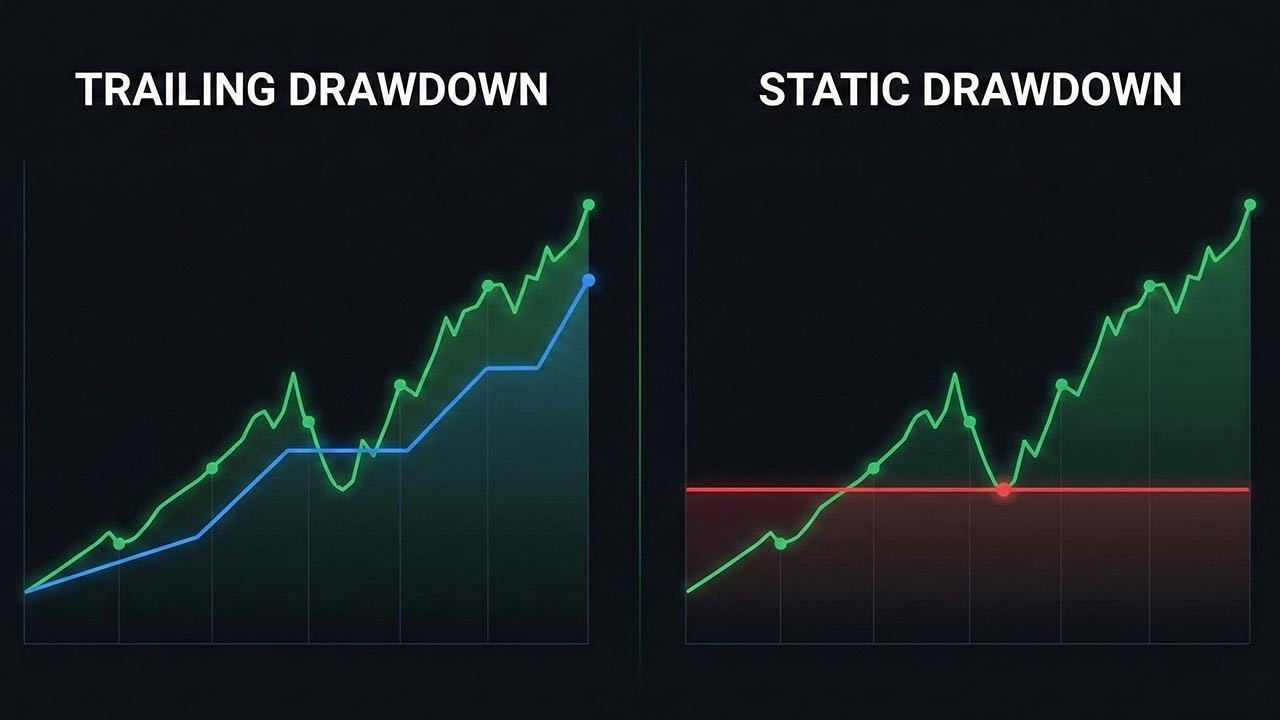
Trailing Drawdown
Moves upward as your account grows.
Protects profits but reduces flexibility.
Punishes aggressive early trading.
This model rewards consistency but can feel restrictive if you scale positions quickly.
Static Drawdown
Fixed loss limit from starting balance.
Easier to manage psychologically.
Preferred by structured traders.
Understanding this single factor often determines whether a trader passes or fails. Strong risk management for forex funded accounts usually begins with understanding drawdown mechanics.
Step 3: Daily Loss vs Overall Loss — What Really Matters
Many traders focus only on overall drawdown, but daily loss limits often cause the majority of failures.
Daily loss controls emotional trading days.
Overall loss measures long-term discipline.
If your strategy experiences temporary volatility, a tight daily limit can end the challenge even when your system is profitable over time.
In 2026, successful traders choose accounts where daily risk aligns with their average trade exposure. Traders preparing seriously often study how to pass a funded account challenge before selecting their model.
Step 4: Profit Targets Are No Longer the Main Difficulty
Interestingly, many modern funded accounts now remove strict profit targets or make them secondary.
Why?
Prop firms increasingly evaluate:
Risk behavior
Trade consistency
Sustainability
A trader who grows slowly but safely is often more valuable than someone who reaches large profits through aggressive risk.
This shift benefits traders who focus on process rather than quick gains. Many modern prop firms now highlight structures such as prop firms with no consistency rule to encourage sustainable trading behavior.

Step 5: Leverage Should Match Experience Level
Leverage is a tool, not an advantage.
Higher leverage:
Increases opportunity
Amplifies mistakes
Accelerates drawdown breaches
Beginners often assume higher leverage improves passing chances. In reality, moderate leverage encourages controlled position sizing and better long-term performance. Understanding margin vs leverage in trading is essential before choosing higher-risk account settings.
Which Pipstone Capital Challenge Fits Your Trading Style?
A good example of structured account progression can be seen in Pipstone Capital’s funded challenge models, which are designed around different trader profiles rather than a one-size-fits-all evaluation.
Each model targets a different level of experience and risk preference.
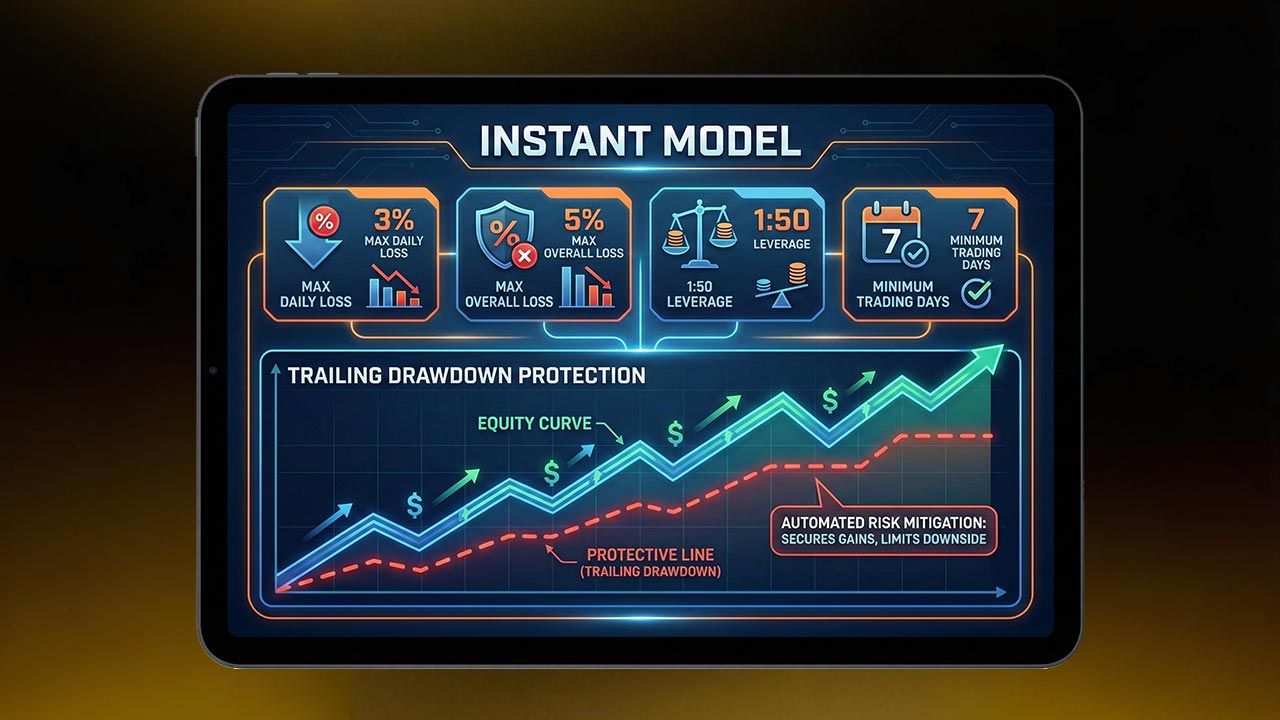
Instant Model — Built for Conservative Traders
Profit Target: No limit
Max Daily Loss: 3% ($150)
Max Overall Loss: 5% ($250)
Minimum Trading Days: 7 days
Leverage: 1:50
Drawdown Type: Trailing
The Instant model focuses heavily on discipline. With a trailing drawdown and tighter loss limits, this structure favors traders who already have strong risk control and patience.
Because there is no profit target pressure, traders can focus purely on execution quality rather than rushing trades. The seven-day requirement also encourages consistency instead of one lucky trading session.
Best suited for:
Low-risk traders
Consistency-focused strategies
Traders transitioning from personal accounts to prop trading
1-Step Model — Balanced Speed and Flexibility
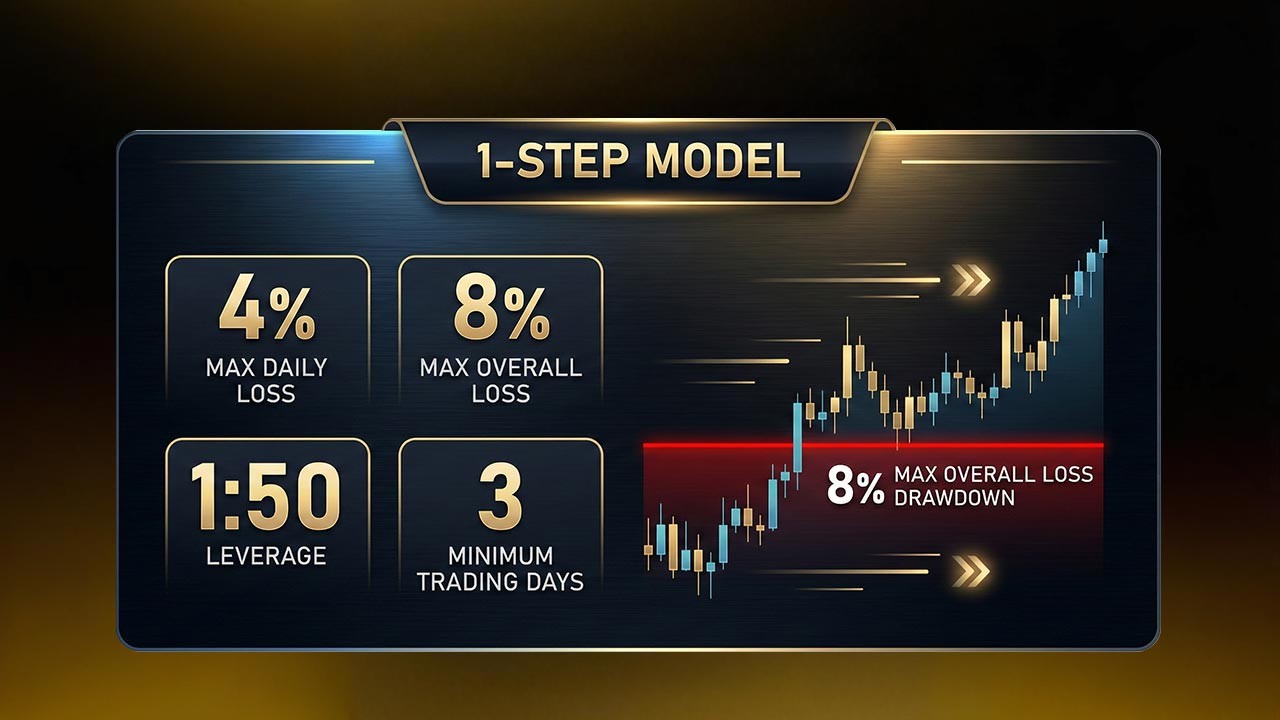
Profit Target: No limit
Max Daily Loss: 4% ($200)
Max Overall Loss: 8% ($400)
Minimum Trading Days: 3 days
Leverage: 1:50
Drawdown Type: Static
The 1-Step challenge removes much of the psychological pressure created by trailing drawdowns. A static loss limit allows traders to manage positions without constantly worrying about moving thresholds.
With fewer required trading days, experienced traders can qualify faster while still maintaining structured risk limits. This structure closely reflects how a one step evaluation is designed for faster progression.
Best suited for:
Confident traders with proven systems
Intraday traders seeking faster progression
Traders who prefer predictable risk parameters
2-Step Model — Maximum Flexibility for Strategy Development
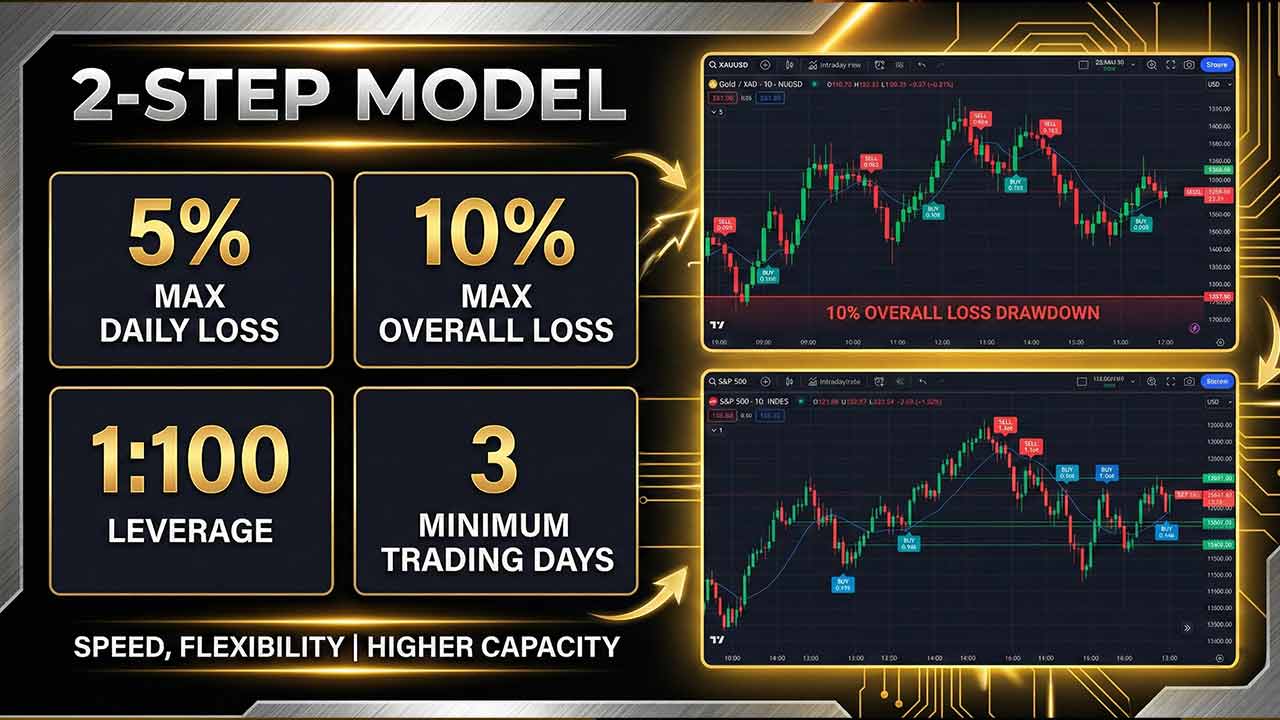
Profit Target: No limit
Max Daily Loss: 5% ($250)
Max Overall Loss: 10% ($500)
Minimum Trading Days: 3 days
Leverage: 1:100
Drawdown Type: Static
The 2-Step model provides the most flexibility. Higher loss allowances and increased leverage create room for traders who actively manage positions or trade volatile markets like gold or indices.
Because risk limits are wider, traders can recover from temporary drawdowns without immediately failing the challenge.
Best suited for:
Active traders
Gold and index traders
Traders still refining consistency
Step 6: Match the Account to Your Psychology
One of the biggest lessons across the funded trading industry is simple:
Most traders fail psychologically, not technically.
If rules feel restrictive, traders begin forcing trades.
If limits feel too loose, traders often over-risk.
The ideal account should feel structured but comfortable, allowing you to trade normally rather than adapting your behavior just to survive rules. Developing strong trading psychology helps traders stay consistent under evaluation pressure.
Step 7: Think Long Term, Not Just Passing
Passing a challenge is only the beginning.
Before choosing an account, consider:
Can you maintain performance under these rules long term?
Do withdrawal policies support consistent income?
Does the structure allow scaling?
A funded account should support your trading career, not just a single evaluation phase. Understanding the broader debate of prop firms vs brokers also helps traders decide why funded models exist in the first place.
Final Thoughts
In 2026, choosing a funded account is less about finding the biggest capital offer and more about finding rule compatibility.
The traders who succeed are those who:
Understand their trading style first
Choose drawdown models carefully
Respect daily loss limits
Avoid leverage mismatches
Select challenges aligned with their psychology
Whether selecting an Instant, 1-Step, or 2-Step structure like those offered by Pipstone Capital, the goal remains the same: create an environment where consistency becomes natural.
Because in funded trading, passing the challenge is not about trading harder, it is about trading in conditions designed for how you already perform best.
FAQs: Choosing Funded Accounts
What is the most important factor when choosing a funded account?
The risk rules. Daily loss, overall drawdown, and drawdown type affect your passing probability more than account size.
Should beginners choose high leverage accounts?
Usually no. Moderate leverage helps control risk and prevents early challenge failures.
Is a one-step challenge better than a two-step challenge?
Not necessarily. One-step models suit experienced traders, while two-step challenges offer more flexibility for developing consistency.
What drawdown type is easier to manage?
Static drawdown is generally easier because limits stay fixed, making risk planning more predictable.
How long should I prepare before starting a funded challenge?
Until your strategy shows consistent results on demo or simulated trading, not based on a fixed timeline.



How to Choose Funded Accounts Before Starting a Challenge in 2026
The funded trading industry has evolved fast over the past few years. In 2026, traders are no longer failing challenges because they lack strategy, most fail because they choose the wrong funded account structure before they even place their first trade.
Many traders focus on profit splits, account size, or marketing promises. But experienced prop traders understand something different: the rules of the account matter more than the capital itself.
Choosing the right funded account is not about finding the “best” challenge. It is about finding the one that fits your psychology, trading style, and risk tolerance. Before you start any evaluation, understanding how account conditions affect your behavior can dramatically improve your chances of passing.
Why Funded Account Selection Matters More in 2026
Modern prop firms have shifted toward risk-control models rather than aggressive profit targets. Evaluations are designed to measure:
Risk management discipline
Consistency over time
Emotional control under pressure
Rule compliance
This means the challenge is less about making large profits quickly and more about surviving within structured limits. Traders who understand how a forex funded account actually works tend to adapt faster to evaluation rules.
Many traders unknowingly sabotage themselves by choosing accounts that conflict with how they naturally trade. A scalper may pick rules designed for swing traders. A beginner may choose aggressive drawdown limits meant for professionals.
The result is predictable: overtrading, emotional decisions, and failed evaluations. Many of these mistakes are covered in detail when learning how to pass a prop firm challenge before starting an evaluation.
Step 1: Understand Your Trading Style First
Before comparing funded programs, start with yourself.
Ask honestly:
Do you trade frequently or wait for high-quality setups?
Do you prefer short intraday moves or multi-day positions?
How comfortable are you with drawdowns?
Do you perform well under time pressure?
Different styles require different rule environments.
Scalpers and Intraday Traders
They benefit from:
Flexible daily loss limits
Stable execution conditions
Static drawdowns instead of trailing ones
Because trades happen frequently, tight restrictions can quickly invalidate otherwise profitable strategies.
Swing Traders
They usually need:
Higher overall loss allowance
Less pressure to trade daily
Stable equity calculations
Holding trades longer requires breathing room.
Beginners
New traders often underestimate psychological pressure. Accounts with strict limits or aggressive scaling requirements can lead to forced trades simply to “stay active.”
In most cases, beginners succeed faster when rules allow recovery rather than punishment. Building structure early with a clear trading plan for a funded account challenge often makes the biggest difference.
Step 2: Learn the Difference Between Drawdown Types
One of the most misunderstood elements of funded challenges is drawdown structure.
Trailing Drawdown
Moves upward as your account grows.
Protects profits but reduces flexibility.
Punishes aggressive early trading.
This model rewards consistency but can feel restrictive if you scale positions quickly.
Static Drawdown
Fixed loss limit from starting balance.
Easier to manage psychologically.
Preferred by structured traders.
Understanding this single factor often determines whether a trader passes or fails. Strong risk management for forex funded accounts usually begins with understanding drawdown mechanics.
Step 3: Daily Loss vs Overall Loss — What Really Matters
Many traders focus only on overall drawdown, but daily loss limits often cause the majority of failures.
Daily loss controls emotional trading days.
Overall loss measures long-term discipline.
If your strategy experiences temporary volatility, a tight daily limit can end the challenge even when your system is profitable over time.
In 2026, successful traders choose accounts where daily risk aligns with their average trade exposure. Traders preparing seriously often study how to pass a funded account challenge before selecting their model.
Step 4: Profit Targets Are No Longer the Main Difficulty
Interestingly, many modern funded accounts now remove strict profit targets or make them secondary.
Why?
Prop firms increasingly evaluate:
Risk behavior
Trade consistency
Sustainability
A trader who grows slowly but safely is often more valuable than someone who reaches large profits through aggressive risk.
This shift benefits traders who focus on process rather than quick gains. Many modern prop firms now highlight structures such as prop firms with no consistency rule to encourage sustainable trading behavior.
Step 5: Leverage Should Match Experience Level
Leverage is a tool, not an advantage.
Higher leverage:
Increases opportunity
Amplifies mistakes
Accelerates drawdown breaches
Beginners often assume higher leverage improves passing chances. In reality, moderate leverage encourages controlled position sizing and better long-term performance. Understanding margin vs leverage in trading is essential before choosing higher-risk account settings.
Which Pipstone Capital Challenge Fits Your Trading Style?
A good example of structured account progression can be seen in Pipstone Capital’s funded challenge models, which are designed around different trader profiles rather than a one-size-fits-all evaluation.
Each model targets a different level of experience and risk preference.
Instant Model — Built for Conservative Traders
Profit Target: No limit
Max Daily Loss: 3% ($150)
Max Overall Loss: 5% ($250)
Minimum Trading Days: 7 days
Leverage: 1:50
Drawdown Type: Trailing
The Instant model focuses heavily on discipline. With a trailing drawdown and tighter loss limits, this structure favors traders who already have strong risk control and patience.
Because there is no profit target pressure, traders can focus purely on execution quality rather than rushing trades. The seven-day requirement also encourages consistency instead of one lucky trading session.
Best suited for:
Low-risk traders
Consistency-focused strategies
Traders transitioning from personal accounts to prop trading
1-Step Model — Balanced Speed and Flexibility
Profit Target: No limit
Max Daily Loss: 4% ($200)
Max Overall Loss: 8% ($400)
Minimum Trading Days: 3 days
Leverage: 1:50
Drawdown Type: Static
The 1-Step challenge removes much of the psychological pressure created by trailing drawdowns. A static loss limit allows traders to manage positions without constantly worrying about moving thresholds.
With fewer required trading days, experienced traders can qualify faster while still maintaining structured risk limits. This structure closely reflects how a one step evaluation is designed for faster progression.
Best suited for:
Confident traders with proven systems
Intraday traders seeking faster progression
Traders who prefer predictable risk parameters
2-Step Model — Maximum Flexibility for Strategy Development
Profit Target: No limit
Max Daily Loss: 5% ($250)
Max Overall Loss: 10% ($500)
Minimum Trading Days: 3 days
Leverage: 1:100
Drawdown Type: Static
The 2-Step model provides the most flexibility. Higher loss allowances and increased leverage create room for traders who actively manage positions or trade volatile markets like gold or indices.
Because risk limits are wider, traders can recover from temporary drawdowns without immediately failing the challenge.
Best suited for:
Active traders
Gold and index traders
Traders still refining consistency
Step 6: Match the Account to Your Psychology
One of the biggest lessons across the funded trading industry is simple:
Most traders fail psychologically, not technically.
If rules feel restrictive, traders begin forcing trades.
If limits feel too loose, traders often over-risk.
The ideal account should feel structured but comfortable, allowing you to trade normally rather than adapting your behavior just to survive rules. Developing strong trading psychology helps traders stay consistent under evaluation pressure.
Step 7: Think Long Term, Not Just Passing
Passing a challenge is only the beginning.
Before choosing an account, consider:
Can you maintain performance under these rules long term?
Do withdrawal policies support consistent income?
Does the structure allow scaling?
A funded account should support your trading career, not just a single evaluation phase. Understanding the broader debate of prop firms vs brokers also helps traders decide why funded models exist in the first place.
Final Thoughts
In 2026, choosing a funded account is less about finding the biggest capital offer and more about finding rule compatibility.
The traders who succeed are those who:
Understand their trading style first
Choose drawdown models carefully
Respect daily loss limits
Avoid leverage mismatches
Select challenges aligned with their psychology
Whether selecting an Instant, 1-Step, or 2-Step structure like those offered by Pipstone Capital, the goal remains the same: create an environment where consistency becomes natural.
Because in funded trading, passing the challenge is not about trading harder, it is about trading in conditions designed for how you already perform best.
FAQs: Choosing Funded Accounts
What is the most important factor when choosing a funded account?
The risk rules. Daily loss, overall drawdown, and drawdown type affect your passing probability more than account size.
Should beginners choose high leverage accounts?
Usually no. Moderate leverage helps control risk and prevents early challenge failures.
Is a one-step challenge better than a two-step challenge?
Not necessarily. One-step models suit experienced traders, while two-step challenges offer more flexibility for developing consistency.
What drawdown type is easier to manage?
Static drawdown is generally easier because limits stay fixed, making risk planning more predictable.
How long should I prepare before starting a funded challenge?
Until your strategy shows consistent results on demo or simulated trading, not based on a fixed timeline.
