


Prop Firms With No Consistency Rule: Why Traders Choose Pipstone 2026

In 2026, more traders are actively searching for prop firms with no consistency rule—and for good reason.
As prop trading has matured, traders have become far more aware of how evaluation rules shape behavior. What once looked like “risk control” now often feels like artificial pressure. Consistency rules, in particular, are one of the biggest reasons capable traders fail otherwise manageable challenges.
That shift in awareness explains why prop firms with no consistency rule are gaining traction, and why Pipstone Capital is increasingly chosen by traders who want to trade the market as it actually behaves - not how a spreadsheet expects it to.
What Is Consistency Rule in Prop Firm Trading?
To understand why traders avoid it, you first need clarity on what is consistency rule in prop firm evaluations.
A prop firm consistency rule is not a single universal rule. Instead, it’s a category of restrictions designed to control how profits are generated rather than how risk is managed.
Common versions of a prop firm consistency rule include:
Limiting how much profit can be made in a single trading day
Restricting one trade from contributing too much to total profits
Forcing profits to be “evenly distributed” across multiple days
Combining minimum trading days with profit-shape conditions
On paper, these rules aim to prevent reckless behavior. In practice, they often penalize traders who simply executed well during high-probability market conditions.
That’s why many traders now prioritize prop firms with no consistency rule like Pipstone Capital instead of trying to “game” the evaluation logic.

Why Prop Firm Consistency Rules Don’t Match Real Trading
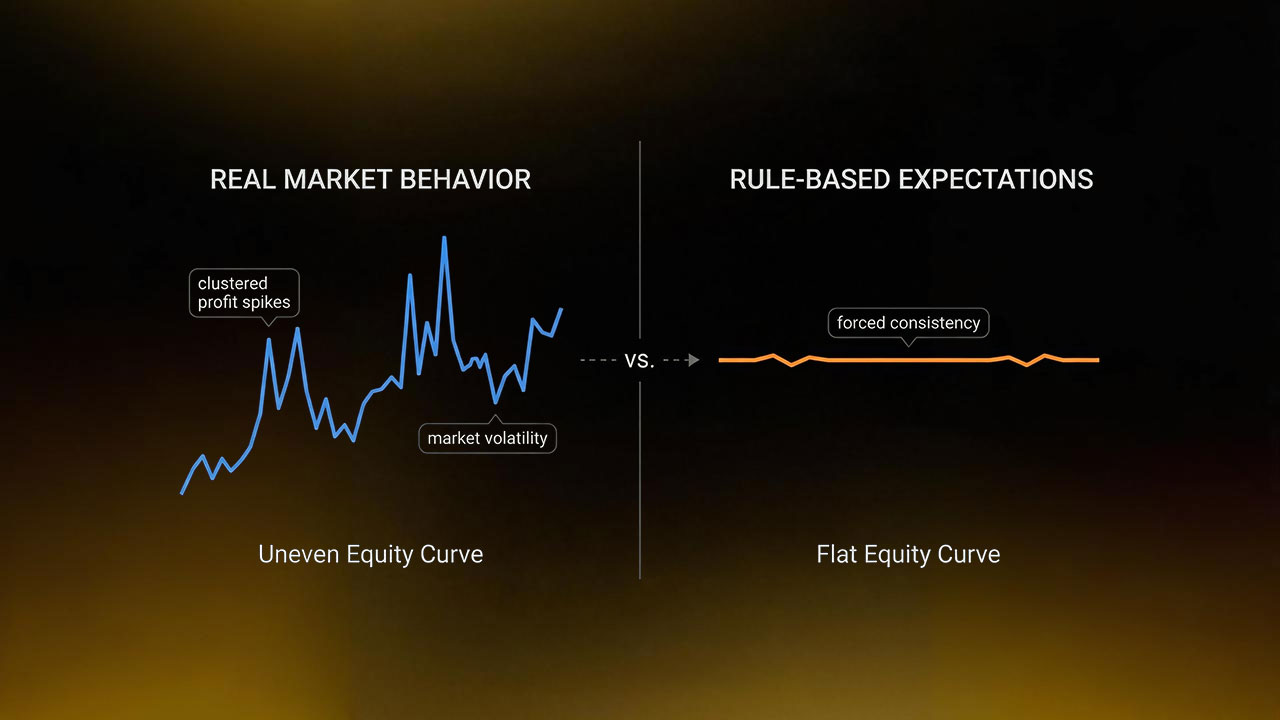
Markets are not linear. Trading results are not symmetrical. And profitability rarely shows up in neat daily increments. Many traders only begin questioning consistency rules after learning what prop trading is and seeing how modern prop firm evaluations are designed to reflect real market behavior.
Here’s why consistency rules conflict with real execution in 2026:
1. Profits Naturally Cluster
Breakouts, news volatility, and trend continuation don’t happen on schedule. A trader may wait days for one clean move. When it finally arrives, that single session can outperform an entire week.
Consistency rules treat this as a problem - when it’s actually normal. Traders who already understand how to pass a forex prop firm challenge recognize that strong results often come from patience and timing, not forced daily participation.
2. Traders Start Managing Rules Instead of Risk
Once a prop firm consistency rule is in place, traders begin asking the wrong questions:
“Should I stop trading so today isn’t too profitable?”
“Will this trade ruin my profit distribution?”
“Do I need another small trade just to balance results?”
That mental load directly impacts decision quality.
3. It Encourages Early Exits and Overtrading
To avoid violations, traders often:
cut winners too early
take unnecessary trades on slow days
trade just to satisfy minimum-day logic
None of this improves risk control. It simply reshapes behavior to fit the rule.
Why Traders Now Prefer Prop Firms With No Consistency Rule
In 2026, traders searching for prop firms with no consistency rule are not asking for fewer rules - they’re asking for better ones. Traders who have studied how to pass a funded account challenge quickly realize that execution quality matters far more than evenly distributed profits.
A no-consistency-rule structure allows traders to:
Have one strong day without being penalized
Trade selectively instead of daily
Size positions properly when probability is high
Focus on execution quality rather than profit symmetry
This is why demand for prop firms with no consistency rule continues to rise, especially among experienced traders.
Why Pipstone Capital Fits Traders Avoiding Consistency Rules

Pipstone Capital has become a clear choice for traders who understand that consistency should come from process, not forced profit distribution. This philosophy aligns with professional risk management in forex prop trading, where long-term capital preservation matters more than daily profit shape.
Here’s why traders gravitate toward Pipstone Capital in 2026:
1. Trading Is Judged on Risk, Not Profit Shape
Without a prop firm consistency rule distorting results, traders are evaluated on:
drawdown control
execution discipline
overall account performance
This aligns far more closely with professional trading standards.
2. Selective Traders Are Not Punished
Many profitable traders don’t trade every day. They wait. Pipstone Capital appeals to traders who prefer patience over frequency - something consistency rules actively discourage.
3. No “Hidden Consistency” Mechanics
Some firms advertise flexibility but enforce consistency indirectly through:
daily profit caps
single-trade contribution limits
Traders choosing Pipstone Capital do so because the rule structure is transparent and doesn’t disguise a consistency rule under another name.
Instant Funding Prop Firms Without Consistency Rule: What to Watch For
Search demand for instant funding prop firms without consistency rule has also increased sharply in 2026, but traders need to be careful.
Not every prop firm advertising instant funding truly removes consistency pressure.
When evaluating instant funding prop firms without consistency rule, traders should always check:
Are there daily profit ceilings?
Is there a maximum profit per trade?
Are trading days artificially enforced?
Does the rulebook penalize “too good” performance?
True flexibility means performance is evaluated holistically, which is how Pipstone Capital structures its programs - no consistency rule, instant funding, clear drawdown limits, scalable account sizes, fast payouts, and rules built around risk control rather than profit-shape formulas.
Who Should Choose Prop Firms With No Consistency Rule?
You’re likely a good fit for prop firms with no consistency rule if:
Your edge shows up in specific sessions or volatility windows
You often have one or two standout days per cycle
You scale risk only on A+ setups
You dislike trading just to satisfy rules
You prioritize expectancy over frequency
Traders like this tend to perform better when artificial constraints are removed.
Final Takeaway
The rise of prop firms with no consistency rule reflects a broader shift in trader maturity.
In 2026, traders no longer want to pass challenges by smoothing equity curves. They want to trade professionally - waiting for opportunity, managing risk, and capitalizing when probability aligns.
That’s why Proprietary firm like Pipestone Capital continues to attract thousands of traders who understand a simple truth:
Real consistency comes from disciplined execution, not forced profit patterns.
FAQ: Prop Firms With No Consistency Rule
What is consistency rule in prop firm challenges?
A consistency rule is a restriction that controls how profits are distributed across days or trades, rather than focusing purely on risk limits.
Are prop firms with no consistency rule safer?
They are not “safer,” but they are often fairer. Risk control still exists, but traders aren’t penalized for legitimate performance variation.
Do prop firms with no consistency rule still require discipline?
Absolutely. Removing a prop firm consistency rule does not remove drawdown limits, position sizing rules, or risk management requirements.
Are there instant funding prop firms without consistency rule?
Yes, but traders should carefully review whether flexibility is genuine or replaced with indirect profit caps.



Prop Firms With No Consistency Rule: Why Traders Choose Pipstone 2026
In 2026, more traders are actively searching for prop firms with no consistency rule—and for good reason.
As prop trading has matured, traders have become far more aware of how evaluation rules shape behavior. What once looked like “risk control” now often feels like artificial pressure. Consistency rules, in particular, are one of the biggest reasons capable traders fail otherwise manageable challenges.
That shift in awareness explains why prop firms with no consistency rule are gaining traction, and why Pipstone Capital is increasingly chosen by traders who want to trade the market as it actually behaves - not how a spreadsheet expects it to.
What Is Consistency Rule in Prop Firm Trading?
To understand why traders avoid it, you first need clarity on what is consistency rule in prop firm evaluations.
A prop firm consistency rule is not a single universal rule. Instead, it’s a category of restrictions designed to control how profits are generated rather than how risk is managed.
Common versions of a prop firm consistency rule include:
Limiting how much profit can be made in a single trading day
Restricting one trade from contributing too much to total profits
Forcing profits to be “evenly distributed” across multiple days
Combining minimum trading days with profit-shape conditions
On paper, these rules aim to prevent reckless behavior. In practice, they often penalize traders who simply executed well during high-probability market conditions.
That’s why many traders now prioritize prop firms with no consistency rule like Pipstone Capital instead of trying to “game” the evaluation logic.
Why Prop Firm Consistency Rules Don’t Match Real Trading
Markets are not linear. Trading results are not symmetrical. And profitability rarely shows up in neat daily increments. Many traders only begin questioning consistency rules after learning what prop trading is and seeing how modern prop firm evaluations are designed to reflect real market behavior.
Here’s why consistency rules conflict with real execution in 2026:
1. Profits Naturally Cluster
Breakouts, news volatility, and trend continuation don’t happen on schedule. A trader may wait days for one clean move. When it finally arrives, that single session can outperform an entire week.
Consistency rules treat this as a problem - when it’s actually normal. Traders who already understand how to pass a forex prop firm challenge recognize that strong results often come from patience and timing, not forced daily participation.
2. Traders Start Managing Rules Instead of Risk
Once a prop firm consistency rule is in place, traders begin asking the wrong questions:
“Should I stop trading so today isn’t too profitable?”
“Will this trade ruin my profit distribution?”
“Do I need another small trade just to balance results?”
That mental load directly impacts decision quality.
3. It Encourages Early Exits and Overtrading
To avoid violations, traders often:
cut winners too early
take unnecessary trades on slow days
trade just to satisfy minimum-day logic
None of this improves risk control. It simply reshapes behavior to fit the rule.
Why Traders Now Prefer Prop Firms With No Consistency Rule
In 2026, traders searching for prop firms with no consistency rule are not asking for fewer rules - they’re asking for better ones. Traders who have studied how to pass a funded account challenge quickly realize that execution quality matters far more than evenly distributed profits.
A no-consistency-rule structure allows traders to:
Have one strong day without being penalized
Trade selectively instead of daily
Size positions properly when probability is high
Focus on execution quality rather than profit symmetry
This is why demand for prop firms with no consistency rule continues to rise, especially among experienced traders.
Why Pipstone Capital Fits Traders Avoiding Consistency Rules
Pipstone Capital has become a clear choice for traders who understand that consistency should come from process, not forced profit distribution. This philosophy aligns with professional risk management in forex prop trading, where long-term capital preservation matters more than daily profit shape.
Here’s why traders gravitate toward Pipstone Capital in 2026:
1. Trading Is Judged on Risk, Not Profit Shape
Without a prop firm consistency rule distorting results, traders are evaluated on:
drawdown control
execution discipline
overall account performance
This aligns far more closely with professional trading standards.
2. Selective Traders Are Not Punished
Many profitable traders don’t trade every day. They wait. Pipstone Capital appeals to traders who prefer patience over frequency - something consistency rules actively discourage.
3. No “Hidden Consistency” Mechanics
Some firms advertise flexibility but enforce consistency indirectly through:
daily profit caps
single-trade contribution limits
Traders choosing Pipstone Capital do so because the rule structure is transparent and doesn’t disguise a consistency rule under another name.
Instant Funding Prop Firms Without Consistency Rule: What to Watch For
Search demand for instant funding prop firms without consistency rule has also increased sharply in 2026, but traders need to be careful.
Not every prop firm advertising instant funding truly removes consistency pressure.
When evaluating instant funding prop firms without consistency rule, traders should always check:
Are there daily profit ceilings?
Is there a maximum profit per trade?
Are trading days artificially enforced?
Does the rulebook penalize “too good” performance?
True flexibility means performance is evaluated holistically, which is how Pipstone Capital structures its programs - no consistency rule, instant funding, clear drawdown limits, scalable account sizes, fast payouts, and rules built around risk control rather than profit-shape formulas.
Who Should Choose Prop Firms With No Consistency Rule?
You’re likely a good fit for prop firms with no consistency rule if:
Your edge shows up in specific sessions or volatility windows
You often have one or two standout days per cycle
You scale risk only on A+ setups
You dislike trading just to satisfy rules
You prioritize expectancy over frequency
Traders like this tend to perform better when artificial constraints are removed.
Final Takeaway
The rise of prop firms with no consistency rule reflects a broader shift in trader maturity.
In 2026, traders no longer want to pass challenges by smoothing equity curves. They want to trade professionally - waiting for opportunity, managing risk, and capitalizing when probability aligns.
That’s why Proprietary firm like Pipestone Capital continues to attract thousands of traders who understand a simple truth:
Real consistency comes from disciplined execution, not forced profit patterns.
FAQ: Prop Firms With No Consistency Rule
What is consistency rule in prop firm challenges?
A consistency rule is a restriction that controls how profits are distributed across days or trades, rather than focusing purely on risk limits.
Are prop firms with no consistency rule safer?
They are not “safer,” but they are often fairer. Risk control still exists, but traders aren’t penalized for legitimate performance variation.
Do prop firms with no consistency rule still require discipline?
Absolutely. Removing a prop firm consistency rule does not remove drawdown limits, position sizing rules, or risk management requirements.
Are there instant funding prop firms without consistency rule?
Yes, but traders should carefully review whether flexibility is genuine or replaced with indirect profit caps.
