


1:30 vs 1:50 vs 1:100 vs 1:500 Leverage: What Changes?

Forex leverage is usually presented as a simple ratio: 1:30, 1:50, 1:100, or even 1:500. The higher the second number, the more market exposure a trader can control with the same amount of margin.
That explanation is correct, but it leaves out the most important part.
Higher leverage does not automatically increase the profit or loss on a trade. Your position size determines how much money you gain or lose when the market moves. Leverage mainly changes how much margin you need to open that position—and how easy it becomes to take positions that are too large for your account.
Understanding this difference can prevent a lot of expensive mistakes.
What Does a Leverage Ratio Mean?
A leverage ratio shows how much exposure you can control for every $1 of required margin.
For example:
1:30 leverage: Every $1 of margin can control $30.
1:50 leverage: Every $1 can control $50.
1:100 leverage: Every $1 can control $100.
1:500 leverage: Every $1 can control $500.
The basic margin formula is:
Required margin = Position size ÷ Leverage
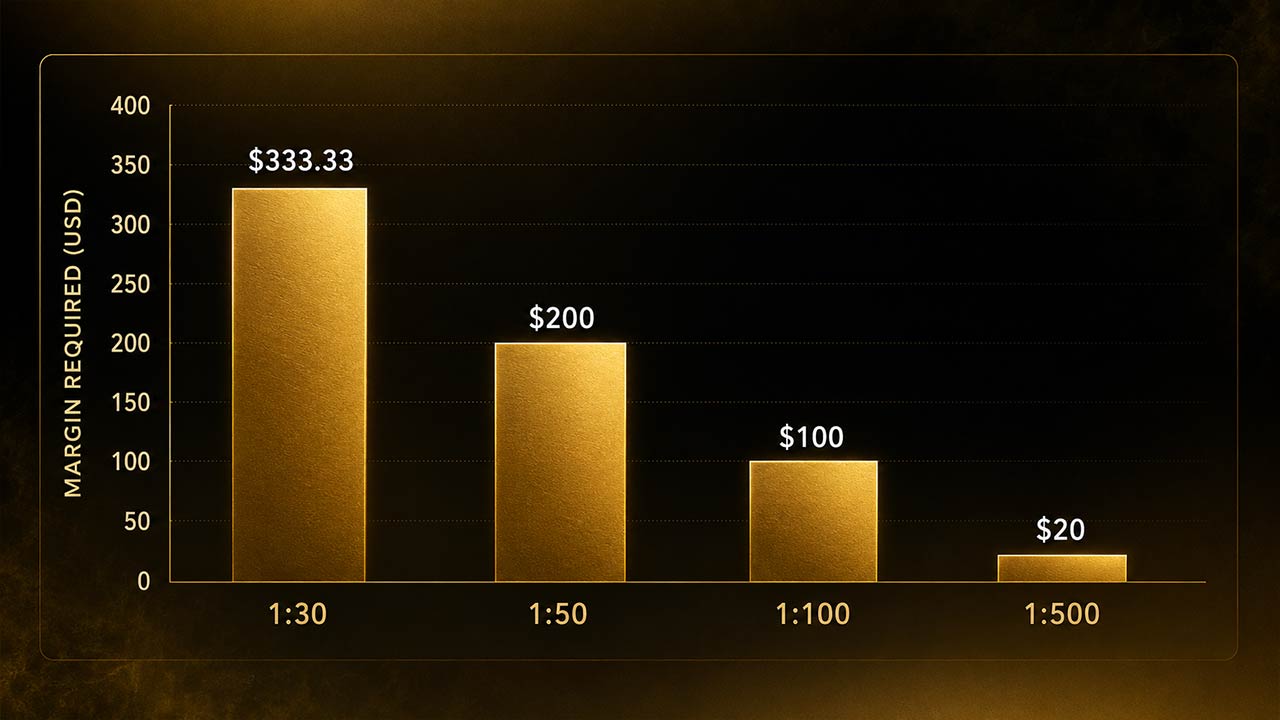
Suppose you want to open a forex position worth $10,000. The required margin would look like this:
Leverage | Margin Requirement | Margin Needed |
1:30 | 3.33% | $333.33 |
1:50 | 2% | $200 |
1:100 | 1% | $100 |
1:500 | 0.20% | $20 |
At 1:500 leverage, the same position uses far less margin than it would at 1:30. However, the $10,000 position still has the same market value. We suggest reading this article about forex leverage trading to learn more in depth.
Does Higher Leverage Change Profit and Loss?
Not when the position size remains the same.
Imagine two traders open identical $10,000 EUR/USD positions. One uses 1:30 leverage and the other uses 1:500.
If EUR/USD rises by 1%, both positions gain approximately $100. If it falls by 1%, both lose approximately $100.
The trader using 1:500 did not make more money simply because more leverage was available. That trader only needed less margin to open the position.
This is where people often misunderstand leverage. They see the lower margin requirement and increase their position size. Once the position becomes larger, every pip becomes more valuable, and normal market movement creates much bigger changes in account equity. The leverage ratio available in your account is only the maximum permitted level. Comparing real leverage vs account leverage shows how much exposure your open positions are actually creating.
Leverage amplifies results indirectly by allowing greater exposure. Regulators such as the CFTC warn that high leverage can amplify both gains and losses, particularly when traders use margin to control positions much larger than their deposits.
A higher leverage ratio reduces the margin required to open the same position, but it does not reduce the trade’s market risk. Understanding the difference between margin and leverage prevents traders from confusing lower margin requirements with lower risk.

What Changes at 1:30 Leverage?
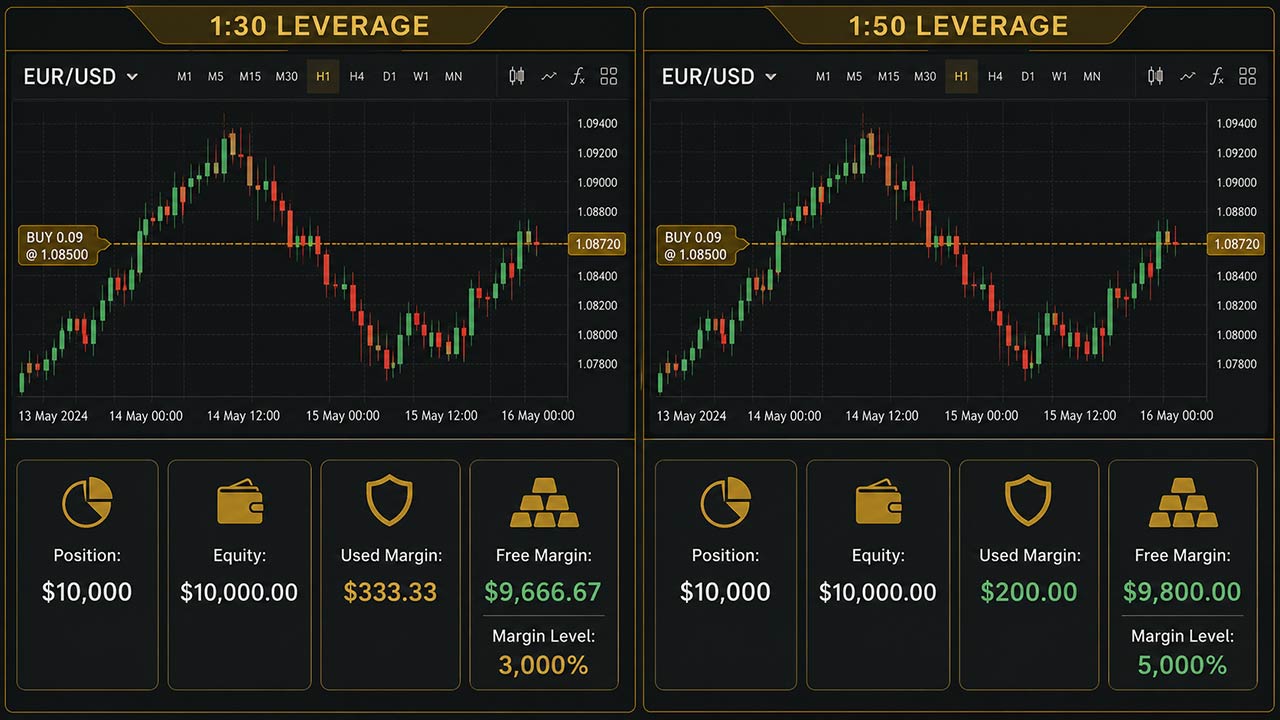
At 1:30, a trader must provide approximately 3.33% of the position value as margin.
A $30,000 position would therefore require around $1,000 in margin. Because each position uses more of the account’s available funds, traders have less room to stack multiple trades or open unusually large positions.
This can create a natural barrier against overexposure. It does not remove risk, but it makes aggressive position sizing more difficult.
A trader can still lose heavily at 1:30 by using too much of the available margin, trading without a stop-loss, or opening several correlated positions. The ratio is lower, but it is not automatically safe.
The 1:30 level is also significant because ESMA established a 30:1 limit for retail CFDs on major currency pairs as part of its investor-protection measures. Lower limits apply to several more volatile asset classes.

What Changes at 1:50 Leverage?
At 1:50, the margin requirement falls to 2%.
A trader needs $200 to control a $10,000 position or $2,000 to control a $100,000 position. Compared with 1:30, more free margin remains available after the trade is opened.
That extra flexibility can be useful when trades are sized according to a fixed risk percentage. It gives the account more space to absorb floating movement and may allow several planned positions to remain open at once.
However, the extra buying power must not be confused with extra risk capacity.
Pipstone Capital’s one-step challenge currently lists 1:50 leverage alongside no time limit and defined daily and overall drawdown limits. This structure reflects an important point about funded trading: available leverage must still be managed within the account’s risk rules.
What Changes at 1:100 Leverage?
At 1:100 leverage, only 1% margin is required.
A $100,000 position would require approximately $1,000 in margin. This gives traders considerably more buying power than 1:30 or 1:50.
The benefit is capital efficiency. A carefully sized position uses only a small part of the account’s available margin. The danger is that the platform may allow a trader to open far more exposure than the account can realistically handle.
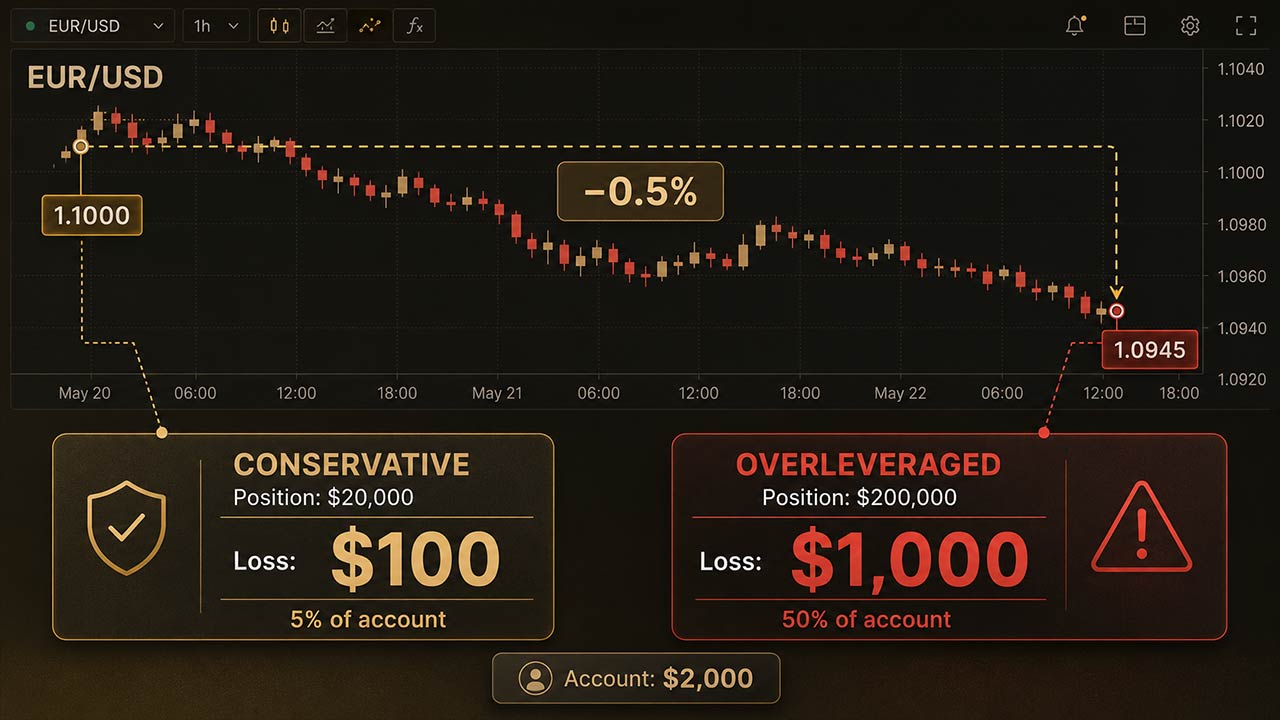
For example, a trader with $2,000 may technically have access to as much as $200,000 in exposure at 1:100. Using that full amount would leave the account extremely sensitive to even a small adverse move.
A 0.5% move against a $200,000 position represents a $1,000 loss before accounting for spreads, commissions, slippage, or financing costs. That would equal half of the original account balance.
The issue is not the ratio by itself. The issue is how much of that leverage the trader actually uses.
Higher account leverage does not cause losses by itself, but it makes larger positions easier to open. This can lead to overleveraging when total exposure becomes too large for the account to support safely.
What Changes at 1:500 Leverage?
At 1:500, the margin requirement is just 0.2%.
Only $20 is needed to open a $10,000 position, while a $100,000 position may require approximately $200 in margin.
This can make the account appear stronger than it really is. The platform may show plenty of free margin immediately after a trade is opened, but the position’s full market exposure still affects profit and loss.
A trader with $1,000 technically has up to $500,000 in buying power at 1:500. That does not mean the account can safely support a position anywhere near that size.
A market move of just 0.2% against a $500,000 position equals $1,000. In practice, a margin closeout may occur before the full loss develops, depending on the provider’s stop-out policy. The example simply shows how quickly extreme exposure can overwhelm a small balance.
High leverage also makes it easier to:
Open several oversized trades
Increase lot size after a loss
Trade highly volatile pairs without enough room
Misjudge the effect of spreads and slippage
Breach daily or maximum drawdown limits
The main risk of 1:500 is not that every trade becomes more dangerous automatically. It is that dangerous position sizes become much easier to open.
Side-by-Side Leverage Comparison
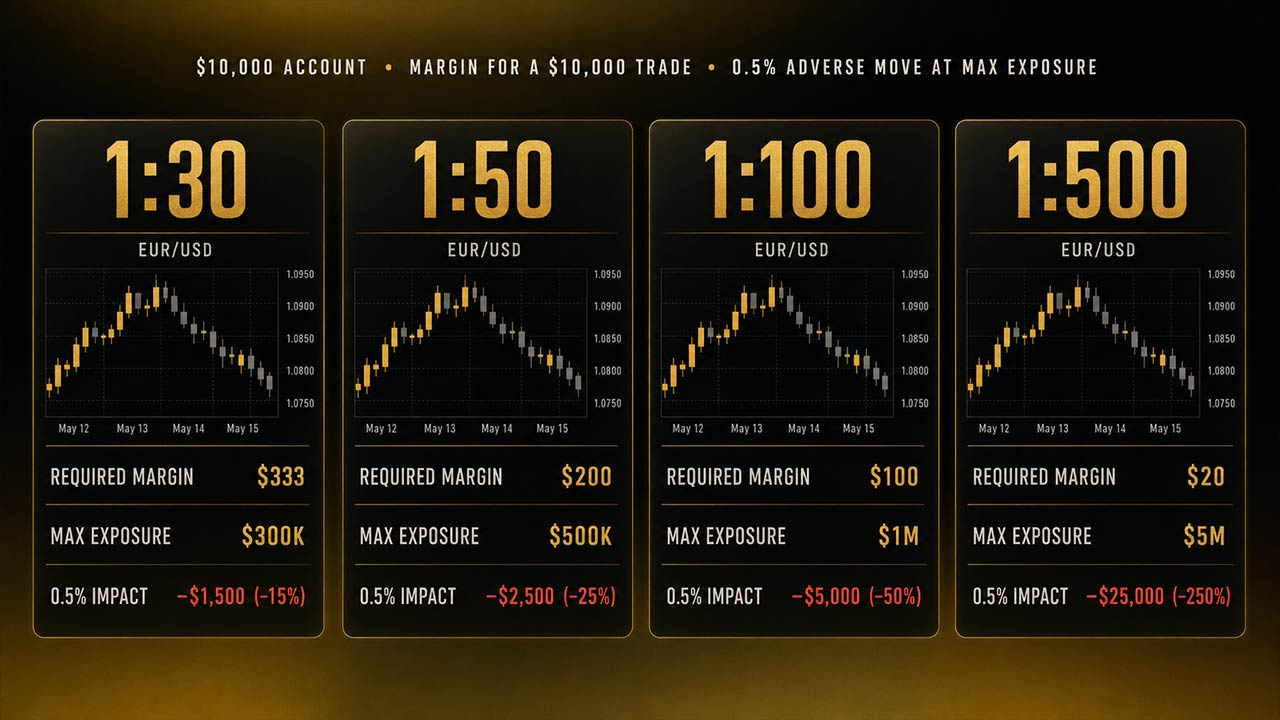
The four leverage levels can be summarized like this:
Leverage | Margin for $10,000 | Maximum Theoretical Exposure With $1,000 | Main Difference |
1:30 | $333.33 | $30,000 | Higher margin use and more limited exposure |
1:50 | $200 | $50,000 | Moderate flexibility and lower margin use |
1:100 | $100 | $100,000 | High buying power with greater overexposure risk |
1:500 | $20 | $500,000 | Very low margin requirement and extreme buying power |
The maximum exposure column is theoretical, not a sensible trading target. Using all available margin leaves little or no room for floating losses, spread changes, commissions, or additional positions.
Leverage Does Not Replace Position Sizing
A trader using 1:500 leverage can take a small, controlled position. A trader using 1:30 can still risk too much.
This is why position sizing should begin with the amount the trader is prepared to lose—not with the maximum lot size the platform allows.
A basic process is:
Decide the maximum account percentage at risk.
Identify the entry and stop-loss price.
Measure the stop distance.
Calculate the position size from that distance.
Check that enough free margin remains after opening the trade.
Leverage should be the final constraint in this process, not the starting point.
For example, suppose a trader has a $10,000 account and limits one trade to a $50 loss. The position size should be calculated so that hitting the stop-loss produces approximately that loss. Whether the account offers 1:30 or 1:500 does not change the planned $50 risk.
Which Leverage Level Is Better?
There is no single ratio that suits every account type, instrument, jurisdiction, or trading method.
Lower leverage such as 1:30 creates tighter limits on maximum exposure. Moderate leverage such as 1:50 offers more flexibility without providing the extreme buying power of 1:500. Higher ratios can reduce required margin, but they also remove barriers that might otherwise prevent oversized trades.
The most useful leverage level is therefore not necessarily the highest one available. It is the level that supports normal execution without encouraging the trader to exceed a clear risk plan.
No leverage ratio is automatically right for every account or strategy. The best leverage for forex trading depends on your experience, account balance, trading style and ability to control position size.
Final Thoughts
The difference between 1:30, 1:50, 1:100, and 1:500 leverage is mainly the margin needed to open a position and the total exposure available to the account. Higher leverage does not change the result of an identical trade. It changes how easily a trader can make that trade much larger.
That distinction matters even more in prop trading, where one oversized position can breach a drawdown rule before a strategy has time to perform. Pipstone Capital offers simulated funded challenges with unlimited trading days, MT5 and cTrader access, no consistency rules, and reward splits of up to 100% through eligible account options. Regardless of the account model, leverage works best when it is treated as a tool for margin efficiency rather than permission to maximize exposure.



1:30 vs 1:50 vs 1:100 vs 1:500 Leverage: What Changes?
Forex leverage is usually presented as a simple ratio: 1:30, 1:50, 1:100, or even 1:500. The higher the second number, the more market exposure a trader can control with the same amount of margin.
That explanation is correct, but it leaves out the most important part.
Higher leverage does not automatically increase the profit or loss on a trade. Your position size determines how much money you gain or lose when the market moves. Leverage mainly changes how much margin you need to open that position—and how easy it becomes to take positions that are too large for your account.
Understanding this difference can prevent a lot of expensive mistakes.
What Does a Leverage Ratio Mean?
A leverage ratio shows how much exposure you can control for every $1 of required margin.
For example:
1:30 leverage: Every $1 of margin can control $30.
1:50 leverage: Every $1 can control $50.
1:100 leverage: Every $1 can control $100.
1:500 leverage: Every $1 can control $500.
The basic margin formula is:
Required margin = Position size ÷ Leverage
Suppose you want to open a forex position worth $10,000. The required margin would look like this:
Leverage | Margin Requirement | Margin Needed |
1:30 | 3.33% | $333.33 |
1:50 | 2% | $200 |
1:100 | 1% | $100 |
1:500 | 0.20% | $20 |
At 1:500 leverage, the same position uses far less margin than it would at 1:30. However, the $10,000 position still has the same market value. We suggest reading this article about forex leverage trading to learn more in depth.
Does Higher Leverage Change Profit and Loss?
Not when the position size remains the same.
Imagine two traders open identical $10,000 EUR/USD positions. One uses 1:30 leverage and the other uses 1:500.
If EUR/USD rises by 1%, both positions gain approximately $100. If it falls by 1%, both lose approximately $100.
The trader using 1:500 did not make more money simply because more leverage was available. That trader only needed less margin to open the position.
This is where people often misunderstand leverage. They see the lower margin requirement and increase their position size. Once the position becomes larger, every pip becomes more valuable, and normal market movement creates much bigger changes in account equity. The leverage ratio available in your account is only the maximum permitted level. Comparing real leverage vs account leverage shows how much exposure your open positions are actually creating.
Leverage amplifies results indirectly by allowing greater exposure. Regulators such as the CFTC warn that high leverage can amplify both gains and losses, particularly when traders use margin to control positions much larger than their deposits.
A higher leverage ratio reduces the margin required to open the same position, but it does not reduce the trade’s market risk. Understanding the difference between margin and leverage prevents traders from confusing lower margin requirements with lower risk.
What Changes at 1:30 Leverage?
At 1:30, a trader must provide approximately 3.33% of the position value as margin.
A $30,000 position would therefore require around $1,000 in margin. Because each position uses more of the account’s available funds, traders have less room to stack multiple trades or open unusually large positions.
This can create a natural barrier against overexposure. It does not remove risk, but it makes aggressive position sizing more difficult.
A trader can still lose heavily at 1:30 by using too much of the available margin, trading without a stop-loss, or opening several correlated positions. The ratio is lower, but it is not automatically safe.
The 1:30 level is also significant because ESMA established a 30:1 limit for retail CFDs on major currency pairs as part of its investor-protection measures. Lower limits apply to several more volatile asset classes.
What Changes at 1:50 Leverage?
At 1:50, the margin requirement falls to 2%.
A trader needs $200 to control a $10,000 position or $2,000 to control a $100,000 position. Compared with 1:30, more free margin remains available after the trade is opened.
That extra flexibility can be useful when trades are sized according to a fixed risk percentage. It gives the account more space to absorb floating movement and may allow several planned positions to remain open at once.
However, the extra buying power must not be confused with extra risk capacity.
Pipstone Capital’s one-step challenge currently lists 1:50 leverage alongside no time limit and defined daily and overall drawdown limits. This structure reflects an important point about funded trading: available leverage must still be managed within the account’s risk rules.
What Changes at 1:100 Leverage?
At 1:100 leverage, only 1% margin is required.
A $100,000 position would require approximately $1,000 in margin. This gives traders considerably more buying power than 1:30 or 1:50.
The benefit is capital efficiency. A carefully sized position uses only a small part of the account’s available margin. The danger is that the platform may allow a trader to open far more exposure than the account can realistically handle.
For example, a trader with $2,000 may technically have access to as much as $200,000 in exposure at 1:100. Using that full amount would leave the account extremely sensitive to even a small adverse move.
A 0.5% move against a $200,000 position represents a $1,000 loss before accounting for spreads, commissions, slippage, or financing costs. That would equal half of the original account balance.
The issue is not the ratio by itself. The issue is how much of that leverage the trader actually uses.
Higher account leverage does not cause losses by itself, but it makes larger positions easier to open. This can lead to overleveraging when total exposure becomes too large for the account to support safely.
What Changes at 1:500 Leverage?
At 1:500, the margin requirement is just 0.2%.
Only $20 is needed to open a $10,000 position, while a $100,000 position may require approximately $200 in margin.
This can make the account appear stronger than it really is. The platform may show plenty of free margin immediately after a trade is opened, but the position’s full market exposure still affects profit and loss.
A trader with $1,000 technically has up to $500,000 in buying power at 1:500. That does not mean the account can safely support a position anywhere near that size.
A market move of just 0.2% against a $500,000 position equals $1,000. In practice, a margin closeout may occur before the full loss develops, depending on the provider’s stop-out policy. The example simply shows how quickly extreme exposure can overwhelm a small balance.
High leverage also makes it easier to:
Open several oversized trades
Increase lot size after a loss
Trade highly volatile pairs without enough room
Misjudge the effect of spreads and slippage
Breach daily or maximum drawdown limits
The main risk of 1:500 is not that every trade becomes more dangerous automatically. It is that dangerous position sizes become much easier to open.
Side-by-Side Leverage Comparison
The four leverage levels can be summarized like this:
Leverage | Margin for $10,000 | Maximum Theoretical Exposure With $1,000 | Main Difference |
1:30 | $333.33 | $30,000 | Higher margin use and more limited exposure |
1:50 | $200 | $50,000 | Moderate flexibility and lower margin use |
1:100 | $100 | $100,000 | High buying power with greater overexposure risk |
1:500 | $20 | $500,000 | Very low margin requirement and extreme buying power |
The maximum exposure column is theoretical, not a sensible trading target. Using all available margin leaves little or no room for floating losses, spread changes, commissions, or additional positions.
Leverage Does Not Replace Position Sizing
A trader using 1:500 leverage can take a small, controlled position. A trader using 1:30 can still risk too much.
This is why position sizing should begin with the amount the trader is prepared to lose—not with the maximum lot size the platform allows.
A basic process is:
Decide the maximum account percentage at risk.
Identify the entry and stop-loss price.
Measure the stop distance.
Calculate the position size from that distance.
Check that enough free margin remains after opening the trade.
Leverage should be the final constraint in this process, not the starting point.
For example, suppose a trader has a $10,000 account and limits one trade to a $50 loss. The position size should be calculated so that hitting the stop-loss produces approximately that loss. Whether the account offers 1:30 or 1:500 does not change the planned $50 risk.
Which Leverage Level Is Better?
There is no single ratio that suits every account type, instrument, jurisdiction, or trading method.
Lower leverage such as 1:30 creates tighter limits on maximum exposure. Moderate leverage such as 1:50 offers more flexibility without providing the extreme buying power of 1:500. Higher ratios can reduce required margin, but they also remove barriers that might otherwise prevent oversized trades.
The most useful leverage level is therefore not necessarily the highest one available. It is the level that supports normal execution without encouraging the trader to exceed a clear risk plan.
No leverage ratio is automatically right for every account or strategy. The best leverage for forex trading depends on your experience, account balance, trading style and ability to control position size.
Final Thoughts
The difference between 1:30, 1:50, 1:100, and 1:500 leverage is mainly the margin needed to open a position and the total exposure available to the account. Higher leverage does not change the result of an identical trade. It changes how easily a trader can make that trade much larger.
That distinction matters even more in prop trading, where one oversized position can breach a drawdown rule before a strategy has time to perform. Pipstone Capital offers simulated funded challenges with unlimited trading days, MT5 and cTrader access, no consistency rules, and reward splits of up to 100% through eligible account options. Regardless of the account model, leverage works best when it is treated as a tool for margin efficiency rather than permission to maximize exposure.
