


How Leverage Increases Drawdown in Forex Trading

Leverage is one of the main reasons forex trading appeals to traders with smaller accounts. It allows you to control a position much larger than the money available in your account. However, that additional exposure comes with a cost: losses grow faster when the market moves against you.
This is where leverage and drawdown become closely connected.
A strategy may appear profitable under normal conditions, but excessive leverage can turn a routine losing streak into a serious account decline. During volatile periods, the damage can happen even faster because price movements become wider, spreads may expand, and trades may close at worse prices than expected.
Understanding how leverage increases drawdown in forex trading can help you choose more reasonable position sizes, protect your available margin, and avoid turning a manageable loss into an account-threatening event.
What Is Drawdown in Forex Trading?
Drawdown measures how far a trading account falls from a previous peak before it begins recovering.
For example, imagine your account grows from $10,000 to $12,000. After several losing trades, the account falls to $9,600. The drawdown is measured from the $12,000 peak, not from the original $10,000 balance.
The calculation is:
Drawdown (%) = (Peak equity − Lowest equity) ÷ Peak equity × 100
In this example:
($12,000 − $9,600) ÷ $12,000 × 100 = 20% drawdown
Drawdown can be calculated using closed account balances, but equity-based drawdown is often more useful because it includes unrealized losses on open trades. Maximum drawdown refers to the largest peak-to-trough decline recorded over a particular period.
A drawdown does not automatically mean a trading strategy has stopped working. Every strategy experiences losing trades. The bigger question is whether the size and duration of the decline remain consistent with the strategy’s historical risk.

How Leverage Increases Forex Drawdown
Leverage does not directly change the number of pips the market moves. Instead, it changes how much money you gain or lose from each pip.
Suppose two traders each have a $10,000 account and trade the same currency pair.
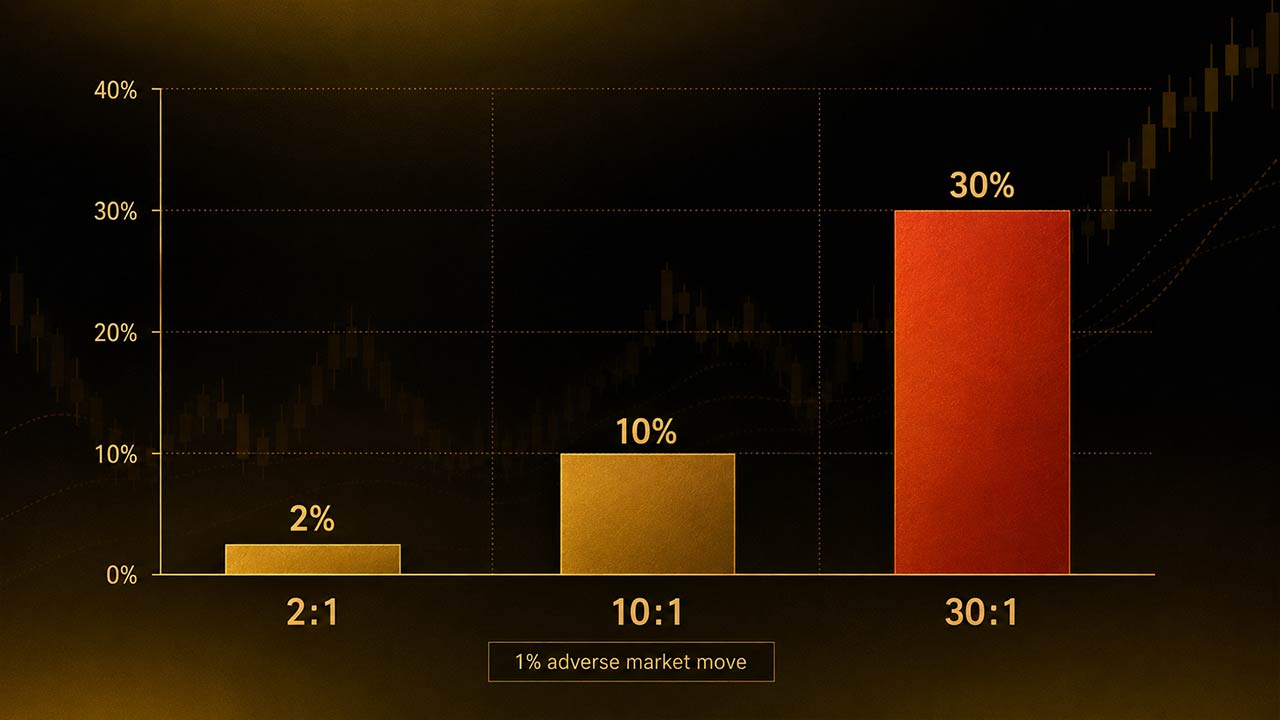
Trader | Market exposure | Effective leverage | Loss after a 1% adverse move |
Trader A | $20,000 | 2:1 | $200 or 2% |
Trader B | $100,000 | 10:1 | $1,000 or 10% |
Trader C | $300,000 | 30:1 | $3,000 or 30% |
The market moved against all three traders by the same 1%. However, their account drawdowns were completely different because their exposure was different.
This is the basic relationship between leverage and drawdown:
The larger your position relative to your account equity, the greater the percentage loss caused by the same market movement.
Regulators describe leverage in a similar way: a relatively small margin deposit can support a much larger forex position, causing minor currency fluctuations to produce much larger gains or losses.
High leverage therefore reduces the amount of market movement your account can absorb. A trader using low leverage may survive an ordinary losing streak, while a heavily leveraged trader following the same entries may reach a margin limit after only a few losses. Learning what forex leverage is in trading makes it easier to see why higher leverage increases both potential returns and overall risk.
Why Volatile Markets Make the Problem Worse
Volatility refers to the speed and size of market-price movements. During central-bank decisions, inflation releases, employment reports or unexpected geopolitical events, currency pairs can move sharply in seconds.
Leverage becomes especially dangerous in these conditions for several reasons.
First, prices can travel farther than expected before a trader reacts. A position that normally fluctuates by $100 may suddenly move by $400 or $500.
Second, spreads can widen. This means a position may begin with a larger immediate loss or require a bigger price move to become profitable.
Third, stop-loss orders may experience slippage. A stop placed at one price can be executed at the next available price when the market moves too quickly. The stop still limits exposure, but the final loss may be larger than planned.
Finally, correlated positions can move together. A trader may believe they have five separate trades, but if all five depend on US-dollar weakness, they may effectively hold one large leveraged position.
These factors explain why leverage that feels manageable during quiet conditions may produce a much deeper drawdown during a volatile session. Similarly, leverage becomes especially dangerous when traders use it to open positions that are too large for their account. This form of overleveraging in forex can turn an ordinary losing trade into a serious account drawdown.

Effective Leverage Rises as Equity Falls
A less obvious danger is that effective leverage can increase while a losing trade remains open.
Consider an account with $10,000 in equity controlling a $100,000 position. Its effective leverage is 10:1.
Now assume the position creates a $2,000 unrealized loss. Account equity falls to $8,000, but the trader is still controlling roughly the same market exposure.
The effective leverage is now:
$100,000 ÷ $8,000 = 12.5:1
The trader did not open another position. The account simply became more leveraged because the equity supporting the existing trade decreased.
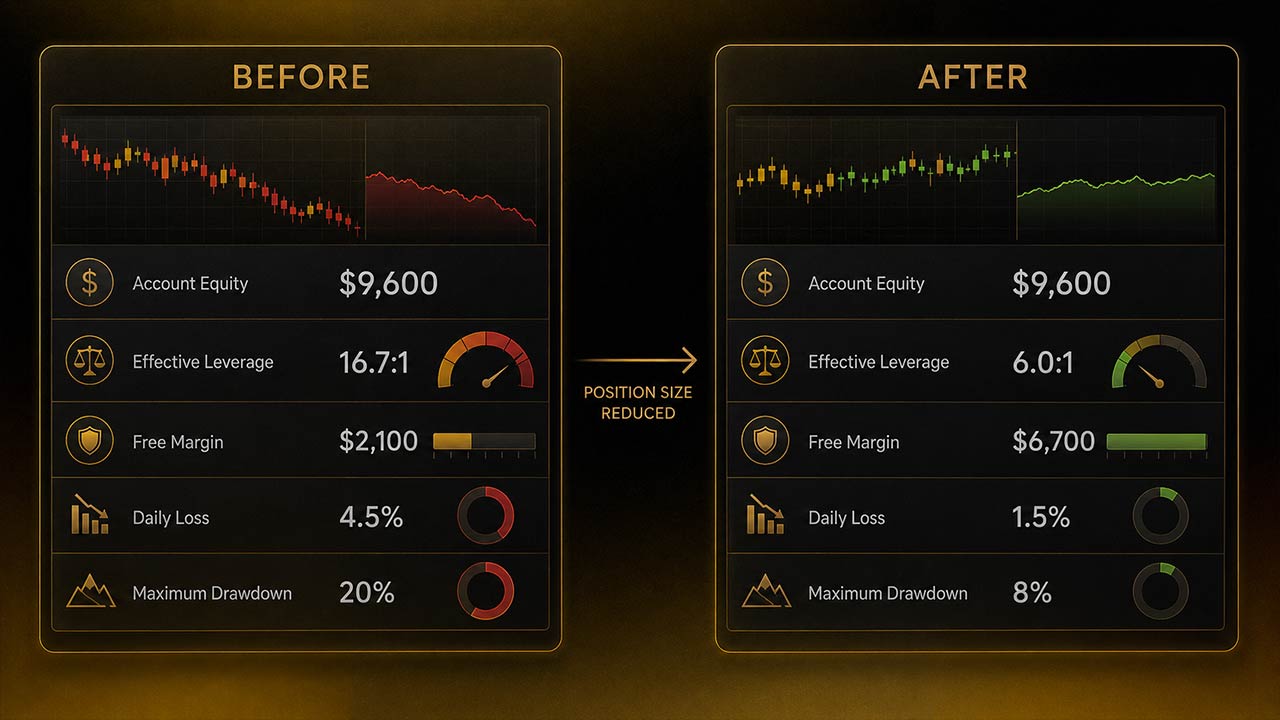
If the loss reaches $4,000, equity falls to $6,000 and effective leverage rises to approximately 16.7:1. Each additional market move now represents a larger percentage of the remaining account.
This creates a negative cycle:
The market moves against the position.
Equity falls.
Effective leverage rises.
Free margin decreases.
The account becomes more sensitive to additional price movements.
Eventually, the account may reach its margin-closeout level. At that point, positions can be reduced or closed to prevent further losses, depending on the broker’s rules and applicable protections.
Learn about free margin in our comprehensive guide.

Leverage Makes Drawdown Recovery Harder
Drawdown becomes increasingly difficult to recover from as it grows.
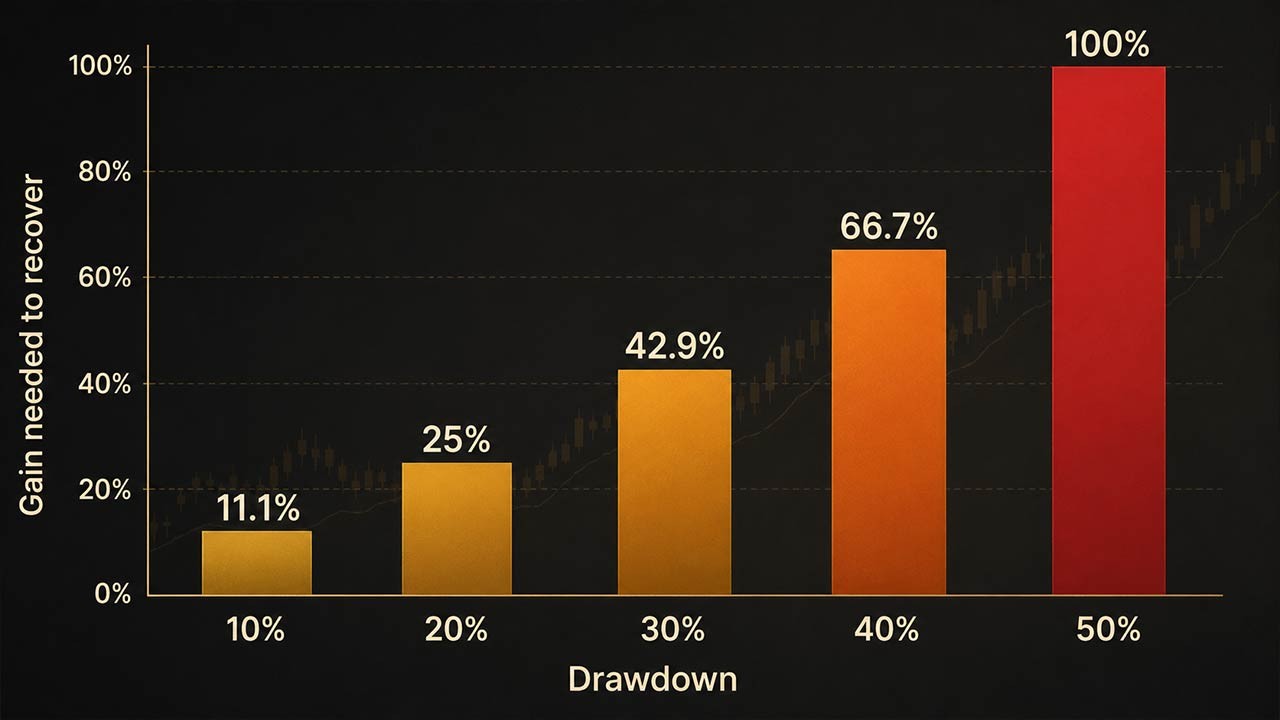
Account drawdown | Return needed to recover |
10% | 11.1% |
20% | 25% |
30% | 42.9% |
40% | 66.7% |
50% | 100% |
After a 10% drawdown, the account needs an 11.1% gain to return to its previous peak. After a 50% drawdown, it must double.
This uneven recovery math is one reason protecting capital matters more than chasing the highest possible return. A trader who accepts frequent 30% or 40% declines needs unusually strong future performance just to recover.
Deep drawdowns also create psychological pressure. Traders may increase their position size, abandon their strategy or take lower-quality setups because they want to recover quickly. This often leads to revenge trading and an even larger decline. Emotional reactions such as overtrading and suddenly abandoning a tested system are common problems during difficult trading periods.
When a Larger Drawdown Does Not Mean the Strategy Failed
A larger monetary drawdown is not always proof that a trading strategy is broken.
Suppose a trader consistently uses one standard lot. If the account was previously worth $100,000 but has fallen to $50,000, that same lot size now represents twice as much exposure relative to equity.
The strategy rules may not have changed, but its effective leverage has.
Changing market prices and volatility can also make fixed position sizes behave differently over time. A position size that once produced moderate dollar swings may create much larger gains and losses in a different market environment.
This is why traders should assess drawdown in percentage terms and compare it with:
Current account equity
Position size
Market volatility
Number of simultaneous trades
Total exposure across correlated pairs
Historical maximum drawdown
Average drawdown duration
The Medium article on leverage and strategy failures makes a similar point: an increase in monetary drawdown may result from fixed sizing, changing prices, or higher exposure rather than a complete breakdown in the trading strategy. Understanding the difference between real leverage and account leverage can help traders identify where that additional risk is actually coming from.
Common Ways Traders Create Excessive Drawdown
Using the maximum leverage available
Available leverage is a trading limit, not a recommended position size. A broker offering 1:100 leverage does not mean every trader should control a position worth 100 times their equity.
Increasing lot size after a loss
Doubling the next position to recover the previous loss can quickly compound drawdown. Another losing trade creates a much larger hit to the account.
Ignoring combined exposure
EUR/USD, GBP/USD and AUD/USD trades may all be affected by the same movement in the US dollar. Opening all three can concentrate risk rather than diversify it.
Moving stop-loss orders
Moving a stop farther away after the market moves against a position increases the amount at risk while the account is already under pressure.
Trading volatile news with normal sizing
A position size designed for an ordinary session may be too large during a major economic announcement.
Risking too much on every trade
Even a strategy with a reasonable win rate can experience several consecutive losses. Large risk per trade leaves little room for a normal losing streak.
How to Control Leverage and Reduce Drawdown
The goal is not necessarily to avoid leverage completely. The goal is to control total exposure so that one trade or one volatile session cannot cause major damage.
Start by deciding how much of the account you are prepared to lose if the stop is reached. Position size should then be calculated from that risk limit and the distance between the entry and stop-loss.
You should also monitor total account risk. Five trades risking 1% each can place roughly 5% of equity at risk, particularly when the positions are strongly correlated.
Other practical controls include:
Use less leverage than the maximum available.
Reduce position size when volatility increases.
Set a personal daily loss limit.
Avoid adding to losing positions without a tested rule.
Track equity-based drawdown, not only closed balance.
Lower risk after a significant losing streak.
Review whether several trades depend on the same currency movement.
Test strategies across both calm and volatile market periods.
Drawdown control is particularly important in prop trading because evaluation and funded-account programs normally include daily and maximum-loss limits. Pipstone Capital is a proprietary trading firm offering evaluation-based funded-account programs in a simulated environment, with no time limits on challenges, MT5 and cTrader access, and reward splits of up to 100% on eligible models. Traders still need to manage leverage carefully because exceeding an account’s loss parameters can end an evaluation regardless of the strategy’s long-term potential.
Conclusion
Leverage increases drawdown because it makes every price movement larger relative to account equity. The effect becomes more severe during volatile markets, when spreads widen, prices move quickly and correlated positions may lose together.
The safest approach is to focus on effective leverage rather than the maximum ratio displayed by a trading platform. Position size, stop distance, volatility and combined exposure matter more than the headline leverage limit.
For traders seeking a structured route into prop trading, Pipstone Capital provides simulated evaluation and funded-account models with no challenge time limits, MT5 and cTrader support, scalable plans and reward splits of up to 100% on eligible accounts. These features provide flexibility, but lasting performance still depends on disciplined position sizing, controlled leverage and respect for drawdown limits.
Frequently Asked Questions
Does higher leverage always cause a larger drawdown?
Not automatically. Higher available leverage only creates a larger drawdown when it is used to increase position exposure. A trader can have access to 1:100 leverage while using a small position with low effective leverage.
Is a 10% drawdown bad in forex trading?
It depends on the strategy, account rules and historical performance. A 10% drawdown may be normal for one system and excessive for another. It should be compared with expected risk, maximum historical drawdown and the return needed for recovery.
Can stop-loss orders prevent drawdown?
Stop-losses can limit individual trade risk, but they cannot eliminate drawdown. Several stopped-out trades can still create a losing streak, and fast markets may produce slippage.
What is the difference between leverage and margin?
Leverage describes the relationship between your market exposure and account capital. Margin is the amount set aside to support the leveraged position.
Why does free margin fall during a drawdown?
Open losses reduce account equity. Because free margin is generally calculated from equity after subtracting used margin, falling equity leaves less capital available to support existing or new trades.
Can a profitable strategy still have a large drawdown?
Yes. A strategy can remain profitable over a long period while experiencing significant temporary declines. However, excessive leverage may make those declines too deep for the account to survive.



How Leverage Increases Drawdown in Forex Trading
Leverage is one of the main reasons forex trading appeals to traders with smaller accounts. It allows you to control a position much larger than the money available in your account. However, that additional exposure comes with a cost: losses grow faster when the market moves against you.
This is where leverage and drawdown become closely connected.
A strategy may appear profitable under normal conditions, but excessive leverage can turn a routine losing streak into a serious account decline. During volatile periods, the damage can happen even faster because price movements become wider, spreads may expand, and trades may close at worse prices than expected.
Understanding how leverage increases drawdown in forex trading can help you choose more reasonable position sizes, protect your available margin, and avoid turning a manageable loss into an account-threatening event.
What Is Drawdown in Forex Trading?
Drawdown measures how far a trading account falls from a previous peak before it begins recovering.
For example, imagine your account grows from $10,000 to $12,000. After several losing trades, the account falls to $9,600. The drawdown is measured from the $12,000 peak, not from the original $10,000 balance.
The calculation is:
Drawdown (%) = (Peak equity − Lowest equity) ÷ Peak equity × 100
In this example:
($12,000 − $9,600) ÷ $12,000 × 100 = 20% drawdown
Drawdown can be calculated using closed account balances, but equity-based drawdown is often more useful because it includes unrealized losses on open trades. Maximum drawdown refers to the largest peak-to-trough decline recorded over a particular period.
A drawdown does not automatically mean a trading strategy has stopped working. Every strategy experiences losing trades. The bigger question is whether the size and duration of the decline remain consistent with the strategy’s historical risk.
How Leverage Increases Forex Drawdown
Leverage does not directly change the number of pips the market moves. Instead, it changes how much money you gain or lose from each pip.
Suppose two traders each have a $10,000 account and trade the same currency pair.
Trader | Market exposure | Effective leverage | Loss after a 1% adverse move |
Trader A | $20,000 | 2:1 | $200 or 2% |
Trader B | $100,000 | 10:1 | $1,000 or 10% |
Trader C | $300,000 | 30:1 | $3,000 or 30% |
The market moved against all three traders by the same 1%. However, their account drawdowns were completely different because their exposure was different.
This is the basic relationship between leverage and drawdown:
The larger your position relative to your account equity, the greater the percentage loss caused by the same market movement.
Regulators describe leverage in a similar way: a relatively small margin deposit can support a much larger forex position, causing minor currency fluctuations to produce much larger gains or losses.
High leverage therefore reduces the amount of market movement your account can absorb. A trader using low leverage may survive an ordinary losing streak, while a heavily leveraged trader following the same entries may reach a margin limit after only a few losses. Learning what forex leverage is in trading makes it easier to see why higher leverage increases both potential returns and overall risk.
Why Volatile Markets Make the Problem Worse
Volatility refers to the speed and size of market-price movements. During central-bank decisions, inflation releases, employment reports or unexpected geopolitical events, currency pairs can move sharply in seconds.
Leverage becomes especially dangerous in these conditions for several reasons.
First, prices can travel farther than expected before a trader reacts. A position that normally fluctuates by $100 may suddenly move by $400 or $500.
Second, spreads can widen. This means a position may begin with a larger immediate loss or require a bigger price move to become profitable.
Third, stop-loss orders may experience slippage. A stop placed at one price can be executed at the next available price when the market moves too quickly. The stop still limits exposure, but the final loss may be larger than planned.
Finally, correlated positions can move together. A trader may believe they have five separate trades, but if all five depend on US-dollar weakness, they may effectively hold one large leveraged position.
These factors explain why leverage that feels manageable during quiet conditions may produce a much deeper drawdown during a volatile session. Similarly, leverage becomes especially dangerous when traders use it to open positions that are too large for their account. This form of overleveraging in forex can turn an ordinary losing trade into a serious account drawdown.
Effective Leverage Rises as Equity Falls
A less obvious danger is that effective leverage can increase while a losing trade remains open.
Consider an account with $10,000 in equity controlling a $100,000 position. Its effective leverage is 10:1.
Now assume the position creates a $2,000 unrealized loss. Account equity falls to $8,000, but the trader is still controlling roughly the same market exposure.
The effective leverage is now:
$100,000 ÷ $8,000 = 12.5:1
The trader did not open another position. The account simply became more leveraged because the equity supporting the existing trade decreased.
If the loss reaches $4,000, equity falls to $6,000 and effective leverage rises to approximately 16.7:1. Each additional market move now represents a larger percentage of the remaining account.
This creates a negative cycle:
The market moves against the position.
Equity falls.
Effective leverage rises.
Free margin decreases.
The account becomes more sensitive to additional price movements.
Eventually, the account may reach its margin-closeout level. At that point, positions can be reduced or closed to prevent further losses, depending on the broker’s rules and applicable protections.
Learn about free margin in our comprehensive guide.
Leverage Makes Drawdown Recovery Harder
Drawdown becomes increasingly difficult to recover from as it grows.
Account drawdown | Return needed to recover |
10% | 11.1% |
20% | 25% |
30% | 42.9% |
40% | 66.7% |
50% | 100% |
After a 10% drawdown, the account needs an 11.1% gain to return to its previous peak. After a 50% drawdown, it must double.
This uneven recovery math is one reason protecting capital matters more than chasing the highest possible return. A trader who accepts frequent 30% or 40% declines needs unusually strong future performance just to recover.
Deep drawdowns also create psychological pressure. Traders may increase their position size, abandon their strategy or take lower-quality setups because they want to recover quickly. This often leads to revenge trading and an even larger decline. Emotional reactions such as overtrading and suddenly abandoning a tested system are common problems during difficult trading periods.
When a Larger Drawdown Does Not Mean the Strategy Failed
A larger monetary drawdown is not always proof that a trading strategy is broken.
Suppose a trader consistently uses one standard lot. If the account was previously worth $100,000 but has fallen to $50,000, that same lot size now represents twice as much exposure relative to equity.
The strategy rules may not have changed, but its effective leverage has.
Changing market prices and volatility can also make fixed position sizes behave differently over time. A position size that once produced moderate dollar swings may create much larger gains and losses in a different market environment.
This is why traders should assess drawdown in percentage terms and compare it with:
Current account equity
Position size
Market volatility
Number of simultaneous trades
Total exposure across correlated pairs
Historical maximum drawdown
Average drawdown duration
The Medium article on leverage and strategy failures makes a similar point: an increase in monetary drawdown may result from fixed sizing, changing prices, or higher exposure rather than a complete breakdown in the trading strategy. Understanding the difference between real leverage and account leverage can help traders identify where that additional risk is actually coming from.
Common Ways Traders Create Excessive Drawdown
Using the maximum leverage available
Available leverage is a trading limit, not a recommended position size. A broker offering 1:100 leverage does not mean every trader should control a position worth 100 times their equity.
Increasing lot size after a loss
Doubling the next position to recover the previous loss can quickly compound drawdown. Another losing trade creates a much larger hit to the account.
Ignoring combined exposure
EUR/USD, GBP/USD and AUD/USD trades may all be affected by the same movement in the US dollar. Opening all three can concentrate risk rather than diversify it.
Moving stop-loss orders
Moving a stop farther away after the market moves against a position increases the amount at risk while the account is already under pressure.
Trading volatile news with normal sizing
A position size designed for an ordinary session may be too large during a major economic announcement.
Risking too much on every trade
Even a strategy with a reasonable win rate can experience several consecutive losses. Large risk per trade leaves little room for a normal losing streak.
How to Control Leverage and Reduce Drawdown
The goal is not necessarily to avoid leverage completely. The goal is to control total exposure so that one trade or one volatile session cannot cause major damage.
Start by deciding how much of the account you are prepared to lose if the stop is reached. Position size should then be calculated from that risk limit and the distance between the entry and stop-loss.
You should also monitor total account risk. Five trades risking 1% each can place roughly 5% of equity at risk, particularly when the positions are strongly correlated.
Other practical controls include:
Use less leverage than the maximum available.
Reduce position size when volatility increases.
Set a personal daily loss limit.
Avoid adding to losing positions without a tested rule.
Track equity-based drawdown, not only closed balance.
Lower risk after a significant losing streak.
Review whether several trades depend on the same currency movement.
Test strategies across both calm and volatile market periods.
Drawdown control is particularly important in prop trading because evaluation and funded-account programs normally include daily and maximum-loss limits. Pipstone Capital is a proprietary trading firm offering evaluation-based funded-account programs in a simulated environment, with no time limits on challenges, MT5 and cTrader access, and reward splits of up to 100% on eligible models. Traders still need to manage leverage carefully because exceeding an account’s loss parameters can end an evaluation regardless of the strategy’s long-term potential.
Conclusion
Leverage increases drawdown because it makes every price movement larger relative to account equity. The effect becomes more severe during volatile markets, when spreads widen, prices move quickly and correlated positions may lose together.
The safest approach is to focus on effective leverage rather than the maximum ratio displayed by a trading platform. Position size, stop distance, volatility and combined exposure matter more than the headline leverage limit.
For traders seeking a structured route into prop trading, Pipstone Capital provides simulated evaluation and funded-account models with no challenge time limits, MT5 and cTrader support, scalable plans and reward splits of up to 100% on eligible accounts. These features provide flexibility, but lasting performance still depends on disciplined position sizing, controlled leverage and respect for drawdown limits.
Frequently Asked Questions
Does higher leverage always cause a larger drawdown?
Not automatically. Higher available leverage only creates a larger drawdown when it is used to increase position exposure. A trader can have access to 1:100 leverage while using a small position with low effective leverage.
Is a 10% drawdown bad in forex trading?
It depends on the strategy, account rules and historical performance. A 10% drawdown may be normal for one system and excessive for another. It should be compared with expected risk, maximum historical drawdown and the return needed for recovery.
Can stop-loss orders prevent drawdown?
Stop-losses can limit individual trade risk, but they cannot eliminate drawdown. Several stopped-out trades can still create a losing streak, and fast markets may produce slippage.
What is the difference between leverage and margin?
Leverage describes the relationship between your market exposure and account capital. Margin is the amount set aside to support the leveraged position.
Why does free margin fall during a drawdown?
Open losses reduce account equity. Because free margin is generally calculated from equity after subtracting used margin, falling equity leaves less capital available to support existing or new trades.
Can a profitable strategy still have a large drawdown?
Yes. A strategy can remain profitable over a long period while experiencing significant temporary declines. However, excessive leverage may make those declines too deep for the account to survive.
