


How Much Free Margin Should You Keep When Trading Forex?

Free margin is easy to ignore when trades are going well. The account may show a healthy balance, positions are open, and the platform may still allow another order. But if too much equity is tied up as used margin, even a normal market move can put the account under pressure.
So, how much free margin should you keep when trading forex? There is no universal percentage for every trader or strategy. A practical starting point is to keep at least 70% to 80% of your equity available as free margin. More cautious traders may keep 80% to 90% free when holding positions overnight or trading during major news.
These are guidelines, not broker rules. Your ideal buffer depends on position size, leverage, stop-loss distance, volatility and the number of open trades.
What Is Free Margin in Forex?
Free margin is the part of your account equity that is not being used to support open positions.
The formula is:
Free margin = Equity − Used margin
Equity is your balance plus or minus the unrealized profit or loss from open trades. This is why free margin changes while the market moves. Profitable trades increase equity and free margin. Losing trades reduce both.
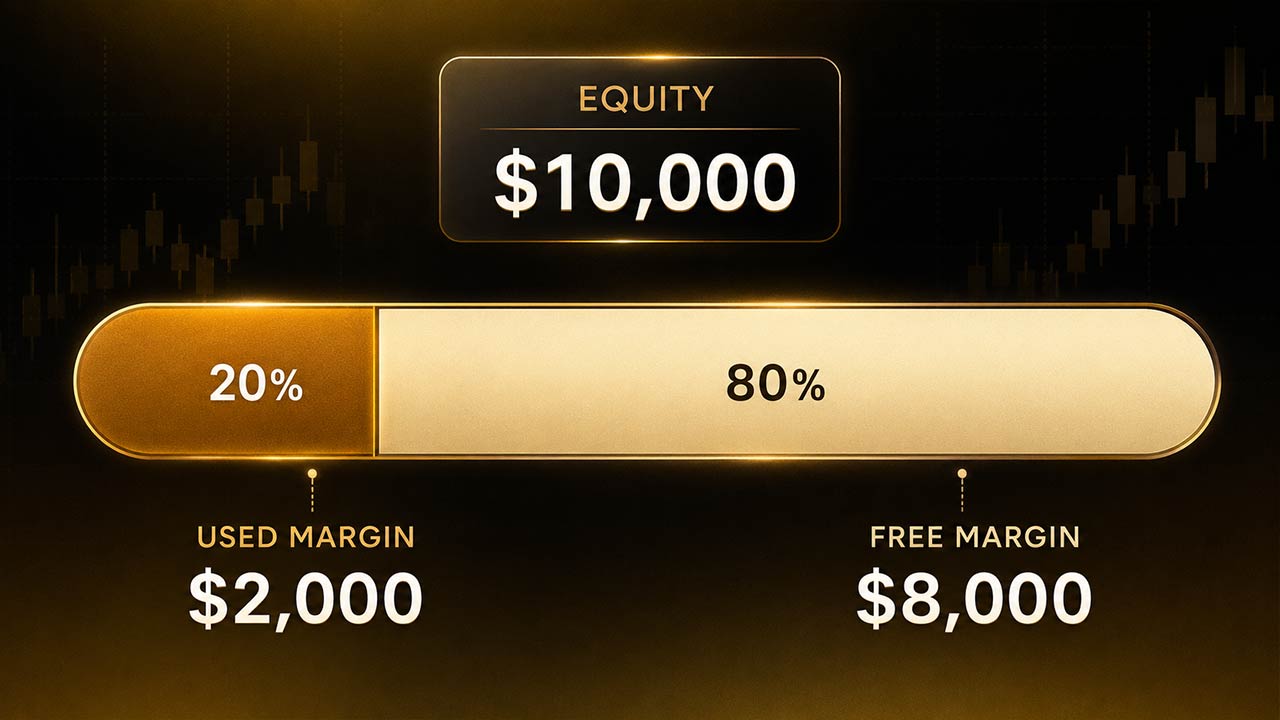
For example:
Equity: $10,000
Used margin: $2,000
Free margin: $8,000
In this case, 80% of the account equity remains free.
Free margin is not money sitting safely outside the market. Floating losses, spreads, commissions, currency conversion and overnight charges can still reduce it.
Free margin is directly affected by the leverage available on your account and the size of your open positions. Understanding what is leverage in trading forex makes it easier to see why available margin changes after each trade.
What Is a Healthy Free-Margin Percentage?
A percentage is more useful than a fixed dollar amount. Keeping $2,000 free may be comfortable on one account and dangerously low on another.
Free margin as a share of equity | General condition | What it suggests |
80%–90%+ | Conservative | Strong room for market movement |
70%–80% | Reasonable buffer | Controlled margin use |
50%–70% | Increased pressure | Less room if trades lose |
Below 50% | High exposure | Margin level can fall quickly |
Near zero | Critical | Stop-out risk rises |
These are practical guidelines, not fixed industry thresholds. A day trader may operate differently from a swing trader holding positions for several days.
The main idea is simple: the more equity committed as margin, the less room the account has to absorb losses.

Free Margin vs Margin Level
Free margin is shown as a dollar amount. Margin level is shown as a percentage.
The formula is:
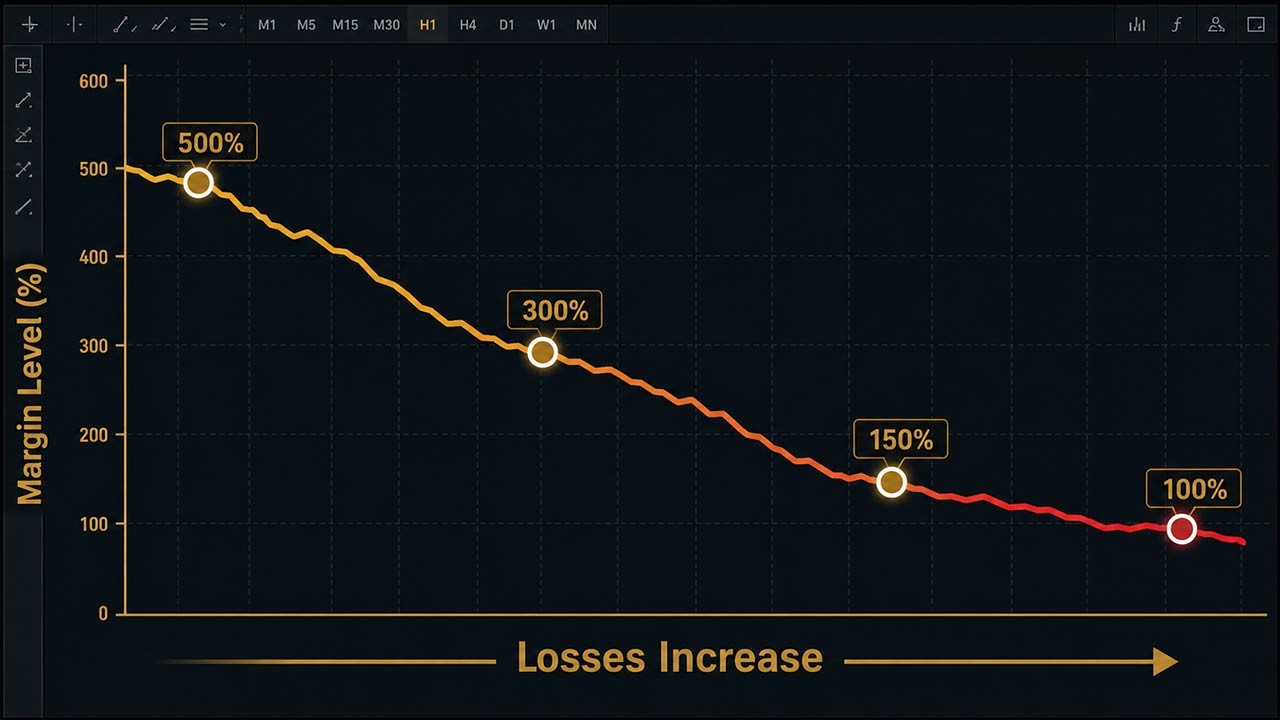
Margin level = (Equity ÷ Used margin) × 100
If equity is $10,000 and used margin is $2,000:
($10,000 ÷ $2,000) × 100 = 500%
A higher margin level normally means more room before the account reaches a margin-call or stop-out threshold. A lower level means greater pressure.
Broker thresholds vary by account type, product and jurisdiction. Some platforms may issue a warning around 100%, while stop-out levels may be much lower. Always check the rules for the specific account.
A Simple Free-Margin Example
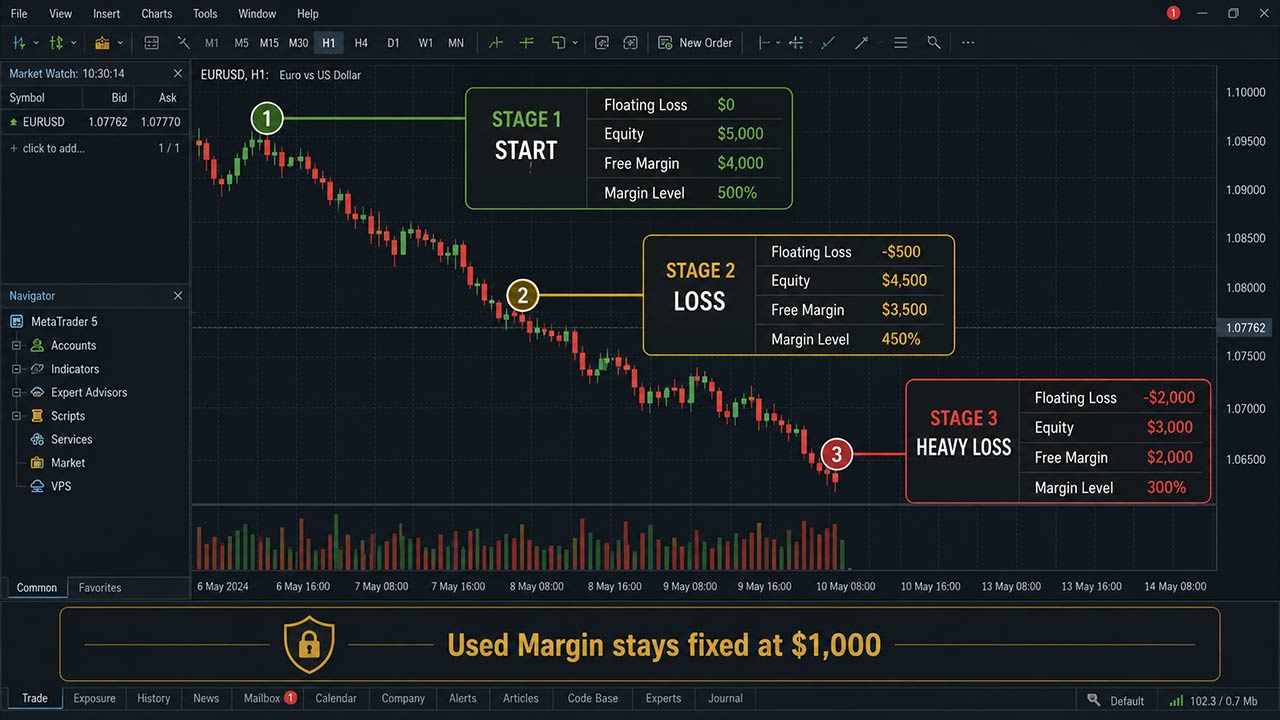
Assume a trader has a $5,000 account and opens positions requiring $1,000 in used margin.
At the start:
Equity: $5,000
Used margin: $1,000
Free margin: $4,000
Margin level: 500%
Now assume the trades show a floating loss of $500:
Equity: $4,500
Free margin: $3,500
Margin level: 450%
No new trade was opened, but the buffer has already shrunk.
If the floating loss grows to $2,000, equity falls to $3,000, free margin drops to $2,000 and margin level reaches 300%.
This is why exposure should not be judged only when a trade is opened. Estimate what the account will look like if every open trade reaches its stop loss.
Free margin cannot be assessed on its own because it changes with both used margin and account equity. Our guide to free margin, used margin and equity explains how these account figures interact while positions are open.
Calculate Free Margin After Your Stop Losses
A useful way to manage free margin is to stress-test the account before entering.
Ask:
What will my free margin and margin level be if all open positions hit their stops?
Suppose you have:
Current equity: $10,000
Existing used margin: $1,500
Margin required for a new trade: $500
Maximum combined loss at all stops: $600
After opening the trade, total used margin would be $2,000. If every stop is hit, projected equity would be $9,400.
Projected free margin:
$9,400 − $2,000 = $7,400
Projected margin level:
($9,400 ÷ $2,000) × 100 = 470%
The account still has a useful buffer. But if the same trader committed $7,000 as used margin, a relatively small loss could push margin level down quickly.
Higher leverage lowers the margin required for a position, but it does not reduce full market exposure. A large trade can still cause a large change in equity.
Adjust the Buffer for Your Trading Style
Day Traders
Day traders usually close positions before the session ends. A 70% to 80% free-margin target may provide a reasonable buffer when position sizes and stops are controlled.
Swing Traders
Swing traders hold positions overnight and may face gaps, swap charges and unexpected news. Keeping 80% or more free margin gives the account more breathing room.
News Traders
Spreads may widen around major economic releases, and slippage can cause a trade to close beyond the intended stop. A buffer closer to 85% to 90% is more sensible during these periods.
Traders With Several Positions
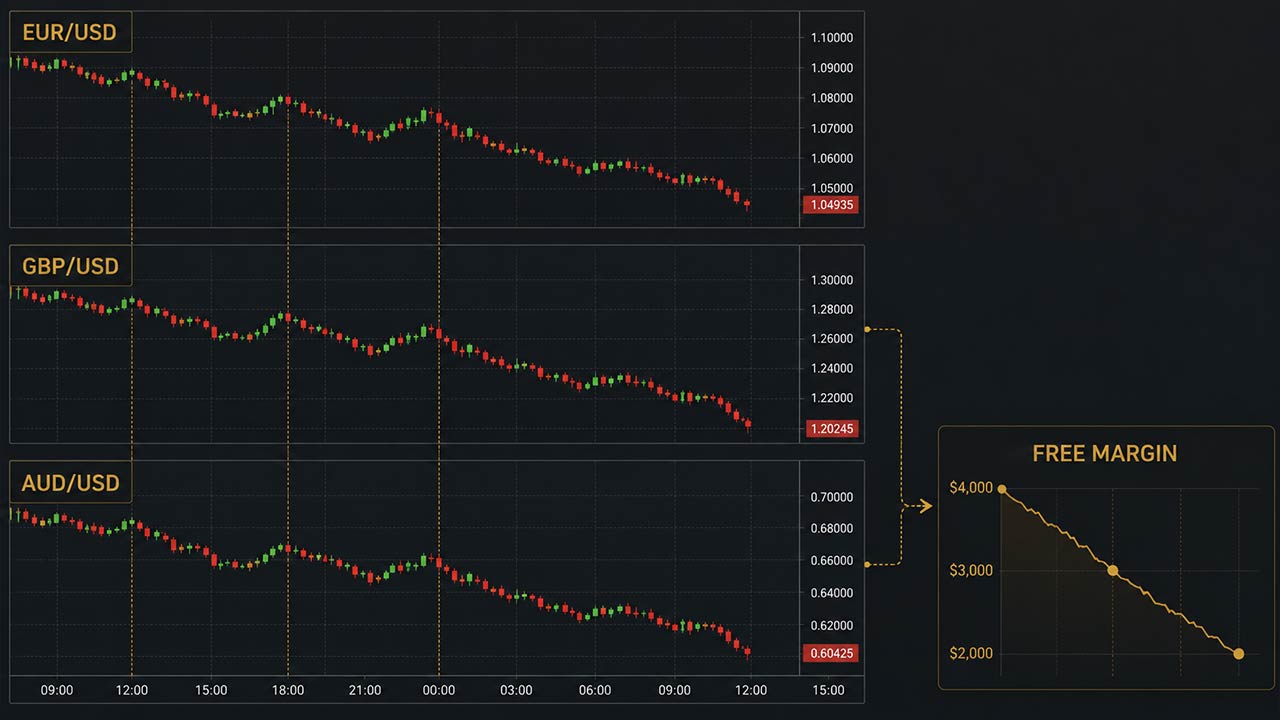
Several small trades can create the same exposure as one large trade. This becomes more dangerous when positions are correlated. Multiple USD trades may move against the account together and build margin pressure faster than expected.
Warning Signs Your Free Margin Is Too Low
Your free margin may be too low when:
A small market move causes a large fall in margin level.
Most of your equity is tied up as used margin.
You rely on floating profits to keep the account healthy.
Several trades depend on the same currency direction.
You cannot open a normal trade without nearing a broker threshold.
You are thinking more about avoiding stop-out than following the setup.
A trader should not plan to operate just above the stop-out level. That leaves little room for spreads, slippage or sudden volatility.
At Pipstone Capital, traders can apply the same principle with up to $100,000 funded accounts by treating free margin as part of total exposure control, not as spare buying power. A platform allowing another position does not automatically make that position a sensible risk.
How to Protect Free Margin
The best way to protect free margin is to control exposure before opening the trade.
Use smaller lot sizes. Smaller positions normally require less margin and produce smaller equity changes for each pip of movement.
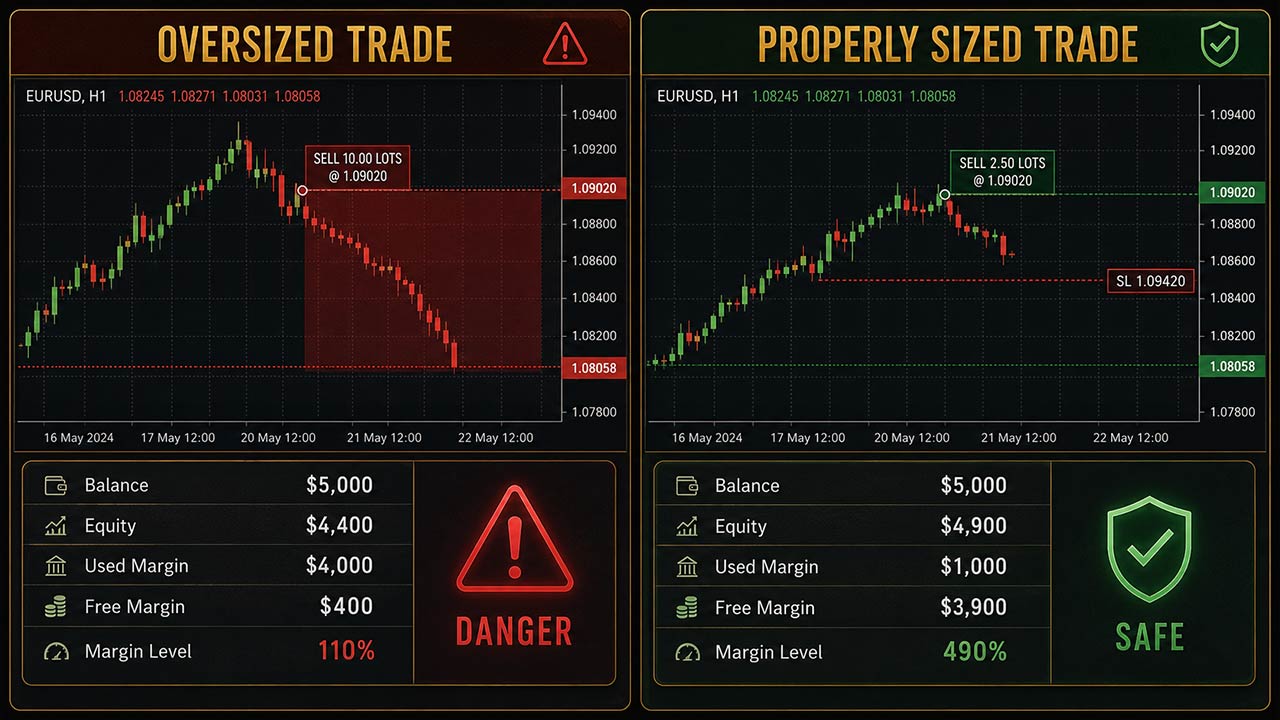
Calculate total account risk instead of reviewing each trade separately. Three trades risking 1% each can expose the account to a 3% loss if all stops are hit.
Avoid stacking correlated positions without recognizing the shared risk. Buying several pairs against the US dollar may be one large dollar trade in disguise.
Set the stop based on the setup, then reduce the lot size until the potential loss fits your risk limit. Do not increase position size simply because high leverage makes the required margin look small.
Finally, check free margin and margin level before major news, before holding trades overnight and before adding another position.
When floating losses reduce equity and leave too little free margin, the account can move closer to a margin call in forex trading and eventually reach the broker’s stop-out level.
Common Free-Margin Mistakes
The first mistake is looking only at balance. Balance reflects closed results, while equity includes floating profit and loss. Margin pressure is based on equity, not balance alone.
The second is treating all free margin as available for the next trade. Technically, it may be available. Practically, a large part should remain untouched as a safety buffer.
The third is assuming higher leverage makes the account safer. It can reduce required margin for the same trade, but it may tempt a trader to open a much larger position. The real risk comes from exposure and position size.
Conclusion
For many forex traders, keeping 70% to 80% of equity as free margin is a reasonable starting point. A buffer of 80% to 90% may be more appropriate for swing trading, volatile markets or major news. These are guidelines rather than guaranteed safety levels.
Before opening a trade, calculate used margin, maximum stop-loss exposure and the projected margin level if every position loses. Whether trading independently or through a funded account by Pipstone Capital, the goal is not to use every dollar the platform makes available. It is to keep enough room for normal market movement without being forced out of otherwise valid trades.
FAQs
Is a 100% Margin Level Safe?
At 100%, equity equals used margin. Many platforms may restrict new trades or issue a warning around this level. It should not be treated as a comfortable target.
Is More Free Margin Always Better?
A larger buffer generally gives the account more room to absorb losses and volatility. However, stop placement, trade quality and total exposure still matter.
Should You Add Money When Free Margin Is Low?
Adding funds can improve equity and margin level, but it does not solve poor position sizing. Reducing exposure may be more important.



How Much Free Margin Should You Keep When Trading Forex?
Free margin is easy to ignore when trades are going well. The account may show a healthy balance, positions are open, and the platform may still allow another order. But if too much equity is tied up as used margin, even a normal market move can put the account under pressure.
So, how much free margin should you keep when trading forex? There is no universal percentage for every trader or strategy. A practical starting point is to keep at least 70% to 80% of your equity available as free margin. More cautious traders may keep 80% to 90% free when holding positions overnight or trading during major news.
These are guidelines, not broker rules. Your ideal buffer depends on position size, leverage, stop-loss distance, volatility and the number of open trades.
What Is Free Margin in Forex?
Free margin is the part of your account equity that is not being used to support open positions.
The formula is:
Free margin = Equity − Used margin
Equity is your balance plus or minus the unrealized profit or loss from open trades. This is why free margin changes while the market moves. Profitable trades increase equity and free margin. Losing trades reduce both.
For example:
Equity: $10,000
Used margin: $2,000
Free margin: $8,000
In this case, 80% of the account equity remains free.
Free margin is not money sitting safely outside the market. Floating losses, spreads, commissions, currency conversion and overnight charges can still reduce it.
Free margin is directly affected by the leverage available on your account and the size of your open positions. Understanding what is leverage in trading forex makes it easier to see why available margin changes after each trade.
What Is a Healthy Free-Margin Percentage?
A percentage is more useful than a fixed dollar amount. Keeping $2,000 free may be comfortable on one account and dangerously low on another.
Free margin as a share of equity | General condition | What it suggests |
80%–90%+ | Conservative | Strong room for market movement |
70%–80% | Reasonable buffer | Controlled margin use |
50%–70% | Increased pressure | Less room if trades lose |
Below 50% | High exposure | Margin level can fall quickly |
Near zero | Critical | Stop-out risk rises |
These are practical guidelines, not fixed industry thresholds. A day trader may operate differently from a swing trader holding positions for several days.
The main idea is simple: the more equity committed as margin, the less room the account has to absorb losses.
Free Margin vs Margin Level
Free margin is shown as a dollar amount. Margin level is shown as a percentage.
The formula is:
Margin level = (Equity ÷ Used margin) × 100
If equity is $10,000 and used margin is $2,000:
($10,000 ÷ $2,000) × 100 = 500%
A higher margin level normally means more room before the account reaches a margin-call or stop-out threshold. A lower level means greater pressure.
Broker thresholds vary by account type, product and jurisdiction. Some platforms may issue a warning around 100%, while stop-out levels may be much lower. Always check the rules for the specific account.
A Simple Free-Margin Example
Assume a trader has a $5,000 account and opens positions requiring $1,000 in used margin.
At the start:
Equity: $5,000
Used margin: $1,000
Free margin: $4,000
Margin level: 500%
Now assume the trades show a floating loss of $500:
Equity: $4,500
Free margin: $3,500
Margin level: 450%
No new trade was opened, but the buffer has already shrunk.
If the floating loss grows to $2,000, equity falls to $3,000, free margin drops to $2,000 and margin level reaches 300%.
This is why exposure should not be judged only when a trade is opened. Estimate what the account will look like if every open trade reaches its stop loss.
Free margin cannot be assessed on its own because it changes with both used margin and account equity. Our guide to free margin, used margin and equity explains how these account figures interact while positions are open.
Calculate Free Margin After Your Stop Losses
A useful way to manage free margin is to stress-test the account before entering.
Ask:
What will my free margin and margin level be if all open positions hit their stops?
Suppose you have:
Current equity: $10,000
Existing used margin: $1,500
Margin required for a new trade: $500
Maximum combined loss at all stops: $600
After opening the trade, total used margin would be $2,000. If every stop is hit, projected equity would be $9,400.
Projected free margin:
$9,400 − $2,000 = $7,400
Projected margin level:
($9,400 ÷ $2,000) × 100 = 470%
The account still has a useful buffer. But if the same trader committed $7,000 as used margin, a relatively small loss could push margin level down quickly.
Higher leverage lowers the margin required for a position, but it does not reduce full market exposure. A large trade can still cause a large change in equity.
Adjust the Buffer for Your Trading Style
Day Traders
Day traders usually close positions before the session ends. A 70% to 80% free-margin target may provide a reasonable buffer when position sizes and stops are controlled.
Swing Traders
Swing traders hold positions overnight and may face gaps, swap charges and unexpected news. Keeping 80% or more free margin gives the account more breathing room.
News Traders
Spreads may widen around major economic releases, and slippage can cause a trade to close beyond the intended stop. A buffer closer to 85% to 90% is more sensible during these periods.
Traders With Several Positions
Several small trades can create the same exposure as one large trade. This becomes more dangerous when positions are correlated. Multiple USD trades may move against the account together and build margin pressure faster than expected.
Warning Signs Your Free Margin Is Too Low
Your free margin may be too low when:
A small market move causes a large fall in margin level.
Most of your equity is tied up as used margin.
You rely on floating profits to keep the account healthy.
Several trades depend on the same currency direction.
You cannot open a normal trade without nearing a broker threshold.
You are thinking more about avoiding stop-out than following the setup.
A trader should not plan to operate just above the stop-out level. That leaves little room for spreads, slippage or sudden volatility.
At Pipstone Capital, traders can apply the same principle with up to $100,000 funded accounts by treating free margin as part of total exposure control, not as spare buying power. A platform allowing another position does not automatically make that position a sensible risk.
How to Protect Free Margin
The best way to protect free margin is to control exposure before opening the trade.
Use smaller lot sizes. Smaller positions normally require less margin and produce smaller equity changes for each pip of movement.
Calculate total account risk instead of reviewing each trade separately. Three trades risking 1% each can expose the account to a 3% loss if all stops are hit.
Avoid stacking correlated positions without recognizing the shared risk. Buying several pairs against the US dollar may be one large dollar trade in disguise.
Set the stop based on the setup, then reduce the lot size until the potential loss fits your risk limit. Do not increase position size simply because high leverage makes the required margin look small.
Finally, check free margin and margin level before major news, before holding trades overnight and before adding another position.
When floating losses reduce equity and leave too little free margin, the account can move closer to a margin call in forex trading and eventually reach the broker’s stop-out level.
Common Free-Margin Mistakes
The first mistake is looking only at balance. Balance reflects closed results, while equity includes floating profit and loss. Margin pressure is based on equity, not balance alone.
The second is treating all free margin as available for the next trade. Technically, it may be available. Practically, a large part should remain untouched as a safety buffer.
The third is assuming higher leverage makes the account safer. It can reduce required margin for the same trade, but it may tempt a trader to open a much larger position. The real risk comes from exposure and position size.
Conclusion
For many forex traders, keeping 70% to 80% of equity as free margin is a reasonable starting point. A buffer of 80% to 90% may be more appropriate for swing trading, volatile markets or major news. These are guidelines rather than guaranteed safety levels.
Before opening a trade, calculate used margin, maximum stop-loss exposure and the projected margin level if every position loses. Whether trading independently or through a funded account by Pipstone Capital, the goal is not to use every dollar the platform makes available. It is to keep enough room for normal market movement without being forced out of otherwise valid trades.
FAQs
Is a 100% Margin Level Safe?
At 100%, equity equals used margin. Many platforms may restrict new trades or issue a warning around this level. It should not be treated as a comfortable target.
Is More Free Margin Always Better?
A larger buffer generally gives the account more room to absorb losses and volatility. However, stop placement, trade quality and total exposure still matter.
Should You Add Money When Free Margin Is Low?
Adding funds can improve equity and margin level, but it does not solve poor position sizing. Reducing exposure may be more important.
