


Real Leverage vs Account Leverage: Why Your Actual Exposure Matters

Leverage is usually presented as a simple number: 1:30, 1:100, 1:200, or even higher. Traders see that ratio inside their trading account and assume it tells them how much risk they are taking.
It does not.
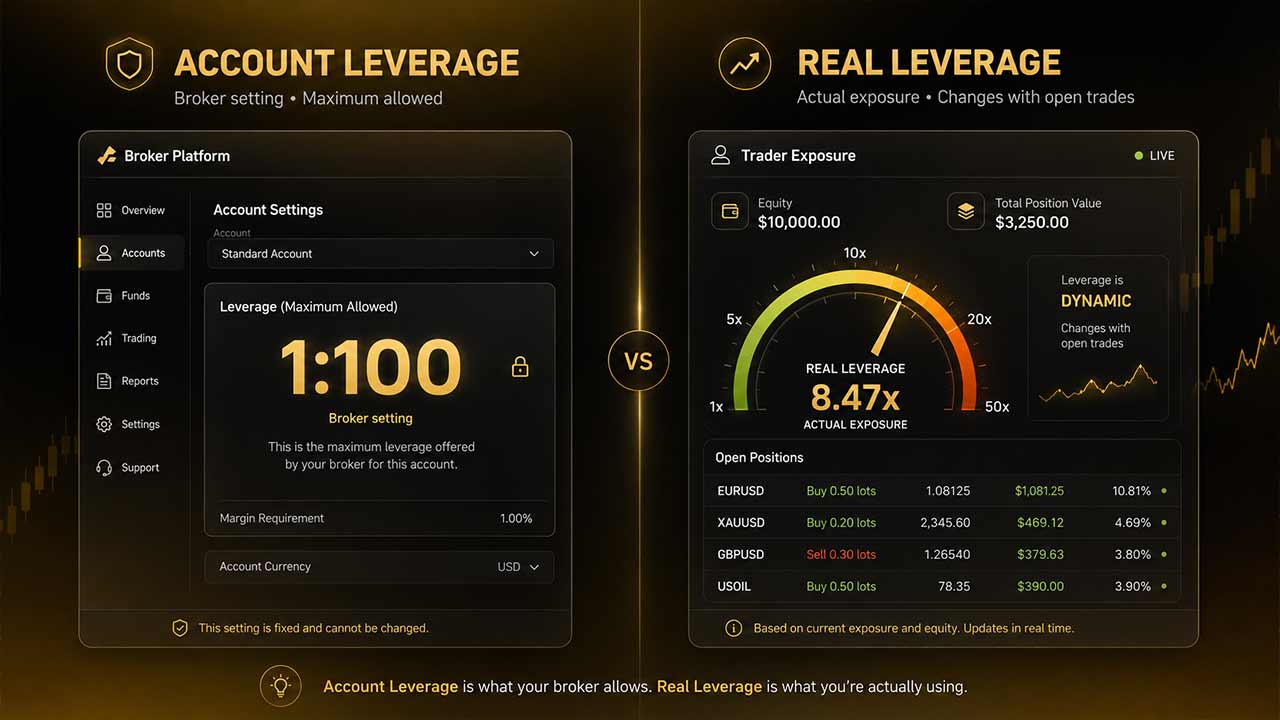
The leverage offered by your broker only shows the maximum position size your account is allowed to control. It does not show how much leverage you are actually using at that moment.
That is where real leverage in forex becomes important.
Real leverage measures the total value of your open positions compared with the equity currently available in your account. It changes whenever you open or close a trade, add to a position, withdraw money, or experience a profit or loss.
Understanding the difference between account leverage and real leverage can help you avoid oversized positions, hidden exposure, and margin problems. It also gives you a much clearer picture of how vulnerable your account is to a sudden market move.
What Is Account Leverage?
Account leverage is the maximum leverage ratio provided by your broker or trading firm.
For example, if your account offers 1:100 leverage, you can theoretically control $100 in market exposure for every $1 of your own capital.
With a $1,000 account, the maximum theoretical exposure would be:
$1,000 × 100 = $100,000
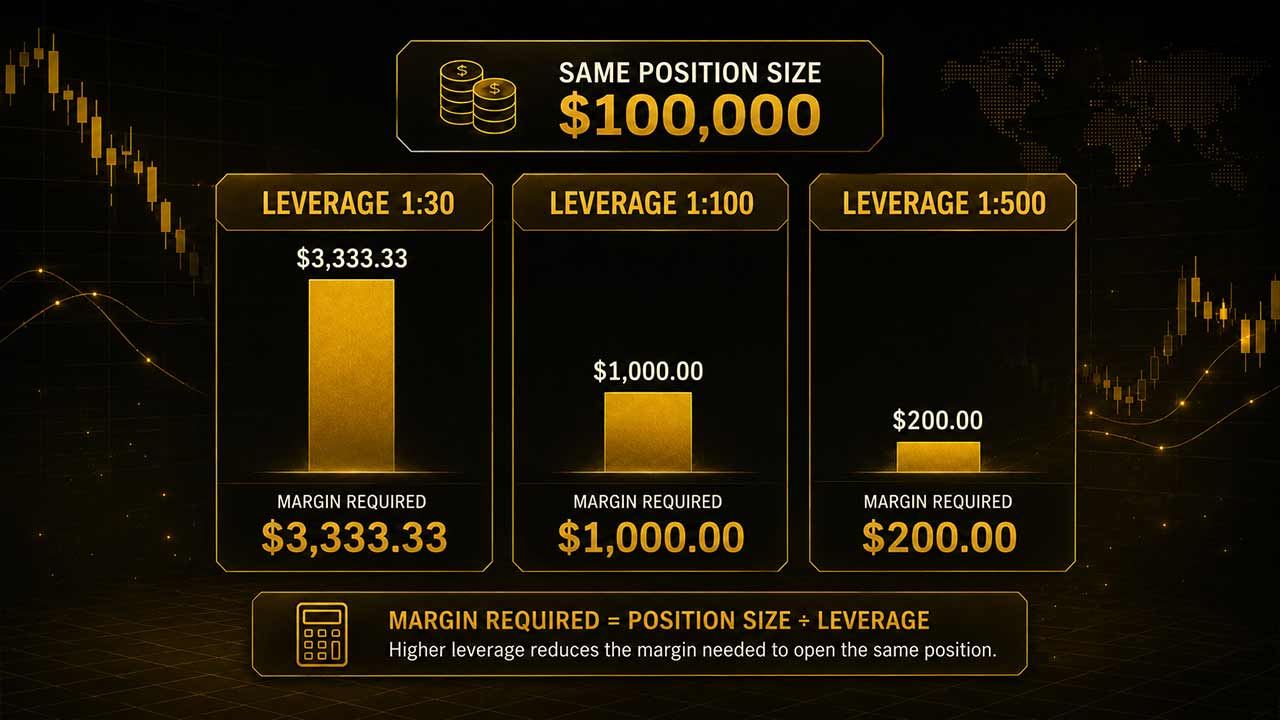
This does not mean you must open a $100,000 position. It only means the account settings allow you to control up to that amount, assuming margin requirements, trading conditions, and available equity permit it.
Account leverage mainly affects how much margin the broker requires when you open a trade.
At 1:100 leverage, controlling a $10,000 position may require approximately $100 in margin.
At 1:30 leverage, the same $10,000 position may require approximately $333.33.
The higher account leverage gives you more buying power and lowers the margin needed to open a position. However, it does not automatically increase your risk. Your risk depends on how much of that buying power you actually use.

Before comparing account leverage with actual exposure, it helps to understand how leverage works in forex trading and why it can increase both buying power and potential losses.
What Is Real Leverage in Forex?
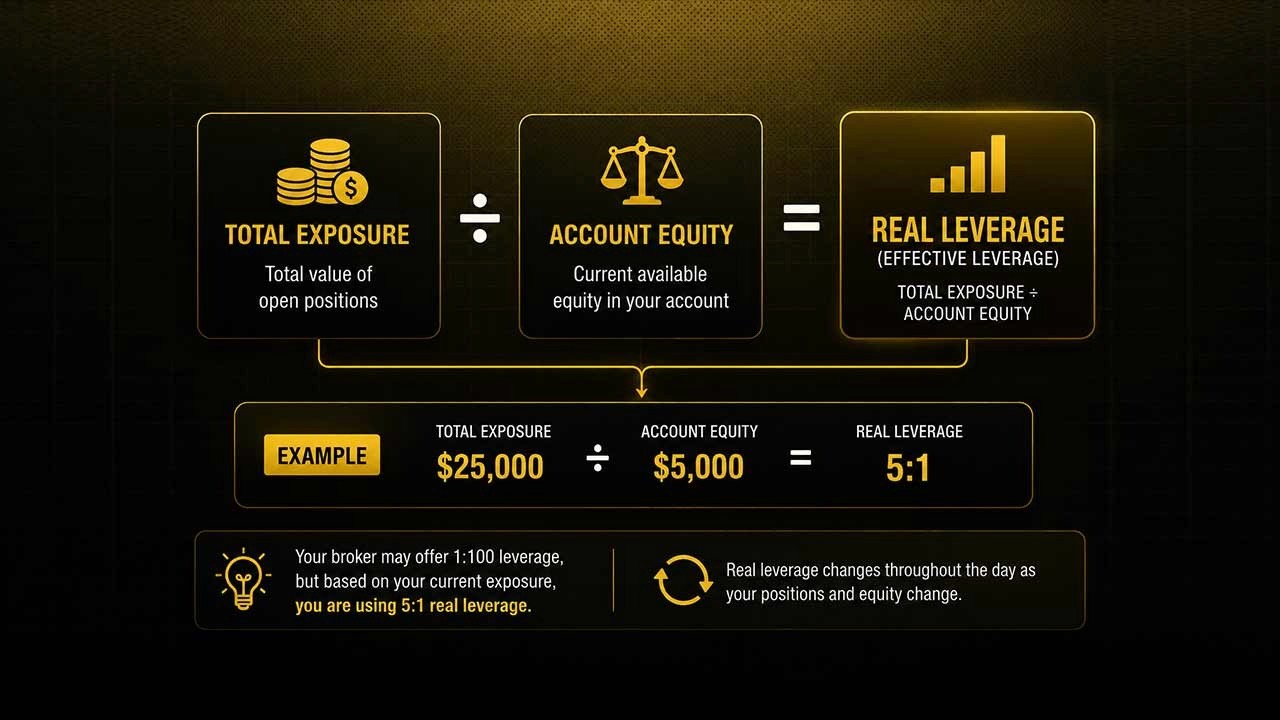
Real leverage, sometimes called effective leverage, compares your total open market exposure with your current account equity.
The basic formula is:
Real leverage = Total value of open positions ÷ Account equity
Suppose you have $5,000 in account equity and one open position worth $25,000.
Your real leverage is:
$25,000 ÷ $5,000 = 5
You are using real leverage of 5:1.
Your broker may offer account leverage of 1:100, but you are only using 5:1 based on your current exposure.
This distinction matters because your account leverage remains fixed unless you or the broker changes it. Real leverage changes throughout the trading day.
Open another position and your real leverage increases. Close a position and it falls. Take a large floating loss and your equity decreases, which can push your real leverage higher even when you have not added a new trade.
Your real leverage changes whenever you increase or decrease your position size. Before opening a trade, understand how lot size in forex trading affects pip value, potential loss and total market exposure.
Account Leverage vs Real Leverage
The main difference in the account leverage vs real leverage comparison is permission versus usage.
Account leverage tells you what your account is allowed to do.
Real leverage tells you what your account is currently doing.
Think of account leverage as the maximum speed of a car. A car may be capable of reaching 250 kilometres per hour, but that does not mean you are always driving at that speed.
Your real speed depends on how hard you press the accelerator. In trading, your real leverage depends on how much exposure you take.
A trader with 1:500 account leverage could use only 2:1 real leverage by opening a small position.
Another trader with 1:30 account leverage could use 20:1 real leverage by opening positions close to the account’s maximum capacity.
The second trader may be taking far more risk, even though the first trader has access to a much higher leverage setting.
Access to 1:100 or 1:500 leverage does not mean you must use that full amount. When choosing the best leverage for forex, consider your strategy, account size and ability to control position exposure.
How to Calculate Your Actual Forex Exposure
Your actual forex exposure is the total notional value of all your open positions.
In forex, one standard lot normally represents 100,000 units of the base currency. A mini lot represents 10,000 units, while a micro lot represents 1,000 units.
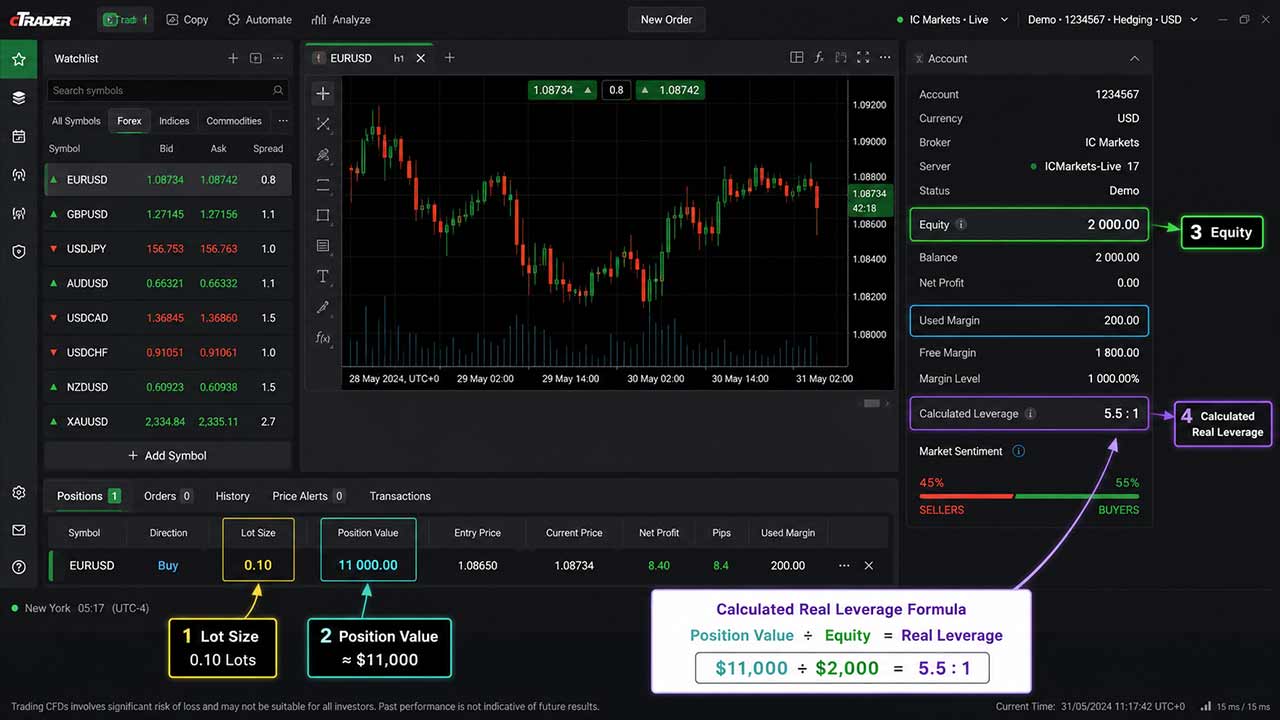
If you open 0.10 lots of EUR/USD, you are controlling approximately €10,000.
If EUR/USD is trading at 1.1000, the position is worth roughly:
€10,000 × 1.1000 = $11,000
If your account equity is $2,000, your real leverage would be:
$11,000 ÷ $2,000 = 5.5
Your effective leverage is approximately 5.5:1.
The exact calculation can become more complicated when your account currency is different from the currencies being traded. However, most trading platforms show the notional value, margin, and account equity needed to estimate your exposure.
Example 1: One Open Position
Imagine a trader has:
Account balance: $10,000
Account equity: $10,000
Broker leverage: 1:100
Open position: $20,000
The trader’s real leverage is:
$20,000 ÷ $10,000 = 2:1
Although the account allows leverage of up to 100:1, the trader is only using 2:1.
A 1% move against the entire position would create an approximate $200 loss, excluding spreads, commissions, financing costs, and currency conversion.
That loss represents around 2% of the trader’s equity.
This is a relatively controlled use of leverage compared with the account’s maximum capacity.
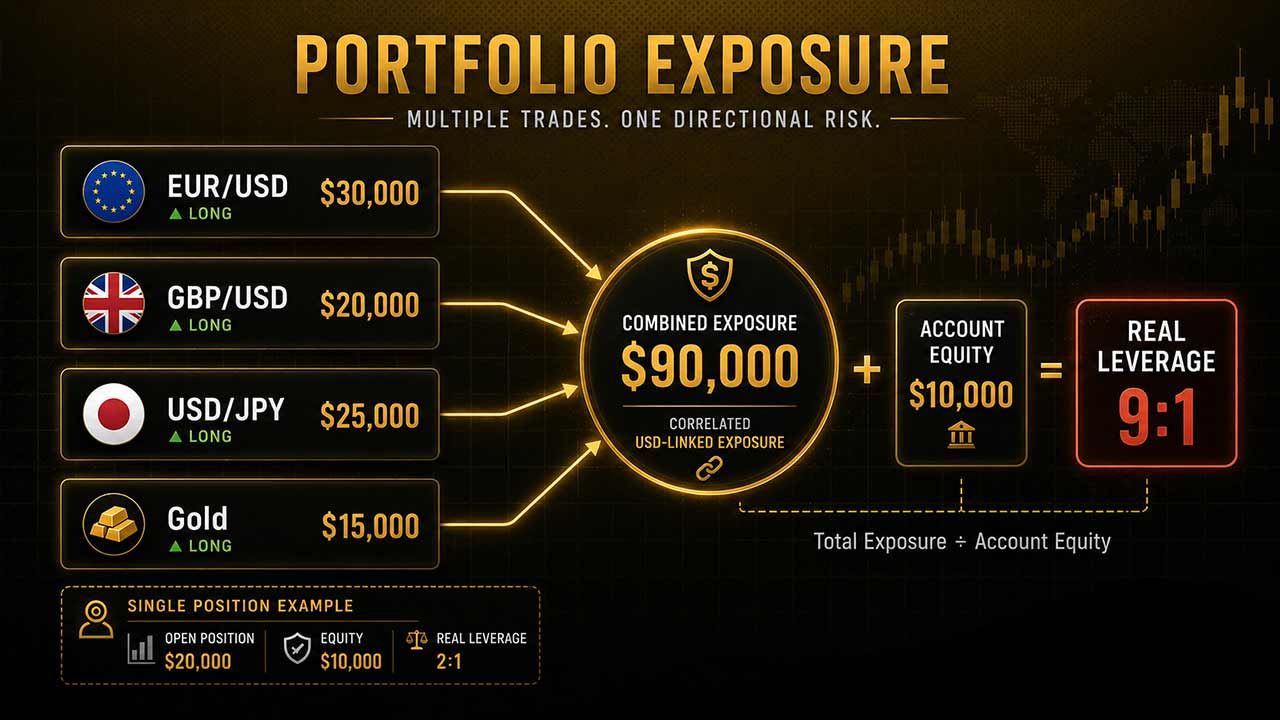
Example 2: Several Open Positions
Now imagine the same trader opens several trades:
EUR/USD position: $30,000
GBP/USD position: $20,000
USD/JPY position: $25,000
Gold position: $15,000
The total market exposure is:
$30,000 + $20,000 + $25,000 + $15,000 = $90,000
With account equity of $10,000, real leverage is:
$90,000 ÷ $10,000 = 9:1
The trader may see four separate trades on the platform and believe the risk is spread out. However, the account is now controlling $90,000 of total exposure.
The positions may also be connected.
EUR/USD and GBP/USD can react similarly to changes in the US dollar. Gold may also move sharply when the dollar, interest-rate expectations, or economic data change. What appears to be four independent trades could behave like one large directional bet.
This is why calculating exposure position by position is not enough. Traders should also consider total exposure and correlation.
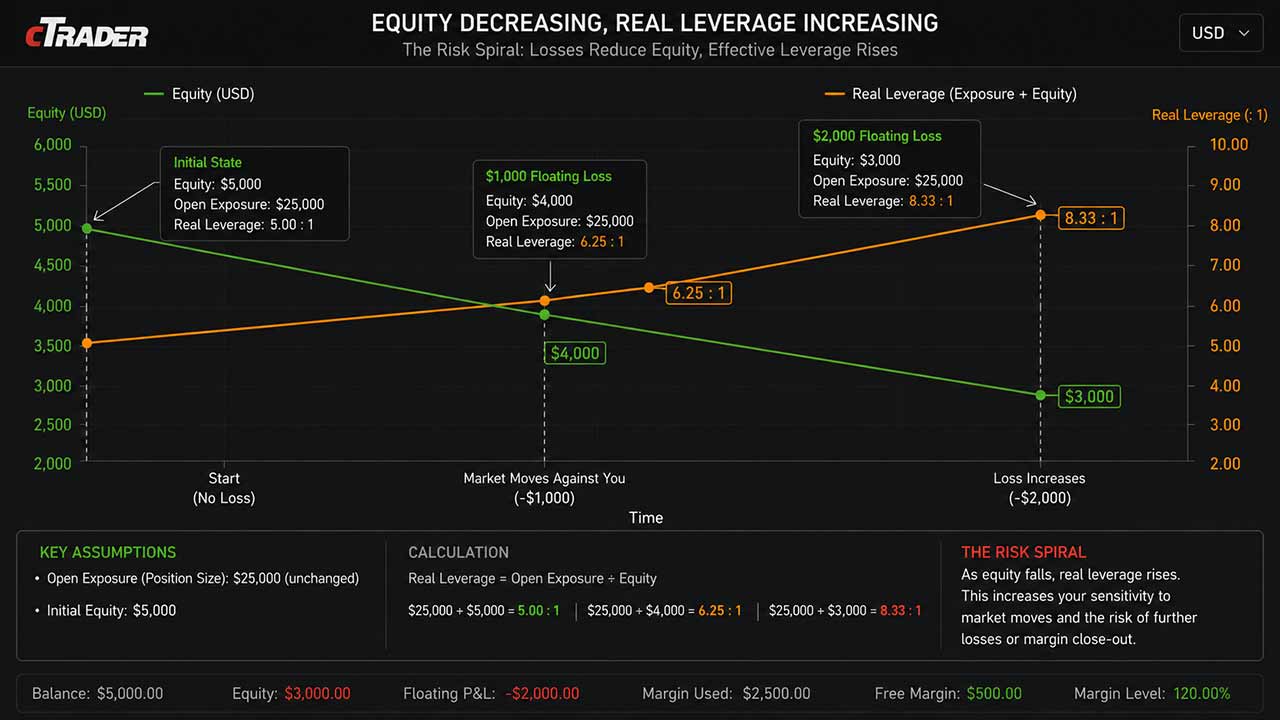
Example 3: Real Leverage Rises After a Loss
Real leverage can increase even when you do not open another trade.
Suppose you have:
Initial equity: $5,000
Open exposure: $25,000
Initial real leverage: 5:1
The market moves against you, creating a $1,000 floating loss. Your equity falls to $4,000, but the position remains open.
Your updated real leverage becomes:
$25,000 ÷ $4,000 = 6.25:1
You did not increase your position size. However, your real leverage rose from 5:1 to 6.25:1 because your equity declined.
If the loss grows to $2,000, equity falls to $3,000:
$25,000 ÷ $3,000 = 8.33:1
This creates a dangerous cycle. As losses reduce equity, effective leverage rises. The account becomes more sensitive to each additional market move.
This is one reason highly leveraged positions can become difficult to recover from. The trader’s risk increases while the financial cushion becomes smaller.
Why Margin Does Not Show Your Full Risk
Many traders look at used margin and assume it represents the amount at risk.
It does not.
Margin is the amount reserved by the broker to keep a leveraged position open. It is not the maximum possible loss on the trade.
Suppose your account uses 1:100 leverage and you open a $50,000 position. The required margin may be around $500.
That does not mean you are only risking $500.
Your loss depends on the position size, market movement, stop-loss placement, slippage, trading costs, and whether the market gaps beyond your stop.
A $50,000 position moving 2% against you could create a loss of around $1,000. The margin requirement may only be $500, but the market exposure is still $50,000.
Real leverage focuses on the full position value rather than the smaller margin deposit. This makes it a more useful measurement of account sensitivity.
Account leverage determines how much margin is required to open a position, but margin and leverage are not the same. Understanding the difference between margin and leverage helps explain why two traders with identical account settings can carry very different exposure.
The Relationship Between Real Leverage and Position Risk
Real leverage and trade risk are connected, but they are not identical.
Real leverage measures total exposure relative to equity. Trade risk estimates how much money you may lose if your stop-loss is reached.
For example, two traders could both use 10:1 real leverage but have different risk levels.
One trader may use a tight stop-loss and risk 1% of the account. The other may use no stop-loss and allow the position to move deeply against them.
The second trader has much greater downside risk, even though both accounts initially show the same effective leverage.
This means traders should monitor both:
Exposure risk: How large are the total open positions compared with account equity?
Stop-loss risk: How much money could be lost if each trade reaches its planned exit?
Real leverage provides the wider account-level view. Position risk provides the trade-level view.
Correlated Trades Can Hide Your Actual Risk
Opening multiple positions does not always create real diversification.
Suppose you buy EUR/USD, buy GBP/USD, and sell USD/CHF. Each position may benefit from a weaker US dollar.
Although the trades involve different currency pairs, all three express a similar market opinion.
If unexpected news strengthens the dollar, all three positions could move against you at the same time.
Your trading platform may show three separate trades, but your actual forex exposure is concentrated around one underlying risk factor.
The same problem can happen when trading different asset classes. Gold, stock indices, cryptocurrencies, and certain currencies can sometimes respond to the same interest-rate announcement or shift in risk sentiment.
Before adding another position, ask whether it introduces a new opportunity or simply increases exposure to an existing idea.
How Much Real Leverage Is Too Much?
There is no single effective leverage ratio that is suitable for every trader.
The appropriate level depends on:
Account size
Trading strategy
Average stop-loss distance
Market volatility
Number of open positions
Correlation between trades
Holding period
Experience level
Maximum acceptable drawdown
A short-term trader may use more exposure but keep positions open briefly with closely managed exits. A swing trader may use less leverage because positions need room to survive larger daily price movements.
Newer traders should generally focus less on using all available buying power and more on keeping exposure manageable.
The fact that an account allows 1:100 or 1:500 leverage does not mean those ratios should become real leverage targets.
Maximum account leverage is a limit, not a recommendation.
How to Control Real Leverage
The simplest way to reduce real leverage is to reduce total position size.
You can also control it by limiting how many positions are open at once, avoiding heavily correlated trades, and maintaining enough unused equity.
Before entering a new position, calculate:
The approximate notional value of the trade
Your existing total open exposure
Your current account equity
Your real leverage after adding the new trade
Your total loss if all open stops are reached
For example, suppose your equity is $8,000 and your current exposure is $32,000. Your real leverage is 4:1.
You are considering adding another $24,000 position.
Your new total exposure would become $56,000:
$56,000 ÷ $8,000 = 7:1
Instead of viewing the new trade alone, you can see that it increases your account from 4:1 to 7:1 real leverage.
That extra calculation may change your decision or encourage you to reduce the position size.
Lowering real leverage is only one part of protecting an account. A complete forex risk management plan should also control risk per trade, correlated positions, daily drawdown and total open exposure.
Common Mistakes Traders Make With Leverage
One common mistake is choosing a high broker leverage setting and then treating the available buying power as usable capital.
Another mistake is calculating exposure only when the first position is opened. Traders may continue adding trades without checking how the combined exposure affects the account.
Some traders also ignore floating losses. Because real leverage uses equity rather than starting balance, open losses must be included in the calculation.
Balance shows the account value after closed trades. Equity includes current floating profits and losses. For a realistic calculation, equity is usually the more useful figure.
Finally, traders often confuse low margin usage with low risk. High broker leverage may keep margin requirements small while allowing total exposure to become dangerously large.
Real Leverage Gives You a More Honest View
Broker-provided leverage is useful for understanding margin requirements and account limits. However, it does not tell you how aggressively you are currently trading.
Real leverage does.
By comparing total open exposure with current equity, you can see how sensitive your account is to market movements. You can also identify when several small positions have quietly become one large exposure.
The goal is not necessarily to avoid leverage. Leverage is a normal part of forex trading. The goal is to use it intentionally rather than allowing position sizes to grow simply because the account permits them.
Conclusion
The account leverage displayed by your broker only tells you how much exposure the account can support. It does not tell you how much risk you are currently taking.
Real leverage gives you that missing information.
By tracking your total open exposure, current equity, correlated positions, and potential stop-loss losses, you get a more accurate view of your account. This makes it easier to control position sizes before a normal market move becomes a serious drawdown.
The most important number is not always the leverage offered by the broker. It is the leverage you are actually using.
If you are serious about trading with discipline and scaling your capital, consider following a structured path. One option is joining Pipestone Capital, which offers competitive funding programs, transparent rules, and trader-focused support. Our 2 Step Challenges also include an EE refund benefit, allowing you to recover your evaluation fee upon success. However, this refund applies only to 2 Step Challenges and does not extend to Instant or 1-Step Challenges.
Frequently Asked Questions
What is real leverage in forex?
Real leverage in forex is the ratio between the total value of your open positions and your current account equity. It shows how much market exposure you are actually using.
What is the difference between account leverage and real leverage?
Account leverage is the maximum leverage offered by the broker. Real leverage measures your current exposure relative to account equity. One represents available capacity, while the other represents actual usage.
How do you calculate effective leverage in forex?
Divide the total notional value of all open positions by your current account equity. If you control $40,000 in positions with $5,000 in equity, your effective leverage is 8:1.
Can real leverage increase without opening a new trade?
Yes. If an open position loses money, account equity falls. Since real leverage is calculated using equity, the ratio can rise even when the total position size remains unchanged.
Is margin the same as the amount at risk?
No. Margin is the amount reserved to maintain a leveraged position. Your actual risk depends on your exposure, market movement, stop-loss distance, slippage, and trading costs.



Real Leverage vs Account Leverage: Why Your Actual Exposure Matters
Leverage is usually presented as a simple number: 1:30, 1:100, 1:200, or even higher. Traders see that ratio inside their trading account and assume it tells them how much risk they are taking.
It does not.
The leverage offered by your broker only shows the maximum position size your account is allowed to control. It does not show how much leverage you are actually using at that moment.
That is where real leverage in forex becomes important.
Real leverage measures the total value of your open positions compared with the equity currently available in your account. It changes whenever you open or close a trade, add to a position, withdraw money, or experience a profit or loss.
Understanding the difference between account leverage and real leverage can help you avoid oversized positions, hidden exposure, and margin problems. It also gives you a much clearer picture of how vulnerable your account is to a sudden market move.
What Is Account Leverage?
Account leverage is the maximum leverage ratio provided by your broker or trading firm.
For example, if your account offers 1:100 leverage, you can theoretically control $100 in market exposure for every $1 of your own capital.
With a $1,000 account, the maximum theoretical exposure would be:
$1,000 × 100 = $100,000
This does not mean you must open a $100,000 position. It only means the account settings allow you to control up to that amount, assuming margin requirements, trading conditions, and available equity permit it.
Account leverage mainly affects how much margin the broker requires when you open a trade.
At 1:100 leverage, controlling a $10,000 position may require approximately $100 in margin.
At 1:30 leverage, the same $10,000 position may require approximately $333.33.
The higher account leverage gives you more buying power and lowers the margin needed to open a position. However, it does not automatically increase your risk. Your risk depends on how much of that buying power you actually use.
Before comparing account leverage with actual exposure, it helps to understand how leverage works in forex trading and why it can increase both buying power and potential losses.
What Is Real Leverage in Forex?
Real leverage, sometimes called effective leverage, compares your total open market exposure with your current account equity.
The basic formula is:
Real leverage = Total value of open positions ÷ Account equity
Suppose you have $5,000 in account equity and one open position worth $25,000.
Your real leverage is:
$25,000 ÷ $5,000 = 5
You are using real leverage of 5:1.
Your broker may offer account leverage of 1:100, but you are only using 5:1 based on your current exposure.
This distinction matters because your account leverage remains fixed unless you or the broker changes it. Real leverage changes throughout the trading day.
Open another position and your real leverage increases. Close a position and it falls. Take a large floating loss and your equity decreases, which can push your real leverage higher even when you have not added a new trade.
Your real leverage changes whenever you increase or decrease your position size. Before opening a trade, understand how lot size in forex trading affects pip value, potential loss and total market exposure.
Account Leverage vs Real Leverage
The main difference in the account leverage vs real leverage comparison is permission versus usage.
Account leverage tells you what your account is allowed to do.
Real leverage tells you what your account is currently doing.
Think of account leverage as the maximum speed of a car. A car may be capable of reaching 250 kilometres per hour, but that does not mean you are always driving at that speed.
Your real speed depends on how hard you press the accelerator. In trading, your real leverage depends on how much exposure you take.
A trader with 1:500 account leverage could use only 2:1 real leverage by opening a small position.
Another trader with 1:30 account leverage could use 20:1 real leverage by opening positions close to the account’s maximum capacity.
The second trader may be taking far more risk, even though the first trader has access to a much higher leverage setting.
Access to 1:100 or 1:500 leverage does not mean you must use that full amount. When choosing the best leverage for forex, consider your strategy, account size and ability to control position exposure.
How to Calculate Your Actual Forex Exposure
Your actual forex exposure is the total notional value of all your open positions.
In forex, one standard lot normally represents 100,000 units of the base currency. A mini lot represents 10,000 units, while a micro lot represents 1,000 units.
If you open 0.10 lots of EUR/USD, you are controlling approximately €10,000.
If EUR/USD is trading at 1.1000, the position is worth roughly:
€10,000 × 1.1000 = $11,000
If your account equity is $2,000, your real leverage would be:
$11,000 ÷ $2,000 = 5.5
Your effective leverage is approximately 5.5:1.
The exact calculation can become more complicated when your account currency is different from the currencies being traded. However, most trading platforms show the notional value, margin, and account equity needed to estimate your exposure.
Example 1: One Open Position
Imagine a trader has:
Account balance: $10,000
Account equity: $10,000
Broker leverage: 1:100
Open position: $20,000
The trader’s real leverage is:
$20,000 ÷ $10,000 = 2:1
Although the account allows leverage of up to 100:1, the trader is only using 2:1.
A 1% move against the entire position would create an approximate $200 loss, excluding spreads, commissions, financing costs, and currency conversion.
That loss represents around 2% of the trader’s equity.
This is a relatively controlled use of leverage compared with the account’s maximum capacity.
Example 2: Several Open Positions
Now imagine the same trader opens several trades:
EUR/USD position: $30,000
GBP/USD position: $20,000
USD/JPY position: $25,000
Gold position: $15,000
The total market exposure is:
$30,000 + $20,000 + $25,000 + $15,000 = $90,000
With account equity of $10,000, real leverage is:
$90,000 ÷ $10,000 = 9:1
The trader may see four separate trades on the platform and believe the risk is spread out. However, the account is now controlling $90,000 of total exposure.
The positions may also be connected.
EUR/USD and GBP/USD can react similarly to changes in the US dollar. Gold may also move sharply when the dollar, interest-rate expectations, or economic data change. What appears to be four independent trades could behave like one large directional bet.
This is why calculating exposure position by position is not enough. Traders should also consider total exposure and correlation.
Example 3: Real Leverage Rises After a Loss
Real leverage can increase even when you do not open another trade.
Suppose you have:
Initial equity: $5,000
Open exposure: $25,000
Initial real leverage: 5:1
The market moves against you, creating a $1,000 floating loss. Your equity falls to $4,000, but the position remains open.
Your updated real leverage becomes:
$25,000 ÷ $4,000 = 6.25:1
You did not increase your position size. However, your real leverage rose from 5:1 to 6.25:1 because your equity declined.
If the loss grows to $2,000, equity falls to $3,000:
$25,000 ÷ $3,000 = 8.33:1
This creates a dangerous cycle. As losses reduce equity, effective leverage rises. The account becomes more sensitive to each additional market move.
This is one reason highly leveraged positions can become difficult to recover from. The trader’s risk increases while the financial cushion becomes smaller.
Why Margin Does Not Show Your Full Risk
Many traders look at used margin and assume it represents the amount at risk.
It does not.
Margin is the amount reserved by the broker to keep a leveraged position open. It is not the maximum possible loss on the trade.
Suppose your account uses 1:100 leverage and you open a $50,000 position. The required margin may be around $500.
That does not mean you are only risking $500.
Your loss depends on the position size, market movement, stop-loss placement, slippage, trading costs, and whether the market gaps beyond your stop.
A $50,000 position moving 2% against you could create a loss of around $1,000. The margin requirement may only be $500, but the market exposure is still $50,000.
Real leverage focuses on the full position value rather than the smaller margin deposit. This makes it a more useful measurement of account sensitivity.
Account leverage determines how much margin is required to open a position, but margin and leverage are not the same. Understanding the difference between margin and leverage helps explain why two traders with identical account settings can carry very different exposure.
The Relationship Between Real Leverage and Position Risk
Real leverage and trade risk are connected, but they are not identical.
Real leverage measures total exposure relative to equity. Trade risk estimates how much money you may lose if your stop-loss is reached.
For example, two traders could both use 10:1 real leverage but have different risk levels.
One trader may use a tight stop-loss and risk 1% of the account. The other may use no stop-loss and allow the position to move deeply against them.
The second trader has much greater downside risk, even though both accounts initially show the same effective leverage.
This means traders should monitor both:
Exposure risk: How large are the total open positions compared with account equity?
Stop-loss risk: How much money could be lost if each trade reaches its planned exit?
Real leverage provides the wider account-level view. Position risk provides the trade-level view.
Correlated Trades Can Hide Your Actual Risk
Opening multiple positions does not always create real diversification.
Suppose you buy EUR/USD, buy GBP/USD, and sell USD/CHF. Each position may benefit from a weaker US dollar.
Although the trades involve different currency pairs, all three express a similar market opinion.
If unexpected news strengthens the dollar, all three positions could move against you at the same time.
Your trading platform may show three separate trades, but your actual forex exposure is concentrated around one underlying risk factor.
The same problem can happen when trading different asset classes. Gold, stock indices, cryptocurrencies, and certain currencies can sometimes respond to the same interest-rate announcement or shift in risk sentiment.
Before adding another position, ask whether it introduces a new opportunity or simply increases exposure to an existing idea.
How Much Real Leverage Is Too Much?
There is no single effective leverage ratio that is suitable for every trader.
The appropriate level depends on:
Account size
Trading strategy
Average stop-loss distance
Market volatility
Number of open positions
Correlation between trades
Holding period
Experience level
Maximum acceptable drawdown
A short-term trader may use more exposure but keep positions open briefly with closely managed exits. A swing trader may use less leverage because positions need room to survive larger daily price movements.
Newer traders should generally focus less on using all available buying power and more on keeping exposure manageable.
The fact that an account allows 1:100 or 1:500 leverage does not mean those ratios should become real leverage targets.
Maximum account leverage is a limit, not a recommendation.
How to Control Real Leverage
The simplest way to reduce real leverage is to reduce total position size.
You can also control it by limiting how many positions are open at once, avoiding heavily correlated trades, and maintaining enough unused equity.
Before entering a new position, calculate:
The approximate notional value of the trade
Your existing total open exposure
Your current account equity
Your real leverage after adding the new trade
Your total loss if all open stops are reached
For example, suppose your equity is $8,000 and your current exposure is $32,000. Your real leverage is 4:1.
You are considering adding another $24,000 position.
Your new total exposure would become $56,000:
$56,000 ÷ $8,000 = 7:1
Instead of viewing the new trade alone, you can see that it increases your account from 4:1 to 7:1 real leverage.
That extra calculation may change your decision or encourage you to reduce the position size.
Lowering real leverage is only one part of protecting an account. A complete forex risk management plan should also control risk per trade, correlated positions, daily drawdown and total open exposure.
Common Mistakes Traders Make With Leverage
One common mistake is choosing a high broker leverage setting and then treating the available buying power as usable capital.
Another mistake is calculating exposure only when the first position is opened. Traders may continue adding trades without checking how the combined exposure affects the account.
Some traders also ignore floating losses. Because real leverage uses equity rather than starting balance, open losses must be included in the calculation.
Balance shows the account value after closed trades. Equity includes current floating profits and losses. For a realistic calculation, equity is usually the more useful figure.
Finally, traders often confuse low margin usage with low risk. High broker leverage may keep margin requirements small while allowing total exposure to become dangerously large.
Real Leverage Gives You a More Honest View
Broker-provided leverage is useful for understanding margin requirements and account limits. However, it does not tell you how aggressively you are currently trading.
Real leverage does.
By comparing total open exposure with current equity, you can see how sensitive your account is to market movements. You can also identify when several small positions have quietly become one large exposure.
The goal is not necessarily to avoid leverage. Leverage is a normal part of forex trading. The goal is to use it intentionally rather than allowing position sizes to grow simply because the account permits them.
Conclusion
The account leverage displayed by your broker only tells you how much exposure the account can support. It does not tell you how much risk you are currently taking.
Real leverage gives you that missing information.
By tracking your total open exposure, current equity, correlated positions, and potential stop-loss losses, you get a more accurate view of your account. This makes it easier to control position sizes before a normal market move becomes a serious drawdown.
The most important number is not always the leverage offered by the broker. It is the leverage you are actually using.
If you are serious about trading with discipline and scaling your capital, consider following a structured path. One option is joining Pipestone Capital, which offers competitive funding programs, transparent rules, and trader-focused support. Our 2 Step Challenges also include an EE refund benefit, allowing you to recover your evaluation fee upon success. However, this refund applies only to 2 Step Challenges and does not extend to Instant or 1-Step Challenges.
Frequently Asked Questions
What is real leverage in forex?
Real leverage in forex is the ratio between the total value of your open positions and your current account equity. It shows how much market exposure you are actually using.
What is the difference between account leverage and real leverage?
Account leverage is the maximum leverage offered by the broker. Real leverage measures your current exposure relative to account equity. One represents available capacity, while the other represents actual usage.
How do you calculate effective leverage in forex?
Divide the total notional value of all open positions by your current account equity. If you control $40,000 in positions with $5,000 in equity, your effective leverage is 8:1.
Can real leverage increase without opening a new trade?
Yes. If an open position loses money, account equity falls. Since real leverage is calculated using equity, the ratio can rise even when the total position size remains unchanged.
Is margin the same as the amount at risk?
No. Margin is the amount reserved to maintain a leveraged position. Your actual risk depends on your exposure, market movement, stop-loss distance, slippage, and trading costs.
