


What Is Forex Leverage in Trading? Benefits and Risks

Forex leverage is one of the first things new traders hear about when they enter the currency market.
It sounds exciting because it allows you to control a larger trade with less money. A small account can open a much bigger position than it could without leverage. That is why forex leverage attracts many beginners.
But this is also where the danger starts.
Forex leverage can help increase profits when a trade moves in your favor. But it can also increase losses when the trade moves against you. The same tool that makes trading look more powerful can also make an account drop faster than expected.
In simple terms, forex leverage lets you use a smaller deposit to open a larger position in the market. Your broker sets aside part of your balance as margin, then gives you access to a bigger trade size.
That sounds useful, and it can be. But leverage is not free money. It is not a shortcut. It is a risk tool.
To use forex leverage properly, you need to understand how it works, how margin works, what can go wrong, and how to control your position size before you enter a trade.
This guide explains forex leverage in a simple way, including the benefits, risks, examples, and common mistakes beginners should avoid.
Forex Leverage Explained in Simple Terms

Forex leverage means using borrowed trading power from your broker to control a larger position than your own cash would normally allow.
For example, let’s say you have $1,000 in your trading account.
Without leverage, you can only trade with that $1,000. Your profit or loss will be based on a $1,000 position.
With forex leverage, your $1,000 may allow you to control $10,000, $50,000, or even $100,000 depending on the leverage level your broker offers.
If your broker offers 100:1 leverage, you can control $100 in the market for every $1 of margin.
So, with $1,000, you may control a $100,000 forex position.
This does not mean the broker gives you $100,000 to keep. It only means you can trade a position of that size while your deposit acts as margin.
The key point is simple: forex leverage increases your market exposure.
That exposure can work for you or against you.
If the trade moves in your favor, your profit is based on the full position size. If the trade moves against you, your loss is also based on the full position size.
This is why forex leverage is often called a double-edged sword.
What Is Leverage in Forex?

Many beginners ask, “what is leverage in forex?” because the term can sound more complex than it really is.
Leverage in forex is the ability to open a bigger trade than your account balance would allow on its own.
It works through margin.
Margin is the amount of money your broker holds from your account to keep the trade open. It is like a deposit for the position.
For example, if you open a $100,000 EUR/USD position with 1% margin, you only need $1,000 in margin.
That means you are using 100:1 leverage.
Here is the simple formula:
Position size = Margin x Leverage
So:
$1,000 x 100 = $100,000
This is how forex leverage gives traders access to larger positions without needing the full trade value in cash.
But there is one big mistake to avoid.
Margin is not your maximum loss.
If you use $1,000 to open a leveraged trade, your risk is not limited only to that $1,000 unless your broker has certain protections and your trade is closed in time. Your profit or loss depends on the full position size.
That is why traders must treat forex leverage with care.

How Does Leverage Work in Forex?
To understand how does leverage work in forex, you need to look at three things:
Position size, margin, and price movement.
Let’s say you open a $100,000 position on EUR/USD.
Your broker requires 1% margin.
That means you need $1,000 to open the trade.
Now let’s say EUR/USD moves 1% in your favor.
A 1% move on a $100,000 position equals $1,000.
That means your $1,000 margin helped you make $1,000 in profit.
That looks powerful.
But now let’s look at the other side.
If EUR/USD moves 1% against you, the loss is also $1,000.
That could wipe out the margin used for the trade.
This is the part many new traders miss. Forex leverage does not only increase the chance of making more money. It also increases the chance of losing money faster.
A small move in the market can have a large effect on your account when the position size is too big.
That is why the question is not only “how does leverage work in forex?” The better question is, “how much leverage can my account handle safely?”

What Is Margin in Forex Leverage?
Margin is the money your broker sets aside from your account when you open a leveraged trade.
It is not a fee. It is not a trading cost. It is the required deposit needed to control a larger position.
Forex leverage and margin are closely linked.
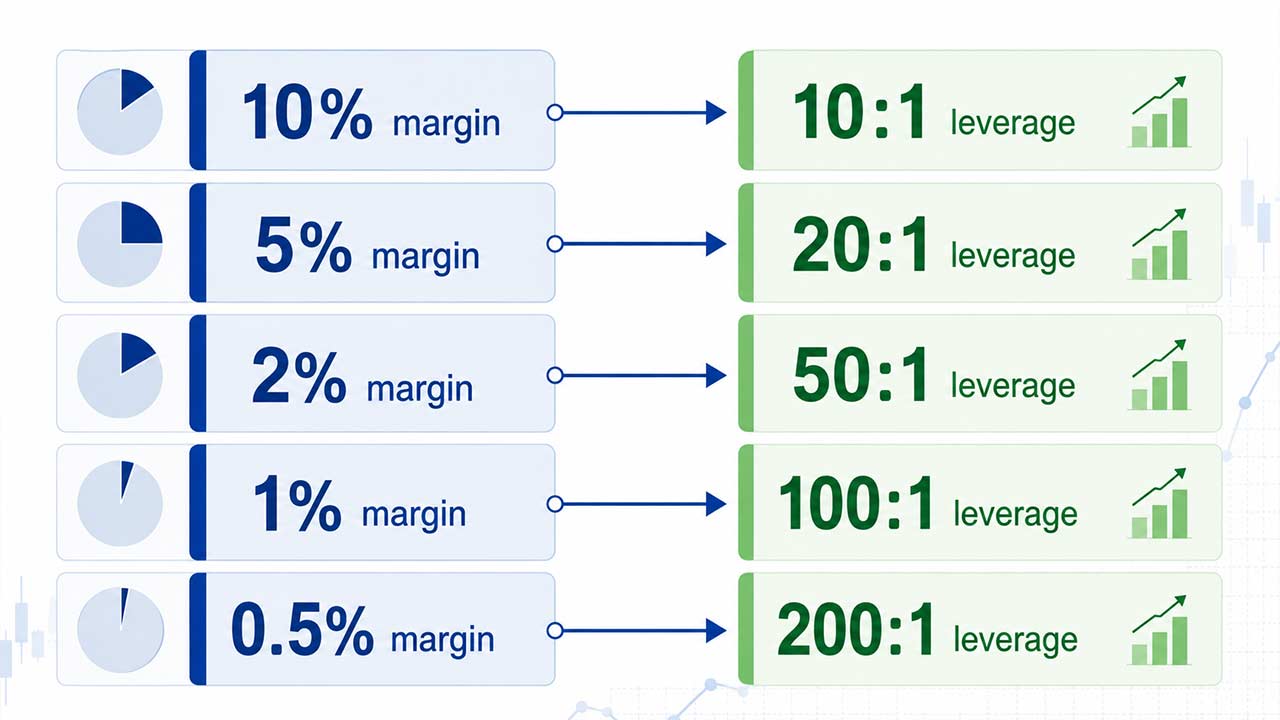
When the margin requirement is lower, the leverage is higher.
Here are simple examples:
10% margin equals 10:1 leverage
5% margin equals 20:1 leverage
2% margin equals 50:1 leverage
1% margin equals 100:1 leverage
0.5% margin equals 200:1 leverage
So, if a broker requires only 1% margin, a trader can control a much bigger position with less money.
This is why forex leverage can be attractive. It gives traders more buying power.
But high buying power can become dangerous if the trader opens trades that are too large for their account.
Margin should not be seen as the amount you are willing to risk. It is only the amount needed to open the trade.
Your real risk depends on your trade size, stop-loss, account balance, and market movement. For a deeper breakdown, read this guide on margin vs leverage in forex before using higher exposure.
Forex Leverage Example for Beginners
Let’s use a simple example.
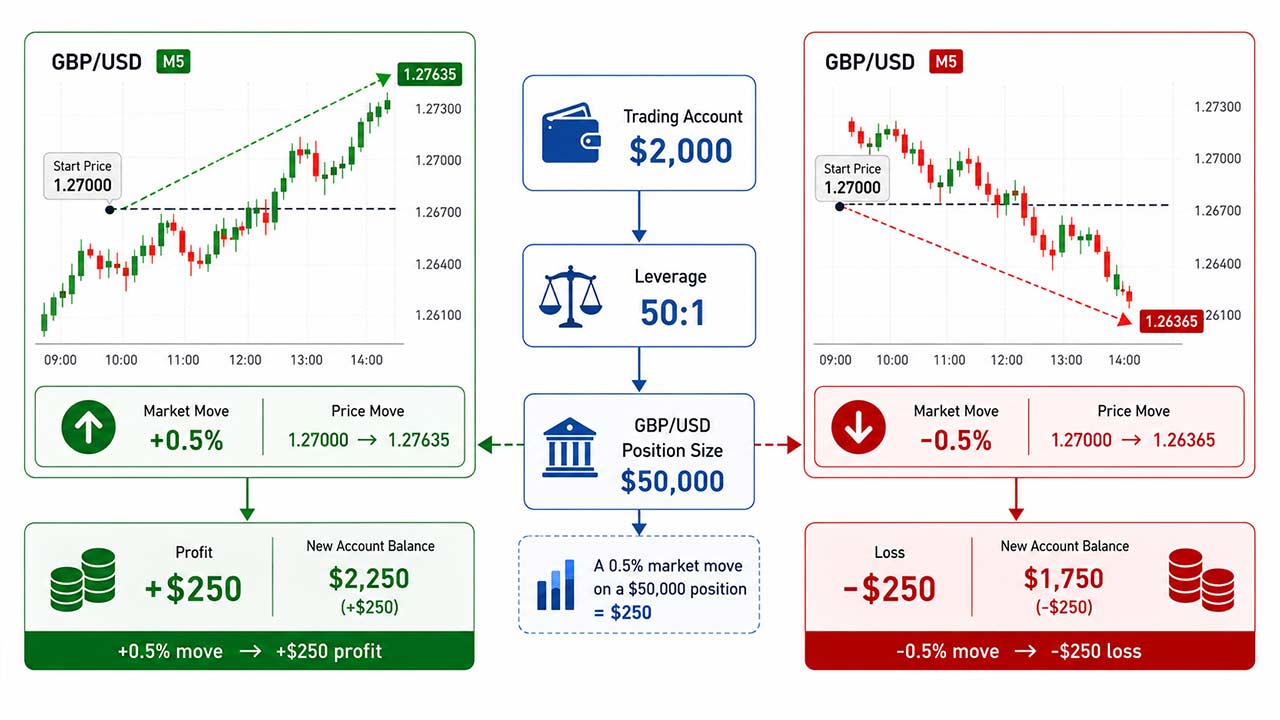
You have a $2,000 trading account.
You want to trade GBP/USD.
Your broker offers 50:1 forex leverage.
This means your $2,000 account could control up to $100,000 in market exposure.
But using the full amount would be risky.
Let’s say you open a $50,000 position instead.
If GBP/USD moves 0.5% in your favor, the profit is $250.
That is a solid gain compared to your $2,000 account.
But if GBP/USD moves 0.5% against you, the loss is also $250.
That is 12.5% of your account on one trade.
Now imagine taking several trades like this in a row. A few losses could cut the account down quickly.
This is why forex leverage should not be judged only by the profit potential. You must also ask how much damage the trade can do if it goes wrong.
A good trader does not ask, “How much can I make if I use maximum leverage?”
A better trader asks, “How much can I lose if this trade fails?” This is also where lot size in forex matters. Your lot size decides how much each pip is worth, so it directly affects how fast leverage can grow or damage your account.
Margin-Based Leverage vs Real Forex Leverage
There is a difference between the leverage your broker offers and the leverage you actually use.
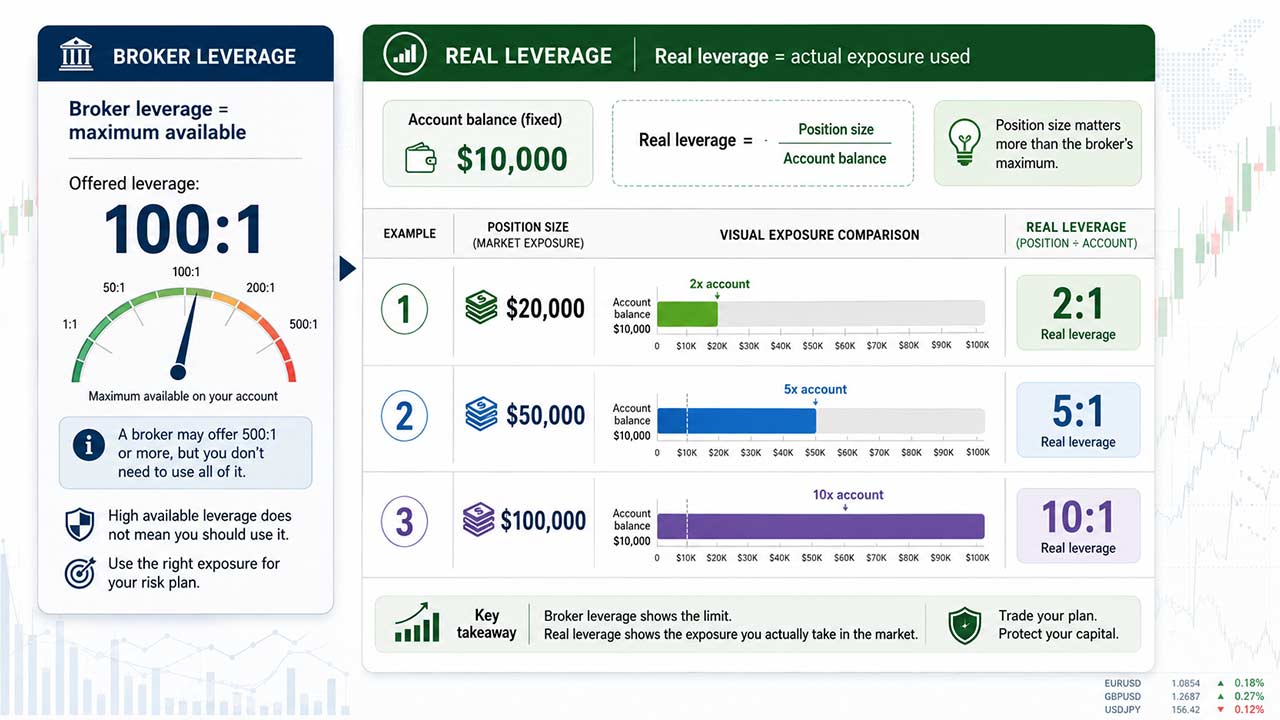
Broker leverage is the maximum leverage available on your account.
Real forex leverage is your true market exposure compared to your account size.
For example, your broker may offer 100:1 leverage.
But if you have a $10,000 account and open a $20,000 trade, your real leverage is only 2:1.
If you open a $50,000 trade, your real leverage is 5:1.
If you open a $100,000 trade, your real leverage is 10:1.
Real forex leverage matters more than the number shown by your broker.
A broker can offer 500:1 leverage, but that does not mean you must use it. You can still trade smaller position sizes and keep your real exposure low.
This is where many new traders make mistakes. They think high leverage means they should open the biggest trade possible.
That is not smart trading.
The goal is not to use all available leverage. The goal is to use the right position size for your account and risk plan.
What Is Maximum Leverage in Forex Trading?
A common beginner question is, “what is maximum leverage in forex trading?”
The answer depends on the broker, country, account type, and currency pair.
Some brokers may offer 30:1 leverage on major forex pairs. Others may offer 50:1, 100:1, 200:1, 500:1, or even higher in certain regions.
Major currency pairs often have higher leverage because they are more liquid. These include pairs like EUR/USD, GBP/USD, USD/JPY, and USD/CHF.
More volatile or less liquid pairs may have lower leverage. This is because sharp moves can create more risk for both the trader and the broker.
For example, a broker may offer higher leverage on EUR/USD but lower leverage on an exotic pair.
So, what is maximum leverage in forex trading? It is the highest leverage your broker allows you to use on a specific pair or account.
But maximum leverage is not the same as smart leverage.
Just because you can use 500:1 does not mean you should.
High forex leverage can make small market moves very costly. The higher the leverage, the less room your trade has to move against you before your account feels pressure.
For most beginners, lower leverage is easier to manage. To choose a safer level, compare the best leverage for forex based on account size, risk tolerance, and trading style.
Why Do Traders Use Leverage?
Traders use forex leverage because it gives them more market exposure with less capital.
Currency prices often move in small steps. A move of 30, 50, or 100 pips can matter, but the money result depends on position size.
Without leverage, small accounts may not see meaningful gains from normal price moves.
Forex leverage solves that problem by allowing traders to open larger positions.
This is one reason forex trading became popular among retail traders. You do not need the full value of a large trade to enter the market.
But this does not mean leverage should be used without limits.
The point of forex leverage is not to gamble with a bigger position. The point is to use market exposure in a controlled way.
When used properly, leverage can support a trading plan. When used badly, it can turn normal losses into account-damaging losses.
Advantages and Disadvantages of Leverage in Forex
Understanding the advantages and disadvantages of leverage in forex is important before using it.
Leverage is not good or bad by itself. It depends on how the trader uses it.
A careful trader may use forex leverage to improve capital use and manage trades with discipline. A careless trader may use it to overtrade, chase losses, and risk too much.
Here are the main advantages and disadvantages of leverage in forex. Before looking at the benefits, remember this: leverage only works when it is backed by strong risk management in forex. Without that, higher buying power can turn into higher losses very fast.
Advantages of Forex Leverage
1. Larger Market Exposure
The main benefit of forex leverage is larger market exposure.
A trader can control a bigger position without depositing the full trade value.
For example, instead of needing $100,000 to trade one standard lot, a trader may only need a small percentage of that amount as margin.
This makes the forex market more accessible.
It allows traders with smaller accounts to take part in the market and trade position sizes that would not be possible without leverage.
But exposure must still be controlled. Bigger positions are not always better.
2. Better Use of Trading Capital
Forex leverage can help traders use capital more efficiently.
Instead of placing a large amount of money into one trade, a trader can use margin and keep the rest of the account available.
This can give more flexibility.
A trader may use free capital to manage risk, handle drawdown, or wait for another setup.
But this advantage only works when the trader does not overuse margin.
If you open too many leveraged trades at the same time, your free margin can disappear quickly.
That is when margin pressure starts.
3. Access for Smaller Accounts
Forex leverage allows smaller traders to enter the market with less upfront capital.
This is one of the biggest reasons beginners are attracted to forex.
A trader may not have $50,000 or $100,000 to trade. But with leverage, they can still open positions based on smaller deposits.
This can be useful, but it can also create false confidence.
A small account should still use small risk.
A $500 account using high forex leverage can lose money very quickly if the trader opens positions that are too large.
Leverage gives access. It does not remove risk.
4. More Flexibility in Trading
Forex leverage gives traders more flexibility with trade size and strategy.
A trader can open smaller or larger positions depending on the setup, stop-loss size, and account balance.
It can also help traders trade different market styles, such as short-term trades, day trades, or swing trades.
Forex also allows traders to buy or sell currency pairs. This means traders can take positions in both rising and falling markets.
Still, flexibility without discipline can become a problem.
A trader who uses leverage to enter random trades is not using leverage well. They are only increasing risk.
5. Higher Profit Potential
Forex leverage can increase profit potential because gains are based on the full position size.
If you control a larger trade, the same price move can create a larger profit.
This is the benefit most beginners notice first.
But this benefit cannot be separated from the risk.
The same larger position can also create a larger loss.
That is why traders should never focus only on profit when using forex leverage. They should first calculate the risk, and some even look at joining Pipstone Capital to get funded, where strict risk control can still lead to solid returns even with a low win rate around 1%.
Disadvantages and Risks of Forex Leverage
1. Losses Can Grow Fast
The biggest risk of forex leverage is that losses are magnified.
If your trade size is too large, even a small move against you can create a large loss.
This happens because profit and loss are based on the full position size, not just the margin used.
A trade may look small because the margin is small. But the real exposure may be much larger.
This is why beginners often lose money with leverage. They open trades that are too big because the required margin looks affordable.
Affordable margin does not mean affordable risk.
2. Margin Calls
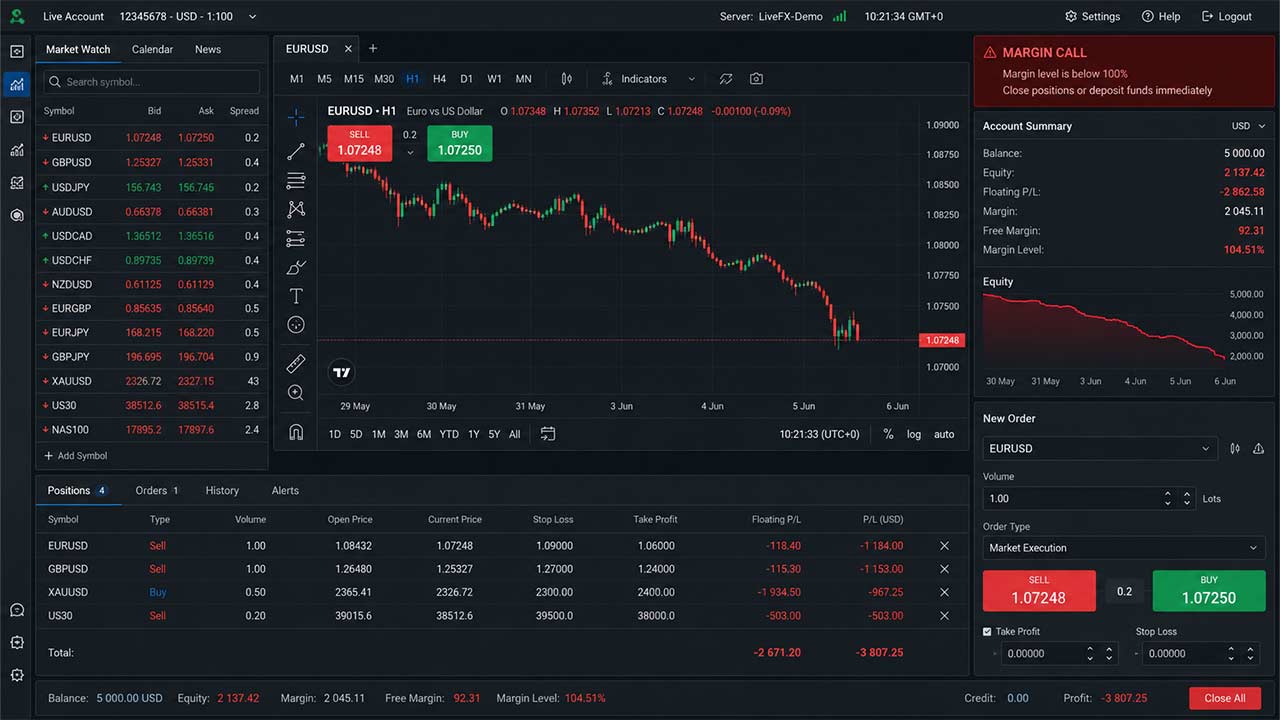
A margin call happens when your account equity falls too low to support your open trades.
If your account does not have enough free margin, your broker may ask you to add funds or may close positions automatically.
This can happen quickly when using high forex leverage.
A margin call is usually a sign that the account is under too much pressure.
It often happens when a trader opens oversized trades, holds losing positions too long, or uses too much available margin.
The best way to avoid margin calls is to use smaller position sizes and keep enough free margin in the account.
3. Emotional Pressure
Forex leverage can make trading more stressful.
When the position size is too large, every small move feels important. A normal pullback can feel like a major loss. A few pips against the trade can create panic.
This pressure leads to bad decisions.
Traders may close winning trades too early. They may hold losing trades too long. They may move stop-loss orders. They may revenge trade after a loss.
Most of these mistakes happen because the trade size is too large for the account.
Good trading should not feel like one trade can destroy your progress.
If a trade creates too much stress, the position is probably too big.
4. Faster Account Damage
High forex leverage can damage an account quickly.
A trader can lose a large part of the account in a short time if they use too much exposure.
This does not require a huge market move.
Even normal price movement can cause problems when leverage is high and risk control is weak.
For example, a trader may use high leverage on a news day. The market spikes, spreads widen, and the trade closes at a worse price than expected.
This can turn a normal loss into a much bigger loss.
5. Overnight Funding Costs
Some leveraged forex trades may have overnight costs.
These are often called swap fees or rollover fees.
They depend on the currency pair, trade direction, interest rate difference, and broker rules.
If you hold a position overnight, these costs may be added or deducted from your account.
For day traders, this may not matter much. But for swing traders, overnight costs can add up over time.
Forex leverage can increase these costs because the trade size is larger.
6. Risk of Losing More Than Expected
In sharp market moves, losses can be larger than expected.
This can happen during major news, low-liquidity periods, market gaps, or sudden price spikes.
Some brokers offer negative balance protection, but not all accounts and regions have the same rules.
Traders should check broker terms before assuming they cannot lose more than their deposit.
Even with protection, using too much forex leverage can still wipe out the account balance.
Is High Forex Leverage Better?
High forex leverage is not always better.
It gives you more buying power, but it also gives you more risk.
A trader using 500:1 leverage can open a very large trade with a small deposit. But that also means a small move against the position can hurt the account fast.
Lower leverage gives trades more room to breathe.
It can also reduce emotional pressure because the trade size is not too large compared to the account.
For beginners, lower forex leverage is usually better. It allows them to learn without putting the account under too much pressure.
Experienced traders may use higher leverage, but many of them still control their real leverage through position sizing.
The broker’s maximum leverage is not the main thing. Your real risk is the main thing.
How to Use Forex Leverage Safely
Forex leverage should always be used with a risk plan.
Here are simple ways to control it.
1. Use Smaller Position Sizes
Position size matters more than the leverage number.
You can have access to 100:1 leverage and still trade safely if your position size is small.
You can also have 30:1 leverage and still trade badly if you risk too much on one trade.
Before entering a trade, decide how much money you are willing to lose if the trade fails.
Many traders risk only a small percentage of their account per trade. This helps protect the account from one bad decision.
2. Always Use a Stop-Loss
A stop-loss helps limit your loss when the market moves against you.
It does not make trading risk-free, but it gives you a clear exit point.
Trading with forex leverage and no stop-loss is dangerous because losses can grow fast.
A stop-loss should be placed based on the trade setup, not based on fear or hope.
Once the trade is open, avoid moving the stop-loss further away just to avoid taking a loss. It also helps to plan your stop loss and take profit levels before entering, so the trade has a clear exit on both sides.
3. Do Not Use All Available Margin
Just because your broker allows you to open a large trade does not mean you should.
Using all available margin leaves no room for normal market movement.
If the trade moves against you, your account can face a margin call quickly.
Keeping free margin gives your account more breathing room.
A good trader does not try to use every bit of available leverage.
4. Watch Your Real Forex Leverage
Always check your total open exposure.
If you have a $2,000 account and your open trades total $100,000, your real leverage is 50:1.
That may be too much for many traders.
The problem gets worse when traders open many positions at once. Each trade adds exposure.
Even if each trade looks small, the total risk may be high.
Tracking real forex leverage helps you avoid hidden overexposure.
5. Be Careful Around News
Forex markets can move fast during major news events.
Inflation reports, interest rate decisions, employment data, and central bank speeches can cause sharp price moves.
During these times, spreads may widen and stop-loss orders may not fill exactly at the chosen price.
If you are new, it is better to reduce trade size or avoid trading during major news.
Forex leverage is more dangerous when the market moves fast.
6. Practice on Demo First
A demo account helps you understand how margin, leverage, position size, and profit or loss work.
It gives you a safe place to make mistakes.
But demo trading does not feel the same as live trading. Real money creates real emotion.
So when moving from demo to live, start small.
Do not use high forex leverage just because your demo trades looked easy.
What Leverage Should Beginners Use?
There is no perfect leverage level for every beginner.
It depends on account size, trade style, pair volatility, experience, and risk tolerance.
Still, beginners are usually better with lower leverage.
For many new traders, 10:1 or 20:1 is easier to manage than very high leverage. It gives more room for learning and lowers the chance of one trade causing serious damage.
A small account may make high leverage feel tempting. The trader may think they need high forex leverage to grow faster.
But fast growth should not be the first goal.
The first goal is to survive long enough to learn.
Once a trader understands risk, position sizing, market behavior, and emotions, they can decide whether higher leverage makes sense.
Common Forex Leverage Mistakes
Using Maximum Leverage on Every Trade
Many beginners use the highest leverage available because they think it gives them the best chance to make money.
This is a mistake.
Maximum leverage should not be treated as a target.
It is only the highest exposure your broker allows.
Using full forex leverage on every trade can make the account too sensitive to small market moves.
Confusing Margin With Risk
Margin is the deposit needed to open a trade.
Risk is how much you can lose if the trade moves against you.
These are not the same thing.
A trade may require only $100 in margin but still expose the account to a much larger loss if the position size is too big.
Opening Too Many Trades
Some traders use leverage to open many trades at the same time.
This can create hidden risk.
Even if each trade looks small, the total exposure can become too large.
When several trades move against the account at once, losses can build quickly.
Trading Without a Plan
Forex leverage makes bad trading habits worse.
If a trader enters without a setup, stop-loss, target, or risk limit, leverage can turn that weak plan into a serious loss.
Before using leverage, every trade should have a clear reason, clear invalidation point, and clear risk amount.
Final Thoughts
Forex leverage can be useful, but only when it is handled with care.
It allows traders to control larger positions with less money. This can help small accounts access the forex market and make better use of capital.
But forex leverage also increases risk.
It can magnify losses, trigger margin calls, create emotional pressure, and damage an account quickly when position sizes are too large.
The safest way to think about leverage is simple: it is not a shortcut to fast profits. It is a tool for managing exposure.
Used with discipline, forex leverage can support a trading strategy. Used without control, it can turn one bad trade into a major loss.
Before using leverage, understand your margin, check your real exposure, use a stop-loss, avoid oversized trades, and plan your risk before thinking about profit. Some traders also find it helpful to learn within a structured environment, like joining Pipestone Capital, where traders benefit from clear evaluation rules, disciplined risk management frameworks, instant account access, and funding up to $400,000 designed to support consistent and responsible trading from the start.
FAQs: Leverage in Forex Trading
What is forex leverage?
Forex leverage is the use of borrowed trading power from a broker to control a larger currency position with a smaller deposit. It allows traders to open bigger trades than their account balance would normally allow.
What is leverage in forex for beginners?
Leverage in forex means your broker lets you trade a larger position by using margin. For example, with 100:1 leverage, $1,000 can control a $100,000 position. This can increase profits, but it can also increase losses.
How does leverage work in forex?
Leverage works by multiplying your trading exposure. If you use 50:1 leverage, every $1 of margin controls $50 in the market. Your profit or loss is based on the full position size, not only the margin used.
What is maximum leverage in forex trading?
Maximum leverage in forex trading is the highest leverage your broker allows for a certain account or currency pair. It may be 30:1, 50:1, 100:1, 500:1, or higher depending on the broker, region, and asset. Higher maximum leverage does not mean it is safe to use.
What are the advantages and disadvantages of leverage in forex?
The advantages and disadvantages of leverage in forex are simple. The main advantages are larger market exposure, better capital use, access for smaller accounts, and higher profit potential. The disadvantages are larger losses, margin calls, emotional pressure, faster account damage, and possible overnight costs.
Is forex leverage risky?
Yes, forex leverage is risky when used without control. It increases both profits and losses. The higher the position size compared to your account, the more risk you take.
Is high forex leverage good for beginners?
High forex leverage is usually not good for beginners. It can make losses happen faster and increase emotional pressure. Lower leverage gives new traders more room to learn and manage mistakes.



What Is Forex Leverage in Trading? Benefits and Risks
Forex leverage is one of the first things new traders hear about when they enter the currency market.
It sounds exciting because it allows you to control a larger trade with less money. A small account can open a much bigger position than it could without leverage. That is why forex leverage attracts many beginners.
But this is also where the danger starts.
Forex leverage can help increase profits when a trade moves in your favor. But it can also increase losses when the trade moves against you. The same tool that makes trading look more powerful can also make an account drop faster than expected.
In simple terms, forex leverage lets you use a smaller deposit to open a larger position in the market. Your broker sets aside part of your balance as margin, then gives you access to a bigger trade size.
That sounds useful, and it can be. But leverage is not free money. It is not a shortcut. It is a risk tool.
To use forex leverage properly, you need to understand how it works, how margin works, what can go wrong, and how to control your position size before you enter a trade.
This guide explains forex leverage in a simple way, including the benefits, risks, examples, and common mistakes beginners should avoid.
Forex Leverage Explained in Simple Terms
Forex leverage means using borrowed trading power from your broker to control a larger position than your own cash would normally allow.
For example, let’s say you have $1,000 in your trading account.
Without leverage, you can only trade with that $1,000. Your profit or loss will be based on a $1,000 position.
With forex leverage, your $1,000 may allow you to control $10,000, $50,000, or even $100,000 depending on the leverage level your broker offers.
If your broker offers 100:1 leverage, you can control $100 in the market for every $1 of margin.
So, with $1,000, you may control a $100,000 forex position.
This does not mean the broker gives you $100,000 to keep. It only means you can trade a position of that size while your deposit acts as margin.
The key point is simple: forex leverage increases your market exposure.
That exposure can work for you or against you.
If the trade moves in your favor, your profit is based on the full position size. If the trade moves against you, your loss is also based on the full position size.
This is why forex leverage is often called a double-edged sword.
What Is Leverage in Forex?
Many beginners ask, “what is leverage in forex?” because the term can sound more complex than it really is.
Leverage in forex is the ability to open a bigger trade than your account balance would allow on its own.
It works through margin.
Margin is the amount of money your broker holds from your account to keep the trade open. It is like a deposit for the position.
For example, if you open a $100,000 EUR/USD position with 1% margin, you only need $1,000 in margin.
That means you are using 100:1 leverage.
Here is the simple formula:
Position size = Margin x Leverage
So:
$1,000 x 100 = $100,000
This is how forex leverage gives traders access to larger positions without needing the full trade value in cash.
But there is one big mistake to avoid.
Margin is not your maximum loss.
If you use $1,000 to open a leveraged trade, your risk is not limited only to that $1,000 unless your broker has certain protections and your trade is closed in time. Your profit or loss depends on the full position size.
That is why traders must treat forex leverage with care.
How Does Leverage Work in Forex?
To understand how does leverage work in forex, you need to look at three things:
Position size, margin, and price movement.
Let’s say you open a $100,000 position on EUR/USD.
Your broker requires 1% margin.
That means you need $1,000 to open the trade.
Now let’s say EUR/USD moves 1% in your favor.
A 1% move on a $100,000 position equals $1,000.
That means your $1,000 margin helped you make $1,000 in profit.
That looks powerful.
But now let’s look at the other side.
If EUR/USD moves 1% against you, the loss is also $1,000.
That could wipe out the margin used for the trade.
This is the part many new traders miss. Forex leverage does not only increase the chance of making more money. It also increases the chance of losing money faster.
A small move in the market can have a large effect on your account when the position size is too big.
That is why the question is not only “how does leverage work in forex?” The better question is, “how much leverage can my account handle safely?”
What Is Margin in Forex Leverage?
Margin is the money your broker sets aside from your account when you open a leveraged trade.
It is not a fee. It is not a trading cost. It is the required deposit needed to control a larger position.
Forex leverage and margin are closely linked.
When the margin requirement is lower, the leverage is higher.
Here are simple examples:
10% margin equals 10:1 leverage
5% margin equals 20:1 leverage
2% margin equals 50:1 leverage
1% margin equals 100:1 leverage
0.5% margin equals 200:1 leverage
So, if a broker requires only 1% margin, a trader can control a much bigger position with less money.
This is why forex leverage can be attractive. It gives traders more buying power.
But high buying power can become dangerous if the trader opens trades that are too large for their account.
Margin should not be seen as the amount you are willing to risk. It is only the amount needed to open the trade.
Your real risk depends on your trade size, stop-loss, account balance, and market movement. For a deeper breakdown, read this guide on margin vs leverage in forex before using higher exposure.
Forex Leverage Example for Beginners
Let’s use a simple example.
You have a $2,000 trading account.
You want to trade GBP/USD.
Your broker offers 50:1 forex leverage.
This means your $2,000 account could control up to $100,000 in market exposure.
But using the full amount would be risky.
Let’s say you open a $50,000 position instead.
If GBP/USD moves 0.5% in your favor, the profit is $250.
That is a solid gain compared to your $2,000 account.
But if GBP/USD moves 0.5% against you, the loss is also $250.
That is 12.5% of your account on one trade.
Now imagine taking several trades like this in a row. A few losses could cut the account down quickly.
This is why forex leverage should not be judged only by the profit potential. You must also ask how much damage the trade can do if it goes wrong.
A good trader does not ask, “How much can I make if I use maximum leverage?”
A better trader asks, “How much can I lose if this trade fails?” This is also where lot size in forex matters. Your lot size decides how much each pip is worth, so it directly affects how fast leverage can grow or damage your account.
Margin-Based Leverage vs Real Forex Leverage
There is a difference between the leverage your broker offers and the leverage you actually use.
Broker leverage is the maximum leverage available on your account.
Real forex leverage is your true market exposure compared to your account size.
For example, your broker may offer 100:1 leverage.
But if you have a $10,000 account and open a $20,000 trade, your real leverage is only 2:1.
If you open a $50,000 trade, your real leverage is 5:1.
If you open a $100,000 trade, your real leverage is 10:1.
Real forex leverage matters more than the number shown by your broker.
A broker can offer 500:1 leverage, but that does not mean you must use it. You can still trade smaller position sizes and keep your real exposure low.
This is where many new traders make mistakes. They think high leverage means they should open the biggest trade possible.
That is not smart trading.
The goal is not to use all available leverage. The goal is to use the right position size for your account and risk plan.
What Is Maximum Leverage in Forex Trading?
A common beginner question is, “what is maximum leverage in forex trading?”
The answer depends on the broker, country, account type, and currency pair.
Some brokers may offer 30:1 leverage on major forex pairs. Others may offer 50:1, 100:1, 200:1, 500:1, or even higher in certain regions.
Major currency pairs often have higher leverage because they are more liquid. These include pairs like EUR/USD, GBP/USD, USD/JPY, and USD/CHF.
More volatile or less liquid pairs may have lower leverage. This is because sharp moves can create more risk for both the trader and the broker.
For example, a broker may offer higher leverage on EUR/USD but lower leverage on an exotic pair.
So, what is maximum leverage in forex trading? It is the highest leverage your broker allows you to use on a specific pair or account.
But maximum leverage is not the same as smart leverage.
Just because you can use 500:1 does not mean you should.
High forex leverage can make small market moves very costly. The higher the leverage, the less room your trade has to move against you before your account feels pressure.
For most beginners, lower leverage is easier to manage. To choose a safer level, compare the best leverage for forex based on account size, risk tolerance, and trading style.
Why Do Traders Use Leverage?
Traders use forex leverage because it gives them more market exposure with less capital.
Currency prices often move in small steps. A move of 30, 50, or 100 pips can matter, but the money result depends on position size.
Without leverage, small accounts may not see meaningful gains from normal price moves.
Forex leverage solves that problem by allowing traders to open larger positions.
This is one reason forex trading became popular among retail traders. You do not need the full value of a large trade to enter the market.
But this does not mean leverage should be used without limits.
The point of forex leverage is not to gamble with a bigger position. The point is to use market exposure in a controlled way.
When used properly, leverage can support a trading plan. When used badly, it can turn normal losses into account-damaging losses.
Advantages and Disadvantages of Leverage in Forex
Understanding the advantages and disadvantages of leverage in forex is important before using it.
Leverage is not good or bad by itself. It depends on how the trader uses it.
A careful trader may use forex leverage to improve capital use and manage trades with discipline. A careless trader may use it to overtrade, chase losses, and risk too much.
Here are the main advantages and disadvantages of leverage in forex. Before looking at the benefits, remember this: leverage only works when it is backed by strong risk management in forex. Without that, higher buying power can turn into higher losses very fast.
Advantages of Forex Leverage
1. Larger Market Exposure
The main benefit of forex leverage is larger market exposure.
A trader can control a bigger position without depositing the full trade value.
For example, instead of needing $100,000 to trade one standard lot, a trader may only need a small percentage of that amount as margin.
This makes the forex market more accessible.
It allows traders with smaller accounts to take part in the market and trade position sizes that would not be possible without leverage.
But exposure must still be controlled. Bigger positions are not always better.
2. Better Use of Trading Capital
Forex leverage can help traders use capital more efficiently.
Instead of placing a large amount of money into one trade, a trader can use margin and keep the rest of the account available.
This can give more flexibility.
A trader may use free capital to manage risk, handle drawdown, or wait for another setup.
But this advantage only works when the trader does not overuse margin.
If you open too many leveraged trades at the same time, your free margin can disappear quickly.
That is when margin pressure starts.
3. Access for Smaller Accounts
Forex leverage allows smaller traders to enter the market with less upfront capital.
This is one of the biggest reasons beginners are attracted to forex.
A trader may not have $50,000 or $100,000 to trade. But with leverage, they can still open positions based on smaller deposits.
This can be useful, but it can also create false confidence.
A small account should still use small risk.
A $500 account using high forex leverage can lose money very quickly if the trader opens positions that are too large.
Leverage gives access. It does not remove risk.
4. More Flexibility in Trading
Forex leverage gives traders more flexibility with trade size and strategy.
A trader can open smaller or larger positions depending on the setup, stop-loss size, and account balance.
It can also help traders trade different market styles, such as short-term trades, day trades, or swing trades.
Forex also allows traders to buy or sell currency pairs. This means traders can take positions in both rising and falling markets.
Still, flexibility without discipline can become a problem.
A trader who uses leverage to enter random trades is not using leverage well. They are only increasing risk.
5. Higher Profit Potential
Forex leverage can increase profit potential because gains are based on the full position size.
If you control a larger trade, the same price move can create a larger profit.
This is the benefit most beginners notice first.
But this benefit cannot be separated from the risk.
The same larger position can also create a larger loss.
That is why traders should never focus only on profit when using forex leverage. They should first calculate the risk, and some even look at joining Pipstone Capital to get funded, where strict risk control can still lead to solid returns even with a low win rate around 1%.
Disadvantages and Risks of Forex Leverage
1. Losses Can Grow Fast
The biggest risk of forex leverage is that losses are magnified.
If your trade size is too large, even a small move against you can create a large loss.
This happens because profit and loss are based on the full position size, not just the margin used.
A trade may look small because the margin is small. But the real exposure may be much larger.
This is why beginners often lose money with leverage. They open trades that are too big because the required margin looks affordable.
Affordable margin does not mean affordable risk.
2. Margin Calls
A margin call happens when your account equity falls too low to support your open trades.
If your account does not have enough free margin, your broker may ask you to add funds or may close positions automatically.
This can happen quickly when using high forex leverage.
A margin call is usually a sign that the account is under too much pressure.
It often happens when a trader opens oversized trades, holds losing positions too long, or uses too much available margin.
The best way to avoid margin calls is to use smaller position sizes and keep enough free margin in the account.
3. Emotional Pressure
Forex leverage can make trading more stressful.
When the position size is too large, every small move feels important. A normal pullback can feel like a major loss. A few pips against the trade can create panic.
This pressure leads to bad decisions.
Traders may close winning trades too early. They may hold losing trades too long. They may move stop-loss orders. They may revenge trade after a loss.
Most of these mistakes happen because the trade size is too large for the account.
Good trading should not feel like one trade can destroy your progress.
If a trade creates too much stress, the position is probably too big.
4. Faster Account Damage
High forex leverage can damage an account quickly.
A trader can lose a large part of the account in a short time if they use too much exposure.
This does not require a huge market move.
Even normal price movement can cause problems when leverage is high and risk control is weak.
For example, a trader may use high leverage on a news day. The market spikes, spreads widen, and the trade closes at a worse price than expected.
This can turn a normal loss into a much bigger loss.
5. Overnight Funding Costs
Some leveraged forex trades may have overnight costs.
These are often called swap fees or rollover fees.
They depend on the currency pair, trade direction, interest rate difference, and broker rules.
If you hold a position overnight, these costs may be added or deducted from your account.
For day traders, this may not matter much. But for swing traders, overnight costs can add up over time.
Forex leverage can increase these costs because the trade size is larger.
6. Risk of Losing More Than Expected
In sharp market moves, losses can be larger than expected.
This can happen during major news, low-liquidity periods, market gaps, or sudden price spikes.
Some brokers offer negative balance protection, but not all accounts and regions have the same rules.
Traders should check broker terms before assuming they cannot lose more than their deposit.
Even with protection, using too much forex leverage can still wipe out the account balance.
Is High Forex Leverage Better?
High forex leverage is not always better.
It gives you more buying power, but it also gives you more risk.
A trader using 500:1 leverage can open a very large trade with a small deposit. But that also means a small move against the position can hurt the account fast.
Lower leverage gives trades more room to breathe.
It can also reduce emotional pressure because the trade size is not too large compared to the account.
For beginners, lower forex leverage is usually better. It allows them to learn without putting the account under too much pressure.
Experienced traders may use higher leverage, but many of them still control their real leverage through position sizing.
The broker’s maximum leverage is not the main thing. Your real risk is the main thing.
How to Use Forex Leverage Safely
Forex leverage should always be used with a risk plan.
Here are simple ways to control it.
1. Use Smaller Position Sizes
Position size matters more than the leverage number.
You can have access to 100:1 leverage and still trade safely if your position size is small.
You can also have 30:1 leverage and still trade badly if you risk too much on one trade.
Before entering a trade, decide how much money you are willing to lose if the trade fails.
Many traders risk only a small percentage of their account per trade. This helps protect the account from one bad decision.
2. Always Use a Stop-Loss
A stop-loss helps limit your loss when the market moves against you.
It does not make trading risk-free, but it gives you a clear exit point.
Trading with forex leverage and no stop-loss is dangerous because losses can grow fast.
A stop-loss should be placed based on the trade setup, not based on fear or hope.
Once the trade is open, avoid moving the stop-loss further away just to avoid taking a loss. It also helps to plan your stop loss and take profit levels before entering, so the trade has a clear exit on both sides.
3. Do Not Use All Available Margin
Just because your broker allows you to open a large trade does not mean you should.
Using all available margin leaves no room for normal market movement.
If the trade moves against you, your account can face a margin call quickly.
Keeping free margin gives your account more breathing room.
A good trader does not try to use every bit of available leverage.
4. Watch Your Real Forex Leverage
Always check your total open exposure.
If you have a $2,000 account and your open trades total $100,000, your real leverage is 50:1.
That may be too much for many traders.
The problem gets worse when traders open many positions at once. Each trade adds exposure.
Even if each trade looks small, the total risk may be high.
Tracking real forex leverage helps you avoid hidden overexposure.
5. Be Careful Around News
Forex markets can move fast during major news events.
Inflation reports, interest rate decisions, employment data, and central bank speeches can cause sharp price moves.
During these times, spreads may widen and stop-loss orders may not fill exactly at the chosen price.
If you are new, it is better to reduce trade size or avoid trading during major news.
Forex leverage is more dangerous when the market moves fast.
6. Practice on Demo First
A demo account helps you understand how margin, leverage, position size, and profit or loss work.
It gives you a safe place to make mistakes.
But demo trading does not feel the same as live trading. Real money creates real emotion.
So when moving from demo to live, start small.
Do not use high forex leverage just because your demo trades looked easy.
What Leverage Should Beginners Use?
There is no perfect leverage level for every beginner.
It depends on account size, trade style, pair volatility, experience, and risk tolerance.
Still, beginners are usually better with lower leverage.
For many new traders, 10:1 or 20:1 is easier to manage than very high leverage. It gives more room for learning and lowers the chance of one trade causing serious damage.
A small account may make high leverage feel tempting. The trader may think they need high forex leverage to grow faster.
But fast growth should not be the first goal.
The first goal is to survive long enough to learn.
Once a trader understands risk, position sizing, market behavior, and emotions, they can decide whether higher leverage makes sense.
Common Forex Leverage Mistakes
Using Maximum Leverage on Every Trade
Many beginners use the highest leverage available because they think it gives them the best chance to make money.
This is a mistake.
Maximum leverage should not be treated as a target.
It is only the highest exposure your broker allows.
Using full forex leverage on every trade can make the account too sensitive to small market moves.
Confusing Margin With Risk
Margin is the deposit needed to open a trade.
Risk is how much you can lose if the trade moves against you.
These are not the same thing.
A trade may require only $100 in margin but still expose the account to a much larger loss if the position size is too big.
Opening Too Many Trades
Some traders use leverage to open many trades at the same time.
This can create hidden risk.
Even if each trade looks small, the total exposure can become too large.
When several trades move against the account at once, losses can build quickly.
Trading Without a Plan
Forex leverage makes bad trading habits worse.
If a trader enters without a setup, stop-loss, target, or risk limit, leverage can turn that weak plan into a serious loss.
Before using leverage, every trade should have a clear reason, clear invalidation point, and clear risk amount.
Final Thoughts
Forex leverage can be useful, but only when it is handled with care.
It allows traders to control larger positions with less money. This can help small accounts access the forex market and make better use of capital.
But forex leverage also increases risk.
It can magnify losses, trigger margin calls, create emotional pressure, and damage an account quickly when position sizes are too large.
The safest way to think about leverage is simple: it is not a shortcut to fast profits. It is a tool for managing exposure.
Used with discipline, forex leverage can support a trading strategy. Used without control, it can turn one bad trade into a major loss.
Before using leverage, understand your margin, check your real exposure, use a stop-loss, avoid oversized trades, and plan your risk before thinking about profit. Some traders also find it helpful to learn within a structured environment, like joining Pipestone Capital, where traders benefit from clear evaluation rules, disciplined risk management frameworks, instant account access, and funding up to $400,000 designed to support consistent and responsible trading from the start.
FAQs: Leverage in Forex Trading
What is forex leverage?
Forex leverage is the use of borrowed trading power from a broker to control a larger currency position with a smaller deposit. It allows traders to open bigger trades than their account balance would normally allow.
What is leverage in forex for beginners?
Leverage in forex means your broker lets you trade a larger position by using margin. For example, with 100:1 leverage, $1,000 can control a $100,000 position. This can increase profits, but it can also increase losses.
How does leverage work in forex?
Leverage works by multiplying your trading exposure. If you use 50:1 leverage, every $1 of margin controls $50 in the market. Your profit or loss is based on the full position size, not only the margin used.
What is maximum leverage in forex trading?
Maximum leverage in forex trading is the highest leverage your broker allows for a certain account or currency pair. It may be 30:1, 50:1, 100:1, 500:1, or higher depending on the broker, region, and asset. Higher maximum leverage does not mean it is safe to use.
What are the advantages and disadvantages of leverage in forex?
The advantages and disadvantages of leverage in forex are simple. The main advantages are larger market exposure, better capital use, access for smaller accounts, and higher profit potential. The disadvantages are larger losses, margin calls, emotional pressure, faster account damage, and possible overnight costs.
Is forex leverage risky?
Yes, forex leverage is risky when used without control. It increases both profits and losses. The higher the position size compared to your account, the more risk you take.
Is high forex leverage good for beginners?
High forex leverage is usually not good for beginners. It can make losses happen faster and increase emotional pressure. Lower leverage gives new traders more room to learn and manage mistakes.
