


Best Stop Loss Strategy for XAU/USD Gold Trading

Gold can move fast, even when the wider forex market looks calm. A small price swing can quickly turn into a large loss without proper risk control.
That makes a clear stop loss strategy for gold trading one of the most important parts of any XAU/USD setup.
The goal is not to place your stop as close as possible. Your stop should sit where the trade idea becomes invalid.
This guide explains how to set a stop loss for XAU/USD, where to place it, and which methods work best.
Why Stop Loss Placement Matters When Trading Gold
XAU/USD often makes sharp moves within a short period. Gold can also produce long wicks around key price levels.
A stop placed too close may get hit during normal market noise. The market can then move in your expected direction without you.
A stop placed too far away creates a different problem. Your loss can become much larger than the trade requires.
Good stop loss placement sits between these two extremes.
Your stop should give the trade enough room to move. At the same time, it should protect your account when your setup fails.
Stop placement should form part of a wider gold trading strategy rather than being decided after entering a trade.

What Is a Stop Loss in Gold Trading?
A stop loss is an order that closes your trade when price reaches a set level.
Suppose you buy gold at $2,650 and place your stop at $2,640. Your position should close if price falls to that area.
The exact exit price may differ during very fast markets. Slippage can occur when prices move quickly.
A stop loss still gives you a clear point where you accept that the trade has failed.
Without one, traders often keep losing trades open while hoping for a reversal.
That can turn a planned small loss into a serious account drawdown.
Best Stop Loss Strategy for Gold Trading
There is no single stop distance that works for every gold trade.
The best stop loss strategy for gold trading uses market structure first. Volatility and position size should then support that decision.
Here are the main methods traders can use.
1. Place the Stop Behind Support or Resistance
Market structure is one of the simplest ways to set a stop.
For a long position, look for a clear support level below your entry. Your stop can sit slightly below that level.
For a short position, find resistance above your entry. Place the stop slightly above that area.
Imagine XAU/USD breaks above $2,650 and then retests $2,650 as support. You enter after buyers defend the level.
Putting your stop directly at $2,650 may be too tight. Gold could move below the level briefly before recovering.
Instead, the stop can sit below the support zone and recent swing low.
The key question is simple:
At what price would my trade setup no longer make sense?
Your stop should usually sit beyond that point.
Stop losses are often placed beyond meaningful levels identified through a XAU/USD support and resistance strategy.

2. Use Recent Swing Highs and Swing Lows
Swing points give traders another clear way to set stops.
A swing low forms when price falls, turns higher, and leaves a visible low behind. A swing high works in the opposite direction.
If you enter a long trade during an uptrend, the latest swing low can guide your stop.
If price breaks that swing low, the short-term bullish structure may have failed.
For short trades, place the stop above a recent swing high.
This method works well because the stop is tied to price action. You are not choosing a random number of points.
Avoid placing the stop exactly on the swing level. Gold often tests obvious highs and lows before moving away.
Give the stop some extra room behind the level.
3. Use ATR to Account for Gold Volatility
Gold does not move the same amount every day.
Some sessions are quiet. Others produce wide candles and sharp price swings.
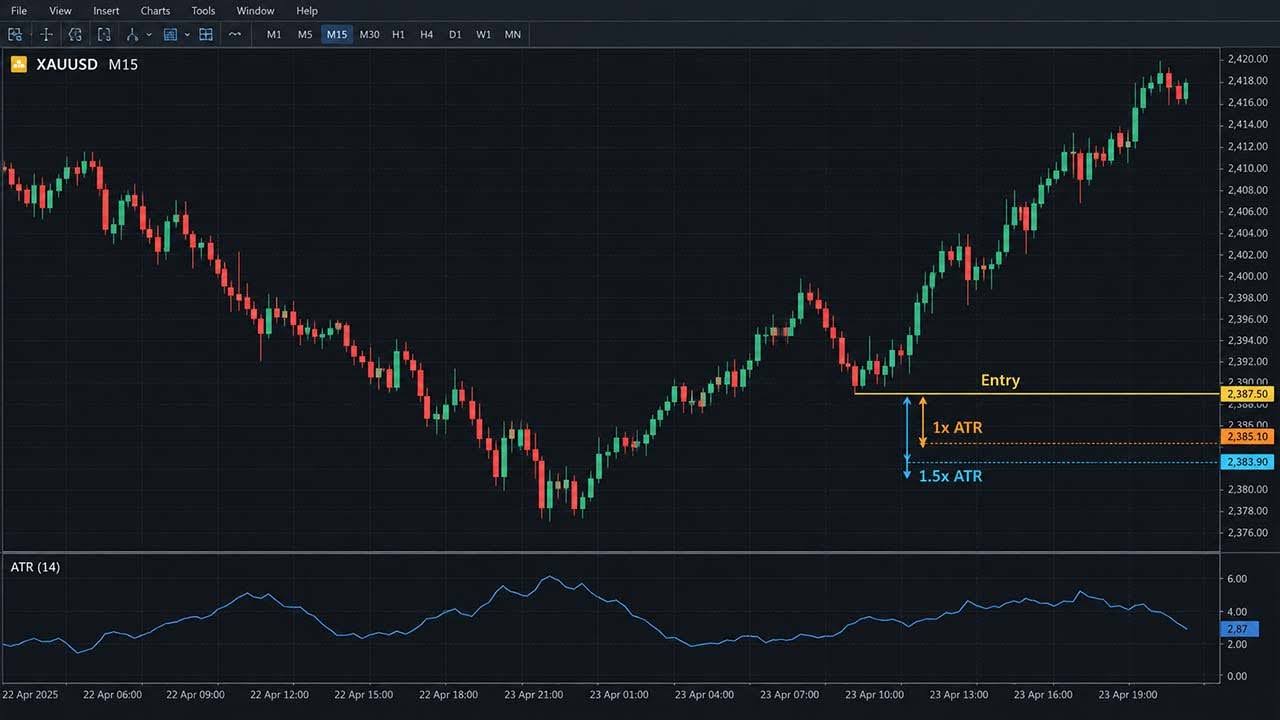
The Average True Range, or ATR, helps measure recent market movement.
For example, suppose the ATR shows gold has been moving about $8 per candle on your chosen timeframe.
A $2 stop may be too tight for those market conditions. Normal price movement could trigger it quickly.
Some traders place their stop around one ATR from the entry. Others use 1.5 or two times ATR.
You do not need to follow those values blindly.
ATR works best when combined with market structure.
First identify where the trade becomes invalid. Then check whether the stop gives enough room for current volatility.
4. Place Stops Outside Breakout Zones
Breakout trades require extra care because false breakouts are common in gold.
Suppose resistance sits near $2,700. Price breaks above that area, and you enter a long position.
Putting your stop just below $2,700 may seem logical. However, gold could retest the breakout zone before moving higher.
A stronger approach is to look at the full breakout structure.
Place the stop below the level that would clearly prove the breakout failed.
This might be below the breakout candle, recent swing low, or wider support zone.
The same rule applies to bearish breakouts.
If gold breaks support, a short trade stop can sit above the failed support zone.
This approach protects the trade from small retests while still giving you a clear exit.
5. Use Candle Structure for Short-Term Gold Trades
Short-term traders often need smaller stops than swing traders.
Candle structure can help when trading on lower timeframes.
Suppose you see a strong bullish rejection candle near support. You enter after the candle closes.
The low of that candle can act as a stop reference.
A break below the rejection candle may suggest buyers have lost control.
The same method works with bearish rejection candles. A short position can use the candle high as its stop level.
Do not use every candle as a stop reference. Focus on candles that form around meaningful price levels.

How Far Should a Stop Loss Be for XAU/USD?
There is no fixed distance that works for every stop loss for XAU/USD.
A 50-point stop might work during one setup and fail during another.
Your stop distance depends on several factors:
Your trading timeframe
Current gold volatility
Nearby support and resistance
Your entry price
Your trading setup
Your position size
Your maximum risk per trade
A five-minute scalping setup will often use a smaller stop than a four-hour swing trade.
That does not mean the smaller stop is safer.
Risk depends on both stop distance and position size.
A trader using a wide stop can reduce their lot size. A trader using a tight stop may use a larger position.
The amount of money at risk should remain controlled in both cases.
Traders should calculate their XAU/USD lot size based on stop distance and the amount of account risk they are willing to take.
Calculate Position Size After Setting Your Stop
Many traders make the mistake of choosing their lot size first.
They then move the stop closer so the trade fits their planned risk.
Reverse that process.
First, choose your entry based on the setup. Then find the correct stop based on market structure.
Only after that should you calculate your position size.
Suppose you want to risk $100 on a trade. Your chart setup requires a wider stop than normal.
Reduce your position size instead of forcing the stop closer.
This keeps the technical setup intact while controlling account risk.
Wider price swings can trigger poorly placed stops quickly, especially when dealing with XAU/USD volatility in funded accounts.
For traders using funded accounts, this becomes even more important. Pipstone Capital offers trading challenges with no time limits and no consistency rules, allowing traders to focus on risk control rather than forcing trades to meet a deadline.

Should You Move Your Stop Loss to Break-Even?
Moving a stop to break-even can protect a winning trade, but timing matters.
Moving it too early can close a good position during a normal pullback.
Consider moving the stop after the market confirms your idea.
For example, price could break another resistance level or create a new higher low.
That gives you a stronger reason to protect the position.
Some traders also move stops after reaching a fixed reward-to-risk point, such as 1:1.
There is no rule that fits every strategy.
Test your method and see how often gold returns to your entry before continuing.
Should You Use a Trailing Stop on Gold?
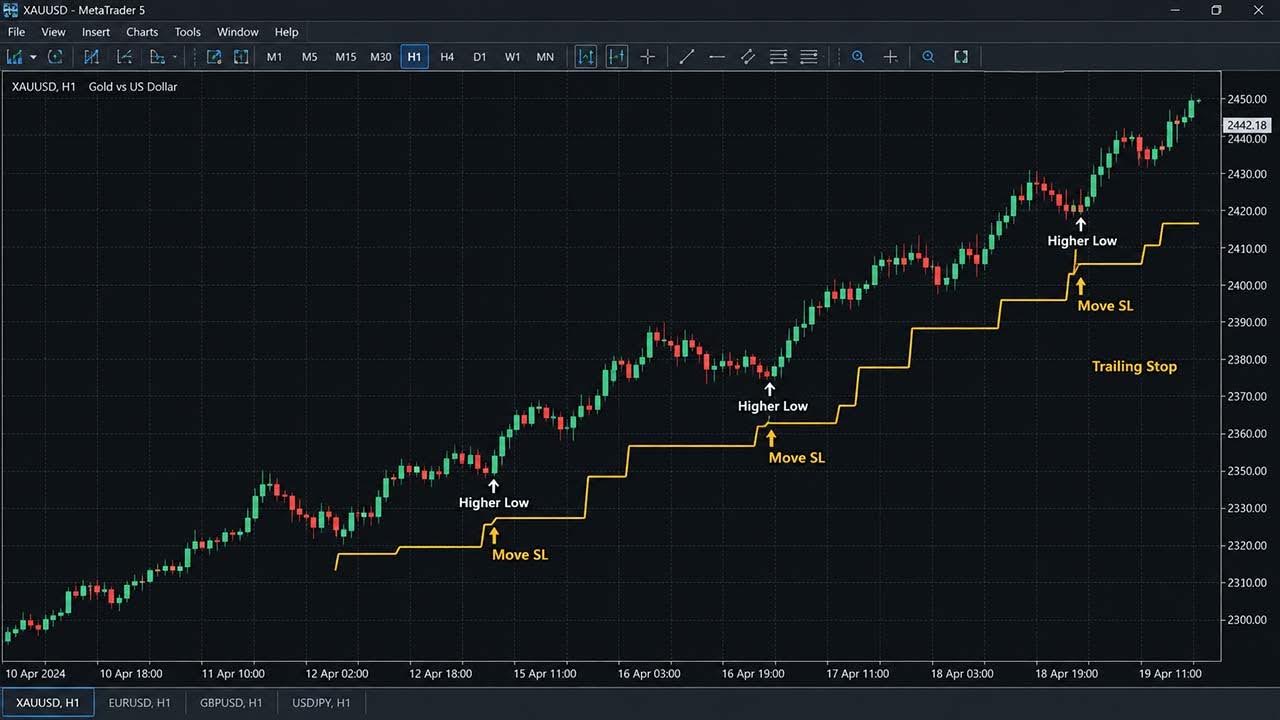
A trailing stop follows price as your trade moves into profit.
It can work well during strong XAU/USD trends.
Suppose gold continues making higher highs and higher lows during a bullish move.
You could move your stop below each new swing low.
This lets the market decide when the trend has weakened.
Avoid moving the stop after every small candle. Gold needs space to move within a trend.
A structure-based trailing stop is often more useful than following price at a fixed small distance.
Common Stop Loss Mistakes in Gold Trading
A good stop strategy also means avoiding common errors.
Placing Stops at Obvious Round Numbers
Gold traders often watch prices such as $2,600, $2,650, and $2,700.
Stops can collect around these levels.
Placing your stop directly on an obvious price may leave it exposed to normal market tests.
Making the Stop Too Tight
A very tight stop does not always mean lower risk.
If normal price swings keep closing your trades, the setup has little chance to work.
Moving the Stop Further Away
Never widen your stop because a losing position is approaching it.
Your original stop represents the point where the setup failed.
Moving it increases your planned loss and removes your risk limit.
Trading Without a Stop During News
Gold can move sharply around inflation data, central bank decisions, and US employment reports.
Trading without a stop during these periods can create large losses quickly.
Slippage can still occur, but a planned stop remains better than having no exit point.
Using the Same Stop Distance Every Time
Gold volatility changes from day to day.
A fixed stop distance ignores current market conditions and chart structure.
Build your stop around the trade, not a preset number.
A Simple XAU/USD Stop Loss Checklist
Before opening a gold trade, check these points:
Identify your entry based on a clear setup.
Find the level where your idea becomes invalid.
Place the stop beyond nearby market structure.
Check whether current volatility supports that distance.
Calculate your position size based on your risk limit.
Do not widen the stop after entering.
Adjust stops only when price gives a valid reason.
This process keeps your stop loss strategy for gold trading consistent across different market conditions.
Final Thoughts
The best stop loss strategy for gold trading starts with market structure, not a random number of points.
Place your stop where the trade idea becomes invalid. Then check volatility and adjust your position size to control risk.
Support, resistance, swing points, ATR, and candle structure can all help define a better stop loss for XAU/USD.
Most importantly, decide your risk before entering the trade. Do not move your stop further away just because the position starts losing.
If you want to apply these risk rules under funded trading conditions, Pipstone Capital offers MT5 and cTrader challenges with no time limits, no consistency rules, and reward splits of up to 100% on eligible accounts. A clear stop loss plan can help you protect drawdown limits while giving each gold setup enough room to work.
FAQs: Stop Loss for XAU/USD
What is the best stop loss for XAU/USD?
The best stop sits beyond the level where your trade setup becomes invalid. Use support, resistance, swing points, and volatility to find that area.
How many points should my gold stop loss be?
There is no fixed number that works for every XAU/USD trade. Stop distance changes with timeframe, volatility, and market structure.
Is ATR useful for setting a gold stop loss?
Yes. ATR helps show how much gold has recently been moving. It can prevent you from placing stops inside normal market noise.
Should I move my gold stop loss to break-even?
You can move it after price confirms your setup. Moving it too early may close the trade during a normal pullback.
Should I trade gold without a stop loss?
Trading without a stop exposes your account to losses with no defined limit. A planned exit helps control risk before entering.



Best Stop Loss Strategy for XAU/USD Gold Trading
Gold can move fast, even when the wider forex market looks calm. A small price swing can quickly turn into a large loss without proper risk control.
That makes a clear stop loss strategy for gold trading one of the most important parts of any XAU/USD setup.
The goal is not to place your stop as close as possible. Your stop should sit where the trade idea becomes invalid.
This guide explains how to set a stop loss for XAU/USD, where to place it, and which methods work best.
Why Stop Loss Placement Matters When Trading Gold
XAU/USD often makes sharp moves within a short period. Gold can also produce long wicks around key price levels.
A stop placed too close may get hit during normal market noise. The market can then move in your expected direction without you.
A stop placed too far away creates a different problem. Your loss can become much larger than the trade requires.
Good stop loss placement sits between these two extremes.
Your stop should give the trade enough room to move. At the same time, it should protect your account when your setup fails.
Stop placement should form part of a wider gold trading strategy rather than being decided after entering a trade.
What Is a Stop Loss in Gold Trading?
A stop loss is an order that closes your trade when price reaches a set level.
Suppose you buy gold at $2,650 and place your stop at $2,640. Your position should close if price falls to that area.
The exact exit price may differ during very fast markets. Slippage can occur when prices move quickly.
A stop loss still gives you a clear point where you accept that the trade has failed.
Without one, traders often keep losing trades open while hoping for a reversal.
That can turn a planned small loss into a serious account drawdown.
Best Stop Loss Strategy for Gold Trading
There is no single stop distance that works for every gold trade.
The best stop loss strategy for gold trading uses market structure first. Volatility and position size should then support that decision.
Here are the main methods traders can use.
1. Place the Stop Behind Support or Resistance
Market structure is one of the simplest ways to set a stop.
For a long position, look for a clear support level below your entry. Your stop can sit slightly below that level.
For a short position, find resistance above your entry. Place the stop slightly above that area.
Imagine XAU/USD breaks above $2,650 and then retests $2,650 as support. You enter after buyers defend the level.
Putting your stop directly at $2,650 may be too tight. Gold could move below the level briefly before recovering.
Instead, the stop can sit below the support zone and recent swing low.
The key question is simple:
At what price would my trade setup no longer make sense?
Your stop should usually sit beyond that point.
Stop losses are often placed beyond meaningful levels identified through a XAU/USD support and resistance strategy.
2. Use Recent Swing Highs and Swing Lows
Swing points give traders another clear way to set stops.
A swing low forms when price falls, turns higher, and leaves a visible low behind. A swing high works in the opposite direction.
If you enter a long trade during an uptrend, the latest swing low can guide your stop.
If price breaks that swing low, the short-term bullish structure may have failed.
For short trades, place the stop above a recent swing high.
This method works well because the stop is tied to price action. You are not choosing a random number of points.
Avoid placing the stop exactly on the swing level. Gold often tests obvious highs and lows before moving away.
Give the stop some extra room behind the level.
3. Use ATR to Account for Gold Volatility
Gold does not move the same amount every day.
Some sessions are quiet. Others produce wide candles and sharp price swings.
The Average True Range, or ATR, helps measure recent market movement.
For example, suppose the ATR shows gold has been moving about $8 per candle on your chosen timeframe.
A $2 stop may be too tight for those market conditions. Normal price movement could trigger it quickly.
Some traders place their stop around one ATR from the entry. Others use 1.5 or two times ATR.
You do not need to follow those values blindly.
ATR works best when combined with market structure.
First identify where the trade becomes invalid. Then check whether the stop gives enough room for current volatility.
4. Place Stops Outside Breakout Zones
Breakout trades require extra care because false breakouts are common in gold.
Suppose resistance sits near $2,700. Price breaks above that area, and you enter a long position.
Putting your stop just below $2,700 may seem logical. However, gold could retest the breakout zone before moving higher.
A stronger approach is to look at the full breakout structure.
Place the stop below the level that would clearly prove the breakout failed.
This might be below the breakout candle, recent swing low, or wider support zone.
The same rule applies to bearish breakouts.
If gold breaks support, a short trade stop can sit above the failed support zone.
This approach protects the trade from small retests while still giving you a clear exit.
5. Use Candle Structure for Short-Term Gold Trades
Short-term traders often need smaller stops than swing traders.
Candle structure can help when trading on lower timeframes.
Suppose you see a strong bullish rejection candle near support. You enter after the candle closes.
The low of that candle can act as a stop reference.
A break below the rejection candle may suggest buyers have lost control.
The same method works with bearish rejection candles. A short position can use the candle high as its stop level.
Do not use every candle as a stop reference. Focus on candles that form around meaningful price levels.
How Far Should a Stop Loss Be for XAU/USD?
There is no fixed distance that works for every stop loss for XAU/USD.
A 50-point stop might work during one setup and fail during another.
Your stop distance depends on several factors:
Your trading timeframe
Current gold volatility
Nearby support and resistance
Your entry price
Your trading setup
Your position size
Your maximum risk per trade
A five-minute scalping setup will often use a smaller stop than a four-hour swing trade.
That does not mean the smaller stop is safer.
Risk depends on both stop distance and position size.
A trader using a wide stop can reduce their lot size. A trader using a tight stop may use a larger position.
The amount of money at risk should remain controlled in both cases.
Traders should calculate their XAU/USD lot size based on stop distance and the amount of account risk they are willing to take.
Calculate Position Size After Setting Your Stop
Many traders make the mistake of choosing their lot size first.
They then move the stop closer so the trade fits their planned risk.
Reverse that process.
First, choose your entry based on the setup. Then find the correct stop based on market structure.
Only after that should you calculate your position size.
Suppose you want to risk $100 on a trade. Your chart setup requires a wider stop than normal.
Reduce your position size instead of forcing the stop closer.
This keeps the technical setup intact while controlling account risk.
Wider price swings can trigger poorly placed stops quickly, especially when dealing with XAU/USD volatility in funded accounts.
For traders using funded accounts, this becomes even more important. Pipstone Capital offers trading challenges with no time limits and no consistency rules, allowing traders to focus on risk control rather than forcing trades to meet a deadline.
Should You Move Your Stop Loss to Break-Even?
Moving a stop to break-even can protect a winning trade, but timing matters.
Moving it too early can close a good position during a normal pullback.
Consider moving the stop after the market confirms your idea.
For example, price could break another resistance level or create a new higher low.
That gives you a stronger reason to protect the position.
Some traders also move stops after reaching a fixed reward-to-risk point, such as 1:1.
There is no rule that fits every strategy.
Test your method and see how often gold returns to your entry before continuing.
Should You Use a Trailing Stop on Gold?
A trailing stop follows price as your trade moves into profit.
It can work well during strong XAU/USD trends.
Suppose gold continues making higher highs and higher lows during a bullish move.
You could move your stop below each new swing low.
This lets the market decide when the trend has weakened.
Avoid moving the stop after every small candle. Gold needs space to move within a trend.
A structure-based trailing stop is often more useful than following price at a fixed small distance.
Common Stop Loss Mistakes in Gold Trading
A good stop strategy also means avoiding common errors.
Placing Stops at Obvious Round Numbers
Gold traders often watch prices such as $2,600, $2,650, and $2,700.
Stops can collect around these levels.
Placing your stop directly on an obvious price may leave it exposed to normal market tests.
Making the Stop Too Tight
A very tight stop does not always mean lower risk.
If normal price swings keep closing your trades, the setup has little chance to work.
Moving the Stop Further Away
Never widen your stop because a losing position is approaching it.
Your original stop represents the point where the setup failed.
Moving it increases your planned loss and removes your risk limit.
Trading Without a Stop During News
Gold can move sharply around inflation data, central bank decisions, and US employment reports.
Trading without a stop during these periods can create large losses quickly.
Slippage can still occur, but a planned stop remains better than having no exit point.
Using the Same Stop Distance Every Time
Gold volatility changes from day to day.
A fixed stop distance ignores current market conditions and chart structure.
Build your stop around the trade, not a preset number.
A Simple XAU/USD Stop Loss Checklist
Before opening a gold trade, check these points:
Identify your entry based on a clear setup.
Find the level where your idea becomes invalid.
Place the stop beyond nearby market structure.
Check whether current volatility supports that distance.
Calculate your position size based on your risk limit.
Do not widen the stop after entering.
Adjust stops only when price gives a valid reason.
This process keeps your stop loss strategy for gold trading consistent across different market conditions.
Final Thoughts
The best stop loss strategy for gold trading starts with market structure, not a random number of points.
Place your stop where the trade idea becomes invalid. Then check volatility and adjust your position size to control risk.
Support, resistance, swing points, ATR, and candle structure can all help define a better stop loss for XAU/USD.
Most importantly, decide your risk before entering the trade. Do not move your stop further away just because the position starts losing.
If you want to apply these risk rules under funded trading conditions, Pipstone Capital offers MT5 and cTrader challenges with no time limits, no consistency rules, and reward splits of up to 100% on eligible accounts. A clear stop loss plan can help you protect drawdown limits while giving each gold setup enough room to work.
FAQs: Stop Loss for XAU/USD
What is the best stop loss for XAU/USD?
The best stop sits beyond the level where your trade setup becomes invalid. Use support, resistance, swing points, and volatility to find that area.
How many points should my gold stop loss be?
There is no fixed number that works for every XAU/USD trade. Stop distance changes with timeframe, volatility, and market structure.
Is ATR useful for setting a gold stop loss?
Yes. ATR helps show how much gold has recently been moving. It can prevent you from placing stops inside normal market noise.
Should I move my gold stop loss to break-even?
You can move it after price confirms your setup. Moving it too early may close the trade during a normal pullback.
Should I trade gold without a stop loss?
Trading without a stop exposes your account to losses with no defined limit. A planned exit helps control risk before entering.
