


XAU/USD Lot Size and Position Sizing for Funded Accounts

Gold can move fast enough to punish poor position sizing within minutes.
That matters even more when you trade a funded account. Your goal is not only finding good entries. You also need to protect the account from daily loss limits and large drawdowns.
Choosing the right gold lot size helps control how much money each trade can lose. It also lets you place your stop loss where the trade setup needs it.
This guide explains how to calculate gold lot size for XAU/USD. You will also learn how position sizing changes when trading funded accounts.
What Does Gold Lot Size Mean?
Lot size shows how large your XAU/USD position is.
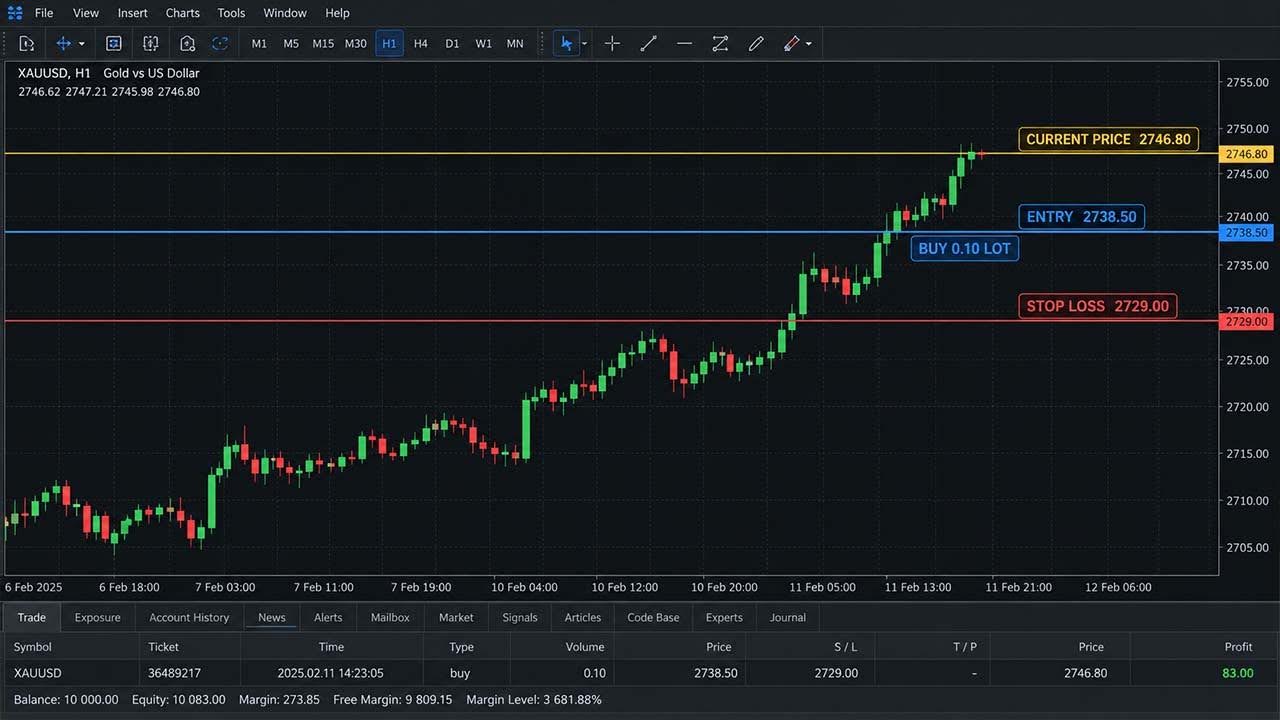
On most forex trading platforms, one standard lot of gold equals 100 ounces. A 0.10 lot position equals 10 ounces, while 0.01 lot equals one ounce.
This means every price move has a different cash value based on your position size.
A disciplined gold trading strategy should set position size before the trade is opened.
For example, assume gold moves from $2,500 to $2,501.
With a standard contract size of 100 ounces:
1.00 lot changes by about $100.
0.50 lot changes by about $50.
0.10 lot changes by about $10.
0.01 lot changes by about $1.
These figures assume a 100-ounce contract size. Always check your broker or platform contract details first.
Your XAUUSD lot size should therefore match your risk limit, not your profit goal.
Why Position Sizing Matters More on Funded Accounts
A personal account gives you control over your own risk limits. Funded accounts work differently.
Prop trading accounts often include rules covering maximum daily loss and total account drawdown. Breaking those limits can end your funded account or challenge.
One oversized gold trade can put those limits at risk.
Imagine your daily loss limit is $2,500. You enter several XAU/USD trades risking $1,000 each.
Two losing positions already place you close to that limit. Another loss could break the account rules.
This is why position sizing must start with risk.
Do not begin by asking how many lots you want to trade. Ask how much money you can safely lose.
The lot size comes after that.
How to Calculate Gold Lot Size
You need three numbers before opening the trade:
Your account size.
Your risk per trade.
Your stop loss distance.
The basic formula is:
Lot Size = Risk Amount ÷ Cash Risk Per Standard Lot
For gold, you can calculate the standard-lot risk using your stop distance.
Assume your broker uses a 100-ounce XAU/USD contract.
If your stop sits $10 from your entry:
$10 × 100 ounces = $1,000 risk per 1.00 lot
If you only want to risk $300:
$300 ÷ $1,000 = 0.30 lots
Your calculated gold lot size would be 0.30 lots.
The same method works with wider or tighter stops.
Gold Lot Size Example
Assume you have a $100,000 funded account.
You decide to risk 0.5% per trade.
Your maximum risk becomes:
$100,000 × 0.5% = $500
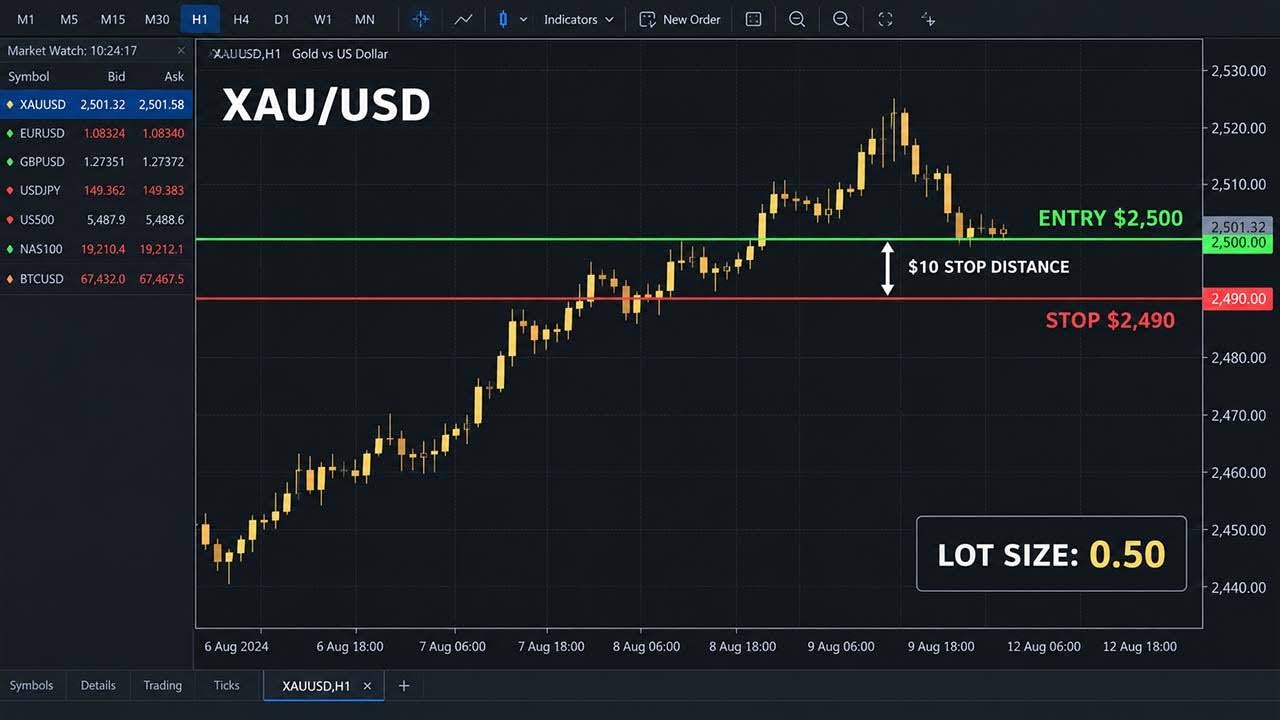
Gold trades at $2,500, while your stop loss sits at $2,490.
Your stop distance is $10.
With a 100-ounce standard contract:
$10 × 100 = $1,000 risk per standard lot
Now divide your chosen risk by the standard-lot risk:
$500 ÷ $1,000 = 0.50 lots
You could trade 0.50 lots while keeping planned risk near $500.
Trading 1.00 lot instead would double your risk to about $1,000.
Calculate Risk Before Choosing Your Stop Loss
A common mistake is changing the stop loss to make a larger position possible.
That reverses the correct process.
Your stop should come from the chart. Your lot size should come from your stop.
Assume a gold setup needs a $15 stop based on recent price swings. You should not reduce it to $5 just to trade more lots.
A tight stop may get hit by normal gold price movement.
Instead, keep the $15 stop and lower your position size.
Suppose you want to risk $300.
A $15 move on one standard lot creates about $1,500 of risk.
Your position becomes:
$300 ÷ $1,500 = 0.20 lots
The trade still risks around $300, even with the wider stop.
This approach gives the setup room to work without raising your account risk.
Position size should be calculated together with your XAU/USD stop loss strategy, since wider stops usually require smaller positions.
How Much Should You Risk on XAU/USD?
There is no single risk percentage that fits every trader.
Many traders use a fixed percentage of their account for each trade. Common examples include 0.25%, 0.5%, and 1%.
For funded accounts, smaller risk can provide more room for losing trades.
For example, risking 1% on each trade means five losses cost about 5%. That can become a serious problem when account rules include strict drawdown limits.
Risking 0.25% or 0.5% gives you more room before reaching those limits.
The right level also depends on your trading style.
A trader taking one setup each day can manage risk differently from a gold scalper opening several positions.
Pipstone Capital traders can use this risk-first approach while working through funded-account challenges. The goal is to keep each XAU/USD trade controlled instead of relying on oversized positions.

Adjust Lot Size When Gold Volatility Changes
Gold does not move the same way every day.
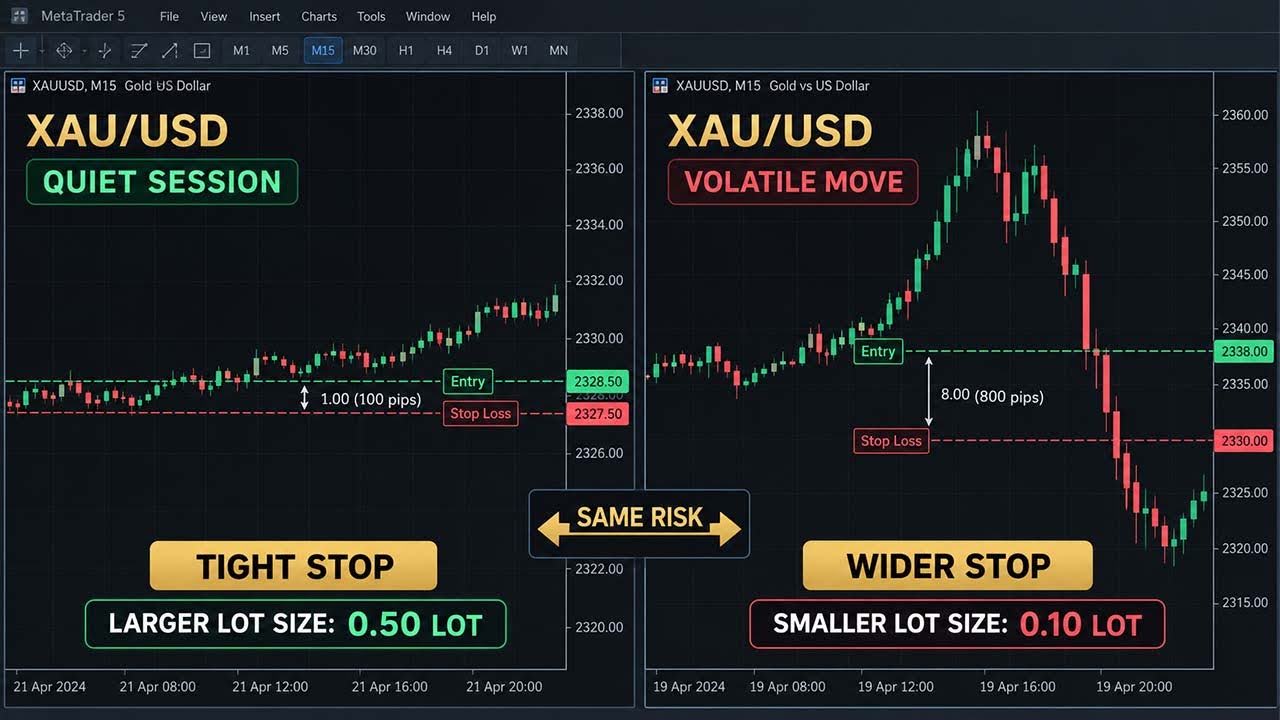
Some sessions stay quiet for hours. Others produce sharp price swings within minutes.
Economic news can create even larger moves.
Your XAUUSD lot size should adjust when the stop loss becomes wider.
Imagine you normally use a $5 stop and trade 0.50 lots.
Your risk would be:
$5 × 100 × 0.50 = $250
Now market conditions require a $10 stop.
Keeping 0.50 lots would increase risk to:
$10 × 100 × 0.50 = $500
To maintain the same $250 risk, reduce the size to 0.25 lots.
This simple adjustment keeps risk stable while gold volatility changes.
Higher gold volatility in prop firm accounts may require smaller position sizes during fast market conditions.
Position Sizing When Trading Multiple Gold Trades
Risk becomes harder to control when several XAU/USD positions are open together.
Three separate trades can still act like one large gold position.
Suppose you open three trades that each risk $300.
Your total exposure becomes $900.
If all three depend on gold moving in the same direction, they may lose together.
This matters during sharp reversals.
Instead of viewing each position alone, calculate your total open risk.
For example, you might set a personal limit of 1% total open risk.
If two active trades already use 0.8%, another 0.5% position would exceed that limit.
You could reduce the third trade or skip it.
This protects your account from hidden risk across several positions.
Scaling Into an XAU/USD Trade
Some traders enter gold positions in stages.
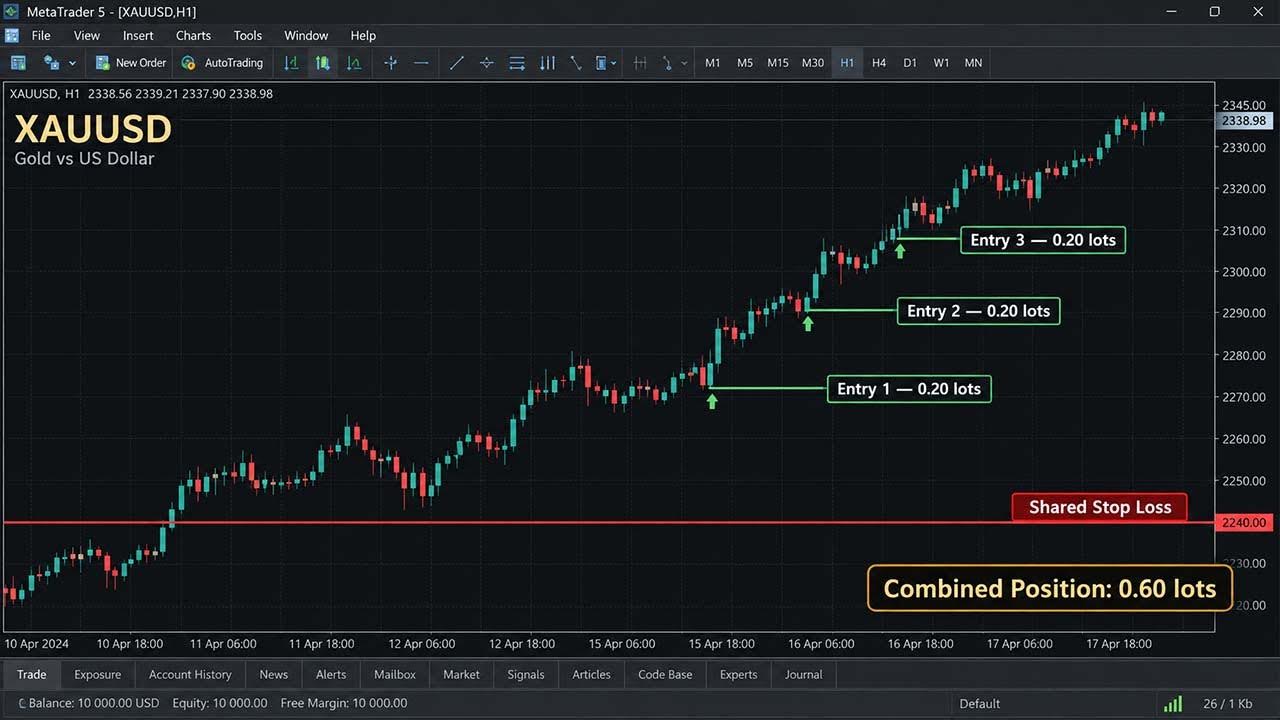
For example, you could split a planned 0.60 lot trade into three 0.20 lot entries.
This can help when price approaches an area instead of touching one exact level.
However, your combined risk must remain within your original limit.
Assume the full setup can risk $400.
Adding another position does not mean you receive another $400 risk allowance.
All entries together should still stay near your planned $400 loss.
This is especially important on funded accounts, where several small positions can quickly create large total exposure.
Common Gold Lot Size Mistakes
Using the Same Lot Size on Every Trade
A fixed lot size ignores changing stop distances.
A 0.50 lot trade with a $5 stop has very different risk from the same size with a $20 stop.
Calculate each trade separately.
Increasing Size After a Loss
Some traders increase their next position to recover money quickly.
This can create a much larger second loss.
Keep position size based on planned risk, not recent trading results.
Ignoring Open Positions
Your next trade may look safe by itself.
However, combined risk from several open trades can become too high.
Always check total exposure before adding another position.
Using Maximum Possible Size
Your platform may allow a very large gold position.
That does not mean you should use it.
Margin capacity and safe risk are completely different things.
Forgetting News Risk
Gold often reacts strongly to major US economic reports and central bank news.
Price can move quickly through expected levels during these periods.
Reducing lot size before high-impact events can help limit that risk.
Build a Simple Gold Position Sizing Routine
Position sizing does not need to be complex.
Before every trade, follow the same process:
Find your entry from the XAU/USD chart.
Place the stop where the setup becomes invalid.
Measure the dollar distance to the stop.
Choose your maximum cash risk.
Calculate the correct lot size.
Check your total open account risk.
Confirm the final size before placing the order.
Doing this before every trade removes guesswork.
You should know your possible loss before clicking Buy or Sell.
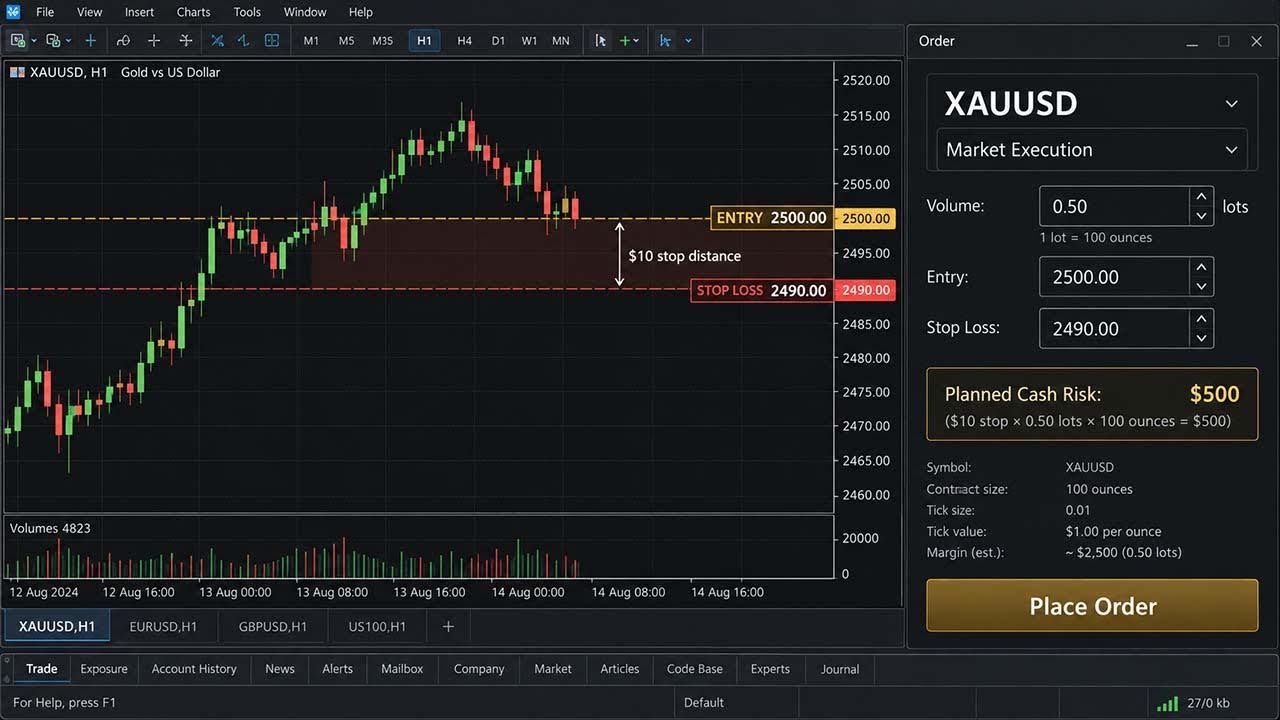
Example Position Sizes for a $100,000 Funded Account
Consider a trader who limits risk to $500 per position.
With a standard 100-ounce gold contract, position size changes with the stop:
Gold Stop Distance | Risk at 1.00 Lot | Lot Size for $500 Risk |
$5 | $500 | 1.00 lot |
$10 | $1,000 | 0.50 lots |
$15 | $1,500 | 0.33 lots |
$20 | $2,000 | 0.25 lots |
$25 | $2,500 | 0.20 lots |
The table shows why lot size should never be chosen alone.
As the stop gets wider, the position becomes smaller.
This keeps the cash risk close to the same amount.
Final Thoughts
Good gold trading starts with controlling what happens when a trade fails.
Your gold lot size should come from your risk amount and stop distance. It should never come from how much profit you want to make.
Measure the trade first. Set a stop based on the chart, then calculate your position size.
This approach becomes even more important when trading funded accounts with firm loss limits.
Award winning forex prop firm Pipstone Capital gives traders access to funded-account programs designed around clear trading rules. Using disciplined XAU/USD position sizing can help you manage those accounts while keeping each trade within your planned risk.
The goal is simple: control the loss before thinking about the profit.
FAQ About Gold Lot Size
What is a good lot size for XAU/USD?
A good lot size depends on your account, stop distance, and planned risk.
There is no single XAU/USD lot size that suits every trade.
How do I calculate gold lot size?
First calculate how much money you want to risk.
Then measure the distance between your entry and stop loss. Use the contract size to calculate the cash risk for one standard lot.
Divide your planned cash risk by that amount.
Is 1 lot of gold too much for a funded account?
It depends on the stop distance and account rules.
One standard lot with a $2 stop carries far less risk than one lot with a $20 stop.
Judge the position by cash risk, not lot size alone.
Should I lower my lot size during news events?
Lowering your position can reduce risk when gold becomes more volatile.
You can also avoid trading when price action becomes too hard to control.
Should funded traders use fixed lot sizes?
A fixed lot size can create uneven risk because stop distances change.
Risk-based position sizing keeps each trade closer to your chosen loss amount.



XAU/USD Lot Size and Position Sizing for Funded Accounts
Gold can move fast enough to punish poor position sizing within minutes.
That matters even more when you trade a funded account. Your goal is not only finding good entries. You also need to protect the account from daily loss limits and large drawdowns.
Choosing the right gold lot size helps control how much money each trade can lose. It also lets you place your stop loss where the trade setup needs it.
This guide explains how to calculate gold lot size for XAU/USD. You will also learn how position sizing changes when trading funded accounts.
What Does Gold Lot Size Mean?
Lot size shows how large your XAU/USD position is.
On most forex trading platforms, one standard lot of gold equals 100 ounces. A 0.10 lot position equals 10 ounces, while 0.01 lot equals one ounce.
This means every price move has a different cash value based on your position size.
A disciplined gold trading strategy should set position size before the trade is opened.
For example, assume gold moves from $2,500 to $2,501.
With a standard contract size of 100 ounces:
1.00 lot changes by about $100.
0.50 lot changes by about $50.
0.10 lot changes by about $10.
0.01 lot changes by about $1.
These figures assume a 100-ounce contract size. Always check your broker or platform contract details first.
Your XAUUSD lot size should therefore match your risk limit, not your profit goal.
Why Position Sizing Matters More on Funded Accounts
A personal account gives you control over your own risk limits. Funded accounts work differently.
Prop trading accounts often include rules covering maximum daily loss and total account drawdown. Breaking those limits can end your funded account or challenge.
One oversized gold trade can put those limits at risk.
Imagine your daily loss limit is $2,500. You enter several XAU/USD trades risking $1,000 each.
Two losing positions already place you close to that limit. Another loss could break the account rules.
This is why position sizing must start with risk.
Do not begin by asking how many lots you want to trade. Ask how much money you can safely lose.
The lot size comes after that.
How to Calculate Gold Lot Size
You need three numbers before opening the trade:
Your account size.
Your risk per trade.
Your stop loss distance.
The basic formula is:
Lot Size = Risk Amount ÷ Cash Risk Per Standard Lot
For gold, you can calculate the standard-lot risk using your stop distance.
Assume your broker uses a 100-ounce XAU/USD contract.
If your stop sits $10 from your entry:
$10 × 100 ounces = $1,000 risk per 1.00 lot
If you only want to risk $300:
$300 ÷ $1,000 = 0.30 lots
Your calculated gold lot size would be 0.30 lots.
The same method works with wider or tighter stops.
Gold Lot Size Example
Assume you have a $100,000 funded account.
You decide to risk 0.5% per trade.
Your maximum risk becomes:
$100,000 × 0.5% = $500
Gold trades at $2,500, while your stop loss sits at $2,490.
Your stop distance is $10.
With a 100-ounce standard contract:
$10 × 100 = $1,000 risk per standard lot
Now divide your chosen risk by the standard-lot risk:
$500 ÷ $1,000 = 0.50 lots
You could trade 0.50 lots while keeping planned risk near $500.
Trading 1.00 lot instead would double your risk to about $1,000.
Calculate Risk Before Choosing Your Stop Loss
A common mistake is changing the stop loss to make a larger position possible.
That reverses the correct process.
Your stop should come from the chart. Your lot size should come from your stop.
Assume a gold setup needs a $15 stop based on recent price swings. You should not reduce it to $5 just to trade more lots.
A tight stop may get hit by normal gold price movement.
Instead, keep the $15 stop and lower your position size.
Suppose you want to risk $300.
A $15 move on one standard lot creates about $1,500 of risk.
Your position becomes:
$300 ÷ $1,500 = 0.20 lots
The trade still risks around $300, even with the wider stop.
This approach gives the setup room to work without raising your account risk.
Position size should be calculated together with your XAU/USD stop loss strategy, since wider stops usually require smaller positions.
How Much Should You Risk on XAU/USD?
There is no single risk percentage that fits every trader.
Many traders use a fixed percentage of their account for each trade. Common examples include 0.25%, 0.5%, and 1%.
For funded accounts, smaller risk can provide more room for losing trades.
For example, risking 1% on each trade means five losses cost about 5%. That can become a serious problem when account rules include strict drawdown limits.
Risking 0.25% or 0.5% gives you more room before reaching those limits.
The right level also depends on your trading style.
A trader taking one setup each day can manage risk differently from a gold scalper opening several positions.
Pipstone Capital traders can use this risk-first approach while working through funded-account challenges. The goal is to keep each XAU/USD trade controlled instead of relying on oversized positions.
Adjust Lot Size When Gold Volatility Changes
Gold does not move the same way every day.
Some sessions stay quiet for hours. Others produce sharp price swings within minutes.
Economic news can create even larger moves.
Your XAUUSD lot size should adjust when the stop loss becomes wider.
Imagine you normally use a $5 stop and trade 0.50 lots.
Your risk would be:
$5 × 100 × 0.50 = $250
Now market conditions require a $10 stop.
Keeping 0.50 lots would increase risk to:
$10 × 100 × 0.50 = $500
To maintain the same $250 risk, reduce the size to 0.25 lots.
This simple adjustment keeps risk stable while gold volatility changes.
Higher gold volatility in prop firm accounts may require smaller position sizes during fast market conditions.
Position Sizing When Trading Multiple Gold Trades
Risk becomes harder to control when several XAU/USD positions are open together.
Three separate trades can still act like one large gold position.
Suppose you open three trades that each risk $300.
Your total exposure becomes $900.
If all three depend on gold moving in the same direction, they may lose together.
This matters during sharp reversals.
Instead of viewing each position alone, calculate your total open risk.
For example, you might set a personal limit of 1% total open risk.
If two active trades already use 0.8%, another 0.5% position would exceed that limit.
You could reduce the third trade or skip it.
This protects your account from hidden risk across several positions.
Scaling Into an XAU/USD Trade
Some traders enter gold positions in stages.
For example, you could split a planned 0.60 lot trade into three 0.20 lot entries.
This can help when price approaches an area instead of touching one exact level.
However, your combined risk must remain within your original limit.
Assume the full setup can risk $400.
Adding another position does not mean you receive another $400 risk allowance.
All entries together should still stay near your planned $400 loss.
This is especially important on funded accounts, where several small positions can quickly create large total exposure.
Common Gold Lot Size Mistakes
Using the Same Lot Size on Every Trade
A fixed lot size ignores changing stop distances.
A 0.50 lot trade with a $5 stop has very different risk from the same size with a $20 stop.
Calculate each trade separately.
Increasing Size After a Loss
Some traders increase their next position to recover money quickly.
This can create a much larger second loss.
Keep position size based on planned risk, not recent trading results.
Ignoring Open Positions
Your next trade may look safe by itself.
However, combined risk from several open trades can become too high.
Always check total exposure before adding another position.
Using Maximum Possible Size
Your platform may allow a very large gold position.
That does not mean you should use it.
Margin capacity and safe risk are completely different things.
Forgetting News Risk
Gold often reacts strongly to major US economic reports and central bank news.
Price can move quickly through expected levels during these periods.
Reducing lot size before high-impact events can help limit that risk.
Build a Simple Gold Position Sizing Routine
Position sizing does not need to be complex.
Before every trade, follow the same process:
Find your entry from the XAU/USD chart.
Place the stop where the setup becomes invalid.
Measure the dollar distance to the stop.
Choose your maximum cash risk.
Calculate the correct lot size.
Check your total open account risk.
Confirm the final size before placing the order.
Doing this before every trade removes guesswork.
You should know your possible loss before clicking Buy or Sell.
Example Position Sizes for a $100,000 Funded Account
Consider a trader who limits risk to $500 per position.
With a standard 100-ounce gold contract, position size changes with the stop:
Gold Stop Distance | Risk at 1.00 Lot | Lot Size for $500 Risk |
$5 | $500 | 1.00 lot |
$10 | $1,000 | 0.50 lots |
$15 | $1,500 | 0.33 lots |
$20 | $2,000 | 0.25 lots |
$25 | $2,500 | 0.20 lots |
The table shows why lot size should never be chosen alone.
As the stop gets wider, the position becomes smaller.
This keeps the cash risk close to the same amount.
Final Thoughts
Good gold trading starts with controlling what happens when a trade fails.
Your gold lot size should come from your risk amount and stop distance. It should never come from how much profit you want to make.
Measure the trade first. Set a stop based on the chart, then calculate your position size.
This approach becomes even more important when trading funded accounts with firm loss limits.
Award winning forex prop firm Pipstone Capital gives traders access to funded-account programs designed around clear trading rules. Using disciplined XAU/USD position sizing can help you manage those accounts while keeping each trade within your planned risk.
The goal is simple: control the loss before thinking about the profit.
FAQ About Gold Lot Size
What is a good lot size for XAU/USD?
A good lot size depends on your account, stop distance, and planned risk.
There is no single XAU/USD lot size that suits every trade.
How do I calculate gold lot size?
First calculate how much money you want to risk.
Then measure the distance between your entry and stop loss. Use the contract size to calculate the cash risk for one standard lot.
Divide your planned cash risk by that amount.
Is 1 lot of gold too much for a funded account?
It depends on the stop distance and account rules.
One standard lot with a $2 stop carries far less risk than one lot with a $20 stop.
Judge the position by cash risk, not lot size alone.
Should I lower my lot size during news events?
Lowering your position can reduce risk when gold becomes more volatile.
You can also avoid trading when price action becomes too hard to control.
Should funded traders use fixed lot sizes?
A fixed lot size can create uneven risk because stop distances change.
Risk-based position sizing keeps each trade closer to your chosen loss amount.
