


Managing Gold Volatility Without Losing a Funded Account
Gold trading looks attractive when volatility rises. Large moves create opportunity, fast profits, and strong momentum. But for funded traders, volatility can become dangerous very quickly.
Many traders lose funded accounts during high-volatility gold sessions because they treat XAU/USD like a normal forex pair. Gold does not behave the same way. It moves aggressively during news events, reacts sharply to interest rate expectations, and can wipe out daily drawdown limits within minutes.
Passing a prop firm challenge is one thing. Keeping the funded account is another.
The traders who survive long-term are not always the most accurate traders. They are usually the traders who know how to control risk when volatility expands.
Why Gold Becomes Dangerous on Funded Accounts
Gold volatility is not automatically bad. The real problem starts when traders use the same lot size during unstable market conditions.
A funded account has fixed rules:
daily drawdown limits
maximum loss rules
trailing drawdown restrictions
consistency expectations
Gold volatility does not care about those rules.
A normal 20-pip move can suddenly become a 100-pip candle after inflation data, central bank comments, or geopolitical headlines. Traders who are overexposed usually lose control during these moments.
This is why many prop traders fail after getting funded. They increase risk once they feel confident.
Gold punishes emotional trading faster than most markets.
The Biggest Mistake Funded Traders Make
Most traders think the danger comes from losing trades.
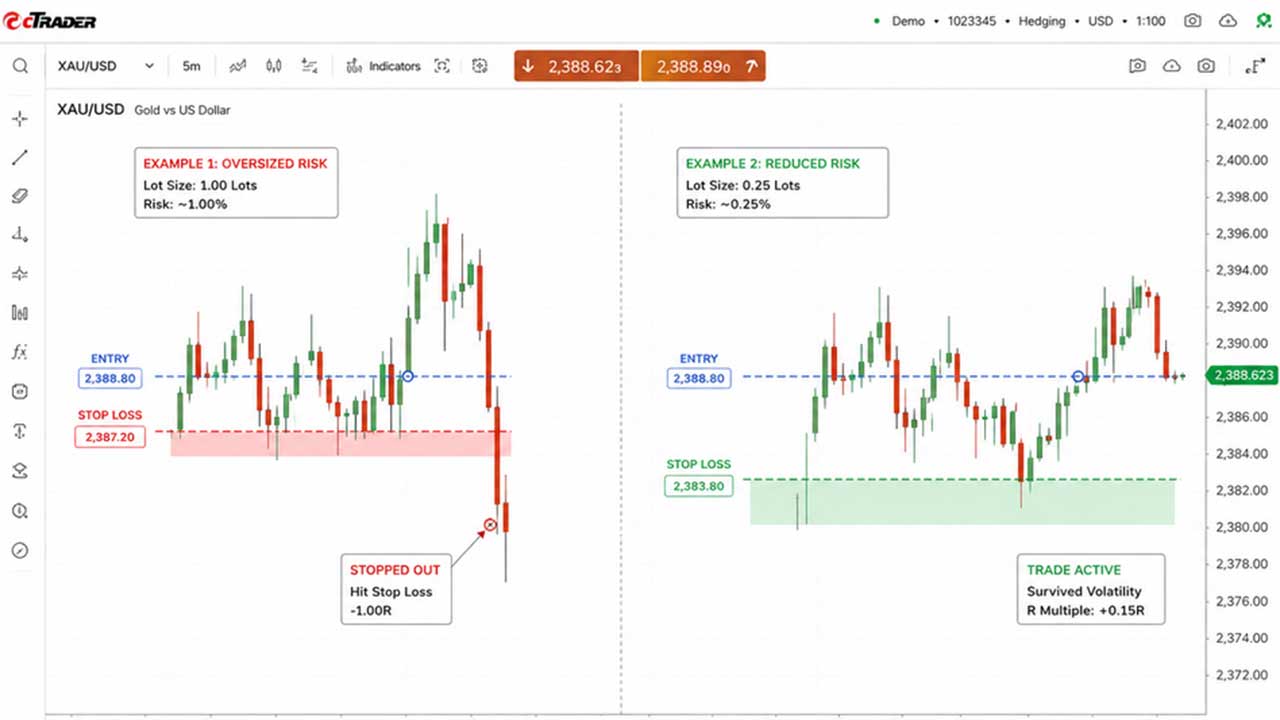
In reality, the danger usually comes from oversized positions.
A trader can have a strong strategy and still lose the account because the lot size is too large for current volatility conditions.
For example:
risking 1% during calm sessions may feel manageable
risking 1% during extreme gold volatility becomes completely different
The spread expands. Candles become unstable. Slippage increases. Stop losses get hit faster.
This is why professional funded traders reduce exposure when volatility rises.
They do not try to “fight” the market.
Volatility Should Change Your Position Size
One of the biggest differences between experienced traders and struggling traders is adaptability.
Beginners often use fixed lot sizes.
Experienced traders adjust risk based on:
ATR expansion
market conditions
session volatility
upcoming news
liquidity conditions
If gold starts moving abnormally, your position sizing should immediately change.
Many traders ignore this because they focus too much on potential profits.
The goal on a funded account is not maximizing one trade.
The goal is protecting the account long enough to compound payouts consistently.

Why Overtrading Gold Destroys Funded Accounts
Gold creates emotional pressure because it moves quickly.
After missing one move, traders often force another entry. Then another. Then another.
This usually leads to:
revenge trading
emotional scalping
oversized recovery trades
violating drawdown rules
Overtrading becomes even worse during London and New York session overlaps when volatility spikes.
The traders who survive funded accounts usually trade less than expected.
They wait for:
clean structure
liquidity sweeps
strong confirmation
controlled risk environments
Sometimes the best trade is no trade.
Trading News Volatility the Wrong Way
Many traders lose funded accounts trying to catch explosive gold moves during:
CPI releases
FOMC statements
NFP reports
geopolitical headlines
The problem is not volatility itself.
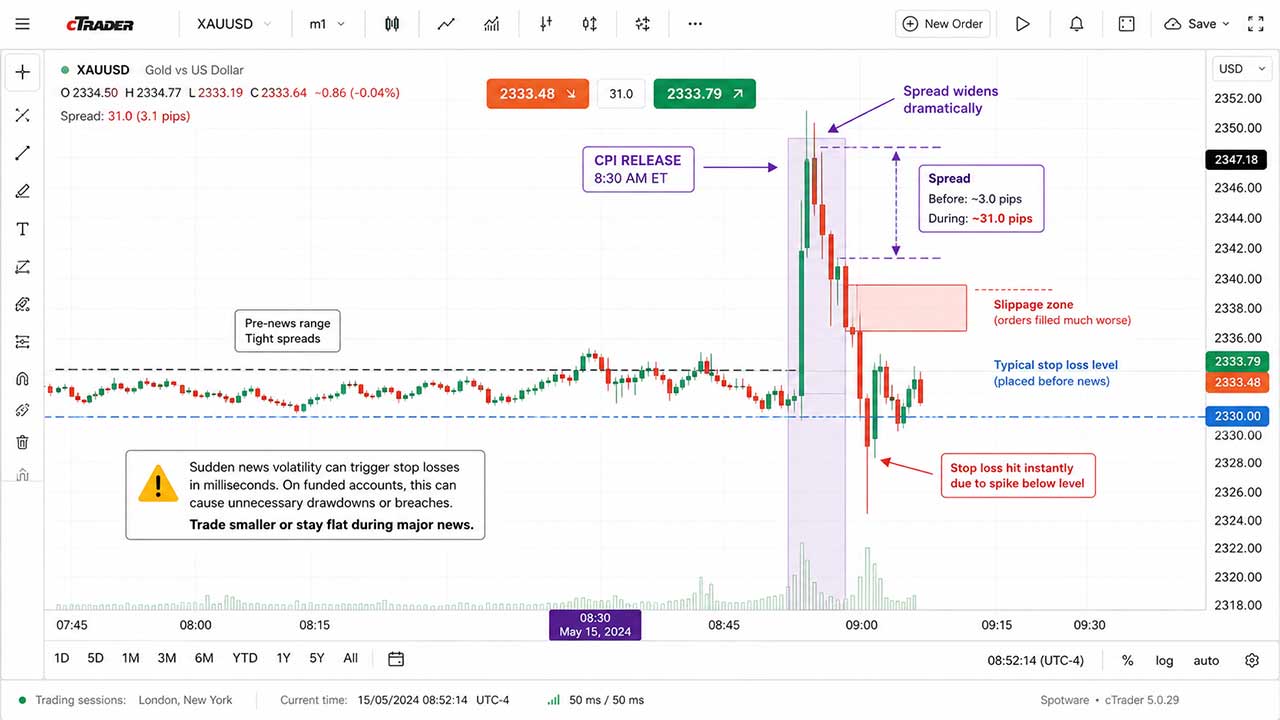
The problem is unpredictable execution conditions.
During major news:
spreads widen
stop losses slip
candles become unstable
liquidity disappears temporarily
A perfect setup can fail instantly.
Experienced funded traders often reduce size heavily during these periods or avoid trading entirely.
Protecting the account matters more than forcing volatility trades.
Major geopolitical developments can increase instability across financial markets, especially during periods of macro uncertainty and rising expectations around forex volatility during major events.
Why Drawdown Management Matters More Than Win Rate
A lot of traders obsess over win rate.
But funded trading is usually about drawdown control.
You can survive with:
moderate win rates
smaller gains
slower growth
You cannot survive repeated deep drawdowns.
A trader risking too aggressively on gold may win several trades in a row, then lose everything in one volatile session.
This is why low-drawdown trading matters so much in prop firms.
The best funded traders focus on:
stable execution
protecting equity
controlled risk exposure
repeatable performance
Consistency keeps accounts alive.
Session Timing Changes Everything in Gold Trading
Gold volatility changes throughout the trading day.
The Asian session often builds liquidity slowly.
London open usually creates expansion and aggressive movement.
New York can create continuation or complete reversals depending on macro news.
Understanding session behavior helps traders avoid emotional entries.
Many funded traders get trapped by entering randomly during unstable transition periods.
Instead of trading every move, experienced traders focus on high-quality windows where volatility becomes more structured.
This reduces unnecessary drawdown pressure.
Liquidity Traps and Emotional Entries
Gold frequently sweeps liquidity before making the real move.
This is why traders often get stopped out seconds before price reverses.
Emotional traders respond by:
re-entering impulsively
increasing lot size
chasing momentum
abandoning their original plan
This cycle destroys funded accounts.
Professional traders understand that liquidity sweeps are normal in XAU/USD.
Instead of reacting emotionally, they wait for confirmation after manipulation occurs.
Patience is one of the most underrated skills in funded trading.
Why Small Losses Are Important
Many traders try too hard to avoid losing trades.
That mindset usually creates bigger losses.
Small controlled losses are part of professional trading.
The problem starts when traders:
move stop losses
refuse to exit losing trades
average down aggressively
hold positions emotionally
Gold volatility becomes extremely dangerous when discipline disappears.
Funded traders should think like risk managers first.
A small loss protects the account.
A large emotional loss can end the evaluation or funded phase immediately.
The Psychology Behind Gold Volatility
Gold trading is highly psychological because volatility creates emotional urgency.
Large candles make traders feel like they are missing opportunities.
This often causes:
fear of missing out
emotional entries
impulsive exits
revenge trading behavior
The market becomes even more dangerous after a few winning trades.
Overconfidence is one of the fastest ways to lose a funded account.
Traders begin increasing size because they feel “locked in.”
Then one volatile move erases several days of progress.
This is why disciplined traders stay mechanically consistent regardless of recent results.
Why One Good Trade Is Better Than Five Random Trades
Many successful funded traders do not trade all day.
Some only take one or two quality setups.
This approach works especially well in gold trading because volatility creates enough opportunity already.
You do not need constant exposure.
A single clean setup with:
proper confirmation
controlled risk
favorable structure
can outperform multiple emotional trades.
Funded traders who survive long-term usually avoid forcing activity.
They focus on quality instead of excitement.
Protecting Profits Is Part of the Trading Strategy
One of the biggest mistakes traders make after reaching profit targets is becoming careless.
After several strong days, they suddenly:
increase risk
trade unstable setups
hold trades longer
become emotionally aggressive
This often gives profits back quickly.
Funded traders should protect momentum once they are ahead.
Sometimes reducing size after a strong week is smarter than trying to maximize returns.
Professional trading is about survival first.
Growth comes after consistency.
Many traders focus heavily on passing evaluations, but long-term consistency matters even more after getting funded by a prop firm.
Technology and Execution Matter During Volatility
Execution quality becomes extremely important during fast gold movements.
Poor execution conditions can increase:
slippage
delayed entries
spread costs
stop-loss inconsistencies
This is one reason traders often look for brokers and prop environments with:
tight spreads
fast execution
stable platforms
low latency
When trading high-volatility markets like gold, execution quality directly affects risk management.
For traders managing funded accounts, conditions matter more than marketing hype.
Platform performance also matters during fast-moving sessions, especially when traders compare execution speed, order handling, and charting tools in cTrader vs MetaTrader 5 environments.
Building a Low-Drawdown Gold Trading Approach
Low-drawdown trading does not mean trading without risk.
It means controlling exposure carefully enough to survive volatility.
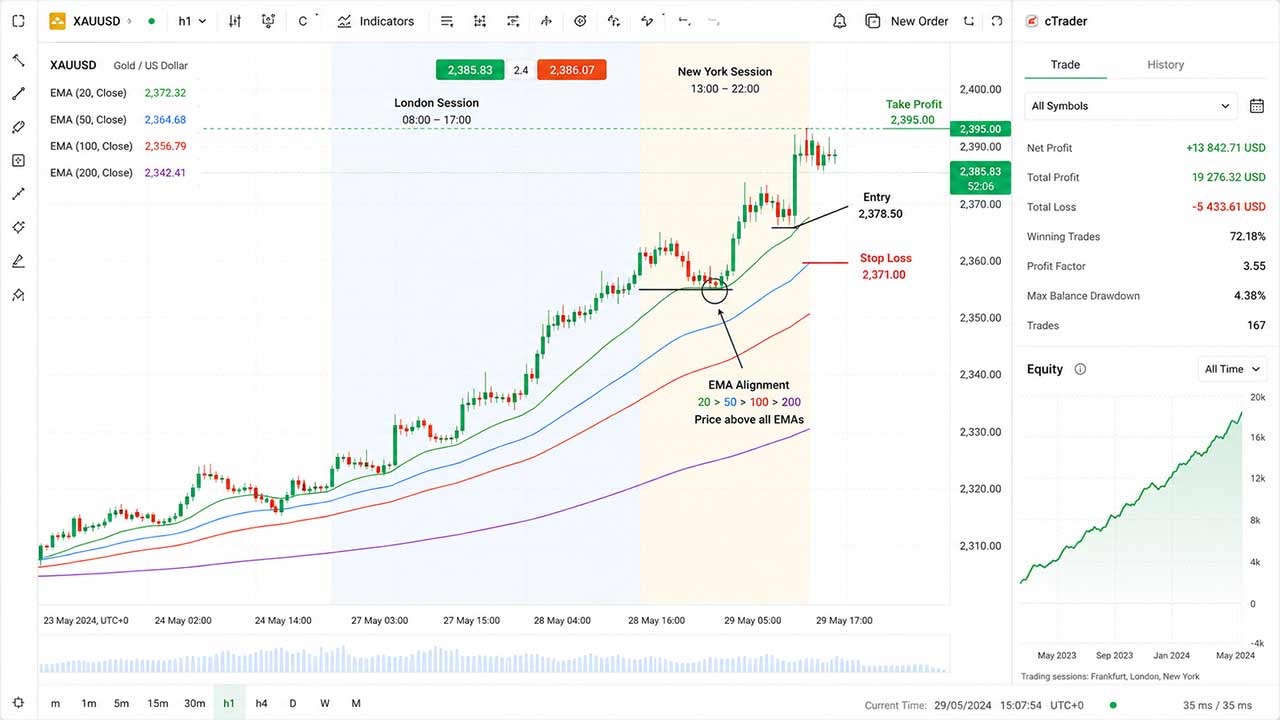
A sustainable gold trading approach usually includes:
smaller position sizing
strict stop losses
session awareness
limited trades per day
avoiding emotional recovery trading
adapting to volatility conditions
The traders who last in prop firms are usually the traders who remain calm during unstable markets.
They do not chase every move.
They focus on protecting the account first.
Final Thoughts
Gold volatility creates opportunity, but it also exposes weak risk management very quickly.
Most funded accounts are not lost because traders completely lack skill. They are lost because discipline disappears during high-volatility conditions.
The traders who survive funded trading long-term understand something important: protecting capital is part of the strategy. Managing gold volatility successfully comes down to adapting risk during unstable conditions, respecting drawdown limits, staying emotionally controlled, and focusing on consistency instead of excitement.
That mindset is what keeps funded accounts alive.
Pipstone Capital gives gold traders access to raw spreads, fast execution, and funded accounts up to $400,000 without any consistency rules.
FAQs
Is gold trading harder on a funded account?
Yes. Gold moves aggressively during volatile sessions, which makes drawdown management more important.
What is the biggest mistake funded gold traders make?
Most traders fail from oversized positions and emotional trading during volatility spikes.
Should traders avoid gold during news events?
Not always, but many funded traders reduce risk or stay out during major releases like CPI or FOMC.
Why is low-drawdown trading important in prop firms?
Low drawdown helps traders survive daily loss limits and maintain long-term account consistency.



Managing Gold Volatility Without Losing a Funded Account
Gold trading looks attractive when volatility rises. Large moves create opportunity, fast profits, and strong momentum. But for funded traders, volatility can become dangerous very quickly.
Many traders lose funded accounts during high-volatility gold sessions because they treat XAU/USD like a normal forex pair. Gold does not behave the same way. It moves aggressively during news events, reacts sharply to interest rate expectations, and can wipe out daily drawdown limits within minutes.
Passing a prop firm challenge is one thing. Keeping the funded account is another.
The traders who survive long-term are not always the most accurate traders. They are usually the traders who know how to control risk when volatility expands.
Why Gold Becomes Dangerous on Funded Accounts
Gold volatility is not automatically bad. The real problem starts when traders use the same lot size during unstable market conditions.
A funded account has fixed rules:
daily drawdown limits
maximum loss rules
trailing drawdown restrictions
consistency expectations
Gold volatility does not care about those rules.
A normal 20-pip move can suddenly become a 100-pip candle after inflation data, central bank comments, or geopolitical headlines. Traders who are overexposed usually lose control during these moments.
This is why many prop traders fail after getting funded. They increase risk once they feel confident.
Gold punishes emotional trading faster than most markets.
The Biggest Mistake Funded Traders Make
Most traders think the danger comes from losing trades.
In reality, the danger usually comes from oversized positions.
A trader can have a strong strategy and still lose the account because the lot size is too large for current volatility conditions.
For example:
risking 1% during calm sessions may feel manageable
risking 1% during extreme gold volatility becomes completely different
The spread expands. Candles become unstable. Slippage increases. Stop losses get hit faster.
This is why professional funded traders reduce exposure when volatility rises.
They do not try to “fight” the market.
Volatility Should Change Your Position Size
One of the biggest differences between experienced traders and struggling traders is adaptability.
Beginners often use fixed lot sizes.
Experienced traders adjust risk based on:
ATR expansion
market conditions
session volatility
upcoming news
liquidity conditions
If gold starts moving abnormally, your position sizing should immediately change.
Many traders ignore this because they focus too much on potential profits.
The goal on a funded account is not maximizing one trade.
The goal is protecting the account long enough to compound payouts consistently.
Why Overtrading Gold Destroys Funded Accounts
Gold creates emotional pressure because it moves quickly.
After missing one move, traders often force another entry. Then another. Then another.
This usually leads to:
revenge trading
emotional scalping
oversized recovery trades
violating drawdown rules
Overtrading becomes even worse during London and New York session overlaps when volatility spikes.
The traders who survive funded accounts usually trade less than expected.
They wait for:
clean structure
liquidity sweeps
strong confirmation
controlled risk environments
Sometimes the best trade is no trade.
Trading News Volatility the Wrong Way
Many traders lose funded accounts trying to catch explosive gold moves during:
CPI releases
FOMC statements
NFP reports
geopolitical headlines
The problem is not volatility itself.
The problem is unpredictable execution conditions.
During major news:
spreads widen
stop losses slip
candles become unstable
liquidity disappears temporarily
A perfect setup can fail instantly.
Experienced funded traders often reduce size heavily during these periods or avoid trading entirely.
Protecting the account matters more than forcing volatility trades.
Major geopolitical developments can increase instability across financial markets, especially during periods of macro uncertainty and rising expectations around forex volatility during major events.
Why Drawdown Management Matters More Than Win Rate
A lot of traders obsess over win rate.
But funded trading is usually about drawdown control.
You can survive with:
moderate win rates
smaller gains
slower growth
You cannot survive repeated deep drawdowns.
A trader risking too aggressively on gold may win several trades in a row, then lose everything in one volatile session.
This is why low-drawdown trading matters so much in prop firms.
The best funded traders focus on:
stable execution
protecting equity
controlled risk exposure
repeatable performance
Consistency keeps accounts alive.
Session Timing Changes Everything in Gold Trading
Gold volatility changes throughout the trading day.
The Asian session often builds liquidity slowly.
London open usually creates expansion and aggressive movement.
New York can create continuation or complete reversals depending on macro news.
Understanding session behavior helps traders avoid emotional entries.
Many funded traders get trapped by entering randomly during unstable transition periods.
Instead of trading every move, experienced traders focus on high-quality windows where volatility becomes more structured.
This reduces unnecessary drawdown pressure.
Liquidity Traps and Emotional Entries
Gold frequently sweeps liquidity before making the real move.
This is why traders often get stopped out seconds before price reverses.
Emotional traders respond by:
re-entering impulsively
increasing lot size
chasing momentum
abandoning their original plan
This cycle destroys funded accounts.
Professional traders understand that liquidity sweeps are normal in XAU/USD.
Instead of reacting emotionally, they wait for confirmation after manipulation occurs.
Patience is one of the most underrated skills in funded trading.
Why Small Losses Are Important
Many traders try too hard to avoid losing trades.
That mindset usually creates bigger losses.
Small controlled losses are part of professional trading.
The problem starts when traders:
move stop losses
refuse to exit losing trades
average down aggressively
hold positions emotionally
Gold volatility becomes extremely dangerous when discipline disappears.
Funded traders should think like risk managers first.
A small loss protects the account.
A large emotional loss can end the evaluation or funded phase immediately.
The Psychology Behind Gold Volatility
Gold trading is highly psychological because volatility creates emotional urgency.
Large candles make traders feel like they are missing opportunities.
This often causes:
fear of missing out
emotional entries
impulsive exits
revenge trading behavior
The market becomes even more dangerous after a few winning trades.
Overconfidence is one of the fastest ways to lose a funded account.
Traders begin increasing size because they feel “locked in.”
Then one volatile move erases several days of progress.
This is why disciplined traders stay mechanically consistent regardless of recent results.
Why One Good Trade Is Better Than Five Random Trades
Many successful funded traders do not trade all day.
Some only take one or two quality setups.
This approach works especially well in gold trading because volatility creates enough opportunity already.
You do not need constant exposure.
A single clean setup with:
proper confirmation
controlled risk
favorable structure
can outperform multiple emotional trades.
Funded traders who survive long-term usually avoid forcing activity.
They focus on quality instead of excitement.
Protecting Profits Is Part of the Trading Strategy
One of the biggest mistakes traders make after reaching profit targets is becoming careless.
After several strong days, they suddenly:
increase risk
trade unstable setups
hold trades longer
become emotionally aggressive
This often gives profits back quickly.
Funded traders should protect momentum once they are ahead.
Sometimes reducing size after a strong week is smarter than trying to maximize returns.
Professional trading is about survival first.
Growth comes after consistency.
Many traders focus heavily on passing evaluations, but long-term consistency matters even more after getting funded by a prop firm.
Technology and Execution Matter During Volatility
Execution quality becomes extremely important during fast gold movements.
Poor execution conditions can increase:
slippage
delayed entries
spread costs
stop-loss inconsistencies
This is one reason traders often look for brokers and prop environments with:
tight spreads
fast execution
stable platforms
low latency
When trading high-volatility markets like gold, execution quality directly affects risk management.
For traders managing funded accounts, conditions matter more than marketing hype.
Platform performance also matters during fast-moving sessions, especially when traders compare execution speed, order handling, and charting tools in cTrader vs MetaTrader 5 environments.
Building a Low-Drawdown Gold Trading Approach
Low-drawdown trading does not mean trading without risk.
It means controlling exposure carefully enough to survive volatility.
A sustainable gold trading approach usually includes:
smaller position sizing
strict stop losses
session awareness
limited trades per day
avoiding emotional recovery trading
adapting to volatility conditions
The traders who last in prop firms are usually the traders who remain calm during unstable markets.
They do not chase every move.
They focus on protecting the account first.
Final Thoughts
Gold volatility creates opportunity, but it also exposes weak risk management very quickly.
Most funded accounts are not lost because traders completely lack skill. They are lost because discipline disappears during high-volatility conditions.
The traders who survive funded trading long-term understand something important: protecting capital is part of the strategy. Managing gold volatility successfully comes down to adapting risk during unstable conditions, respecting drawdown limits, staying emotionally controlled, and focusing on consistency instead of excitement.
That mindset is what keeps funded accounts alive.
Pipstone Capital gives gold traders access to raw spreads, fast execution, and funded accounts up to $400,000 without any consistency rules.
FAQs
Is gold trading harder on a funded account?
Yes. Gold moves aggressively during volatile sessions, which makes drawdown management more important.
What is the biggest mistake funded gold traders make?
Most traders fail from oversized positions and emotional trading during volatility spikes.
Should traders avoid gold during news events?
Not always, but many funded traders reduce risk or stay out during major releases like CPI or FOMC.
Why is low-drawdown trading important in prop firms?
Low drawdown helps traders survive daily loss limits and maintain long-term account consistency.
