


Gold Scalping Strategy: How to Scalp XAU/USD

Gold can move quickly, especially during the busiest trading sessions. That makes XAU/USD attractive to traders looking for short-term setups.
A gold scalping strategy focuses on capturing small price movements rather than holding trades for hours. Traders may stay in a position for only a few minutes, sometimes even less.
The idea sounds simple, but gold can punish poor entries very quickly. XAU/USD often reacts sharply around key price levels, economic news, and market openings.
This guide explains how XAU/USD scalping works and shows a simple strategy you can practice.
What Is Gold Scalping?
Gold scalping is a short-term trading style focused on small XAU/USD price movements.
Instead of waiting for a large trend, a scalper looks for repeated short moves throughout a session.
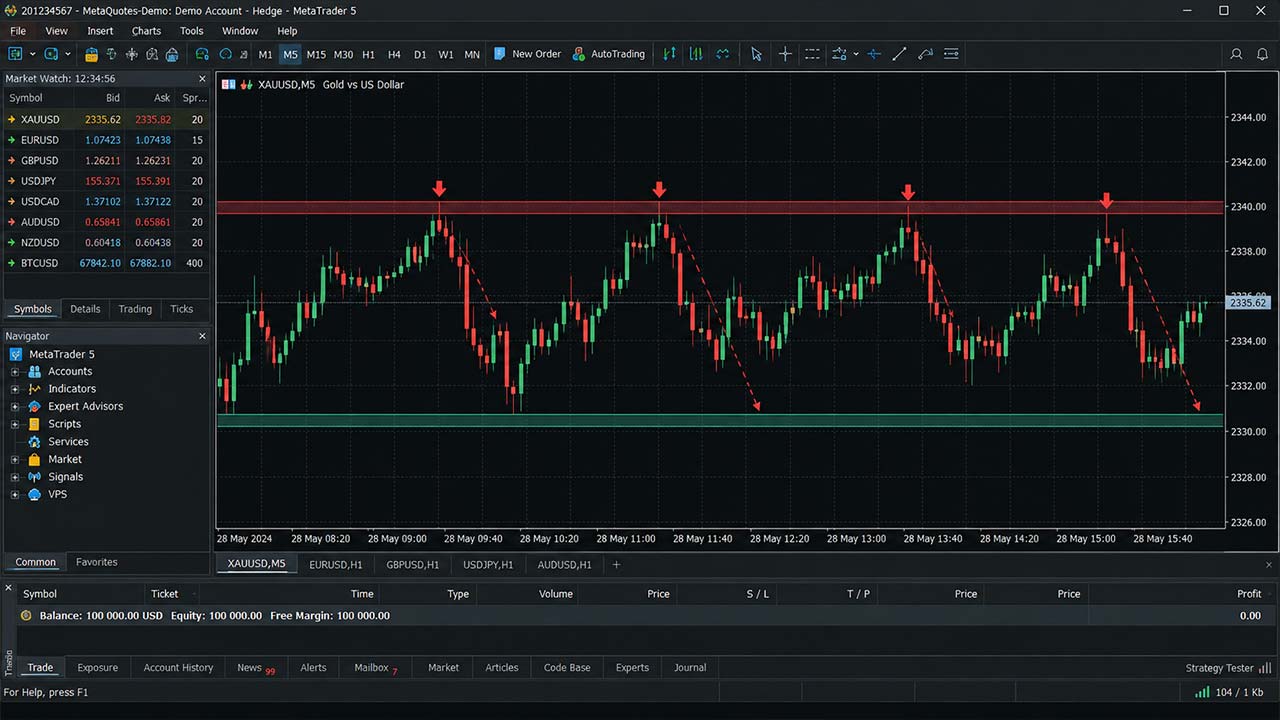
For example, a trader might enter after gold rejects resistance and exit near the next support level.
The profit target could be relatively small. The trader depends on accurate entries, tight risk control, and enough good setups.
Most gold scalpers use charts such as:
1-minute chart
5-minute chart
15-minute chart
The 5-minute chart is often a practical middle ground. It shows short-term movement without as much noise as the 1-minute chart.
The 15-minute chart can then provide the broader market direction.
Scalping is one short-term approach within a broader XAU/USD trading strategy that also covers market structure and risk.
Why Is XAU/USD Popular for Scalping?
Gold often produces strong intraday price movements.
These movements can create more opportunities than slower markets, but they also increase risk.
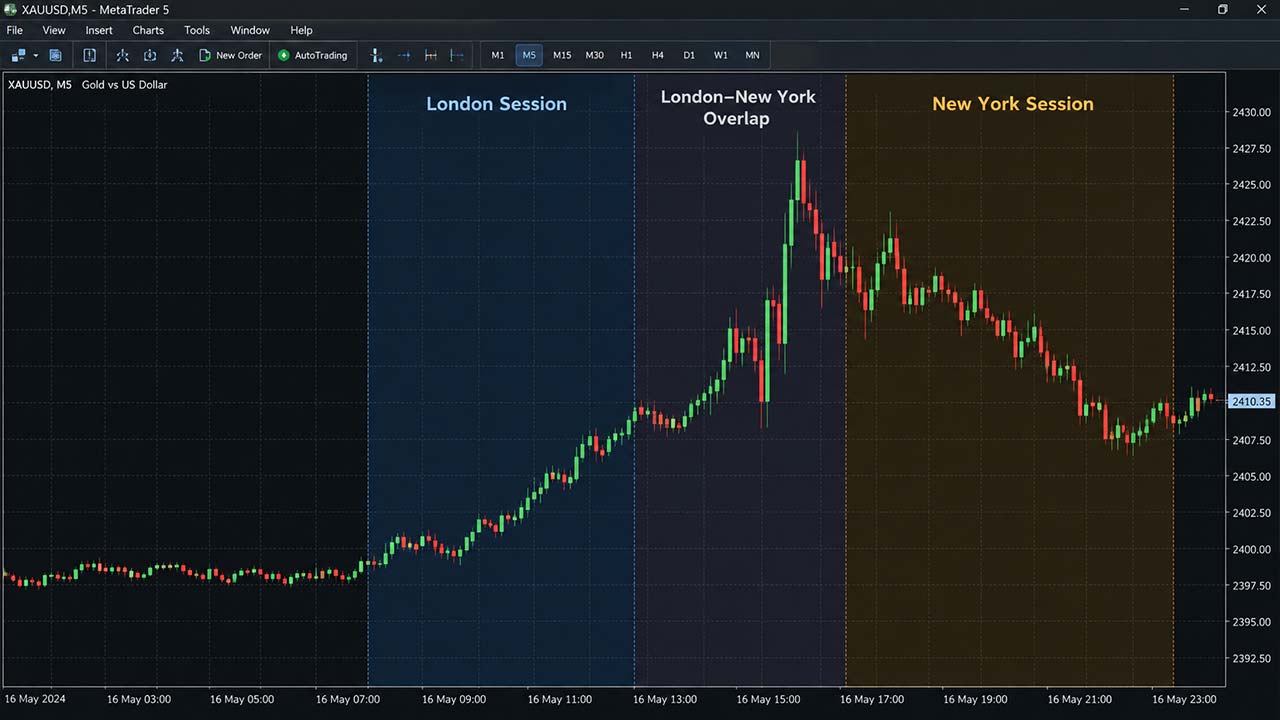
XAU/USD is especially active when major financial markets are open. Trading volume usually increases during the London and New York sessions.
Several factors can quickly move gold prices, including:
US dollar strength
Interest rate expectations
Inflation data
US employment reports
Federal Reserve announcements
Geopolitical events
Changes in market risk sentiment
Gold can therefore move sharply even when other markets remain quiet.
For scalpers, that movement creates opportunity. But volatility alone does not make a good trade.
You still need structure.

The Best Time for XAU/USD Scalping
Timing matters when using a gold scalping strategy.
Gold tends to offer cleaner opportunities when trading activity is high.
The London session is one important period because European markets bring more liquidity into gold trading.
Activity often increases again when New York opens.
The London-New York overlap can be particularly active. Both major markets are operating during this period.
Higher activity may produce:
Stronger breakouts
Faster moves
Better follow-through
More frequent tests of important levels
However, more volatility also means price can move against you faster.
Avoid assuming that every busy period creates a good setup. Sometimes the best decision is simply waiting.
Scalpers often focus on periods with stronger liquidity, so knowing the best time to trade gold can help identify more active sessions.
A Simple Gold Scalping Strategy
A practical approach combines trend direction, support and resistance, and price action.
You do not need ten indicators covering your chart.
The goal is to identify direction first, then wait for price to reach an important area.
Here is one way to structure the setup.
Step 1: Identify the Short-Term Trend
Start with the 15-minute chart.
Look at the market structure rather than trying to predict the next move.
An uptrend normally creates:
Higher highs
Higher lows
A downtrend normally creates:
Lower highs
Lower lows
If the structure is unclear, the market may be ranging.
You can then move to the 5-minute chart to search for an entry.
Trading in the direction of the larger short-term move can help filter weaker setups.
For example, if the 15-minute chart shows higher highs and higher lows, focus mainly on buying pullbacks.
Step 2: Mark Support and Resistance
Next, mark areas where price has reacted several times.
You do not need dozens of lines.
Focus on the levels that are clearly visible without forcing them.
Useful areas may include:
Previous session highs
Previous session lows
Intraday support
Intraday resistance
Strong breakout levels
Recent swing highs
Recent swing lows
Think of these areas as zones rather than exact prices.
Gold often moves slightly beyond a level before reversing.
That is why entering immediately when price touches your line can be risky.

Step 3: Wait for Price to Reach Your Zone
Patience matters more than the number of trades you take.
Suppose XAU/USD is trending upward.
You identify support around a previous breakout area.
Instead of buying immediately, wait for price to pull back into that zone.
Then watch the 5-minute chart.
You are looking for evidence that buyers are returning.
Possible signs include:
Bullish rejection candle
Bullish engulfing candle
Failed breakdown
Higher low forming near support
The same logic works in reverse when looking for a short trade near resistance.
Step 4: Use Price Action for Your Entry
Price action can help reduce random entries.
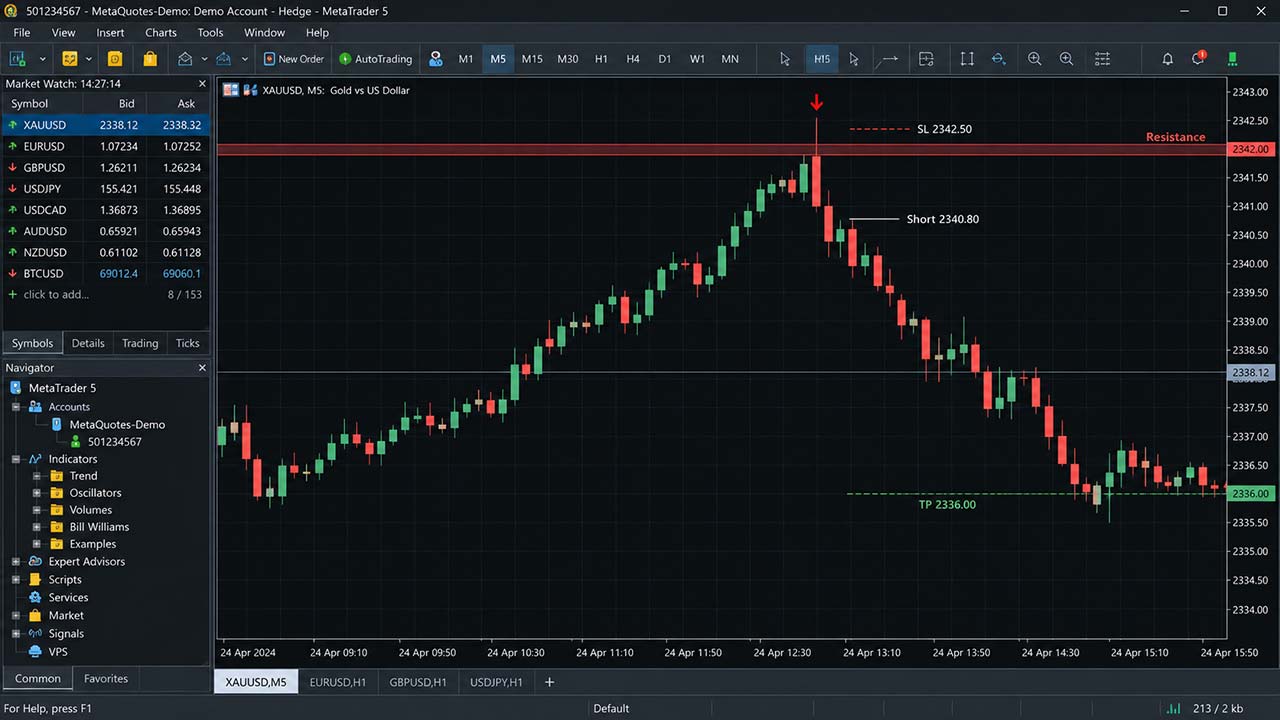
Imagine gold moves into resistance after a short rally.
Price briefly trades above the level but quickly falls back below it.
A bearish rejection candle then forms.
That can indicate buyers failed to hold the breakout.
A scalper might consider a short setup after the rejection confirms.
For a long setup, you would look for the opposite pattern near support.
The important point is that the level comes first.
The candlestick pattern only helps confirm what price is doing around that level.
Adding an EMA to the Strategy
Some traders prefer one simple trend indicator alongside price action.
A common choice is the 20-period or 50-period exponential moving average.
The EMA can help show short-term direction.
For example:
Price above the EMA can support a bullish bias.
Price below the EMA can support a bearish bias.
Flat EMA movement may suggest a range.
Avoid treating the EMA as an automatic buy or sell signal.
Instead, combine it with market structure.
Suppose gold is creating higher highs on the 15-minute chart.
On the 5-minute chart, price pulls back toward support while remaining above the 20 EMA.
A bullish rejection from that area may offer a stronger setup than simply buying because price touched the EMA.
The chart should tell one clear story.
Example of a Gold Scalping Trade
Imagine XAU/USD is trading in a short-term uptrend.
The 15-minute chart shows higher highs and higher lows.
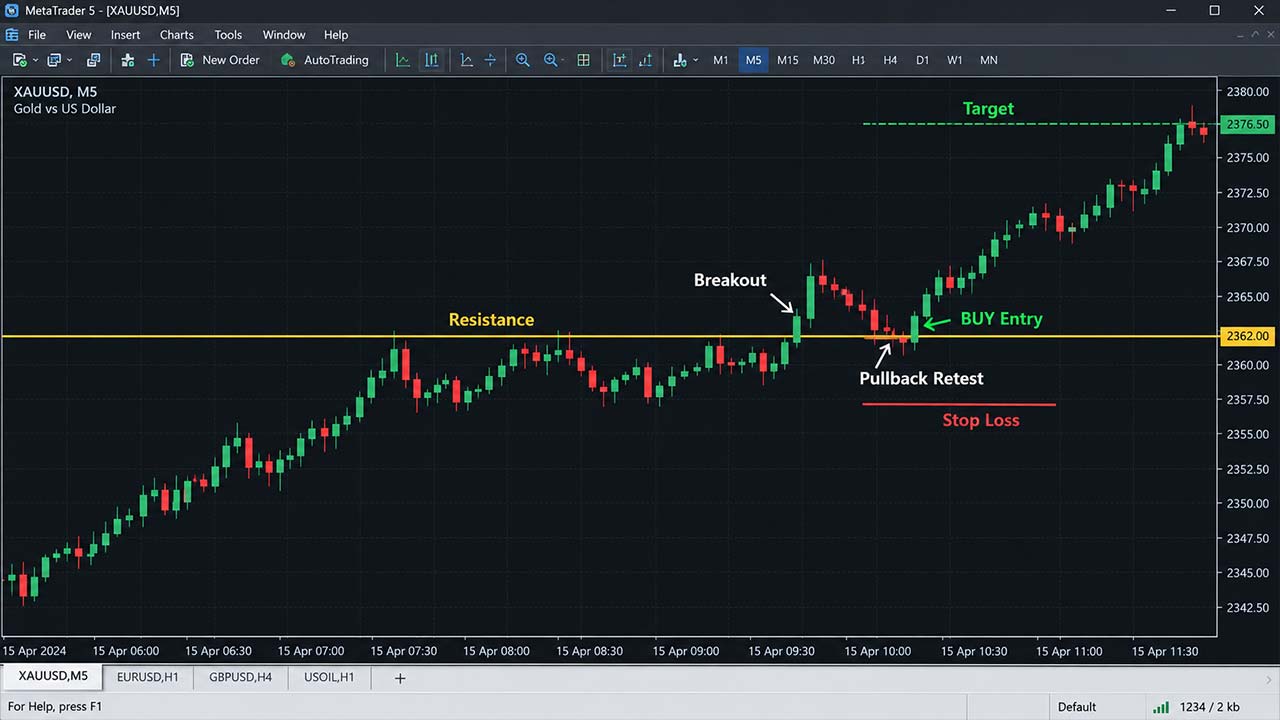
You move to the 5-minute chart and mark a previous resistance level that has recently been broken.
Price then pulls back toward that level.
Instead of immediately buying, you wait.
Gold briefly moves below the old resistance before returning above it. A bullish rejection candle forms.
The setup now contains several signals:
The larger short-term trend is bullish.
Price has returned to support.
A previous breakout level is being retested.
Buyers rejected lower prices.
A trader could enter after confirmation and place the stop below the recent swing low.
The profit target could be placed near the previous intraday high.
Stop Loss Placement When Scalping Gold
A stop loss should have a logical reason behind its position.
Avoid choosing a random distance just because you want a small loss.
For a long position, the stop may sit below:
The recent swing low
The support zone
The rejection candle
For short trades, it may sit above the recent swing high or resistance area.
Gold often produces short price spikes.
Stops placed too close to the entry can therefore get triggered by normal market movement.
At the same time, making your stop extremely wide defeats the purpose of scalping.
The position size should adjust to the stop distance, not the other way around.
Short-term trades still need clear risk limits, which makes a defined XAU/USD stop loss strategy important for scalpers.
What Risk-to-Reward Ratio Should Gold Scalpers Use?
There is no single ratio that works for every setup.
Some scalpers target 1:1.
Others may wait for trades offering 1:1.5 or 1:2.
What matters is whether your average winning trades cover your losses over time.
For example, risking $20 to make $10 requires a very high win rate.
Risking $20 to potentially make $30 gives you more room for losing trades.
Never increase the profit target only because you want a better ratio.
Your target should still make sense based on the chart.
Nearby support, resistance, and recent highs or lows can provide logical exit points.
Trading XAU/USD During News
Economic news can create some of gold's largest intraday moves.
It can also create some of the worst scalping conditions.
Important events include:
US CPI releases
Nonfarm Payrolls
Federal Reserve rate decisions
Fed Chair speeches
US GDP data
Gold can move sharply within seconds during major announcements.
Price may jump through support, resistance, entries, and stops before normal conditions return.
Unless your strategy is built for news trading, waiting until the initial reaction settles can reduce unnecessary risk.
You do not need to trade every move.
Common Gold Scalping Mistakes
Trading Every Small Movement
Movement does not automatically mean opportunity.
Taking every candle as a possible setup usually leads to overtrading.
Wait for price to reach areas you planned before entering.
Using Too Many Indicators
Adding indicators can make a chart look advanced without improving the strategy.
Five indicators giving slightly different signals often create confusion.
Start with price structure, key levels, and perhaps one supporting indicator.
Increasing Position Size After a Loss
Gold moves quickly.
Trying to recover a losing trade by increasing your next position can turn a small loss into a large one.
Treat each setup independently.
Moving the Stop Loss
A trade should have a defined invalidation point before entry.
If price reaches that point, your original idea has probably failed.
Moving the stop simply because you do not want to take the loss increases risk.
Scalping Without a Clear Trading Plan
Every trade should answer four basic questions:
Why am I entering?
Where is my stop?
Where is my target?
How much am I risking?
If you cannot answer them, you probably do not have a complete setup.
Practice Gold Scalping Under Prop Firm Rules
Scalping becomes harder when traders are constantly worried about unnecessary restrictions.
Pipstone Capital gives traders access to MT5 and cTrader challenges with no time limits and no consistency rules, letting you develop your XAU/USD scalping approach without forcing trades just to meet a deadline.
Eligible accounts can also receive up to a 100% reward split, giving successful traders a clear reason to focus on disciplined execution instead of chasing oversized positions.
The goal should still be protecting the account first. A strong gold strategy means little if one bad trade breaks your risk limits.
Funded traders should understand gold volatility in funded accounts before using aggressive scalping setups.
Gold Scalping Strategy Checklist
Before entering an XAU/USD scalp, check that:
You know the 15-minute market direction.
Support and resistance are clearly marked.
Price has reached your planned trading area.
You have confirmation from price action.
Your stop has a logical position.
Your target is based on market structure.
Your position size fits your risk.
No major economic announcement is about to occur.
You do not need every possible signal.
You need enough evidence to justify the trade.
Final Thoughts
A good gold scalping strategy does not need to be complicated. Start by identifying the short-term trend, mark important support and resistance zones, and wait for price action to confirm your entry.
The hardest part of XAU/USD scalping is often staying patient while gold moves quickly. You do not need to catch every move. You need a repeatable setup with controlled risk.
If you want to put that approach into practice through a prop firm challenge, Pipstone Capital offers MT5 and cTrader trading with no time limits, no consistency rules, and up to a 100% reward split on eligible accounts. That gives traders more room to wait for quality gold setups rather than forcing trades to meet unnecessary deadlines.
FAQs: Gold Scalping Techniques
Is gold good for scalping?
Gold can suit scalping because XAU/USD often has strong intraday volatility and high trading activity. That same volatility also makes poor risk management expensive.
What timeframe is best for gold scalping?
Many traders use the 5-minute chart for entries and the 15-minute chart for direction. The 1-minute chart offers more setups but contains much more market noise.
What is the best indicator for XAU/USD scalping?
There is no single best indicator. Traders often use an EMA alongside support, resistance, and price action to help identify short-term direction.
Can beginners scalp gold?
Beginners can practice gold scalping on a demo account, but the speed of XAU/USD makes discipline important. New traders should first learn position sizing, stop placement, and basic market structure.
How many gold scalping trades should I take per day?
There is no required number. Some sessions may provide several clear setups, while others provide none. Trading only when your conditions appear is more important than hitting a daily trade target.



Gold Scalping Strategy: How to Scalp XAU/USD
Gold can move quickly, especially during the busiest trading sessions. That makes XAU/USD attractive to traders looking for short-term setups.
A gold scalping strategy focuses on capturing small price movements rather than holding trades for hours. Traders may stay in a position for only a few minutes, sometimes even less.
The idea sounds simple, but gold can punish poor entries very quickly. XAU/USD often reacts sharply around key price levels, economic news, and market openings.
This guide explains how XAU/USD scalping works and shows a simple strategy you can practice.
What Is Gold Scalping?
Gold scalping is a short-term trading style focused on small XAU/USD price movements.
Instead of waiting for a large trend, a scalper looks for repeated short moves throughout a session.
For example, a trader might enter after gold rejects resistance and exit near the next support level.
The profit target could be relatively small. The trader depends on accurate entries, tight risk control, and enough good setups.
Most gold scalpers use charts such as:
1-minute chart
5-minute chart
15-minute chart
The 5-minute chart is often a practical middle ground. It shows short-term movement without as much noise as the 1-minute chart.
The 15-minute chart can then provide the broader market direction.
Scalping is one short-term approach within a broader XAU/USD trading strategy that also covers market structure and risk.
Why Is XAU/USD Popular for Scalping?
Gold often produces strong intraday price movements.
These movements can create more opportunities than slower markets, but they also increase risk.
XAU/USD is especially active when major financial markets are open. Trading volume usually increases during the London and New York sessions.
Several factors can quickly move gold prices, including:
US dollar strength
Interest rate expectations
Inflation data
US employment reports
Federal Reserve announcements
Geopolitical events
Changes in market risk sentiment
Gold can therefore move sharply even when other markets remain quiet.
For scalpers, that movement creates opportunity. But volatility alone does not make a good trade.
You still need structure.
The Best Time for XAU/USD Scalping
Timing matters when using a gold scalping strategy.
Gold tends to offer cleaner opportunities when trading activity is high.
The London session is one important period because European markets bring more liquidity into gold trading.
Activity often increases again when New York opens.
The London-New York overlap can be particularly active. Both major markets are operating during this period.
Higher activity may produce:
Stronger breakouts
Faster moves
Better follow-through
More frequent tests of important levels
However, more volatility also means price can move against you faster.
Avoid assuming that every busy period creates a good setup. Sometimes the best decision is simply waiting.
Scalpers often focus on periods with stronger liquidity, so knowing the best time to trade gold can help identify more active sessions.
A Simple Gold Scalping Strategy
A practical approach combines trend direction, support and resistance, and price action.
You do not need ten indicators covering your chart.
The goal is to identify direction first, then wait for price to reach an important area.
Here is one way to structure the setup.
Step 1: Identify the Short-Term Trend
Start with the 15-minute chart.
Look at the market structure rather than trying to predict the next move.
An uptrend normally creates:
Higher highs
Higher lows
A downtrend normally creates:
Lower highs
Lower lows
If the structure is unclear, the market may be ranging.
You can then move to the 5-minute chart to search for an entry.
Trading in the direction of the larger short-term move can help filter weaker setups.
For example, if the 15-minute chart shows higher highs and higher lows, focus mainly on buying pullbacks.
Step 2: Mark Support and Resistance
Next, mark areas where price has reacted several times.
You do not need dozens of lines.
Focus on the levels that are clearly visible without forcing them.
Useful areas may include:
Previous session highs
Previous session lows
Intraday support
Intraday resistance
Strong breakout levels
Recent swing highs
Recent swing lows
Think of these areas as zones rather than exact prices.
Gold often moves slightly beyond a level before reversing.
That is why entering immediately when price touches your line can be risky.
Step 3: Wait for Price to Reach Your Zone
Patience matters more than the number of trades you take.
Suppose XAU/USD is trending upward.
You identify support around a previous breakout area.
Instead of buying immediately, wait for price to pull back into that zone.
Then watch the 5-minute chart.
You are looking for evidence that buyers are returning.
Possible signs include:
Bullish rejection candle
Bullish engulfing candle
Failed breakdown
Higher low forming near support
The same logic works in reverse when looking for a short trade near resistance.
Step 4: Use Price Action for Your Entry
Price action can help reduce random entries.
Imagine gold moves into resistance after a short rally.
Price briefly trades above the level but quickly falls back below it.
A bearish rejection candle then forms.
That can indicate buyers failed to hold the breakout.
A scalper might consider a short setup after the rejection confirms.
For a long setup, you would look for the opposite pattern near support.
The important point is that the level comes first.
The candlestick pattern only helps confirm what price is doing around that level.
Adding an EMA to the Strategy
Some traders prefer one simple trend indicator alongside price action.
A common choice is the 20-period or 50-period exponential moving average.
The EMA can help show short-term direction.
For example:
Price above the EMA can support a bullish bias.
Price below the EMA can support a bearish bias.
Flat EMA movement may suggest a range.
Avoid treating the EMA as an automatic buy or sell signal.
Instead, combine it with market structure.
Suppose gold is creating higher highs on the 15-minute chart.
On the 5-minute chart, price pulls back toward support while remaining above the 20 EMA.
A bullish rejection from that area may offer a stronger setup than simply buying because price touched the EMA.
The chart should tell one clear story.
Example of a Gold Scalping Trade
Imagine XAU/USD is trading in a short-term uptrend.
The 15-minute chart shows higher highs and higher lows.
You move to the 5-minute chart and mark a previous resistance level that has recently been broken.
Price then pulls back toward that level.
Instead of immediately buying, you wait.
Gold briefly moves below the old resistance before returning above it. A bullish rejection candle forms.
The setup now contains several signals:
The larger short-term trend is bullish.
Price has returned to support.
A previous breakout level is being retested.
Buyers rejected lower prices.
A trader could enter after confirmation and place the stop below the recent swing low.
The profit target could be placed near the previous intraday high.
Stop Loss Placement When Scalping Gold
A stop loss should have a logical reason behind its position.
Avoid choosing a random distance just because you want a small loss.
For a long position, the stop may sit below:
The recent swing low
The support zone
The rejection candle
For short trades, it may sit above the recent swing high or resistance area.
Gold often produces short price spikes.
Stops placed too close to the entry can therefore get triggered by normal market movement.
At the same time, making your stop extremely wide defeats the purpose of scalping.
The position size should adjust to the stop distance, not the other way around.
Short-term trades still need clear risk limits, which makes a defined XAU/USD stop loss strategy important for scalpers.
What Risk-to-Reward Ratio Should Gold Scalpers Use?
There is no single ratio that works for every setup.
Some scalpers target 1:1.
Others may wait for trades offering 1:1.5 or 1:2.
What matters is whether your average winning trades cover your losses over time.
For example, risking $20 to make $10 requires a very high win rate.
Risking $20 to potentially make $30 gives you more room for losing trades.
Never increase the profit target only because you want a better ratio.
Your target should still make sense based on the chart.
Nearby support, resistance, and recent highs or lows can provide logical exit points.
Trading XAU/USD During News
Economic news can create some of gold's largest intraday moves.
It can also create some of the worst scalping conditions.
Important events include:
US CPI releases
Nonfarm Payrolls
Federal Reserve rate decisions
Fed Chair speeches
US GDP data
Gold can move sharply within seconds during major announcements.
Price may jump through support, resistance, entries, and stops before normal conditions return.
Unless your strategy is built for news trading, waiting until the initial reaction settles can reduce unnecessary risk.
You do not need to trade every move.
Common Gold Scalping Mistakes
Trading Every Small Movement
Movement does not automatically mean opportunity.
Taking every candle as a possible setup usually leads to overtrading.
Wait for price to reach areas you planned before entering.
Using Too Many Indicators
Adding indicators can make a chart look advanced without improving the strategy.
Five indicators giving slightly different signals often create confusion.
Start with price structure, key levels, and perhaps one supporting indicator.
Increasing Position Size After a Loss
Gold moves quickly.
Trying to recover a losing trade by increasing your next position can turn a small loss into a large one.
Treat each setup independently.
Moving the Stop Loss
A trade should have a defined invalidation point before entry.
If price reaches that point, your original idea has probably failed.
Moving the stop simply because you do not want to take the loss increases risk.
Scalping Without a Clear Trading Plan
Every trade should answer four basic questions:
Why am I entering?
Where is my stop?
Where is my target?
How much am I risking?
If you cannot answer them, you probably do not have a complete setup.
Practice Gold Scalping Under Prop Firm Rules
Scalping becomes harder when traders are constantly worried about unnecessary restrictions.
Pipstone Capital gives traders access to MT5 and cTrader challenges with no time limits and no consistency rules, letting you develop your XAU/USD scalping approach without forcing trades just to meet a deadline.
Eligible accounts can also receive up to a 100% reward split, giving successful traders a clear reason to focus on disciplined execution instead of chasing oversized positions.
The goal should still be protecting the account first. A strong gold strategy means little if one bad trade breaks your risk limits.
Funded traders should understand gold volatility in funded accounts before using aggressive scalping setups.
Gold Scalping Strategy Checklist
Before entering an XAU/USD scalp, check that:
You know the 15-minute market direction.
Support and resistance are clearly marked.
Price has reached your planned trading area.
You have confirmation from price action.
Your stop has a logical position.
Your target is based on market structure.
Your position size fits your risk.
No major economic announcement is about to occur.
You do not need every possible signal.
You need enough evidence to justify the trade.
Final Thoughts
A good gold scalping strategy does not need to be complicated. Start by identifying the short-term trend, mark important support and resistance zones, and wait for price action to confirm your entry.
The hardest part of XAU/USD scalping is often staying patient while gold moves quickly. You do not need to catch every move. You need a repeatable setup with controlled risk.
If you want to put that approach into practice through a prop firm challenge, Pipstone Capital offers MT5 and cTrader trading with no time limits, no consistency rules, and up to a 100% reward split on eligible accounts. That gives traders more room to wait for quality gold setups rather than forcing trades to meet unnecessary deadlines.
FAQs: Gold Scalping Techniques
Is gold good for scalping?
Gold can suit scalping because XAU/USD often has strong intraday volatility and high trading activity. That same volatility also makes poor risk management expensive.
What timeframe is best for gold scalping?
Many traders use the 5-minute chart for entries and the 15-minute chart for direction. The 1-minute chart offers more setups but contains much more market noise.
What is the best indicator for XAU/USD scalping?
There is no single best indicator. Traders often use an EMA alongside support, resistance, and price action to help identify short-term direction.
Can beginners scalp gold?
Beginners can practice gold scalping on a demo account, but the speed of XAU/USD makes discipline important. New traders should first learn position sizing, stop placement, and basic market structure.
How many gold scalping trades should I take per day?
There is no required number. Some sessions may provide several clear setups, while others provide none. Trading only when your conditions appear is more important than hitting a daily trade target.
