


What Is Drawdown in Trading Prop Firm? How Leverage Affects It

Drawdown is one of the most important rules when trading with a prop firm.
You may have a good strategy and still lose an account through poor risk control. One bad day can also breach a rule, even after several profitable weeks.
This is why traders need to understand drawdown before choosing a funded account.
Leverage also plays a major role because it controls how much market exposure you can take. Used poorly, it can push your account toward its drawdown limit much faster.
In this guide, we explain prop firm drawdown, its main types, and how leverage affects risk.
What Is Drawdown in Trading Prop Firm?
Drawdown measures how far your trading account falls from a set reference point.
In prop trading, drawdown is also a firm rule that limits how much you can lose.
If you breach that limit, you may fail your challenge or lose your funded account.
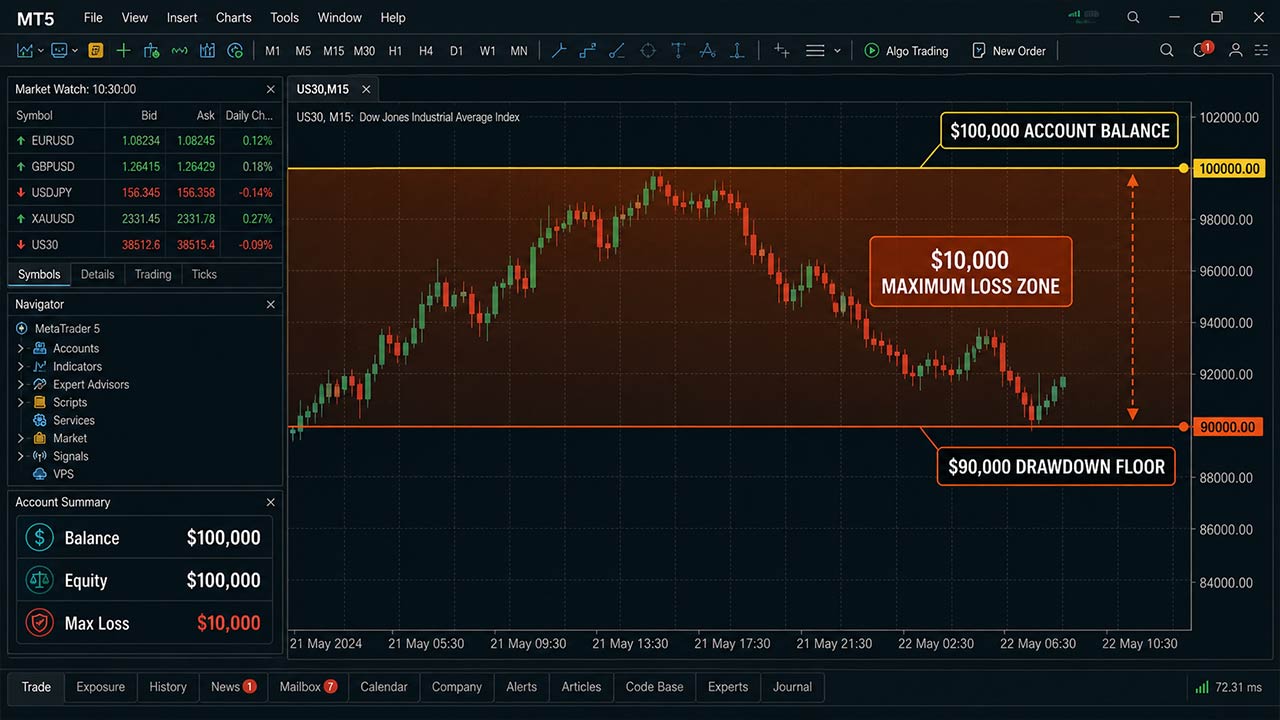
For example, imagine you receive a $100,000 account with a 10% maximum drawdown.
Your total allowed loss would be $10,000 under a simple static rule.
That means your account cannot fall below $90,000.
However, prop firm drawdown rules are not always this simple.
Some firms use fixed limits, while others move the loss floor after profits.
You also need to know whether open losses count toward the limit.
Prop firms often set clear daily and maximum drawdown limits. Before looking at those rules, it helps to learn how leverage works in forex and how it changes a trader’s market exposure.
What Are the Main Types of Prop Firm Drawdown?
The percentage alone does not tell you how strict a drawdown rule really is.
A 10% limit at one firm may work very differently from another.
Here are the main drawdown rules you need to understand.
1. Daily Drawdown
Daily drawdown limits how much you can lose during one trading day.
Suppose your account has a 5% daily loss limit.
On a $100,000 account, that could mean a maximum daily loss of $5,000.
You could still be profitable for the month and break this rule.
That is why daily risk control matters just as much as total account risk.
Some firms also reset the daily limit at a set time.
Always check how and when that reset takes place.
2. Maximum Drawdown
Maximum drawdown sets the total loss your account can take.
This limit usually applies throughout the life of the account.
A $100,000 account with 10% maximum drawdown gives $10,000 of loss room.
Breaching that floor can end the account.

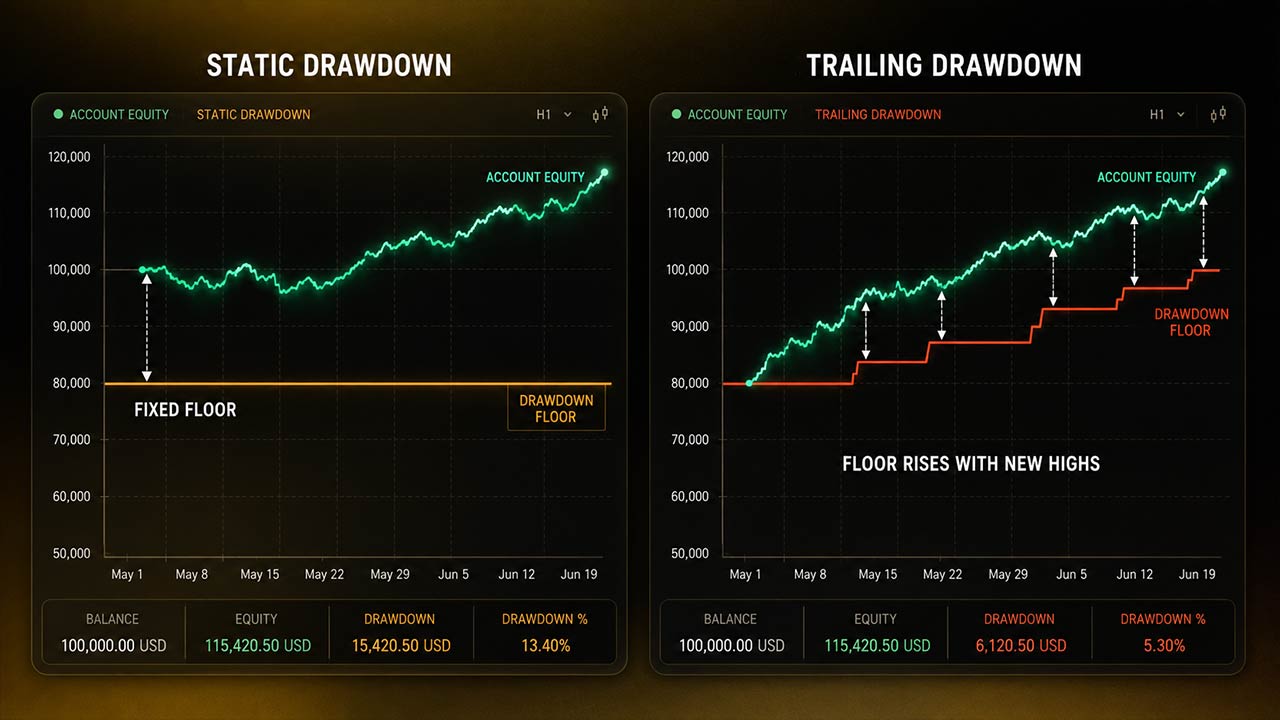
3. Static Drawdown
Static drawdown keeps the loss floor in the same place.
Imagine your starting balance is $100,000 with a $90,000 minimum balance.
You then grow the account to $110,000.
Your minimum balance may still remain at $90,000.
That gives you more room as profits build.
4. Trailing Drawdown
Trailing drawdown can move upward when your account reaches new highs.
Suppose your loss allowance is $5,000.
Your account rises from $100,000 to $106,000.
The drawdown floor may move higher as your account reaches that new peak.
This means you cannot always give back all your earlier profits.
Some trailing rules move during the day. Others update after the session closes.
That difference can have a major effect on your trading style.
Balance-Based vs Equity-Based Drawdown
You also need to know what account value the prop firm tracks.
This can change when a drawdown breach happens.
Balance-Based Drawdown
Balance usually reflects profits and losses from trades you already closed.
Open trades do not normally change your balance until they are closed.
A balance-based rule may therefore focus more on completed trades.
Equity-Based Drawdown
Equity includes your balance plus profits or losses from open trades.
This makes floating losses much more important.
Imagine your balance remains at $100,000.
You have an open position showing a $6,000 loss.
Your equity would now be around $94,000.
An equity-based drawdown rule may count that loss before you close the trade.
This is why traders should never judge risk using account balance alone.

How Does Leverage Affect Drawdown in a Prop Firm?
Leverage does not automatically change your prop firm's drawdown limit.
Instead, leverage changes how much market exposure you can control.
That exposure can make your account reach its drawdown limit much faster.
Consider two traders with the same $100,000 account.
Trader A controls a $100,000 market position.
Trader B controls a $500,000 position.
A 1% move against Trader A creates about a $1,000 loss.
The same move against Trader B creates about a $5,000 loss.
Both traders had the same account size.
Their market exposure was very different.
This is the main link between prop firm leverage and drawdown.
Higher leverage gives you access to larger trades.
Larger trades can produce larger gains, but losses also grow faster.
5 Ways High Leverage Can Increase Drawdown Risk
High leverage becomes dangerous when traders use it to increase risk too far.
Here are five common ways that happens.
1. Larger Position Sizes
More available margin can make large trades look affordable.
However, margin required and actual trading risk are not the same thing.
A trade can require little margin while still carrying major loss risk.
Larger positions can make relatively small market movements create much larger percentage losses. Our guide explains how leverage increases drawdown and why position exposure matters.
2. Too Many Open Trades
Leverage can allow several trades to stay open at the same time.
This becomes risky when those trades move in the same direction.
Three separate positions may act like one large trade during strong market moves.
3. Small Price Moves Cause Bigger Losses
Large market exposure makes each price movement worth more money.
Even a normal pullback can create a sharp fall in equity.
This is critical when your firm uses equity-based drawdown.
4. Volatile Markets Hit Harder
Markets such as gold can make large moves in short periods.
Oversized XAU/USD trades can therefore consume drawdown room very quickly.
Stops can also fill beyond the planned price during sharp market moves.
5. Traders Mistake Buying Power for Risk Budget
A prop firm may let you control a large market position.
That does not mean you should use the full amount available.
Your true risk budget should be based on drawdown, not buying power.
How Much Should You Risk With a Prop Firm?
Start with your drawdown limit before deciding position size.
Do not build your risk plan only around the headline account balance.
Suppose you have a $100,000 account with $10,000 maximum drawdown.
That $10,000 is your real loss buffer.
Risking $2,000 on one trade would use 20% of that buffer.
Risking $500 would use only 5%.
This gives you much more room for losing trades and normal trading swings.
Many traders also set their own daily stop below the firm's daily limit.
For example, the firm may allow a $5,000 daily loss.
Your own stop could be much smaller.
This prevents one bad session from pushing the account close to failure.
A prop firm may offer 1:50 or 1:100 leverage, but this does not mean the trader is using the full amount. Understanding account leverage vs real leverage gives a better view of actual market exposure.
How to Protect Your Account From Drawdown
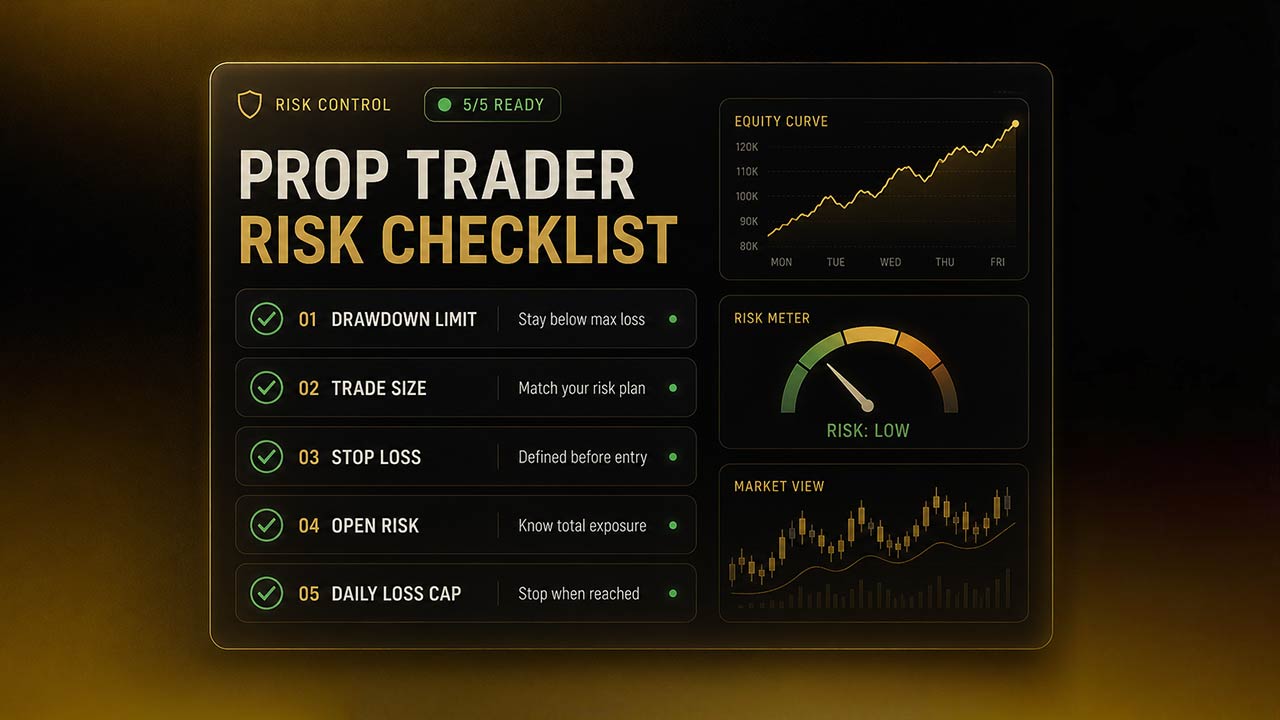
A simple risk plan can help you stay far from the loss limit.
Use these rules before entering your next prop firm trade:
Know every drawdown rule before trading.
Check daily, maximum, static, trailing, balance, and equity rules.Risk a small part of your loss buffer.
Base risk on available drawdown rather than account size alone.Use stop losses.
Know where your trade becomes wrong before entering the market.Control total open risk.
Several small positions can still create one large combined risk.Reduce size during volatile markets.
Wider price swings often need smaller trade sizes.Set your own daily loss limit.
Stop before reaching the prop firm's official limit.Avoid trying to recover losses quickly.
Larger recovery trades often create even deeper drawdowns.
What Should You Check Before Choosing a Prop Firm?
Do not compare prop firms using account size alone.
A large account can still have very tight trading rules.
Ask these questions before buying a challenge:
What is the daily drawdown limit?
What is the maximum drawdown?
Is the drawdown static or trailing?
Is it based on balance or equity?
Does trailing drawdown move during open trades?
When does the daily loss limit reset?
Do open profits affect the drawdown floor?
What leverage is offered on your trading account?
Are there limits on lot size or total exposure?
These details tell you far more than the headline account value.
Drawdown and Leverage: The Key Relationship
Think of drawdown as your account's loss boundary.
Think of leverage as a tool that affects how quickly you can reach it.
High leverage does not force you to take large trades.
It simply gives you the ability to control more market exposure.
The problem starts when position size grows faster than your risk plan.
A trader using moderate exposure can survive several losing trades.
An oversized position can consume the same drawdown in one bad move.
Large drawdowns often begin when traders take more exposure than their account can safely handle. This is a common form of overleveraging in forex trading.
For prop traders, survival comes before chasing large short-term gains.
At Pipstone Capital, traders should understand account rules before placing their first trade. Knowing your limits helps you build position sizes around risk rather than emotion.
In fact, drawdown depends heavily on how large each trade is relative to the account. Understanding lot size in forex trading helps traders estimate how much each pip movement could affect equity.
Final Thoughts
Understanding what is drawdown in trading prop firm accounts is vital before taking a challenge.
Do not focus only on the account size or profit target.
Study how the firm calculates daily and maximum losses.
Then check whether the drawdown is static, trailing, balance-based, or equity-based.
Leverage should also be part of that review.
More buying power can help when risk stays controlled.
It can also destroy an account quickly when position sizes become too large.
Build each trade around your available drawdown.
That approach gives you more room to manage losses and keep trading consistently.
FAQs About Drawdown in Prop Trading
What is drawdown in trading prop firm accounts?
Drawdown is the amount your account can fall before reaching a firm's loss limit. Breaching that limit can cause the account to fail.
Does leverage increase drawdown?
Leverage itself does not create drawdown. It allows larger market exposure, which can make losses grow much faster.
What is the difference between daily and maximum drawdown?
Daily drawdown limits losses during one trading day. Maximum drawdown limits total account losses across the account's life.
Is static or trailing drawdown better?
Static drawdown is easier to track because the loss floor stays fixed. Trailing drawdown can become tighter as your account reaches new highs.
Can an open trade breach a prop firm drawdown rule?
Yes, when the firm uses equity-based drawdown. Floating losses can reduce equity enough to trigger a breach before closing the trade.



What Is Drawdown in Trading Prop Firm? How Leverage Affects It
Drawdown is one of the most important rules when trading with a prop firm.
You may have a good strategy and still lose an account through poor risk control. One bad day can also breach a rule, even after several profitable weeks.
This is why traders need to understand drawdown before choosing a funded account.
Leverage also plays a major role because it controls how much market exposure you can take. Used poorly, it can push your account toward its drawdown limit much faster.
In this guide, we explain prop firm drawdown, its main types, and how leverage affects risk.
What Is Drawdown in Trading Prop Firm?
Drawdown measures how far your trading account falls from a set reference point.
In prop trading, drawdown is also a firm rule that limits how much you can lose.
If you breach that limit, you may fail your challenge or lose your funded account.
For example, imagine you receive a $100,000 account with a 10% maximum drawdown.
Your total allowed loss would be $10,000 under a simple static rule.
That means your account cannot fall below $90,000.
However, prop firm drawdown rules are not always this simple.
Some firms use fixed limits, while others move the loss floor after profits.
You also need to know whether open losses count toward the limit.
Prop firms often set clear daily and maximum drawdown limits. Before looking at those rules, it helps to learn how leverage works in forex and how it changes a trader’s market exposure.
What Are the Main Types of Prop Firm Drawdown?
The percentage alone does not tell you how strict a drawdown rule really is.
A 10% limit at one firm may work very differently from another.
Here are the main drawdown rules you need to understand.
1. Daily Drawdown
Daily drawdown limits how much you can lose during one trading day.
Suppose your account has a 5% daily loss limit.
On a $100,000 account, that could mean a maximum daily loss of $5,000.
You could still be profitable for the month and break this rule.
That is why daily risk control matters just as much as total account risk.
Some firms also reset the daily limit at a set time.
Always check how and when that reset takes place.
2. Maximum Drawdown
Maximum drawdown sets the total loss your account can take.
This limit usually applies throughout the life of the account.
A $100,000 account with 10% maximum drawdown gives $10,000 of loss room.
Breaching that floor can end the account.
3. Static Drawdown
Static drawdown keeps the loss floor in the same place.
Imagine your starting balance is $100,000 with a $90,000 minimum balance.
You then grow the account to $110,000.
Your minimum balance may still remain at $90,000.
That gives you more room as profits build.
4. Trailing Drawdown
Trailing drawdown can move upward when your account reaches new highs.
Suppose your loss allowance is $5,000.
Your account rises from $100,000 to $106,000.
The drawdown floor may move higher as your account reaches that new peak.
This means you cannot always give back all your earlier profits.
Some trailing rules move during the day. Others update after the session closes.
That difference can have a major effect on your trading style.
Balance-Based vs Equity-Based Drawdown
You also need to know what account value the prop firm tracks.
This can change when a drawdown breach happens.
Balance-Based Drawdown
Balance usually reflects profits and losses from trades you already closed.
Open trades do not normally change your balance until they are closed.
A balance-based rule may therefore focus more on completed trades.
Equity-Based Drawdown
Equity includes your balance plus profits or losses from open trades.
This makes floating losses much more important.
Imagine your balance remains at $100,000.
You have an open position showing a $6,000 loss.
Your equity would now be around $94,000.
An equity-based drawdown rule may count that loss before you close the trade.
This is why traders should never judge risk using account balance alone.
How Does Leverage Affect Drawdown in a Prop Firm?
Leverage does not automatically change your prop firm's drawdown limit.
Instead, leverage changes how much market exposure you can control.
That exposure can make your account reach its drawdown limit much faster.
Consider two traders with the same $100,000 account.
Trader A controls a $100,000 market position.
Trader B controls a $500,000 position.
A 1% move against Trader A creates about a $1,000 loss.
The same move against Trader B creates about a $5,000 loss.
Both traders had the same account size.
Their market exposure was very different.
This is the main link between prop firm leverage and drawdown.
Higher leverage gives you access to larger trades.
Larger trades can produce larger gains, but losses also grow faster.
5 Ways High Leverage Can Increase Drawdown Risk
High leverage becomes dangerous when traders use it to increase risk too far.
Here are five common ways that happens.
1. Larger Position Sizes
More available margin can make large trades look affordable.
However, margin required and actual trading risk are not the same thing.
A trade can require little margin while still carrying major loss risk.
Larger positions can make relatively small market movements create much larger percentage losses. Our guide explains how leverage increases drawdown and why position exposure matters.
2. Too Many Open Trades
Leverage can allow several trades to stay open at the same time.
This becomes risky when those trades move in the same direction.
Three separate positions may act like one large trade during strong market moves.
3. Small Price Moves Cause Bigger Losses
Large market exposure makes each price movement worth more money.
Even a normal pullback can create a sharp fall in equity.
This is critical when your firm uses equity-based drawdown.
4. Volatile Markets Hit Harder
Markets such as gold can make large moves in short periods.
Oversized XAU/USD trades can therefore consume drawdown room very quickly.
Stops can also fill beyond the planned price during sharp market moves.
5. Traders Mistake Buying Power for Risk Budget
A prop firm may let you control a large market position.
That does not mean you should use the full amount available.
Your true risk budget should be based on drawdown, not buying power.
How Much Should You Risk With a Prop Firm?
Start with your drawdown limit before deciding position size.
Do not build your risk plan only around the headline account balance.
Suppose you have a $100,000 account with $10,000 maximum drawdown.
That $10,000 is your real loss buffer.
Risking $2,000 on one trade would use 20% of that buffer.
Risking $500 would use only 5%.
This gives you much more room for losing trades and normal trading swings.
Many traders also set their own daily stop below the firm's daily limit.
For example, the firm may allow a $5,000 daily loss.
Your own stop could be much smaller.
This prevents one bad session from pushing the account close to failure.
A prop firm may offer 1:50 or 1:100 leverage, but this does not mean the trader is using the full amount. Understanding account leverage vs real leverage gives a better view of actual market exposure.
How to Protect Your Account From Drawdown
A simple risk plan can help you stay far from the loss limit.
Use these rules before entering your next prop firm trade:
Know every drawdown rule before trading.
Check daily, maximum, static, trailing, balance, and equity rules.Risk a small part of your loss buffer.
Base risk on available drawdown rather than account size alone.Use stop losses.
Know where your trade becomes wrong before entering the market.Control total open risk.
Several small positions can still create one large combined risk.Reduce size during volatile markets.
Wider price swings often need smaller trade sizes.Set your own daily loss limit.
Stop before reaching the prop firm's official limit.Avoid trying to recover losses quickly.
Larger recovery trades often create even deeper drawdowns.
What Should You Check Before Choosing a Prop Firm?
Do not compare prop firms using account size alone.
A large account can still have very tight trading rules.
Ask these questions before buying a challenge:
What is the daily drawdown limit?
What is the maximum drawdown?
Is the drawdown static or trailing?
Is it based on balance or equity?
Does trailing drawdown move during open trades?
When does the daily loss limit reset?
Do open profits affect the drawdown floor?
What leverage is offered on your trading account?
Are there limits on lot size or total exposure?
These details tell you far more than the headline account value.
Drawdown and Leverage: The Key Relationship
Think of drawdown as your account's loss boundary.
Think of leverage as a tool that affects how quickly you can reach it.
High leverage does not force you to take large trades.
It simply gives you the ability to control more market exposure.
The problem starts when position size grows faster than your risk plan.
A trader using moderate exposure can survive several losing trades.
An oversized position can consume the same drawdown in one bad move.
Large drawdowns often begin when traders take more exposure than their account can safely handle. This is a common form of overleveraging in forex trading.
For prop traders, survival comes before chasing large short-term gains.
At Pipstone Capital, traders should understand account rules before placing their first trade. Knowing your limits helps you build position sizes around risk rather than emotion.
In fact, drawdown depends heavily on how large each trade is relative to the account. Understanding lot size in forex trading helps traders estimate how much each pip movement could affect equity.
Final Thoughts
Understanding what is drawdown in trading prop firm accounts is vital before taking a challenge.
Do not focus only on the account size or profit target.
Study how the firm calculates daily and maximum losses.
Then check whether the drawdown is static, trailing, balance-based, or equity-based.
Leverage should also be part of that review.
More buying power can help when risk stays controlled.
It can also destroy an account quickly when position sizes become too large.
Build each trade around your available drawdown.
That approach gives you more room to manage losses and keep trading consistently.
FAQs About Drawdown in Prop Trading
What is drawdown in trading prop firm accounts?
Drawdown is the amount your account can fall before reaching a firm's loss limit. Breaching that limit can cause the account to fail.
Does leverage increase drawdown?
Leverage itself does not create drawdown. It allows larger market exposure, which can make losses grow much faster.
What is the difference between daily and maximum drawdown?
Daily drawdown limits losses during one trading day. Maximum drawdown limits total account losses across the account's life.
Is static or trailing drawdown better?
Static drawdown is easier to track because the loss floor stays fixed. Trailing drawdown can become tighter as your account reaches new highs.
Can an open trade breach a prop firm drawdown rule?
Yes, when the firm uses equity-based drawdown. Floating losses can reduce equity enough to trigger a breach before closing the trade.
