


What Leverage Should You Use During a Prop-Firm Challenge?

Leverage can help during a prop-firm challenge, but more is not always better.
Many traders see 1:50 or 1:100 leverage and focus on buying power. The bigger concern should be how much of that buying power you actually use.
A prop challenge normally has strict daily and total loss limits. That changes how leverage should be approached.
Using too much exposure can turn one normal losing trade into a serious drawdown. Using too little may make the profit target harder to reach.
So, what leverage should you use during a prop-firm challenge?
For most traders, 1:30 to 1:50 provides more than enough buying power. Even when a challenge offers 1:100, you do not need to use the full amount.
Your position size, stop loss, and risk per trade matter far more.
What Does Leverage Mean in a Prop-Firm Challenge?
Leverage lets you control a larger market position with less required margin.
For example, 1:50 leverage means every $1 of margin can control $50.
With 1:100 leverage, that same $1 can control $100.
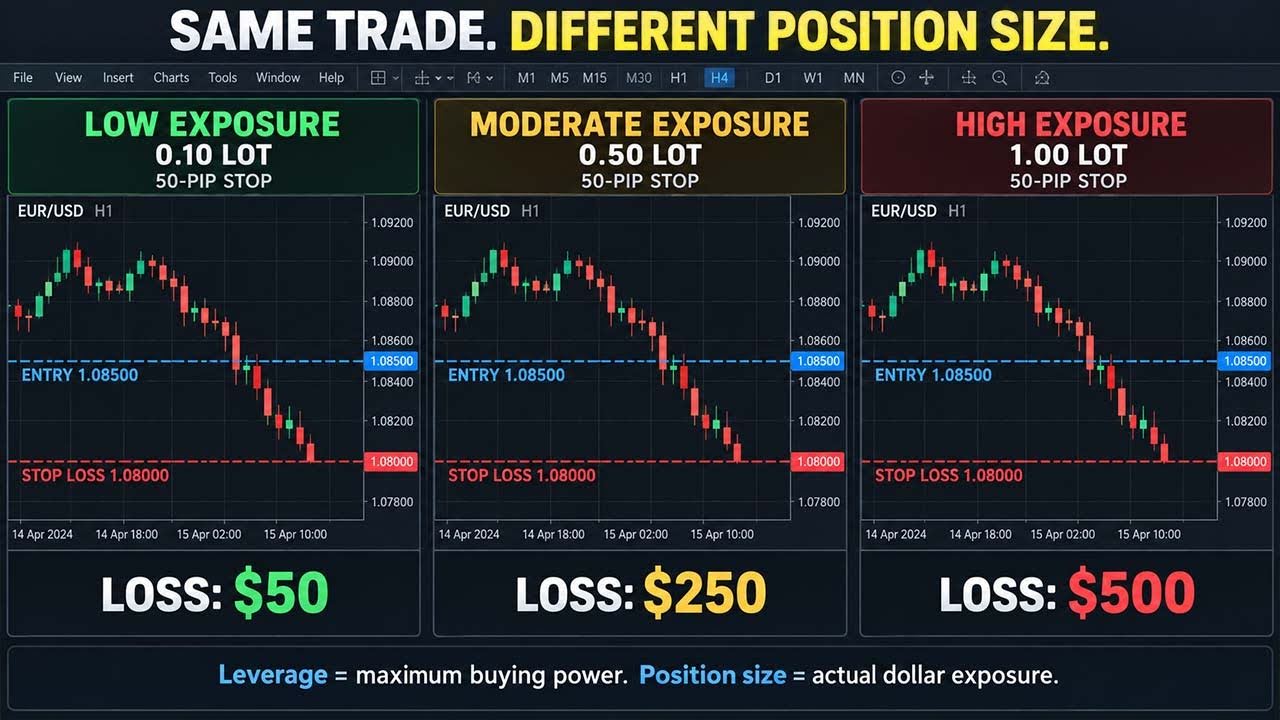
That does not mean you should open positions worth 100 times your account balance.
Think of leverage as your maximum available buying power, not a target.
A trader using a 1:100 account can still trade more carefully than someone using 1:30.
The difference comes down to position size.
What Is the Best Leverage for a Prop-Firm Challenge?
There is no single best leverage ratio for every trader.
However, these ranges give a useful starting point:
Leverage | Best suited for | Risk level |
1:10 | Very cautious trading | Low |
1:20 | Swing traders and beginners | Low |
1:30 | Controlled forex trading | Low to moderate |
1:50 | Most prop challenge strategies | Moderate |
1:100 | Active and experienced traders | Moderate to high |
1:200+ | Very aggressive trading | High |
For most challenge traders, 1:30 to 1:50 is enough.
Forex pairs usually do not require extreme leverage when positions are sized correctly.
A 1:100 account can also work well. You simply need to avoid using all the buying power available.
Challenge traders do not need to use the maximum leverage available on their account. The best leverage for forex trading depends on account size, strategy, stop distance and the trader’s ability to control exposure.

1. Start With Risk Per Trade, Not Leverage
This is one of the biggest mistakes traders make during evaluations.
They ask:
“How much leverage can I use?”
A better question is:
“How much am I willing to lose if this trade fails?”
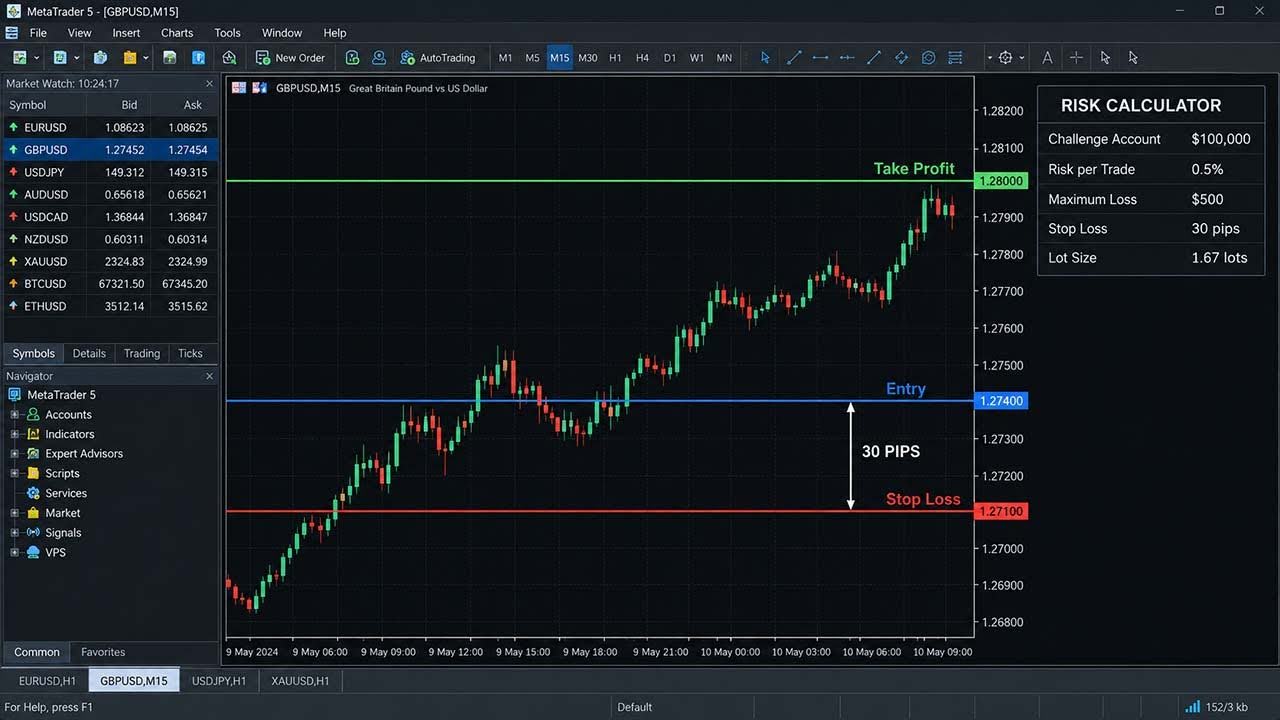
Suppose you have a $100,000 challenge account.
You decide to risk 0.5% on each trade.
That means your maximum planned loss is:
$100,000 × 0.5% = $500
Your next step is choosing your stop loss.
Position size can then be calculated from the $500 risk and stop distance.
The account's maximum leverage only determines whether enough margin exists to open that position.
This approach keeps leverage from controlling your risk plan.
2. Avoid Using Maximum Available Leverage
A prop firm may offer 1:100 leverage.
That does not mean your trades should use anything close to that exposure.
Imagine a $100,000 account controlling $500,000 of market exposure.
Your effective leverage would be about 5:1.
If the account technically allows 100:1, you still have plenty of unused buying power.
Now compare that with controlling $3 million from the same account.
A small price move can create a much larger change in account equity.
This becomes dangerous when the challenge has strict drawdown rules.
High available leverage is useful.
High used leverage is where problems often begin.
The leverage offered by a prop firm only sets the maximum available capacity. Comparing real leverage vs account leverage shows how much exposure your open positions are actually creating.

3. Keep Risk Per Trade Small
Many prop traders risk somewhere between 0.25% and 1% per trade.
The right amount depends on your strategy.
For example:
0.25% risk: Useful for high-frequency strategies or losing streaks.
0.5% risk: A balanced level for many challenge traders.
1% risk: More aggressive and requires stronger control.
2%+ risk: Can quickly become dangerous during a prop challenge.
Consider a trader risking 2% per position.
Three full losses equal roughly 6% of starting capital.
That could place the account close to its daily or total drawdown limit.
At 0.5% risk, the same three losses equal about 1.5%.
You now have much more room to recover.
4. Match Leverage to Your Trading Style
Different trading styles need different amounts of buying power.
Scalping
Scalpers often open short-duration positions with tight stops.
Higher available leverage can help with margin needs.
However, frequent trades can also increase total exposure quickly.
A scalper may have several positions open at once.
Risk across all open trades should still remain controlled.
Day Trading
For most day traders, 1:30 or 1:50 is usually enough.
These traders may open several trades during active market sessions.
Moderate leverage gives them flexibility without encouraging huge positions.
Swing Trading
Swing traders often use wider stop losses and hold positions longer.
They usually require less leverage.
A wide stop means position size should be smaller to keep risk fixed.
Lower effective leverage often works well for this style.
5. Pay Attention to Total Open Risk
Risking 0.5% per trade sounds conservative.
But what happens when five positions are open?
If every position risks 0.5%, total open risk could reach 2.5%.
Correlation can make this even worse.
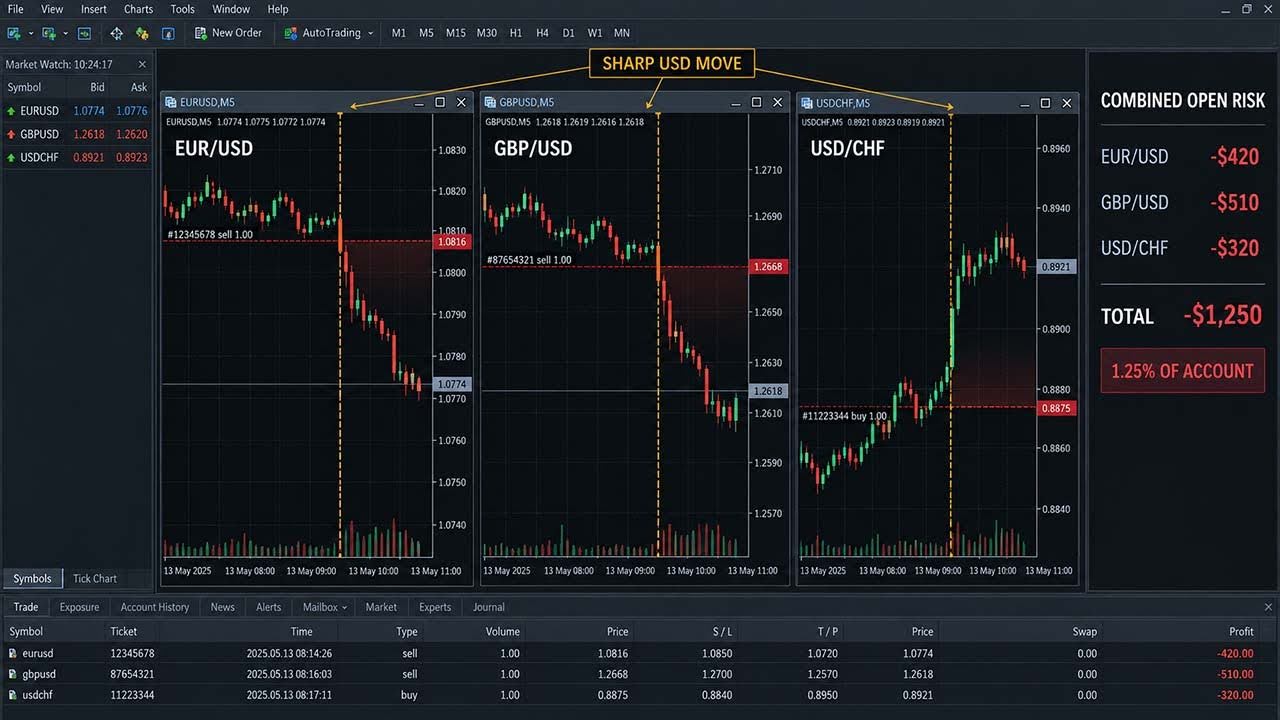
Imagine buying EUR/USD, GBP/USD, and selling USD/CHF.
These trades may all depend heavily on the same US dollar move.
They look like three separate trades.
In practice, they may behave like one large directional bet.
Before opening another position, check:
Current open risk
Currency exposure
Correlated positions
Remaining daily loss room
Available margin
This matters more than the headline leverage ratio.
6. Leave Room for Losing Streaks
No strategy wins every trade.
Your leverage plan should assume losing streaks will happen.
Suppose you risk 0.5% per trade and lose six trades.
Your loss is around 3%, ignoring small changes from account balance.
Now assume you risk 1.5%.
Six losses could cost around 9%.
The strategy may be exactly the same.
Only the position sizing changed.
This is why aggressive leverage can make good strategies fail prop challenges.
The trader simply runs out of drawdown room before the strategy recovers.
7. Do Not Increase Leverage to Chase the Profit Target
A profit target can create pressure.
You may reach 5% profit and start thinking about the remaining target.
That is when many traders increase lot sizes.
A few winning trades may pass the challenge faster.
One large loss can also erase days of progress.
If your normal strategy risks 0.5% per trade, keep that approach near the target.
Do not suddenly risk 2% because you are close to passing.
The same rule applies after losses.
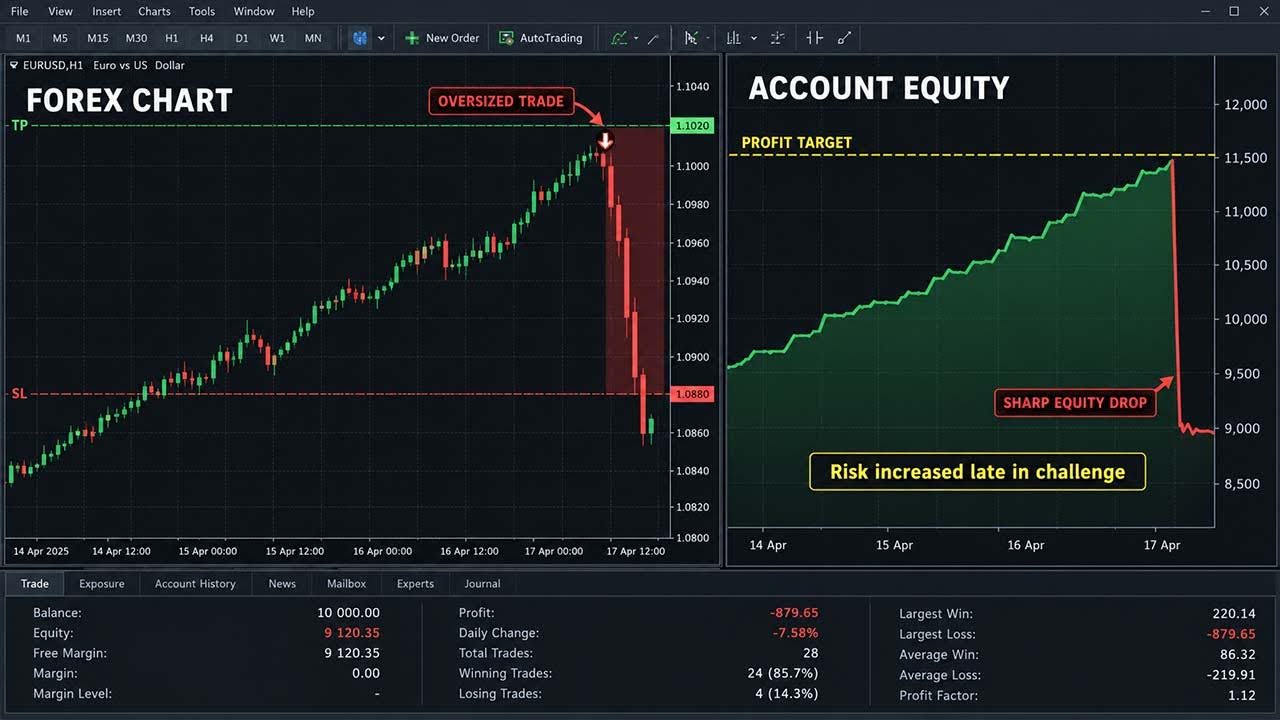
Increasing position size to recover earlier losses is one of the fastest ways to breach a challenge.
Higher leverage can make oversized trades easier to open, especially when traders try to reach a profit target quickly. This can lead to overleveraging in forex and much larger account swings.
Is 1:100 Leverage Too High for a Prop Challenge?
Not by itself.
A 1:100 account does not automatically create high risk.
It only gives you access to more buying power.
You could have 1:100 available leverage while using very small positions.
In that case, actual exposure may remain conservative.
Problems begin when traders treat maximum leverage like available risk capital.
That is not what leverage represents.
Your drawdown limit remains the real boundary.
1:50 vs 1:100 Leverage for Prop Challenges
Both can work.
1:50 leverage is usually enough for most forex traders.
It provides strong buying power while reducing the temptation to open extreme positions.
1:100 leverage offers more flexibility.
It may suit scalpers, active day traders, and traders managing several positions.
But 1:100 does not mean trades should become twice as large.
Position size should still come from your stop loss and planned account risk.
At Pipstone Capital, the current 1-Step Challenge offers 1:50 leverage, while the 2-Step Challenge offers 1:100. Both models also have no time limit, which removes the need to increase risk simply because a deadline is approaching.
7 Rules for Using Leverage During a Prop Challenge
A simple risk framework can prevent many avoidable challenge failures:
Risk 0.25% to 1% per trade.
Calculate position size before entering.
Never treat maximum leverage as a target.
Track total risk across all open positions.
Reduce exposure when trading correlated markets.
Do not increase lot size after losses.
Protect the drawdown limit before chasing the profit target.
These rules make leverage a tool rather than a threat.
What Leverage Should Beginners Use?
Beginners should usually focus on moderate leverage.
Something around 1:30 or 1:50 provides enough room for most forex strategies.
More importantly, beginners should keep actual trade risk low.
Starting around 0.25% to 0.5% per trade can provide more room for mistakes.
A challenge is already difficult enough without oversized positions.
Learning to survive losing trades is more important than maximizing buying power.
Final Thoughts
The best leverage for a prop-firm challenge is not necessarily the highest leverage offered.
For most traders, 1:30 to 1:50 provides plenty of buying power.
A 1:100 challenge can also work well when position sizes stay controlled.
What matters most is how much money you risk when the trade hits its stop loss.
Keep risk small. Watch your total exposure. Leave enough drawdown room for losing streaks.
The goal is not to use as much leverage as possible.
The goal is to reach the profit target without losing control of the account.
Pipstone Capital offers both 1-Step and 2-Step challenge models, giving traders different leverage and risk structures to match their trading style. Traders can focus on their setup without a fixed challenge deadline, while still respecting the account's drawdown rules.
Frequently Asked Questions
What is the best leverage for a prop-firm challenge?
For many traders, 1:30 to 1:50 provides enough buying power. Position size and risk per trade matter more than maximum leverage.
Is 1:100 leverage good for prop trading?
Yes. 1:100 gives traders more margin flexibility. It becomes risky only when that extra buying power is used to open oversized positions.
How much should I risk per trade during a prop challenge?
Many traders stay between 0.25% and 1% per trade. Lower risk gives the account more room to survive losing streaks.
Can high leverage make you fail a prop-firm challenge?
High available leverage alone will not cause failure. Oversized positions can create large losses and trigger daily or overall drawdown limits.
Should I lower my leverage after losing trades?
You should normally reduce position size rather than trying to recover losses with larger trades. Increasing risk after losses can quickly push the account toward its drawdown limit.



What Leverage Should You Use During a Prop-Firm Challenge?
Leverage can help during a prop-firm challenge, but more is not always better.
Many traders see 1:50 or 1:100 leverage and focus on buying power. The bigger concern should be how much of that buying power you actually use.
A prop challenge normally has strict daily and total loss limits. That changes how leverage should be approached.
Using too much exposure can turn one normal losing trade into a serious drawdown. Using too little may make the profit target harder to reach.
So, what leverage should you use during a prop-firm challenge?
For most traders, 1:30 to 1:50 provides more than enough buying power. Even when a challenge offers 1:100, you do not need to use the full amount.
Your position size, stop loss, and risk per trade matter far more.
What Does Leverage Mean in a Prop-Firm Challenge?
Leverage lets you control a larger market position with less required margin.
For example, 1:50 leverage means every $1 of margin can control $50.
With 1:100 leverage, that same $1 can control $100.
That does not mean you should open positions worth 100 times your account balance.
Think of leverage as your maximum available buying power, not a target.
A trader using a 1:100 account can still trade more carefully than someone using 1:30.
The difference comes down to position size.
What Is the Best Leverage for a Prop-Firm Challenge?
There is no single best leverage ratio for every trader.
However, these ranges give a useful starting point:
Leverage | Best suited for | Risk level |
1:10 | Very cautious trading | Low |
1:20 | Swing traders and beginners | Low |
1:30 | Controlled forex trading | Low to moderate |
1:50 | Most prop challenge strategies | Moderate |
1:100 | Active and experienced traders | Moderate to high |
1:200+ | Very aggressive trading | High |
For most challenge traders, 1:30 to 1:50 is enough.
Forex pairs usually do not require extreme leverage when positions are sized correctly.
A 1:100 account can also work well. You simply need to avoid using all the buying power available.
Challenge traders do not need to use the maximum leverage available on their account. The best leverage for forex trading depends on account size, strategy, stop distance and the trader’s ability to control exposure.
1. Start With Risk Per Trade, Not Leverage
This is one of the biggest mistakes traders make during evaluations.
They ask:
“How much leverage can I use?”
A better question is:
“How much am I willing to lose if this trade fails?”
Suppose you have a $100,000 challenge account.
You decide to risk 0.5% on each trade.
That means your maximum planned loss is:
$100,000 × 0.5% = $500
Your next step is choosing your stop loss.
Position size can then be calculated from the $500 risk and stop distance.
The account's maximum leverage only determines whether enough margin exists to open that position.
This approach keeps leverage from controlling your risk plan.
2. Avoid Using Maximum Available Leverage
A prop firm may offer 1:100 leverage.
That does not mean your trades should use anything close to that exposure.
Imagine a $100,000 account controlling $500,000 of market exposure.
Your effective leverage would be about 5:1.
If the account technically allows 100:1, you still have plenty of unused buying power.
Now compare that with controlling $3 million from the same account.
A small price move can create a much larger change in account equity.
This becomes dangerous when the challenge has strict drawdown rules.
High available leverage is useful.
High used leverage is where problems often begin.
The leverage offered by a prop firm only sets the maximum available capacity. Comparing real leverage vs account leverage shows how much exposure your open positions are actually creating.
3. Keep Risk Per Trade Small
Many prop traders risk somewhere between 0.25% and 1% per trade.
The right amount depends on your strategy.
For example:
0.25% risk: Useful for high-frequency strategies or losing streaks.
0.5% risk: A balanced level for many challenge traders.
1% risk: More aggressive and requires stronger control.
2%+ risk: Can quickly become dangerous during a prop challenge.
Consider a trader risking 2% per position.
Three full losses equal roughly 6% of starting capital.
That could place the account close to its daily or total drawdown limit.
At 0.5% risk, the same three losses equal about 1.5%.
You now have much more room to recover.
4. Match Leverage to Your Trading Style
Different trading styles need different amounts of buying power.
Scalping
Scalpers often open short-duration positions with tight stops.
Higher available leverage can help with margin needs.
However, frequent trades can also increase total exposure quickly.
A scalper may have several positions open at once.
Risk across all open trades should still remain controlled.
Day Trading
For most day traders, 1:30 or 1:50 is usually enough.
These traders may open several trades during active market sessions.
Moderate leverage gives them flexibility without encouraging huge positions.
Swing Trading
Swing traders often use wider stop losses and hold positions longer.
They usually require less leverage.
A wide stop means position size should be smaller to keep risk fixed.
Lower effective leverage often works well for this style.
5. Pay Attention to Total Open Risk
Risking 0.5% per trade sounds conservative.
But what happens when five positions are open?
If every position risks 0.5%, total open risk could reach 2.5%.
Correlation can make this even worse.
Imagine buying EUR/USD, GBP/USD, and selling USD/CHF.
These trades may all depend heavily on the same US dollar move.
They look like three separate trades.
In practice, they may behave like one large directional bet.
Before opening another position, check:
Current open risk
Currency exposure
Correlated positions
Remaining daily loss room
Available margin
This matters more than the headline leverage ratio.
6. Leave Room for Losing Streaks
No strategy wins every trade.
Your leverage plan should assume losing streaks will happen.
Suppose you risk 0.5% per trade and lose six trades.
Your loss is around 3%, ignoring small changes from account balance.
Now assume you risk 1.5%.
Six losses could cost around 9%.
The strategy may be exactly the same.
Only the position sizing changed.
This is why aggressive leverage can make good strategies fail prop challenges.
The trader simply runs out of drawdown room before the strategy recovers.
7. Do Not Increase Leverage to Chase the Profit Target
A profit target can create pressure.
You may reach 5% profit and start thinking about the remaining target.
That is when many traders increase lot sizes.
A few winning trades may pass the challenge faster.
One large loss can also erase days of progress.
If your normal strategy risks 0.5% per trade, keep that approach near the target.
Do not suddenly risk 2% because you are close to passing.
The same rule applies after losses.
Increasing position size to recover earlier losses is one of the fastest ways to breach a challenge.
Higher leverage can make oversized trades easier to open, especially when traders try to reach a profit target quickly. This can lead to overleveraging in forex and much larger account swings.
Is 1:100 Leverage Too High for a Prop Challenge?
Not by itself.
A 1:100 account does not automatically create high risk.
It only gives you access to more buying power.
You could have 1:100 available leverage while using very small positions.
In that case, actual exposure may remain conservative.
Problems begin when traders treat maximum leverage like available risk capital.
That is not what leverage represents.
Your drawdown limit remains the real boundary.
1:50 vs 1:100 Leverage for Prop Challenges
Both can work.
1:50 leverage is usually enough for most forex traders.
It provides strong buying power while reducing the temptation to open extreme positions.
1:100 leverage offers more flexibility.
It may suit scalpers, active day traders, and traders managing several positions.
But 1:100 does not mean trades should become twice as large.
Position size should still come from your stop loss and planned account risk.
At Pipstone Capital, the current 1-Step Challenge offers 1:50 leverage, while the 2-Step Challenge offers 1:100. Both models also have no time limit, which removes the need to increase risk simply because a deadline is approaching.
7 Rules for Using Leverage During a Prop Challenge
A simple risk framework can prevent many avoidable challenge failures:
Risk 0.25% to 1% per trade.
Calculate position size before entering.
Never treat maximum leverage as a target.
Track total risk across all open positions.
Reduce exposure when trading correlated markets.
Do not increase lot size after losses.
Protect the drawdown limit before chasing the profit target.
These rules make leverage a tool rather than a threat.
What Leverage Should Beginners Use?
Beginners should usually focus on moderate leverage.
Something around 1:30 or 1:50 provides enough room for most forex strategies.
More importantly, beginners should keep actual trade risk low.
Starting around 0.25% to 0.5% per trade can provide more room for mistakes.
A challenge is already difficult enough without oversized positions.
Learning to survive losing trades is more important than maximizing buying power.
Final Thoughts
The best leverage for a prop-firm challenge is not necessarily the highest leverage offered.
For most traders, 1:30 to 1:50 provides plenty of buying power.
A 1:100 challenge can also work well when position sizes stay controlled.
What matters most is how much money you risk when the trade hits its stop loss.
Keep risk small. Watch your total exposure. Leave enough drawdown room for losing streaks.
The goal is not to use as much leverage as possible.
The goal is to reach the profit target without losing control of the account.
Pipstone Capital offers both 1-Step and 2-Step challenge models, giving traders different leverage and risk structures to match their trading style. Traders can focus on their setup without a fixed challenge deadline, while still respecting the account's drawdown rules.
Frequently Asked Questions
What is the best leverage for a prop-firm challenge?
For many traders, 1:30 to 1:50 provides enough buying power. Position size and risk per trade matter more than maximum leverage.
Is 1:100 leverage good for prop trading?
Yes. 1:100 gives traders more margin flexibility. It becomes risky only when that extra buying power is used to open oversized positions.
How much should I risk per trade during a prop challenge?
Many traders stay between 0.25% and 1% per trade. Lower risk gives the account more room to survive losing streaks.
Can high leverage make you fail a prop-firm challenge?
High available leverage alone will not cause failure. Oversized positions can create large losses and trigger daily or overall drawdown limits.
Should I lower my leverage after losing trades?
You should normally reduce position size rather than trying to recover losses with larger trades. Increasing risk after losses can quickly push the account toward its drawdown limit.
