


Can You Trade Forex Without Leverage?

Yes, you can trade forex without leverage. You simply trade with money already available in your account.
This approach is often called forex trading without leverage or trading at 1:1. Your trade value matches the funds you use.
Many retail forex traders use leverage because currency prices often move by small amounts. Leverage lets traders control larger trades with less money.
But leverage is not a rule. You can trade without it if your broker supports 1:1 trading.
The main trade-off is simple. Your risk is lower, but your profit potential is also smaller.
This guide explains how no leverage forex trading works and when it may make sense. We will also look at capital needs, risk, profit, and common limits.
At Pipstone Capital, traders should understand how trade size changes risk before opening any forex position.
What Does 1:1 Leverage Mean?
A leverage ratio shows how much market exposure your capital can control.
With 1:1 leverage, you do not gain any extra buying power from your broker.
If you have $5,000 available, you can control up to $5,000 in market value.
You are not using $500 to control a $5,000 position. You fund the full amount yourself.
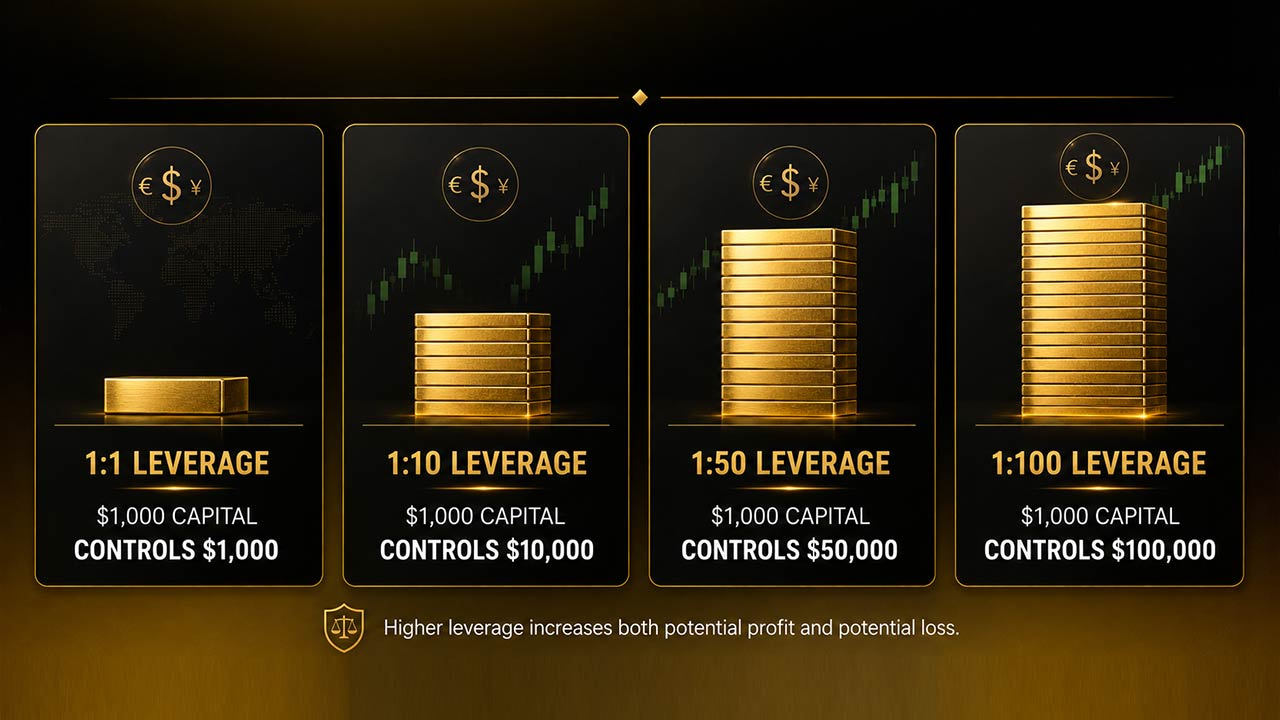
Here is a simple comparison:
1:1 leverage: $1,000 controls $1,000.
1:10 leverage: $1,000 can control $10,000.
1:50 leverage: $1,000 can control $50,000.
1:100 leverage: $1,000 can control $100,000.
Higher leverage does not change how the currency pair moves.
It changes how much exposure you have compared with your own funds.
That difference can have a large impact on both profit and loss. Its best if new traders first learn what is leverage trading in forex to feel comfortable moving forward in leverage trading.
Can You Trade Forex Without Leverage?
Yes. Can you trade forex without leverage? The answer depends mainly on your broker and account settings.
Some brokers let clients trade at 1:1. Others offer a minimum leverage level above that amount.
You should check the broker's account terms before funding an account.
No leverage does not mean forex becomes risk-free.
A currency pair can still move against your position and cause losses.
The difference is that those losses are not magnified by a much larger trade size.
Your account also has more room to absorb normal market moves.
This can make 1:1 trading easier to manage for some traders.
Traders should first check and learn how to choose the best leverage in forex trading.

How Forex Trading Without Leverage Works
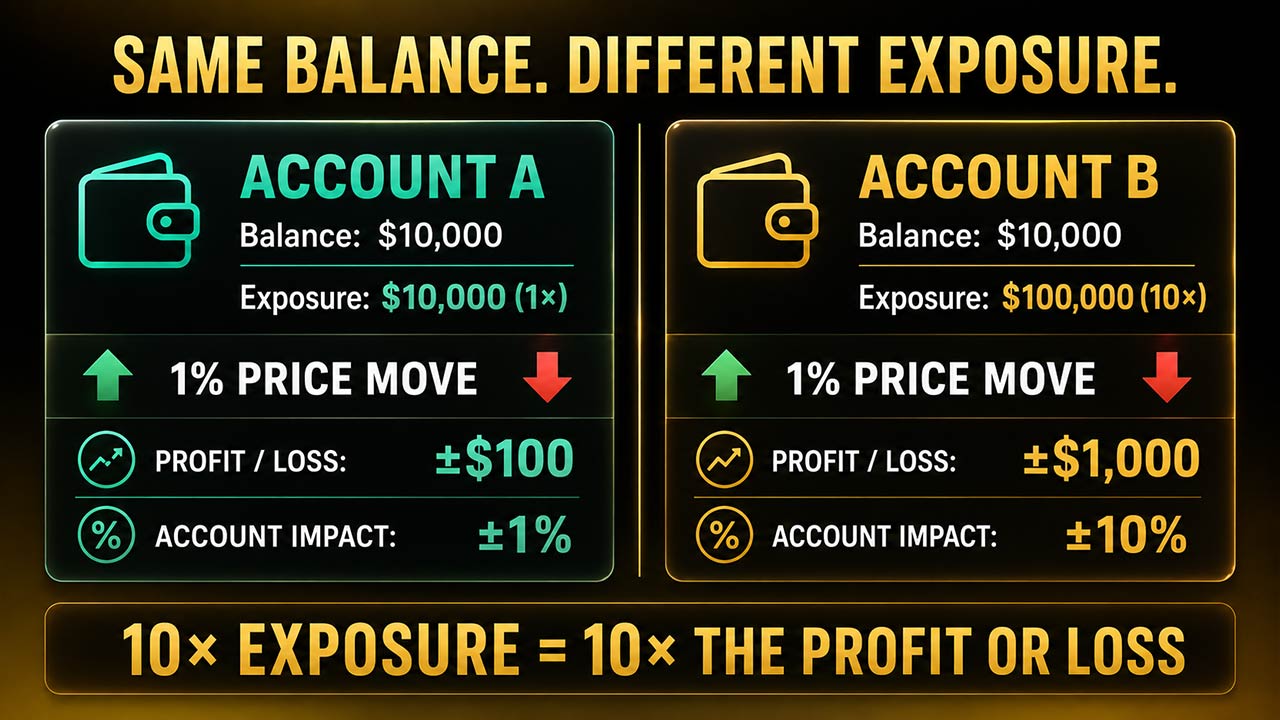
Suppose you have $10,000 in your trading account.
With 1:1 leverage, you could open a position worth $10,000.
Now assume the market moves 1% in your favor.
Your position would gain about $100 before costs.
If the market fell by 1%, your position would lose about $100.
Now compare that with a much larger leveraged trade.
If the same $10,000 account controlled $100,000, a 1% move equals $1,000.
Your gain would be larger when correct.
Your loss would also be much larger when wrong.
That is the core difference between leveraged and non-leveraged forex trading.
How Much Capital Do You Need Without Leverage?
Capital requirements are one of the biggest limits of trading without leverage.
Forex positions can require large amounts of money when you fund the full trade value.
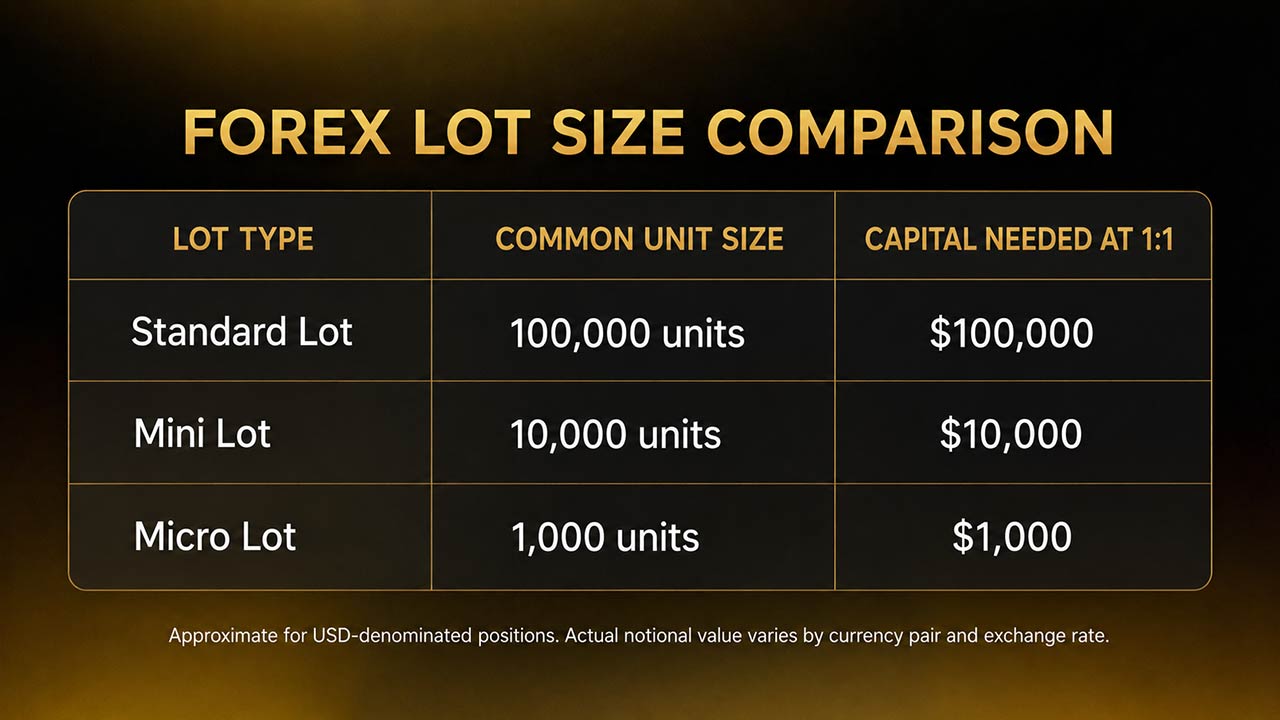
A standard forex lot usually represents 100,000 units of the base currency.
Without leverage, controlling that full position would need a large amount of capital.
Smaller trade sizes can reduce the amount you need.
Many brokers support mini lots, micro lots, or smaller trade sizes.
For example:
A standard lot represents around 100,000 units.
A mini lot represents around 10,000 units.
A micro lot represents around 1,000 units.
The exact cash needed also depends on the currency pair you trade.
A trader with a small account may find 1:1 trading quite limiting.
You may only be able to open very small positions.
That can make each winning trade worth only a small amount.
Profit Differences Without Leverage
The biggest change in forex trading without leverage is usually the size of your profit.
Currencies often move by small amounts during normal market conditions.
A 0.5% move can still be meaningful.
But the dollar gain may remain small when your trade value is also small.
Assume you place a $5,000 forex position.
A 1% move in your favor creates roughly a $50 gain before trading costs.
Now assume leverage lets you control a $50,000 position instead.
That same 1% move creates around $500 in profit.
This is why many retail forex traders use leverage.
They want more exposure without depositing the full value of each trade.
But the same math also applies when the market moves against you.
Loss Differences Without Leverage
Trading without leverage can reduce the speed of large account losses.
That is because your position size stays closer to the money you actually hold.
A 2% loss on a $10,000 position equals about $200.
A 2% loss on a $100,000 position equals about $2,000.
Both trades may come from an account holding the same amount of cash.
The second trader simply controls much more market exposure.
This is why high leverage can create large drawdowns quickly. Understanding high leverage vs low leverage can help traders see how each approach changes market exposure and account risk.
It can also make recovering from losses much harder.
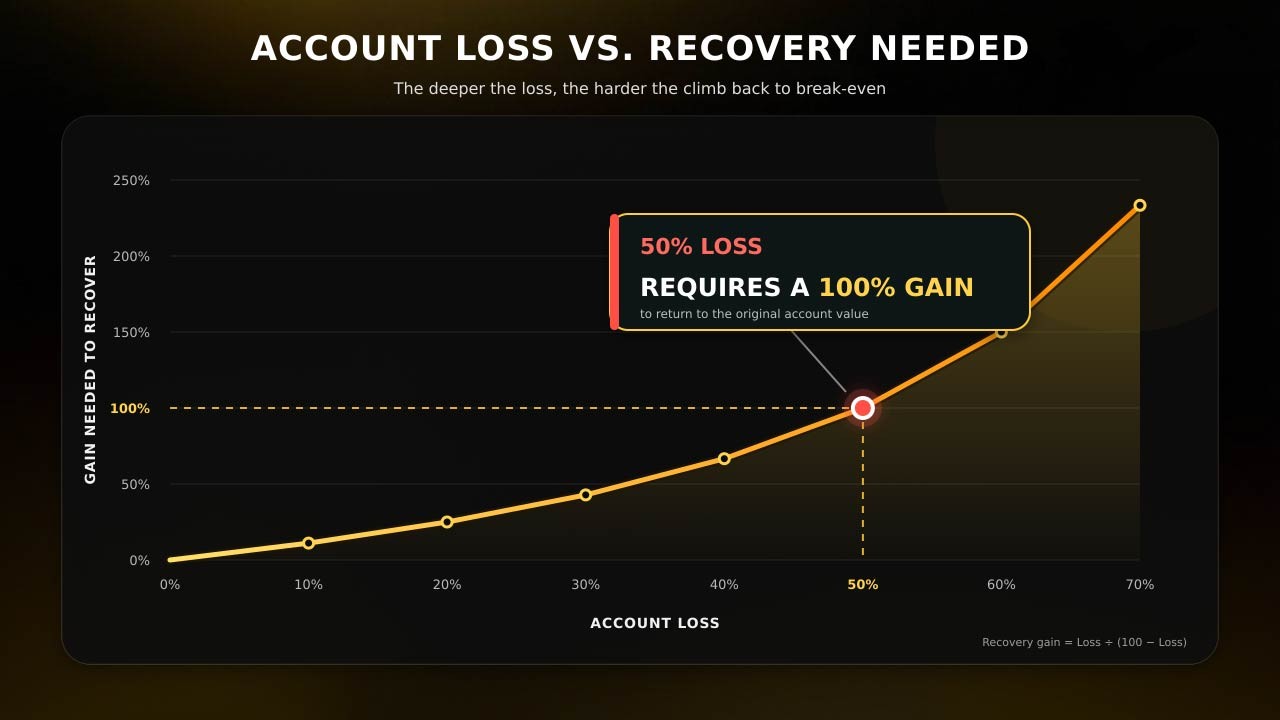
For example, losing 50% of an account leaves only half the starting capital.
The remaining funds must then gain 100% to return to the starting balance.
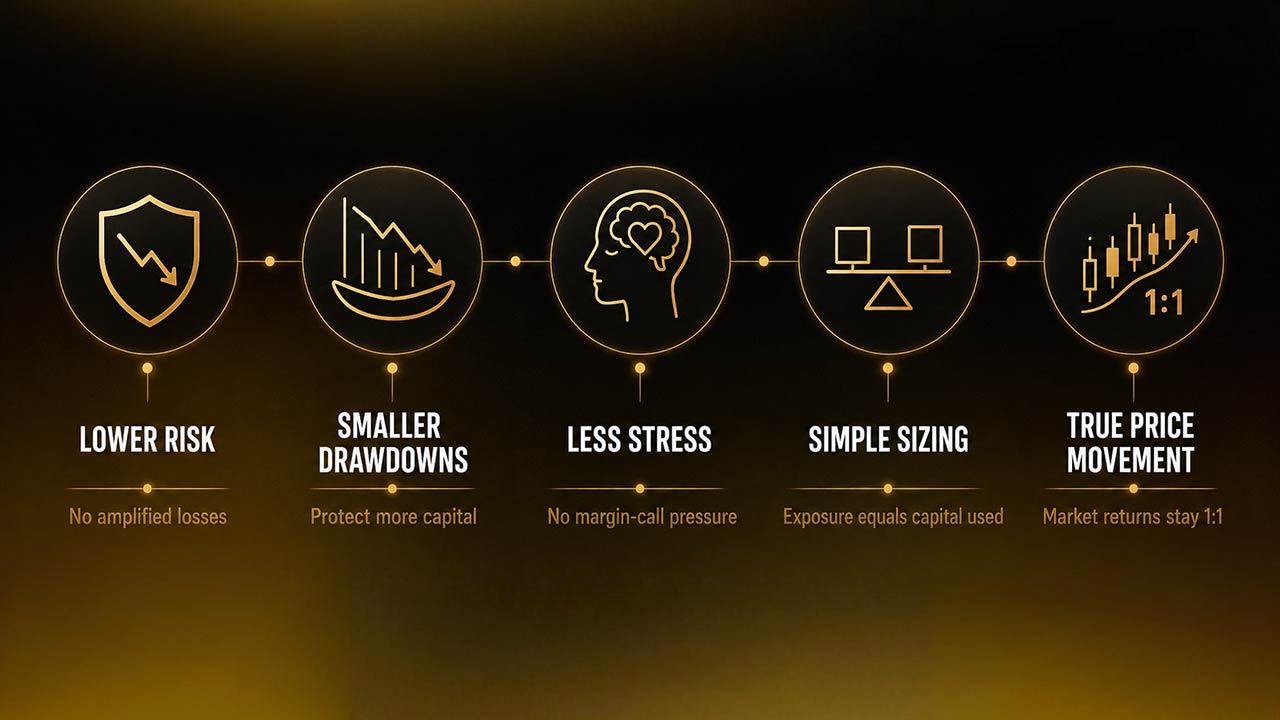
Advantages of No Leverage Forex Trading
There are several reasons traders may prefer 1:1 exposure.
1. Lower Risk From Position Size
Your trades are not much larger than the funds used to open them.
This can limit the impact of each price move on your account.
2. Smaller Drawdowns
Smaller exposure often means losing trades have less impact on total account value.
This can help protect capital during poor trading periods.
3. Less Pressure
Large leveraged positions can cause sharp changes in account value.
Smaller positions may reduce the stress tied to short-term price swings.
4. Simple Position Sizing
The relationship between your cash and market exposure is easier to understand.
You can see how much money is being used for each trade.
5. More Room for Normal Price Moves
Forex prices can move against a trade before moving in the expected direction.
Lower exposure gives the account more room during those moves.
Limitations of Forex Trading Without Leverage
Trading without leverage also has clear downsides.
1. You Need More Capital
You must fund most or all of the position with your own money.
That can make larger positions hard to open.
2. Profit Potential Is Lower
A small forex price move produces a small dollar return on a small position.
This may not meet the goals of active traders.
3. Cash Gets Tied Up
More of your account balance is needed to hold each position.
That leaves less money available for other trades.
4. Diversification Becomes Harder
Opening several positions at once can require a large account.
Small accounts may only support a few trades.
5. Returns May Grow Slowly
Lower exposure usually creates smaller gains when your trade performs well.
Account growth may take longer as a result.
Is Leverage Necessary for Retail Forex Trading?
No. Leverage is not required to trade forex.
However, it plays a major role in retail forex because of how currencies move.
Daily currency moves are often small compared with stocks or some digital assets.
Without leverage, those price changes can produce fairly small cash gains.
That is why brokers offer leveraged trading.
It gives retail traders access to larger market exposure with less cash.
But access does not mean traders should always use the maximum amount available.
A broker may offer 1:100 or 1:500 leverage.
That does not mean every trade must use that full level.
Trade size controls how much leverage you actually use.
You can keep exposure small even when your account offers higher leverage.
This is an important point for new traders.
The account's maximum leverage and your actual leverage are not always the same.
Can You Day Trade Forex Without Leverage?
Yes, but the profit per trade may be quite small.
Day traders often target short price moves during active market hours.
Those moves might be only a fraction of one percent.
With a small position, that can create very small cash returns.
This does not make the approach wrong.
It simply changes what results you should expect from each trade.
Day traders using 1:1 exposure may need more capital to make returns meaningful.
Can You Swing Trade Forex Without Leverage?
Swing trading may fit no-leverage trading better for some traders.
Swing trades often stay open for several days or weeks.
That gives prices more time to make larger moves.
A trader may therefore capture a larger percentage move without increasing exposure.
Still, holding trades longer creates other risks.
News, rate decisions, and economic reports can move currencies while positions remain open.
Risk controls still matter even when no leverage is used.
Common Mistakes When Trading Without Leverage
Removing leverage does not remove poor trading habits.
Traders still need a clear plan and firm risk rules.
Common mistakes include:
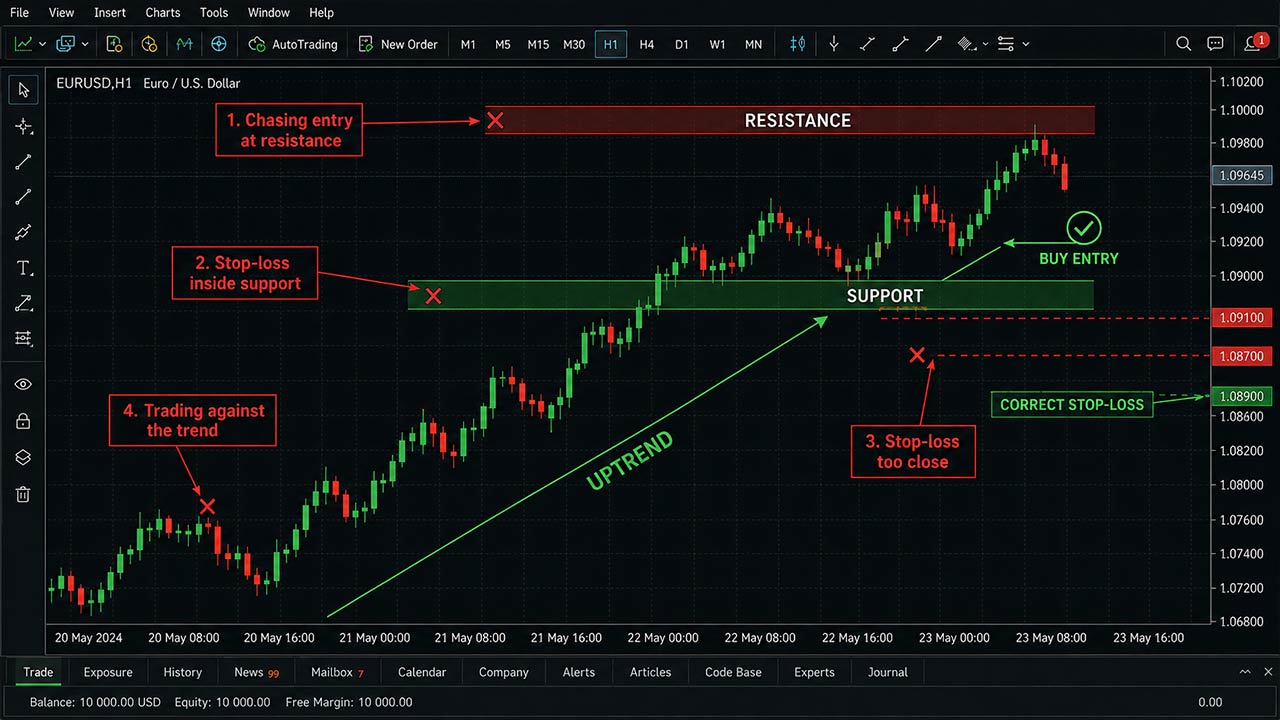
Trading without a stop-loss plan.
Using one indicator for every decision.
Ignoring support and resistance levels.
Opening too many linked currency trades.
Risking too much capital on one idea.
Changing plans because of fear or greed.
Ignoring trading costs and spreads.
Entering trades without checking the wider trend.
It also helps to check more than one chart timeframe.
A short-term setup can look strong while the larger trend points the other way.
Keeping a trade journal can also help spot repeated mistakes.
Is Trading Without Leverage Safer?
It can reduce one major source of risk: oversized market exposure.
But it cannot remove market risk.
You can still lose money when a currency pair moves against your trade.
Poor entries, weak risk control, and bad trade plans still cause losses.
A trader using 1:1 can also lose a large amount through poor position sizing.
The main benefit is that losses are not increased by huge exposure.
That can make account risk easier to control.
Who Might Prefer Forex Trading Without Leverage?
No leverage forex trading may suit traders who:
Have enough capital to fund their positions.
Prefer smaller changes in account value.
Want to focus on protecting capital.
Accept slower account growth.
Trade longer-term market moves.
Want a simple link between cash and exposure.
It may be less useful for traders with very small accounts.
Those traders may struggle to create meaningful returns from normal currency moves.
Final Thoughts
So, can you trade forex without leverage? Yes. At 1:1, your position value closely matches the capital used for the trade.
This can reduce exposure and make account swings easier to manage. The trade-off is higher capital needs and smaller profit potential from normal currency moves.
Leverage is common in retail forex, but using the maximum available amount is never required. What matters most is choosing a position size that fits your risk plan.
For traders who prefer more flexibility, Pipstone Capital offers leverage up to 1:100 with raw spreads on its simulated accounts. Traders can also complete challenges without a time limit and trade through major news events. These features give traders more control over how and when they use their available buying power.
FAQs
Can you trade forex with no leverage?
Yes. If your broker supports 1:1 trading, you can trade using only your own capital.
What does 1:1 leverage mean?
It means $1 of your money controls about $1 of market exposure.
Is forex trading without leverage safer?
It reduces the risk caused by oversized positions. However, forex trading still carries market risk.
How much money do you need to trade without leverage?
It depends on your trade size and currency pair. Larger positions require much more capital at 1:1.
Can you make money trading forex without leverage?
Yes, but gains are usually smaller because your market exposure is lower.
Is leverage required for retail forex trading?
No. Leverage is optional, although many retail traders use it to access larger positions with less capital.



Can You Trade Forex Without Leverage?
Yes, you can trade forex without leverage. You simply trade with money already available in your account.
This approach is often called forex trading without leverage or trading at 1:1. Your trade value matches the funds you use.
Many retail forex traders use leverage because currency prices often move by small amounts. Leverage lets traders control larger trades with less money.
But leverage is not a rule. You can trade without it if your broker supports 1:1 trading.
The main trade-off is simple. Your risk is lower, but your profit potential is also smaller.
This guide explains how no leverage forex trading works and when it may make sense. We will also look at capital needs, risk, profit, and common limits.
At Pipstone Capital, traders should understand how trade size changes risk before opening any forex position.
What Does 1:1 Leverage Mean?
A leverage ratio shows how much market exposure your capital can control.
With 1:1 leverage, you do not gain any extra buying power from your broker.
If you have $5,000 available, you can control up to $5,000 in market value.
You are not using $500 to control a $5,000 position. You fund the full amount yourself.
Here is a simple comparison:
1:1 leverage: $1,000 controls $1,000.
1:10 leverage: $1,000 can control $10,000.
1:50 leverage: $1,000 can control $50,000.
1:100 leverage: $1,000 can control $100,000.
Higher leverage does not change how the currency pair moves.
It changes how much exposure you have compared with your own funds.
That difference can have a large impact on both profit and loss. Its best if new traders first learn what is leverage trading in forex to feel comfortable moving forward in leverage trading.
Can You Trade Forex Without Leverage?
Yes. Can you trade forex without leverage? The answer depends mainly on your broker and account settings.
Some brokers let clients trade at 1:1. Others offer a minimum leverage level above that amount.
You should check the broker's account terms before funding an account.
No leverage does not mean forex becomes risk-free.
A currency pair can still move against your position and cause losses.
The difference is that those losses are not magnified by a much larger trade size.
Your account also has more room to absorb normal market moves.
This can make 1:1 trading easier to manage for some traders.
Traders should first check and learn how to choose the best leverage in forex trading.
How Forex Trading Without Leverage Works
Suppose you have $10,000 in your trading account.
With 1:1 leverage, you could open a position worth $10,000.
Now assume the market moves 1% in your favor.
Your position would gain about $100 before costs.
If the market fell by 1%, your position would lose about $100.
Now compare that with a much larger leveraged trade.
If the same $10,000 account controlled $100,000, a 1% move equals $1,000.
Your gain would be larger when correct.
Your loss would also be much larger when wrong.
That is the core difference between leveraged and non-leveraged forex trading.
How Much Capital Do You Need Without Leverage?
Capital requirements are one of the biggest limits of trading without leverage.
Forex positions can require large amounts of money when you fund the full trade value.
A standard forex lot usually represents 100,000 units of the base currency.
Without leverage, controlling that full position would need a large amount of capital.
Smaller trade sizes can reduce the amount you need.
Many brokers support mini lots, micro lots, or smaller trade sizes.
For example:
A standard lot represents around 100,000 units.
A mini lot represents around 10,000 units.
A micro lot represents around 1,000 units.
The exact cash needed also depends on the currency pair you trade.
A trader with a small account may find 1:1 trading quite limiting.
You may only be able to open very small positions.
That can make each winning trade worth only a small amount.
Profit Differences Without Leverage
The biggest change in forex trading without leverage is usually the size of your profit.
Currencies often move by small amounts during normal market conditions.
A 0.5% move can still be meaningful.
But the dollar gain may remain small when your trade value is also small.
Assume you place a $5,000 forex position.
A 1% move in your favor creates roughly a $50 gain before trading costs.
Now assume leverage lets you control a $50,000 position instead.
That same 1% move creates around $500 in profit.
This is why many retail forex traders use leverage.
They want more exposure without depositing the full value of each trade.
But the same math also applies when the market moves against you.
Loss Differences Without Leverage
Trading without leverage can reduce the speed of large account losses.
That is because your position size stays closer to the money you actually hold.
A 2% loss on a $10,000 position equals about $200.
A 2% loss on a $100,000 position equals about $2,000.
Both trades may come from an account holding the same amount of cash.
The second trader simply controls much more market exposure.
This is why high leverage can create large drawdowns quickly. Understanding high leverage vs low leverage can help traders see how each approach changes market exposure and account risk.
It can also make recovering from losses much harder.
For example, losing 50% of an account leaves only half the starting capital.
The remaining funds must then gain 100% to return to the starting balance.
Advantages of No Leverage Forex Trading
There are several reasons traders may prefer 1:1 exposure.
1. Lower Risk From Position Size
Your trades are not much larger than the funds used to open them.
This can limit the impact of each price move on your account.
2. Smaller Drawdowns
Smaller exposure often means losing trades have less impact on total account value.
This can help protect capital during poor trading periods.
3. Less Pressure
Large leveraged positions can cause sharp changes in account value.
Smaller positions may reduce the stress tied to short-term price swings.
4. Simple Position Sizing
The relationship between your cash and market exposure is easier to understand.
You can see how much money is being used for each trade.
5. More Room for Normal Price Moves
Forex prices can move against a trade before moving in the expected direction.
Lower exposure gives the account more room during those moves.
Limitations of Forex Trading Without Leverage
Trading without leverage also has clear downsides.
1. You Need More Capital
You must fund most or all of the position with your own money.
That can make larger positions hard to open.
2. Profit Potential Is Lower
A small forex price move produces a small dollar return on a small position.
This may not meet the goals of active traders.
3. Cash Gets Tied Up
More of your account balance is needed to hold each position.
That leaves less money available for other trades.
4. Diversification Becomes Harder
Opening several positions at once can require a large account.
Small accounts may only support a few trades.
5. Returns May Grow Slowly
Lower exposure usually creates smaller gains when your trade performs well.
Account growth may take longer as a result.
Is Leverage Necessary for Retail Forex Trading?
No. Leverage is not required to trade forex.
However, it plays a major role in retail forex because of how currencies move.
Daily currency moves are often small compared with stocks or some digital assets.
Without leverage, those price changes can produce fairly small cash gains.
That is why brokers offer leveraged trading.
It gives retail traders access to larger market exposure with less cash.
But access does not mean traders should always use the maximum amount available.
A broker may offer 1:100 or 1:500 leverage.
That does not mean every trade must use that full level.
Trade size controls how much leverage you actually use.
You can keep exposure small even when your account offers higher leverage.
This is an important point for new traders.
The account's maximum leverage and your actual leverage are not always the same.
Can You Day Trade Forex Without Leverage?
Yes, but the profit per trade may be quite small.
Day traders often target short price moves during active market hours.
Those moves might be only a fraction of one percent.
With a small position, that can create very small cash returns.
This does not make the approach wrong.
It simply changes what results you should expect from each trade.
Day traders using 1:1 exposure may need more capital to make returns meaningful.
Can You Swing Trade Forex Without Leverage?
Swing trading may fit no-leverage trading better for some traders.
Swing trades often stay open for several days or weeks.
That gives prices more time to make larger moves.
A trader may therefore capture a larger percentage move without increasing exposure.
Still, holding trades longer creates other risks.
News, rate decisions, and economic reports can move currencies while positions remain open.
Risk controls still matter even when no leverage is used.
Common Mistakes When Trading Without Leverage
Removing leverage does not remove poor trading habits.
Traders still need a clear plan and firm risk rules.
Common mistakes include:
Trading without a stop-loss plan.
Using one indicator for every decision.
Ignoring support and resistance levels.
Opening too many linked currency trades.
Risking too much capital on one idea.
Changing plans because of fear or greed.
Ignoring trading costs and spreads.
Entering trades without checking the wider trend.
It also helps to check more than one chart timeframe.
A short-term setup can look strong while the larger trend points the other way.
Keeping a trade journal can also help spot repeated mistakes.
Is Trading Without Leverage Safer?
It can reduce one major source of risk: oversized market exposure.
But it cannot remove market risk.
You can still lose money when a currency pair moves against your trade.
Poor entries, weak risk control, and bad trade plans still cause losses.
A trader using 1:1 can also lose a large amount through poor position sizing.
The main benefit is that losses are not increased by huge exposure.
That can make account risk easier to control.
Who Might Prefer Forex Trading Without Leverage?
No leverage forex trading may suit traders who:
Have enough capital to fund their positions.
Prefer smaller changes in account value.
Want to focus on protecting capital.
Accept slower account growth.
Trade longer-term market moves.
Want a simple link between cash and exposure.
It may be less useful for traders with very small accounts.
Those traders may struggle to create meaningful returns from normal currency moves.
Final Thoughts
So, can you trade forex without leverage? Yes. At 1:1, your position value closely matches the capital used for the trade.
This can reduce exposure and make account swings easier to manage. The trade-off is higher capital needs and smaller profit potential from normal currency moves.
Leverage is common in retail forex, but using the maximum available amount is never required. What matters most is choosing a position size that fits your risk plan.
For traders who prefer more flexibility, Pipstone Capital offers leverage up to 1:100 with raw spreads on its simulated accounts. Traders can also complete challenges without a time limit and trade through major news events. These features give traders more control over how and when they use their available buying power.
FAQs
Can you trade forex with no leverage?
Yes. If your broker supports 1:1 trading, you can trade using only your own capital.
What does 1:1 leverage mean?
It means $1 of your money controls about $1 of market exposure.
Is forex trading without leverage safer?
It reduces the risk caused by oversized positions. However, forex trading still carries market risk.
How much money do you need to trade without leverage?
It depends on your trade size and currency pair. Larger positions require much more capital at 1:1.
Can you make money trading forex without leverage?
Yes, but gains are usually smaller because your market exposure is lower.
Is leverage required for retail forex trading?
No. Leverage is optional, although many retail traders use it to access larger positions with less capital.
