


High Leverage vs Low Leverage: Which Is Better for Forex Traders?

Forex brokers can offer very different leverage levels. Some accounts offer 1:30 or 1:50. Others can reach 1:500 or higher.
At first, higher leverage can look like the better deal. It lets you control larger trades with less margin.
But that extra buying power can also increase risk. A small market move can have a much bigger effect.
Lower leverage works differently. You need more margin, but your account has less room for oversized trades.
So, which one is better?
The answer depends on your trading style, account size, and risk rules. The highest ratio is not always the best choice.
At Pipstone Capital, traders should understand how leverage affects margin, position size, and total risk before placing trades.
What Does Leverage Mean in Forex?
Leverage lets you control a larger market position using a smaller amount of your own funds.
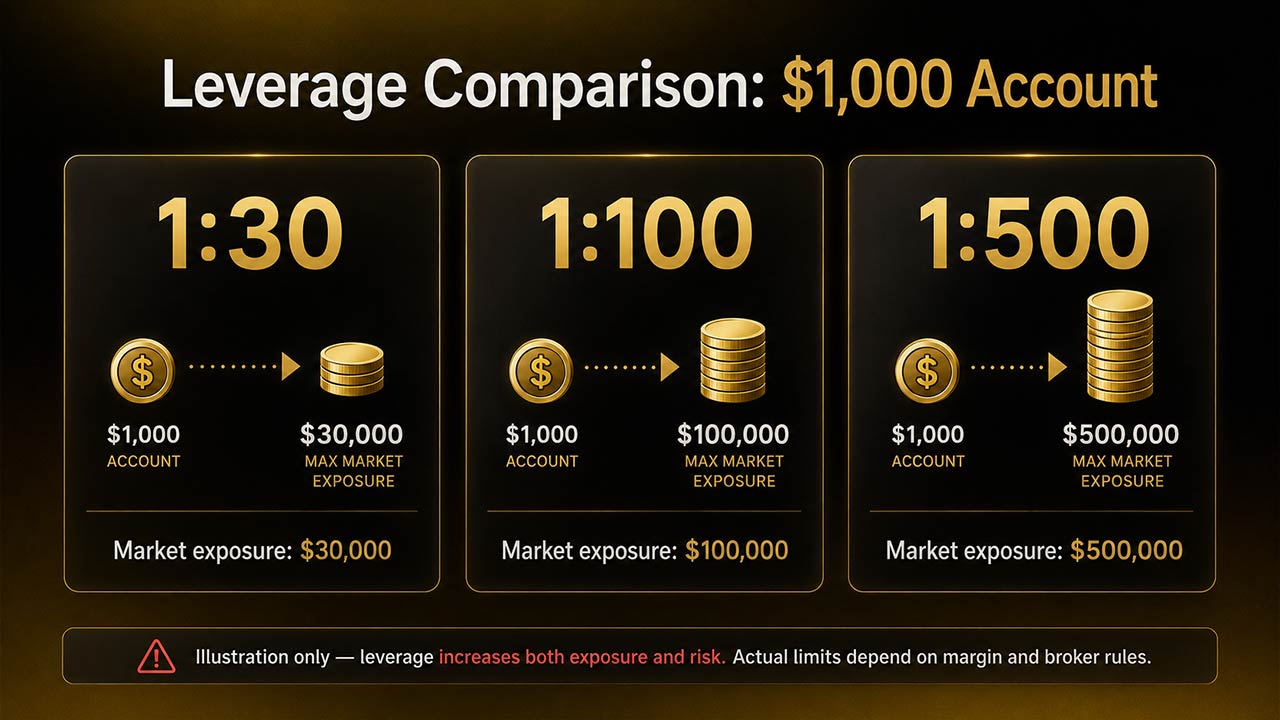
For example, 1:100 leverage means $1 can control up to $100 in market exposure.
If your account has $1,000, you may control much more than $1,000 in trades.
That does not mean you should use the full amount.
Your profit and loss are based on the full position size. They are not based only on your margin.
The main things leverage affects are:
How much margin you need to open a trade.
How much buying power your account has.
How large a position you can open.
How much free margin remains after opening trades.
How easy it becomes to take too much exposure.
Leverage itself does not create the loss. Problems start when extra buying power leads to oversized trades.
What Is High Leverage?
High leverage usually refers to ratios such as 1:200, 1:500, or higher.
It allows traders to open larger positions while using less margin.
For example, high leverage can offer:
Lower margin needs for the same trade size.
More free margin after opening a trade.
More room to hold several small positions.
Greater buying power from the same account balance.
More choice when managing short-term trades.
These points can be useful.
The problem starts when traders see extra free margin and increase their position size too far.
Higher exposure means each pip has a larger effect on the account.
A winning trade can produce a larger gain. A losing trade can produce a larger loss.
High leverage does not make the market move faster. It simply lets you take more exposure.

What Is Low Leverage?
Low leverage gives traders less buying power.
Ratios such as 1:30 or 1:50 are common examples.
You need more margin to hold the same trade size.
That creates a natural limit on how much exposure your account can take.
Some key features of low leverage include:
More margin is needed per position.
Less free margin remains after trades are opened.
Large positions are harder to open.
Total exposure is easier to limit.
Trading mistakes may have less room to grow.
For many traders, these limits can help with risk control.
Lower leverage also makes it harder to build several large trades at once.
That can reduce account pressure when markets move sharply.
High Leverage vs Low Leverage: Main Differences
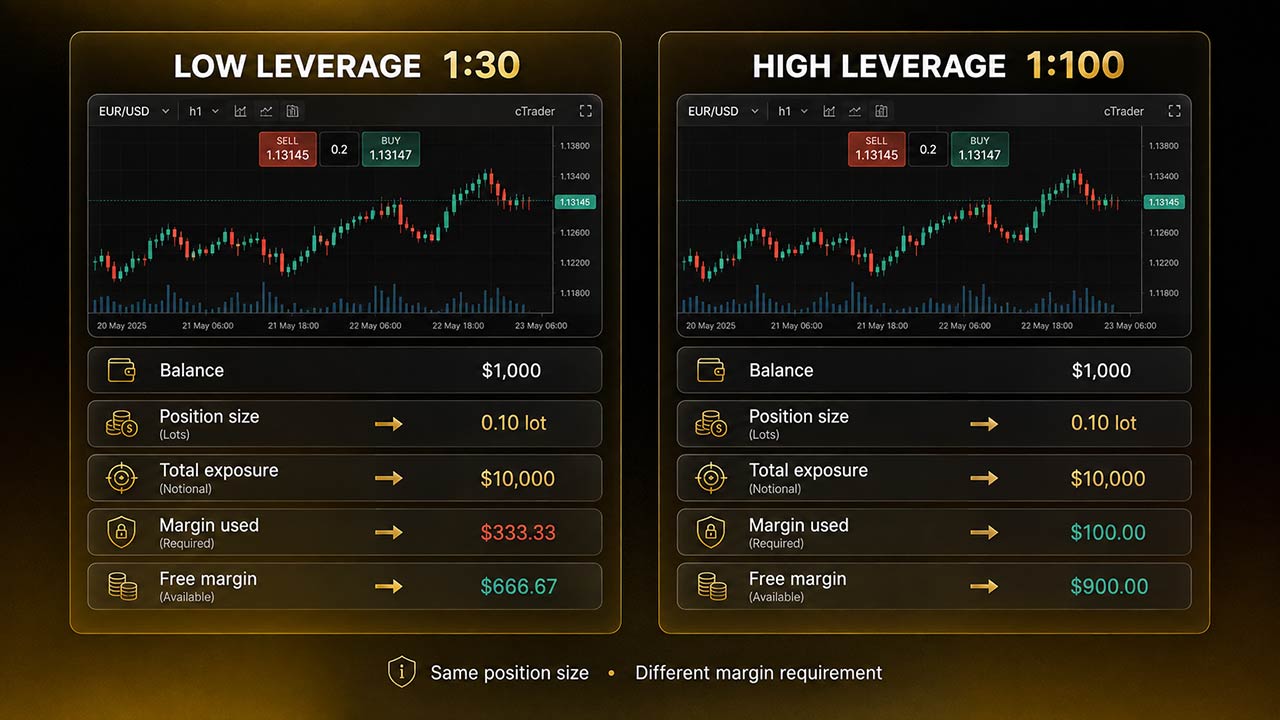
The biggest difference is not profit potential alone. It is how much exposure your account can support.
Factor | High Leverage | Low Leverage |
Margin needed | Lower | Higher |
Buying power | Higher | Lower |
Position size potential | Larger | Smaller |
Risk of oversized trades | Higher | Lower |
Free margin | Usually higher | Usually lower |
Account swings | Can become larger | Often easier to control |
Margin pressure | Can rise fast if overused | Often slower with smaller exposure |
Best suited for | Traders with strict risk rules | Traders who want tighter limits |
Neither option guarantees better results.
A trader using 1:500 leverage can still trade with very small positions.
A trader using 1:30 leverage can still lose money through poor trade sizing.
Your actual exposure matters more than the maximum ratio offered.
Does High Leverage Mean Higher Risk?
High leverage gives you the ability to take more risk.
It does not force you to take that risk.
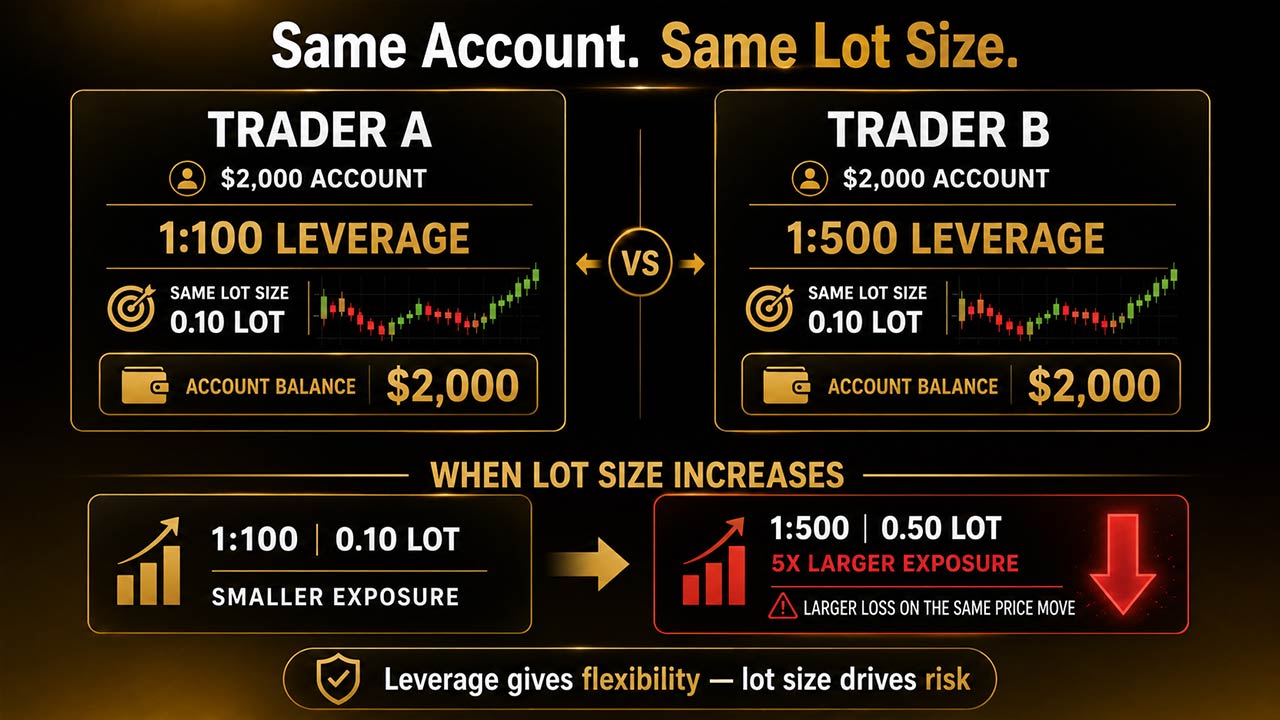
Imagine two traders have $2,000 accounts.
Trader A has 1:100 leverage. Trader B has 1:500 leverage.
Both open the same trade size.
If their entry and exit are equal, their profit or loss can also be equal.
The main difference is how much margin each trader must use.
High leverage becomes more dangerous when traders:
Increase lot size because more margin is available.
Open too many positions at the same time.
Trade without a clear stop loss.
Risk a large share of the account on one trade.
Treat free margin as money that should be used.
This is where higher leverage can lead to much larger account swings.
The issue is not simply the ratio. It is how the buying power gets used.
Why Do Traders Choose High Leverage?
High leverage can be useful when traders have strict risk rules.
The main reasons traders choose it include:
Lower margin use
Less account equity is locked into each position.More free margin
More funds remain available after a trade is opened.More trade flexibility
Traders can manage several small positions without using most available margin.Better margin control
Experienced traders can use higher leverage while keeping position size low.Support for short-term styles
Some scalpers and day traders prefer lower margin needs.
These benefits only matter when trade size stays controlled.
High leverage should never become a reason to increase lot size without a clear risk plan.
The maximum ratio is a limit. It is not a target.
Why Do Traders Choose Low Leverage?
Lower leverage creates stricter limits.
For many traders, that can be helpful.
The main benefits include:
It becomes harder to open oversized positions.
Total exposure can stay closer to account size.
Large account swings may be easier to avoid.
Traders may feel less pressure during normal price moves.
It can support slower and more measured trade choices.
Lower leverage can be useful for newer traders.
It can also suit swing traders who hold positions for longer periods.
Longer trades often need room to handle normal market movement.
Smaller exposure can make those price swings easier to manage. Its not always the case to use leverage when trading, traders use margin instead whenever its possible to use. Read this article to understand if it's worth trading forex without leverage.
High Leverage Can Increase Margin Call Risk
A margin call can happen when losses reduce your account equity too far.
Your broker needs enough funds to support your open positions.
If losses become too large, your margin level can fall toward the broker's limit.
High leverage can make this happen faster when traders use very large positions.
A few common causes include:
Opening positions that are too large.
Holding too many trades at once.
Adding to losing trades.
Trading during sharp price moves without a plan.
Leaving little free margin in the account.
Large positions create larger profit and loss changes from each market move.
A short move against the trade can then remove a large part of the account.
Lower leverage can reduce this risk because it limits how large positions can become.
Still, low leverage does not remove margin call risk.
Bad sizing and several losing trades can hurt any account.
The Real Issue Is Position Size
Many traders focus too much on the leverage number.
They ask whether 1:100 is safer than 1:500.
That question misses the main issue.
What matters most is how much money you can lose if the trade goes wrong.
A simple risk plan should consider:
Your account size.
Your risk per trade.
Your stop-loss distance.
Your position size.
Your total open exposure.
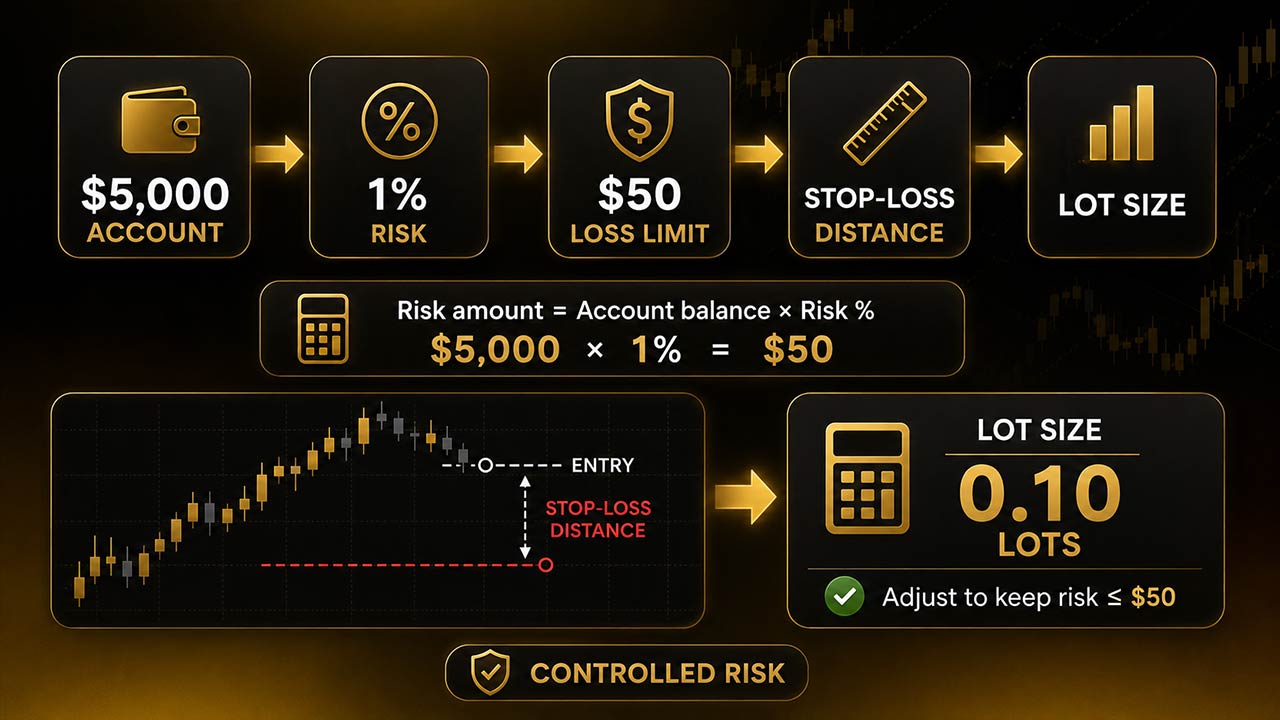
Suppose you have a $5,000 account.
You decide to risk 1%, which equals $50.
Your stop loss and trade size should then be built around that $50 limit.
The same risk plan can work with different leverage ratios.
Higher leverage only gives you more room to open larger positions.
You do not have to use that room.
High Leverage and Trading Psychology
High leverage can also change how traders react to price moves.
Large positions make account values change much faster.
That can create fear during losses and excitement during wins.
Common emotional mistakes include:
Closing a good trade too early.
Moving a stop loss because a loss feels too large.
Increasing lot size after one strong win.
Chasing losses after a bad trade.
Opening more trades because free margin looks high.
Large winning trades can also create false confidence.
One quick gain may lead someone to increase the next trade too much.
A few bad trades can then erase those gains.
Lower exposure can make account swings easier to handle.
Good trading should feel planned and controlled.
Which Leverage Is Better for Beginners?
Lower leverage is often easier for beginners to manage.
New traders are still learning how position size, stops, and margin work.
Extra buying power can make early mistakes more costly.
Lower leverage can help beginners by:
Limiting how large positions can become.
Reducing the chance of using too much margin.
Making trade size easier to control.
Giving more time to learn risk rules.
Reducing the urge to chase large profits.
That does not mean every beginner must choose the lowest ratio possible.
The goal is to use a level that supports good risk control.
Beginners should focus more on protecting capital than chasing large gains.
Is High Leverage Better for Experienced Traders?
Experienced traders may have good reasons to use higher leverage.
They may want lower margin needs while keeping their actual position size small.
Some traders also manage several positions across different forex pairs.
High leverage can be useful when traders:
Have fixed risk limits.
Know how to calculate position size.
Use stop losses with a clear plan.
Track total exposure across all trades.
Avoid using all available buying power.
Experience does not remove risk.
Even skilled traders can lose heavily when exposure gets too large.
High leverage works best when strict risk rules are already in place.

How to Choose the Right Leverage Level
Start with your risk plan, not the biggest ratio available.
Ask yourself these questions:
How much can I lose on one trade?
How many trades do I hold at once?
How large are my normal stop losses?
Do I trade short-term or hold positions longer?
Can I control position size when more margin is available?
How much free margin do I want to keep?
Your trading style also matters.
A swing trader may need more room for price movement.
A scalper may use smaller stops and shorter trade times
Neither style makes high leverage safe by itself.
Account size matters too.
Small accounts can change very quickly when large lot sizes are used.
Risk should stay based on account equity, not available buying power.
Traders who aren't sure which leverage level to go with we suggest reading 1:30 vs 1:50 vs 1:100 vs 1:500 Leverage.
High Leverage vs Low Leverage: Which Is Better?
For many forex traders, lower leverage is easier to control.
It limits oversized positions and keeps exposure closer to account size.
That can make it useful for beginners and traders focused on capital protection.
High leverage still has valid uses.
It can reduce margin needs and give skilled traders more control over free margin.
Before choosing, remember these five points:
Higher leverage gives more buying power.
Lower leverage creates tighter limits.
Position size matters more than the ratio alone.
High leverage should not mean high risk.
Strong risk rules matter with every account type.
A 1:500 account does not mean every trade should use 1:500 exposure.
At Pipstone Capital, traders are encouraged to join trading challenges and benefit from funded trading challenges, using leverage as a powerful margin tool designed to enhance flexibility and precision.
With no consistency rule in place and a strong focus on risk management and disciplined execution, traders can earn their way up and have a successful journey.
Good traders do not ask, “How large can I trade?”
They ask, “How much can I afford to lose if this trade fails?”
That question matters far more than the leverage ratio itself.
Frequently Asked Questions
1. Is high leverage better than low leverage in forex?
Not always. High leverage gives more buying power, but oversized trades become easier to open. Lower leverage can make exposure easier to control.
2. Is 1:500 leverage too high?
1:500 provides a large amount of available buying power. Risk depends on position size and how much exposure the trader actually uses.
3. Can I use high leverage with low risk?
Yes. A trader can have high available leverage while keeping position sizes small. Risk still depends on trade size, stops, and total exposure.
4. What leverage is best for beginner forex traders?
Lower leverage is often easier for beginners. It creates stricter limits while they learn trade sizing, margin, and risk control.
5. Does lower leverage prevent large losses?
No. Lower leverage can limit exposure, but losses are still possible. Traders still need sensible position sizes and clear risk rules.



High Leverage vs Low Leverage: Which Is Better for Forex Traders?
Forex brokers can offer very different leverage levels. Some accounts offer 1:30 or 1:50. Others can reach 1:500 or higher.
At first, higher leverage can look like the better deal. It lets you control larger trades with less margin.
But that extra buying power can also increase risk. A small market move can have a much bigger effect.
Lower leverage works differently. You need more margin, but your account has less room for oversized trades.
So, which one is better?
The answer depends on your trading style, account size, and risk rules. The highest ratio is not always the best choice.
At Pipstone Capital, traders should understand how leverage affects margin, position size, and total risk before placing trades.
What Does Leverage Mean in Forex?
Leverage lets you control a larger market position using a smaller amount of your own funds.
For example, 1:100 leverage means $1 can control up to $100 in market exposure.
If your account has $1,000, you may control much more than $1,000 in trades.
That does not mean you should use the full amount.
Your profit and loss are based on the full position size. They are not based only on your margin.
The main things leverage affects are:
How much margin you need to open a trade.
How much buying power your account has.
How large a position you can open.
How much free margin remains after opening trades.
How easy it becomes to take too much exposure.
Leverage itself does not create the loss. Problems start when extra buying power leads to oversized trades.
What Is High Leverage?
High leverage usually refers to ratios such as 1:200, 1:500, or higher.
It allows traders to open larger positions while using less margin.
For example, high leverage can offer:
Lower margin needs for the same trade size.
More free margin after opening a trade.
More room to hold several small positions.
Greater buying power from the same account balance.
More choice when managing short-term trades.
These points can be useful.
The problem starts when traders see extra free margin and increase their position size too far.
Higher exposure means each pip has a larger effect on the account.
A winning trade can produce a larger gain. A losing trade can produce a larger loss.
High leverage does not make the market move faster. It simply lets you take more exposure.
What Is Low Leverage?
Low leverage gives traders less buying power.
Ratios such as 1:30 or 1:50 are common examples.
You need more margin to hold the same trade size.
That creates a natural limit on how much exposure your account can take.
Some key features of low leverage include:
More margin is needed per position.
Less free margin remains after trades are opened.
Large positions are harder to open.
Total exposure is easier to limit.
Trading mistakes may have less room to grow.
For many traders, these limits can help with risk control.
Lower leverage also makes it harder to build several large trades at once.
That can reduce account pressure when markets move sharply.
High Leverage vs Low Leverage: Main Differences
The biggest difference is not profit potential alone. It is how much exposure your account can support.
Factor | High Leverage | Low Leverage |
Margin needed | Lower | Higher |
Buying power | Higher | Lower |
Position size potential | Larger | Smaller |
Risk of oversized trades | Higher | Lower |
Free margin | Usually higher | Usually lower |
Account swings | Can become larger | Often easier to control |
Margin pressure | Can rise fast if overused | Often slower with smaller exposure |
Best suited for | Traders with strict risk rules | Traders who want tighter limits |
Neither option guarantees better results.
A trader using 1:500 leverage can still trade with very small positions.
A trader using 1:30 leverage can still lose money through poor trade sizing.
Your actual exposure matters more than the maximum ratio offered.
Does High Leverage Mean Higher Risk?
High leverage gives you the ability to take more risk.
It does not force you to take that risk.
Imagine two traders have $2,000 accounts.
Trader A has 1:100 leverage. Trader B has 1:500 leverage.
Both open the same trade size.
If their entry and exit are equal, their profit or loss can also be equal.
The main difference is how much margin each trader must use.
High leverage becomes more dangerous when traders:
Increase lot size because more margin is available.
Open too many positions at the same time.
Trade without a clear stop loss.
Risk a large share of the account on one trade.
Treat free margin as money that should be used.
This is where higher leverage can lead to much larger account swings.
The issue is not simply the ratio. It is how the buying power gets used.
Why Do Traders Choose High Leverage?
High leverage can be useful when traders have strict risk rules.
The main reasons traders choose it include:
Lower margin use
Less account equity is locked into each position.More free margin
More funds remain available after a trade is opened.More trade flexibility
Traders can manage several small positions without using most available margin.Better margin control
Experienced traders can use higher leverage while keeping position size low.Support for short-term styles
Some scalpers and day traders prefer lower margin needs.
These benefits only matter when trade size stays controlled.
High leverage should never become a reason to increase lot size without a clear risk plan.
The maximum ratio is a limit. It is not a target.
Why Do Traders Choose Low Leverage?
Lower leverage creates stricter limits.
For many traders, that can be helpful.
The main benefits include:
It becomes harder to open oversized positions.
Total exposure can stay closer to account size.
Large account swings may be easier to avoid.
Traders may feel less pressure during normal price moves.
It can support slower and more measured trade choices.
Lower leverage can be useful for newer traders.
It can also suit swing traders who hold positions for longer periods.
Longer trades often need room to handle normal market movement.
Smaller exposure can make those price swings easier to manage. Its not always the case to use leverage when trading, traders use margin instead whenever its possible to use. Read this article to understand if it's worth trading forex without leverage.
High Leverage Can Increase Margin Call Risk
A margin call can happen when losses reduce your account equity too far.
Your broker needs enough funds to support your open positions.
If losses become too large, your margin level can fall toward the broker's limit.
High leverage can make this happen faster when traders use very large positions.
A few common causes include:
Opening positions that are too large.
Holding too many trades at once.
Adding to losing trades.
Trading during sharp price moves without a plan.
Leaving little free margin in the account.
Large positions create larger profit and loss changes from each market move.
A short move against the trade can then remove a large part of the account.
Lower leverage can reduce this risk because it limits how large positions can become.
Still, low leverage does not remove margin call risk.
Bad sizing and several losing trades can hurt any account.
The Real Issue Is Position Size
Many traders focus too much on the leverage number.
They ask whether 1:100 is safer than 1:500.
That question misses the main issue.
What matters most is how much money you can lose if the trade goes wrong.
A simple risk plan should consider:
Your account size.
Your risk per trade.
Your stop-loss distance.
Your position size.
Your total open exposure.
Suppose you have a $5,000 account.
You decide to risk 1%, which equals $50.
Your stop loss and trade size should then be built around that $50 limit.
The same risk plan can work with different leverage ratios.
Higher leverage only gives you more room to open larger positions.
You do not have to use that room.
High Leverage and Trading Psychology
High leverage can also change how traders react to price moves.
Large positions make account values change much faster.
That can create fear during losses and excitement during wins.
Common emotional mistakes include:
Closing a good trade too early.
Moving a stop loss because a loss feels too large.
Increasing lot size after one strong win.
Chasing losses after a bad trade.
Opening more trades because free margin looks high.
Large winning trades can also create false confidence.
One quick gain may lead someone to increase the next trade too much.
A few bad trades can then erase those gains.
Lower exposure can make account swings easier to handle.
Good trading should feel planned and controlled.
Which Leverage Is Better for Beginners?
Lower leverage is often easier for beginners to manage.
New traders are still learning how position size, stops, and margin work.
Extra buying power can make early mistakes more costly.
Lower leverage can help beginners by:
Limiting how large positions can become.
Reducing the chance of using too much margin.
Making trade size easier to control.
Giving more time to learn risk rules.
Reducing the urge to chase large profits.
That does not mean every beginner must choose the lowest ratio possible.
The goal is to use a level that supports good risk control.
Beginners should focus more on protecting capital than chasing large gains.
Is High Leverage Better for Experienced Traders?
Experienced traders may have good reasons to use higher leverage.
They may want lower margin needs while keeping their actual position size small.
Some traders also manage several positions across different forex pairs.
High leverage can be useful when traders:
Have fixed risk limits.
Know how to calculate position size.
Use stop losses with a clear plan.
Track total exposure across all trades.
Avoid using all available buying power.
Experience does not remove risk.
Even skilled traders can lose heavily when exposure gets too large.
High leverage works best when strict risk rules are already in place.
How to Choose the Right Leverage Level
Start with your risk plan, not the biggest ratio available.
Ask yourself these questions:
How much can I lose on one trade?
How many trades do I hold at once?
How large are my normal stop losses?
Do I trade short-term or hold positions longer?
Can I control position size when more margin is available?
How much free margin do I want to keep?
Your trading style also matters.
A swing trader may need more room for price movement.
A scalper may use smaller stops and shorter trade times
Neither style makes high leverage safe by itself.
Account size matters too.
Small accounts can change very quickly when large lot sizes are used.
Risk should stay based on account equity, not available buying power.
Traders who aren't sure which leverage level to go with we suggest reading 1:30 vs 1:50 vs 1:100 vs 1:500 Leverage.
High Leverage vs Low Leverage: Which Is Better?
For many forex traders, lower leverage is easier to control.
It limits oversized positions and keeps exposure closer to account size.
That can make it useful for beginners and traders focused on capital protection.
High leverage still has valid uses.
It can reduce margin needs and give skilled traders more control over free margin.
Before choosing, remember these five points:
Higher leverage gives more buying power.
Lower leverage creates tighter limits.
Position size matters more than the ratio alone.
High leverage should not mean high risk.
Strong risk rules matter with every account type.
A 1:500 account does not mean every trade should use 1:500 exposure.
At Pipstone Capital, traders are encouraged to join trading challenges and benefit from funded trading challenges, using leverage as a powerful margin tool designed to enhance flexibility and precision.
With no consistency rule in place and a strong focus on risk management and disciplined execution, traders can earn their way up and have a successful journey.
Good traders do not ask, “How large can I trade?”
They ask, “How much can I afford to lose if this trade fails?”
That question matters far more than the leverage ratio itself.
Frequently Asked Questions
1. Is high leverage better than low leverage in forex?
Not always. High leverage gives more buying power, but oversized trades become easier to open. Lower leverage can make exposure easier to control.
2. Is 1:500 leverage too high?
1:500 provides a large amount of available buying power. Risk depends on position size and how much exposure the trader actually uses.
3. Can I use high leverage with low risk?
Yes. A trader can have high available leverage while keeping position sizes small. Risk still depends on trade size, stops, and total exposure.
4. What leverage is best for beginner forex traders?
Lower leverage is often easier for beginners. It creates stricter limits while they learn trade sizing, margin, and risk control.
5. Does lower leverage prevent large losses?
No. Lower leverage can limit exposure, but losses are still possible. Traders still need sensible position sizes and clear risk rules.
