


Gold Breakout Strategy: How to Trade XAU/USD Breakouts

Gold can spend hours moving inside a narrow range before making a sharp move. When price finally breaks an important level, the move can develop quickly.
A gold breakout strategy aims to catch these moves after price escapes a clear support or resistance area. Instead of predicting where gold will go, traders wait for the market to show its direction first.
This approach works well with XAU/USD because gold often reacts strongly around major price levels. Volatility can rise even faster during London and New York trading hours.
But not every breakout is worth trading. False breakouts are common, especially when liquidity is low or traders enter too early.
In this guide, we will explain how an XAU/USD breakout works, how to identify strong setups, and how to manage the risks.
What Is a Gold Breakout Strategy?
A gold breakout happens when XAU/USD moves beyond an important support or resistance level.
Resistance is an area where buyers previously struggled to push gold higher. Support is an area where sellers struggled to move the market lower.
A breakout occurs when price moves beyond one of these boundaries.
For example, imagine gold has repeatedly failed to move above $3,700. Price continues testing the same resistance area but keeps pulling back.
If XAU/USD eventually closes clearly above $3,700, traders may view the move as a bullish breakout.
A bearish breakout works in the opposite direction. Price breaks below an established support zone, showing that sellers have gained control.
The basic idea behind a gold breakout strategy is simple:
Find an important price level.
Wait for gold to break through it.
Confirm that the breakout looks valid.
Enter in the direction of the breakout.
Place your stop loss beyond the invalidation area.
Set a realistic profit target.
The difficult part is separating genuine breakouts from temporary price spikes.

Why Breakout Trading Works Well With XAU/USD
Gold is one of the most actively traded markets in the world. Large institutional orders can create strong price movements once key levels break.
Gold also attracts short-term traders, swing traders, funds, and investors. This creates periods where many market participants watch the same levels.
Suppose XAU/USD keeps testing the same resistance zone. Sell orders may be sitting around that level, while buy-stop orders sit just above it.
Once resistance breaks, several things can happen together.
Buyers enter the market. Short sellers close losing positions. Pending buy orders can also activate.
That combination can push gold higher very quickly.
The same process happens during bearish breakouts when an important support level fails.
This is why strong XAU/USD breakouts sometimes accelerate immediately after the level is broken.

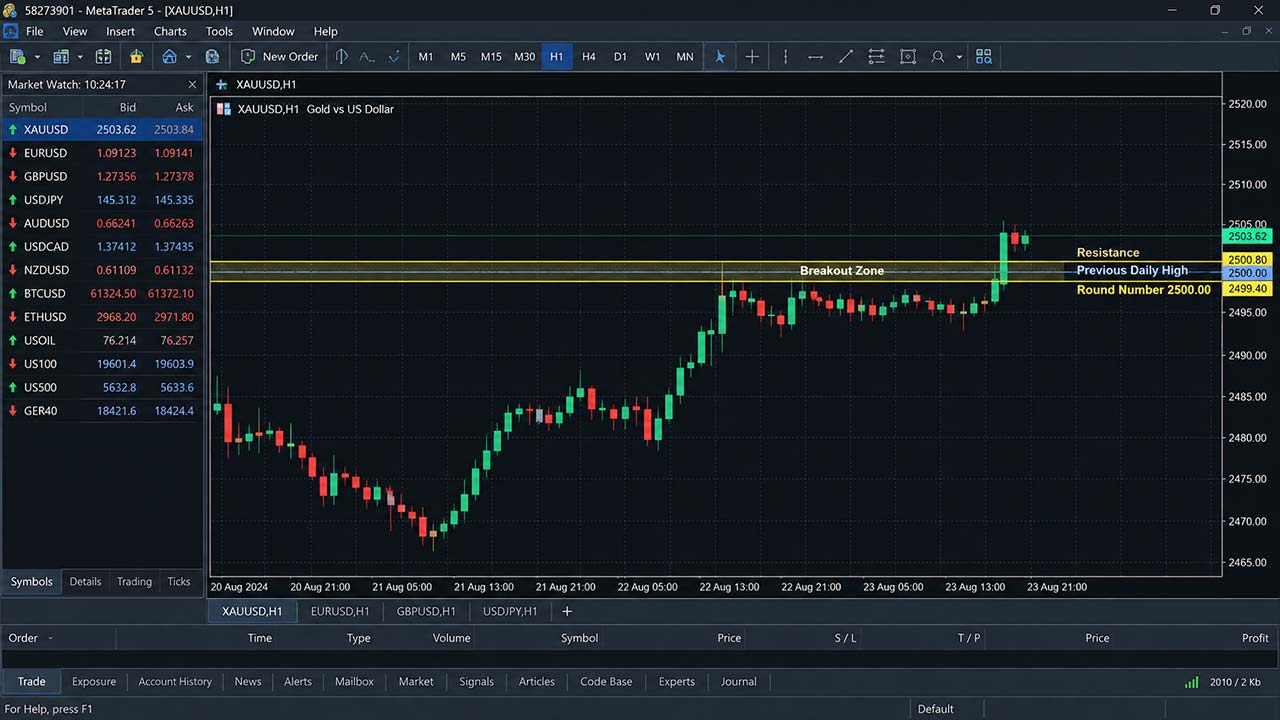
How to Identify Strong Gold Breakout Levels
The quality of your level matters more than the number of breakout trades you take.
Random highs and lows rarely provide good setups. Focus on levels that other traders are also likely watching.
Previous Support and Resistance
Start with obvious horizontal levels.
Look for areas where price has reacted several times before. The more clearly the market respects the area, the more important it can become.
Avoid drawing dozens of lines across your chart. Two or three clear zones are often enough.
Daily Highs and Lows
Previous daily highs and lows can become important breakout points.
Short-term traders often watch these levels because they show where buyers or sellers previously lost control.
A break above yesterday's high can signal rising buying pressure. A break below yesterday's low can show increasing selling pressure.
Trading Range Boundaries
Gold often enters consolidation after making a strong move.
During consolidation, price may bounce between clearly defined support and resistance levels.
The longer the range remains intact, the more attention its boundaries can attract.
A breakout from a tight range can sometimes produce a fast move because price volatility has been compressed.
Psychological Price Levels
Round numbers can also attract attention.
Levels such as $3,700 or $3,750 are easier for traders to recognize than random prices. Orders can sometimes cluster around these areas.
You should not trade a round number simply because it exists. Combine it with market structure and previous price reactions.
How to Confirm an XAU/USD Breakout
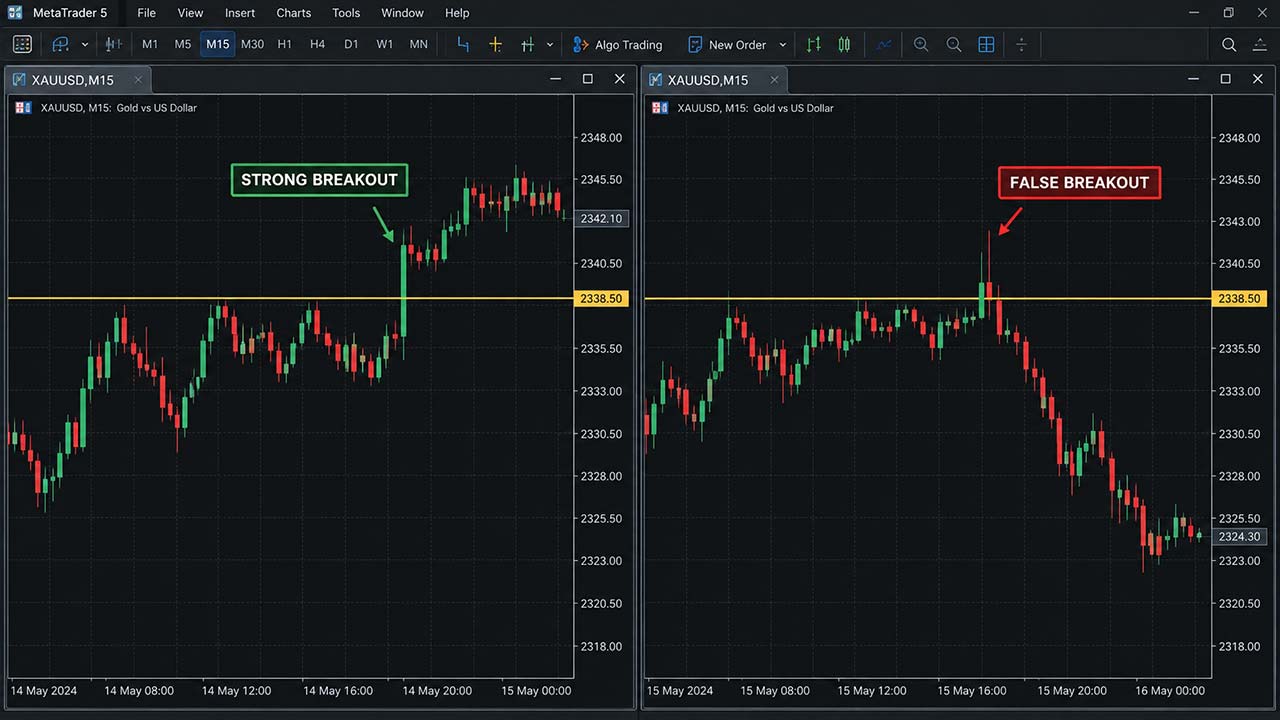
Seeing price move beyond resistance does not automatically mean the breakout is valid.
Gold can briefly cross a level and then reverse within seconds. This is one reason many breakout traders lose money.
Several clues can help confirm the move.
Wait for a Candle Close
One simple method is waiting for a candle to close beyond the level.
Suppose resistance sits around $3,700.
Gold briefly trades at $3,705 but then closes the candle at $3,695. That is not a convincing bullish breakout.
If the candle closes at $3,710 with a strong body, the setup looks more meaningful.
Waiting for confirmation means entering slightly later. However, it can help filter some false breakouts.
Look at the Breakout Candle
The structure of the breakout candle matters.
A strong breakout candle often has a clear body and closes near its high during bullish moves.
A candle with a very long upper wick may show that buyers failed to hold higher prices.
The opposite applies to bearish breakouts.
Check the Market Structure
The breakout should make sense within the wider chart.
A bullish breakout becomes more interesting when gold is already forming higher highs and higher lows.
A bearish breakout carries more weight when the broader structure is already moving downward.
Trading against the larger trend can work, but the setup usually needs stronger confirmation.
Watch for Increased Momentum
Breakouts often come with a noticeable increase in price movement.
You may see larger candles and faster movement as price crosses the level.
Weak movement after the breakout can signal limited buying or selling interest.
Two Ways to Enter a Gold Breakout Trade
There are two common ways to trade an XAU/USD breakout.
Neither method is always better. The right choice depends on the setup and your risk tolerance.
1. Enter After the Breakout Candle
The first method is entering shortly after price closes beyond the level.
For example:
Gold resistance: $3,700
Breakout candle close: $3,710
Entry: around $3,710–$3,715
This approach helps traders enter early when momentum is strong.
The downside is that price can quickly reverse after entry.
A wide breakout candle can also create a poor risk-to-reward setup if the stop needs to sit far away.
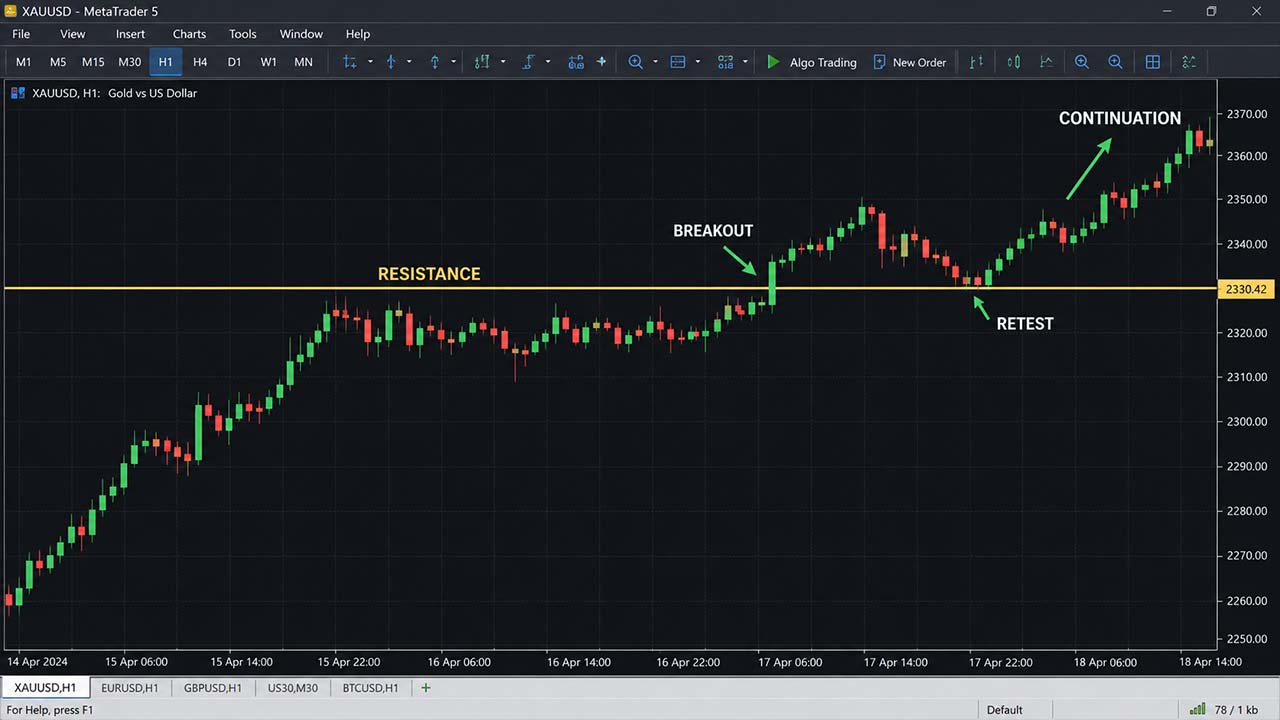
2. Wait for the Retest
A more patient method is waiting for price to return toward the broken level.
Suppose gold breaks above $3,700 and moves to $3,720.
Instead of chasing the move, you wait.
Gold then returns toward $3,700. Former resistance begins acting as support, and buyers step back into the market.
This creates a potential retest entry.
Retests can provide tighter stop-loss placement and better risk-to-reward ratios.
The problem is that strong breakouts do not always retest the level. Sometimes gold simply continues moving without offering another entry.
Example of a Gold Breakout Strategy
Here is a simple example.
Imagine XAU/USD has traded between $3,670 and $3,700 for several hours.
Gold tests $3,700 three times but cannot break above it.
You identify $3,700 as the main resistance level.
Later, during an active trading session, a strong bullish candle closes at $3,708.
Instead of entering immediately, you wait for a retest.
Gold pulls back toward $3,700 and forms a bullish rejection candle around $3,702.
You enter a long position after the rejection.
Your trade might look like this:
Entry: $3,704
Stop loss: $3,694
Risk: $10
Target: $3,724
Potential reward: $20
Risk-to-reward ratio: 1:2
If price returns deeply inside the previous range, the breakout idea becomes weaker.
Your stop protects the position if the setup fails.
For traders who want to test structured setups under clear trading conditions, Pipstone Capital offers prop-firm challenges with no time limit and no consistency rules. Eligible accounts can also receive up to a 100% reward split, giving traders room to follow their strategy instead of forcing unnecessary trades.
Where Should You Place Your Stop Loss?
Stop-loss placement should reflect the reason you entered the trade.
Do not choose a random number of points simply because it feels comfortable.
For a breakout retest, the stop can often sit beyond the retest structure.
If resistance at $3,700 becomes support, your stop might sit below the rejection low or below the former range.
For bearish trades, the same logic works in reverse.
Avoid placing your stop directly on the breakout level. Gold can retest and briefly move through the level before continuing.
Give the setup enough room to behave normally without taking unnecessary risk.
Position size should then be adjusted based on your stop distance.
How to Set Profit Targets
There are several ways to manage profit targets with a gold breakout strategy.
Use a Fixed Risk-to-Reward Ratio
A simple method is targeting two units of reward for every unit of risk.
If you risk $10 in price movement, your target would be around $20 away.
This gives you a 1:2 risk-to-reward ratio.
Target the Next Major Level
You can also use market structure.
Look left on the chart and find the next major support or resistance area.
If the next resistance sits only a few dollars above your entry, chasing the breakout may not make sense.
Measure the Previous Range
Some traders use the height of the previous range to estimate a potential target.
If gold trades between $3,650 and $3,700, the range is $50 wide.
A bullish breakout above $3,700 could therefore use $3,750 as one possible target area.
This is only a guide. Price does not have to move the full distance.

How to Avoid False Gold Breakouts
False breakouts cannot be eliminated completely. They are part of trading.
However, you can avoid some weaker setups.
First, avoid entering the moment price touches the other side of a level. A brief spike is not enough confirmation.
Second, look at where the candle closes. A breakout candle that closes back inside the range should raise concern.
Third, avoid chasing gold after a huge breakout candle. Your stop may become too wide while your remaining upside becomes smaller.
Fourth, consider the trading session.
Breakouts during active market periods often have more participation than moves during quieter hours.
Finally, look at what happens after the breakout.
If price immediately loses momentum and falls back into the range, buyers may not have enough strength to continue.
Common Gold Breakout Trading Mistakes
Breakout trading looks simple on a finished chart. Real-time trading is much harder.
One common mistake is drawing too many support and resistance levels. This creates breakout signals everywhere.
Another problem is entering before the level actually breaks. Traders anticipate the move instead of waiting for confirmation.
Chasing price is another major issue.
Gold may suddenly move $15 or $20 beyond resistance. Entering after most of the move has already happened can leave little room for profit.
Traders also make the mistake of increasing position size because a breakout looks "obvious."
No breakout is guaranteed.
Keep risk consistent regardless of how good the setup appears.
When Should You Avoid Trading Gold Breakouts?
Not every market condition suits breakout trading.
Avoid setups where support and resistance are poorly defined. If you cannot clearly explain where the breakout level sits, the trade probably lacks structure.
Be careful when price is moving randomly around the same level.
Repeated movement above and below resistance can signal that the level is no longer meaningful.
You should also know when major economic announcements are scheduled.
Gold can move sharply around inflation reports, employment data, central bank decisions, and major geopolitical developments.
These moves can create opportunities, but spreads and volatility may increase quickly.
A technically clean setup can behave very differently once major news hits the market.
Gold Breakout Strategy Checklist
Before entering an XAU/USD breakout trade, check a few basic points:
Is the support or resistance level obvious?
Has price reacted to the level before?
Did a candle close beyond the level?
Does the breakout have clear momentum?
Does the wider market structure support the trade?
Are you entering too far from the breakout level?
Is there enough space before the next major level?
Is your stop placed where the setup becomes invalid?
Does the trade offer acceptable risk versus reward?
Are major economic announcements approaching?
You do not need every breakout to become a trade.
Waiting for cleaner setups can be more useful than trying to catch every move.
Final Thoughts
A good gold breakout strategy is less about predicting explosive moves and more about patience.
Find clear levels, wait for the market to break them, and check whether price can hold beyond the level. A candle close or retest can provide extra confirmation before you enter.
Most importantly, control your risk. Even a strong XAU/USD breakout can reverse without warning.
If you want to apply structured gold strategies in a prop-trading environment, Pipstone Capital gives traders no time limit, no consistency rules, and up to a 100% reward split on eligible accounts. That flexibility can make it easier to wait for quality breakout setups rather than forcing trades just to meet a deadline.
FAQs: Gold Breakout Strategy
What is the best gold breakout strategy?
A simple approach is to identify strong support or resistance, wait for a confirmed candle close, and enter after a retest. The stop can sit beyond the failed breakout area, while the target uses market structure or a planned risk-to-reward ratio.
What timeframe is best for XAU/USD breakouts?
It depends on your trading style. Short-term traders may use 5-minute and 15-minute charts, while longer-term traders often watch one-hour or four-hour charts. Higher timeframes can also help identify the main support and resistance zones.
Should I wait for a retest after a gold breakout?
A retest can provide a cleaner entry and tighter stop placement. However, strong breakouts sometimes continue without returning to the broken level.
Why do gold breakouts fail?
Breakouts can fail because momentum disappears, liquidity is weak, or traders react to a temporary price spike. Some moves also trigger pending orders before reversing back inside the previous range.
Can beginners trade XAU/USD breakouts?
Yes, but beginners should practice identifying clear levels and managing risk first. Waiting for confirmation is usually easier than trying to predict breakouts before they happen.



Gold Breakout Strategy: How to Trade XAU/USD Breakouts
Gold can spend hours moving inside a narrow range before making a sharp move. When price finally breaks an important level, the move can develop quickly.
A gold breakout strategy aims to catch these moves after price escapes a clear support or resistance area. Instead of predicting where gold will go, traders wait for the market to show its direction first.
This approach works well with XAU/USD because gold often reacts strongly around major price levels. Volatility can rise even faster during London and New York trading hours.
But not every breakout is worth trading. False breakouts are common, especially when liquidity is low or traders enter too early.
In this guide, we will explain how an XAU/USD breakout works, how to identify strong setups, and how to manage the risks.
What Is a Gold Breakout Strategy?
A gold breakout happens when XAU/USD moves beyond an important support or resistance level.
Resistance is an area where buyers previously struggled to push gold higher. Support is an area where sellers struggled to move the market lower.
A breakout occurs when price moves beyond one of these boundaries.
For example, imagine gold has repeatedly failed to move above $3,700. Price continues testing the same resistance area but keeps pulling back.
If XAU/USD eventually closes clearly above $3,700, traders may view the move as a bullish breakout.
A bearish breakout works in the opposite direction. Price breaks below an established support zone, showing that sellers have gained control.
The basic idea behind a gold breakout strategy is simple:
Find an important price level.
Wait for gold to break through it.
Confirm that the breakout looks valid.
Enter in the direction of the breakout.
Place your stop loss beyond the invalidation area.
Set a realistic profit target.
The difficult part is separating genuine breakouts from temporary price spikes.
Why Breakout Trading Works Well With XAU/USD
Gold is one of the most actively traded markets in the world. Large institutional orders can create strong price movements once key levels break.
Gold also attracts short-term traders, swing traders, funds, and investors. This creates periods where many market participants watch the same levels.
Suppose XAU/USD keeps testing the same resistance zone. Sell orders may be sitting around that level, while buy-stop orders sit just above it.
Once resistance breaks, several things can happen together.
Buyers enter the market. Short sellers close losing positions. Pending buy orders can also activate.
That combination can push gold higher very quickly.
The same process happens during bearish breakouts when an important support level fails.
This is why strong XAU/USD breakouts sometimes accelerate immediately after the level is broken.
How to Identify Strong Gold Breakout Levels
The quality of your level matters more than the number of breakout trades you take.
Random highs and lows rarely provide good setups. Focus on levels that other traders are also likely watching.
Previous Support and Resistance
Start with obvious horizontal levels.
Look for areas where price has reacted several times before. The more clearly the market respects the area, the more important it can become.
Avoid drawing dozens of lines across your chart. Two or three clear zones are often enough.
Daily Highs and Lows
Previous daily highs and lows can become important breakout points.
Short-term traders often watch these levels because they show where buyers or sellers previously lost control.
A break above yesterday's high can signal rising buying pressure. A break below yesterday's low can show increasing selling pressure.
Trading Range Boundaries
Gold often enters consolidation after making a strong move.
During consolidation, price may bounce between clearly defined support and resistance levels.
The longer the range remains intact, the more attention its boundaries can attract.
A breakout from a tight range can sometimes produce a fast move because price volatility has been compressed.
Psychological Price Levels
Round numbers can also attract attention.
Levels such as $3,700 or $3,750 are easier for traders to recognize than random prices. Orders can sometimes cluster around these areas.
You should not trade a round number simply because it exists. Combine it with market structure and previous price reactions.
How to Confirm an XAU/USD Breakout
Seeing price move beyond resistance does not automatically mean the breakout is valid.
Gold can briefly cross a level and then reverse within seconds. This is one reason many breakout traders lose money.
Several clues can help confirm the move.
Wait for a Candle Close
One simple method is waiting for a candle to close beyond the level.
Suppose resistance sits around $3,700.
Gold briefly trades at $3,705 but then closes the candle at $3,695. That is not a convincing bullish breakout.
If the candle closes at $3,710 with a strong body, the setup looks more meaningful.
Waiting for confirmation means entering slightly later. However, it can help filter some false breakouts.
Look at the Breakout Candle
The structure of the breakout candle matters.
A strong breakout candle often has a clear body and closes near its high during bullish moves.
A candle with a very long upper wick may show that buyers failed to hold higher prices.
The opposite applies to bearish breakouts.
Check the Market Structure
The breakout should make sense within the wider chart.
A bullish breakout becomes more interesting when gold is already forming higher highs and higher lows.
A bearish breakout carries more weight when the broader structure is already moving downward.
Trading against the larger trend can work, but the setup usually needs stronger confirmation.
Watch for Increased Momentum
Breakouts often come with a noticeable increase in price movement.
You may see larger candles and faster movement as price crosses the level.
Weak movement after the breakout can signal limited buying or selling interest.
Two Ways to Enter a Gold Breakout Trade
There are two common ways to trade an XAU/USD breakout.
Neither method is always better. The right choice depends on the setup and your risk tolerance.
1. Enter After the Breakout Candle
The first method is entering shortly after price closes beyond the level.
For example:
Gold resistance: $3,700
Breakout candle close: $3,710
Entry: around $3,710–$3,715
This approach helps traders enter early when momentum is strong.
The downside is that price can quickly reverse after entry.
A wide breakout candle can also create a poor risk-to-reward setup if the stop needs to sit far away.
2. Wait for the Retest
A more patient method is waiting for price to return toward the broken level.
Suppose gold breaks above $3,700 and moves to $3,720.
Instead of chasing the move, you wait.
Gold then returns toward $3,700. Former resistance begins acting as support, and buyers step back into the market.
This creates a potential retest entry.
Retests can provide tighter stop-loss placement and better risk-to-reward ratios.
The problem is that strong breakouts do not always retest the level. Sometimes gold simply continues moving without offering another entry.
Example of a Gold Breakout Strategy
Here is a simple example.
Imagine XAU/USD has traded between $3,670 and $3,700 for several hours.
Gold tests $3,700 three times but cannot break above it.
You identify $3,700 as the main resistance level.
Later, during an active trading session, a strong bullish candle closes at $3,708.
Instead of entering immediately, you wait for a retest.
Gold pulls back toward $3,700 and forms a bullish rejection candle around $3,702.
You enter a long position after the rejection.
Your trade might look like this:
Entry: $3,704
Stop loss: $3,694
Risk: $10
Target: $3,724
Potential reward: $20
Risk-to-reward ratio: 1:2
If price returns deeply inside the previous range, the breakout idea becomes weaker.
Your stop protects the position if the setup fails.
For traders who want to test structured setups under clear trading conditions, Pipstone Capital offers prop-firm challenges with no time limit and no consistency rules. Eligible accounts can also receive up to a 100% reward split, giving traders room to follow their strategy instead of forcing unnecessary trades.
Where Should You Place Your Stop Loss?
Stop-loss placement should reflect the reason you entered the trade.
Do not choose a random number of points simply because it feels comfortable.
For a breakout retest, the stop can often sit beyond the retest structure.
If resistance at $3,700 becomes support, your stop might sit below the rejection low or below the former range.
For bearish trades, the same logic works in reverse.
Avoid placing your stop directly on the breakout level. Gold can retest and briefly move through the level before continuing.
Give the setup enough room to behave normally without taking unnecessary risk.
Position size should then be adjusted based on your stop distance.
How to Set Profit Targets
There are several ways to manage profit targets with a gold breakout strategy.
Use a Fixed Risk-to-Reward Ratio
A simple method is targeting two units of reward for every unit of risk.
If you risk $10 in price movement, your target would be around $20 away.
This gives you a 1:2 risk-to-reward ratio.
Target the Next Major Level
You can also use market structure.
Look left on the chart and find the next major support or resistance area.
If the next resistance sits only a few dollars above your entry, chasing the breakout may not make sense.
Measure the Previous Range
Some traders use the height of the previous range to estimate a potential target.
If gold trades between $3,650 and $3,700, the range is $50 wide.
A bullish breakout above $3,700 could therefore use $3,750 as one possible target area.
This is only a guide. Price does not have to move the full distance.
How to Avoid False Gold Breakouts
False breakouts cannot be eliminated completely. They are part of trading.
However, you can avoid some weaker setups.
First, avoid entering the moment price touches the other side of a level. A brief spike is not enough confirmation.
Second, look at where the candle closes. A breakout candle that closes back inside the range should raise concern.
Third, avoid chasing gold after a huge breakout candle. Your stop may become too wide while your remaining upside becomes smaller.
Fourth, consider the trading session.
Breakouts during active market periods often have more participation than moves during quieter hours.
Finally, look at what happens after the breakout.
If price immediately loses momentum and falls back into the range, buyers may not have enough strength to continue.
Common Gold Breakout Trading Mistakes
Breakout trading looks simple on a finished chart. Real-time trading is much harder.
One common mistake is drawing too many support and resistance levels. This creates breakout signals everywhere.
Another problem is entering before the level actually breaks. Traders anticipate the move instead of waiting for confirmation.
Chasing price is another major issue.
Gold may suddenly move $15 or $20 beyond resistance. Entering after most of the move has already happened can leave little room for profit.
Traders also make the mistake of increasing position size because a breakout looks "obvious."
No breakout is guaranteed.
Keep risk consistent regardless of how good the setup appears.
When Should You Avoid Trading Gold Breakouts?
Not every market condition suits breakout trading.
Avoid setups where support and resistance are poorly defined. If you cannot clearly explain where the breakout level sits, the trade probably lacks structure.
Be careful when price is moving randomly around the same level.
Repeated movement above and below resistance can signal that the level is no longer meaningful.
You should also know when major economic announcements are scheduled.
Gold can move sharply around inflation reports, employment data, central bank decisions, and major geopolitical developments.
These moves can create opportunities, but spreads and volatility may increase quickly.
A technically clean setup can behave very differently once major news hits the market.
Gold Breakout Strategy Checklist
Before entering an XAU/USD breakout trade, check a few basic points:
Is the support or resistance level obvious?
Has price reacted to the level before?
Did a candle close beyond the level?
Does the breakout have clear momentum?
Does the wider market structure support the trade?
Are you entering too far from the breakout level?
Is there enough space before the next major level?
Is your stop placed where the setup becomes invalid?
Does the trade offer acceptable risk versus reward?
Are major economic announcements approaching?
You do not need every breakout to become a trade.
Waiting for cleaner setups can be more useful than trying to catch every move.
Final Thoughts
A good gold breakout strategy is less about predicting explosive moves and more about patience.
Find clear levels, wait for the market to break them, and check whether price can hold beyond the level. A candle close or retest can provide extra confirmation before you enter.
Most importantly, control your risk. Even a strong XAU/USD breakout can reverse without warning.
If you want to apply structured gold strategies in a prop-trading environment, Pipstone Capital gives traders no time limit, no consistency rules, and up to a 100% reward split on eligible accounts. That flexibility can make it easier to wait for quality breakout setups rather than forcing trades just to meet a deadline.
FAQs: Gold Breakout Strategy
What is the best gold breakout strategy?
A simple approach is to identify strong support or resistance, wait for a confirmed candle close, and enter after a retest. The stop can sit beyond the failed breakout area, while the target uses market structure or a planned risk-to-reward ratio.
What timeframe is best for XAU/USD breakouts?
It depends on your trading style. Short-term traders may use 5-minute and 15-minute charts, while longer-term traders often watch one-hour or four-hour charts. Higher timeframes can also help identify the main support and resistance zones.
Should I wait for a retest after a gold breakout?
A retest can provide a cleaner entry and tighter stop placement. However, strong breakouts sometimes continue without returning to the broken level.
Why do gold breakouts fail?
Breakouts can fail because momentum disappears, liquidity is weak, or traders react to a temporary price spike. Some moves also trigger pending orders before reversing back inside the previous range.
Can beginners trade XAU/USD breakouts?
Yes, but beginners should practice identifying clear levels and managing risk first. Waiting for confirmation is usually easier than trying to predict breakouts before they happen.
