


What Is a Margin Call in Forex and How Can You Avoid It?

A margin call happens when your forex account no longer has enough equity to support its open positions. It is a warning that losses have reduced your available margin and that some trades may soon be closed automatically.
Margin calls are usually caused by oversized trades, excessive leverage, several positions moving against you, or sudden volatility. Once you understand how margin, equity, and position size work together, the risk becomes easier to control.
For traders developing these habits in a simulated funding environment, Pipstone Capital offers MT5 and cTrader challenges with no time limit, no consistency rules, and reward splits of up to 100% on eligible accounts.
What Is Margin in Forex?
Margin is the money set aside to open and maintain a leveraged trade. It is not a fee, and it is not automatically lost. It acts as collateral while the position remains open.
Suppose you open a $50,000 position with a 2% margin requirement:
Required margin = Position value × Margin requirement
$50,000 × 2% = $1,000
You control a $50,000 position while $1,000 is reserved as margin. However, profit and loss are based on the full position size. That is why an oversized trade can quickly damage a small account.

What Is a Margin Call in Forex?
A margin call occurs when account equity falls to or below the level required to maintain open trades. Equity is your balance plus unrealized profits and minus unrealized losses.
The “call” may be an email, platform alert, account warning, or restriction on opening new trades. In a fast market, there may not be enough time for a warning before positions are closed.
A margin call does not always mean liquidation has started. It means the account has reached a dangerous level. If equity keeps falling and reaches the stop-out level, positions may be closed automatically. Margin calls are closely connected to borrowed market exposure, so traders should first understand what is leverage in forex trading.
Forex Margin Terms to Know
Term | Meaning |
Balance | Account value after closed trades are settled |
Equity | Balance plus or minus unrealized profit and loss |
Used margin | Funds reserved to support open positions |
Free margin | Equity minus used margin |
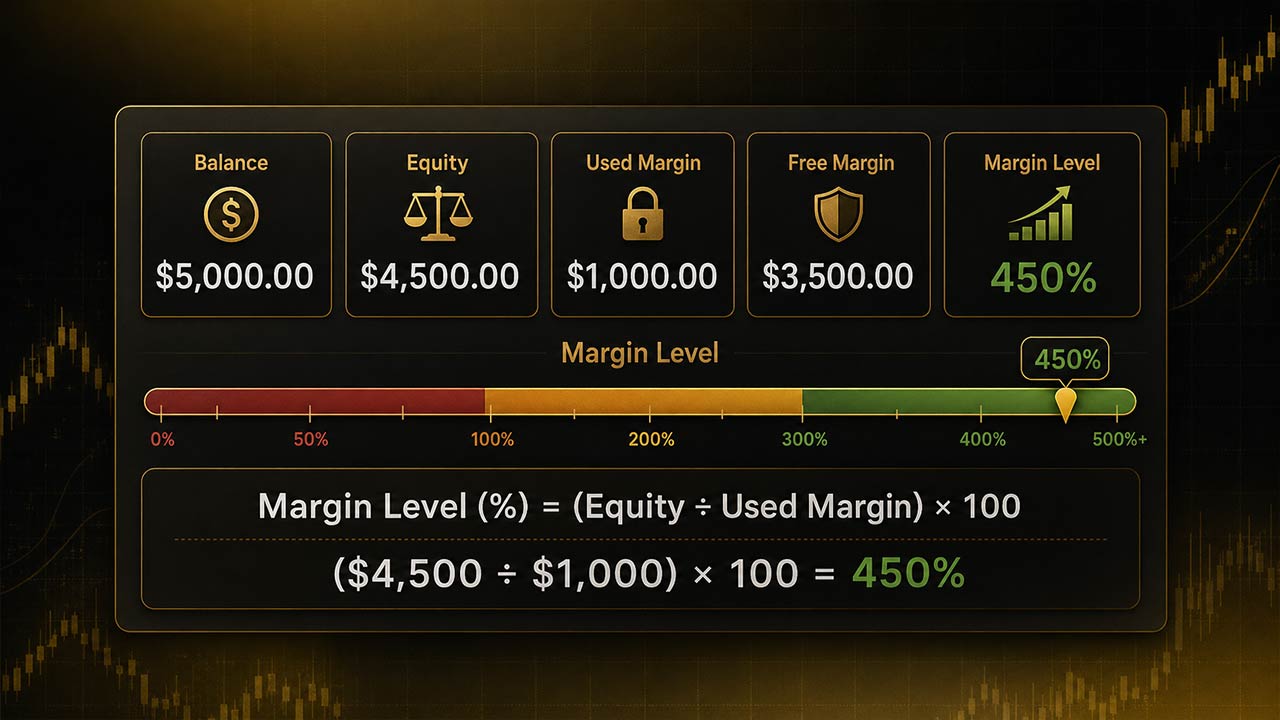
Margin level | Equity divided by used margin, shown as a percentage |
Margin call level | The point where the account becomes under-margined |
Stop-out level | The point where positions may be closed automatically |
The main formula is:
Margin level (%) = (Equity ÷ Used margin) × 100
A higher margin level means the account generally has more room to absorb losses. A falling level means its remaining cushion is shrinking.
Margin Call Example
Assume your account has:
Balance: $5,000
Used margin: $1,000
Floating loss: $2,500
Equity: $2,500
Your margin level is:
($2,500 ÷ $1,000) × 100 = 250%
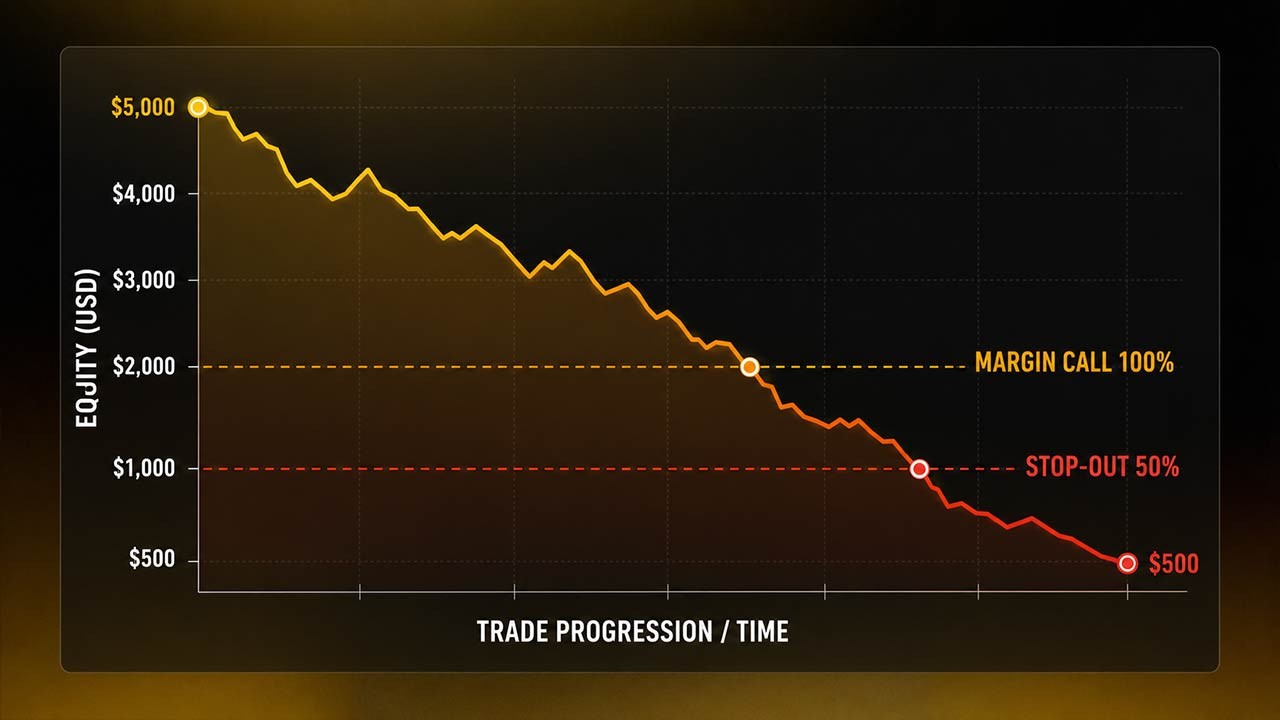
Now suppose the loss increases to $4,000. Equity falls to $1,000:
($1,000 ÷ $1,000) × 100 = 100%
If your provider uses a 100% margin-call threshold, the account would now be under-margined. If equity later falls to $500, the margin level becomes 50%. A provider using a 50% stop-out level could begin closing trades.
These figures are only examples. Providers can use different calculations, warning levels, and liquidation policies. Some may also change margin requirements during periods of higher risk.
Margin Call vs. Stop-Out
Margin call | Stop-out |
Warns that equity is too low | Automatically closes positions |
May restrict new trades | Reduces used margin |
Gives you a chance to respond | Can happen rapidly during volatility |
Threshold varies by provider | Liquidation method varies by provider |
The margin call is the warning stage. The stop-out is the action stage. Once liquidation begins, you may no longer control which positions remain open.
Higher leverage reduces the margin required to open a trade, but it can also make oversized positions easier to take. When choosing the best leverage for forex trading, traders should consider account size, strategy and total market exposure.
Why Do Margin Calls Happen?
Oversized Positions
A large trade uses more margin and leaves less room for normal price movement. Even a modest loss can consume most of the account’s free margin.
Excessive Effective Leverage
Maximum leverage is a limit, not a target. What matters is effective leverage: your total exposure compared with your equity. High leverage combined with a small account creates a thin safety buffer.
Too Many Open Trades
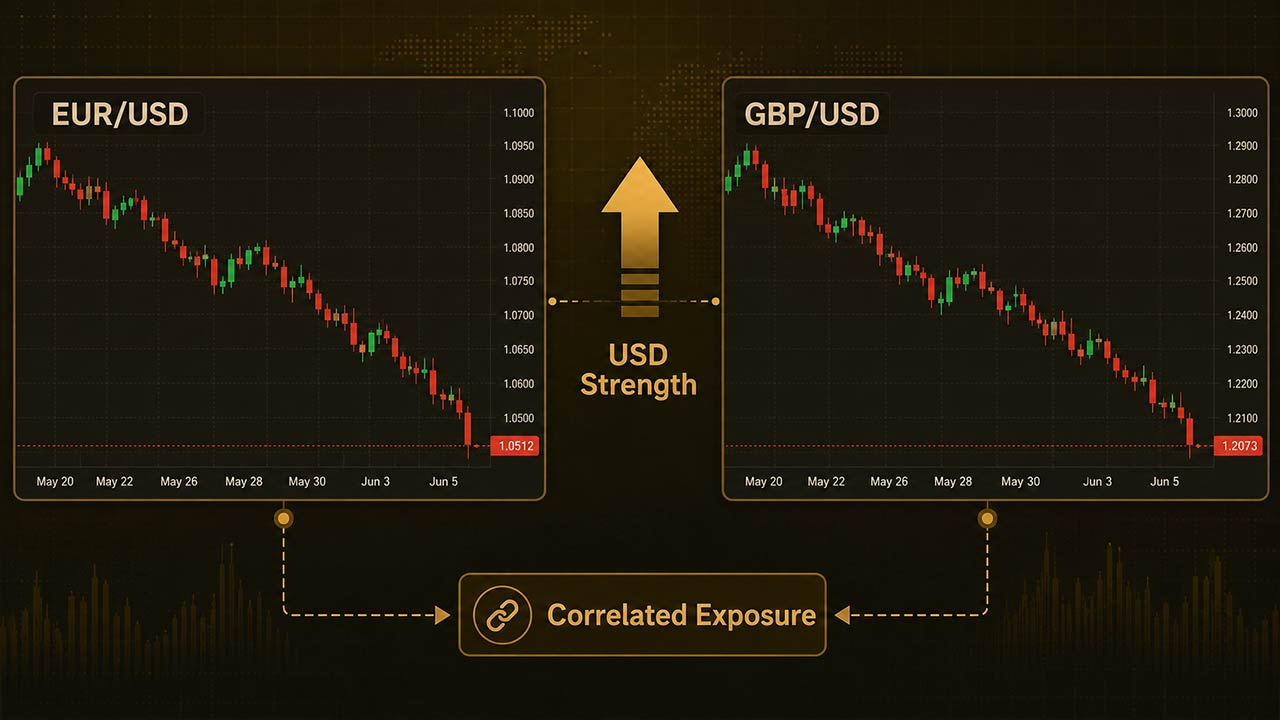
Several small positions can create one large risk, especially when they are correlated. Multiple trades based on the same currency view may all lose together.
For example, buying EUR/USD and GBP/USD at the same time may look like two separate trades. However, both positions can depend heavily on the US dollar weakening. If the dollar strengthens, both trades could move against you together.
Holding and Adding to Losing Trades
As an unrealized loss grows, free margin falls. Adding another position because the market “must reverse” can accelerate the problem unless the additional entry was part of a defined risk plan.
Traders often get into trouble when they keep moving their stop-loss or opening larger positions to recover previous losses. Instead of reducing risk, they increase the amount of margin being used while their equity continues to fall.
News, Gaps, and Low Liquidity
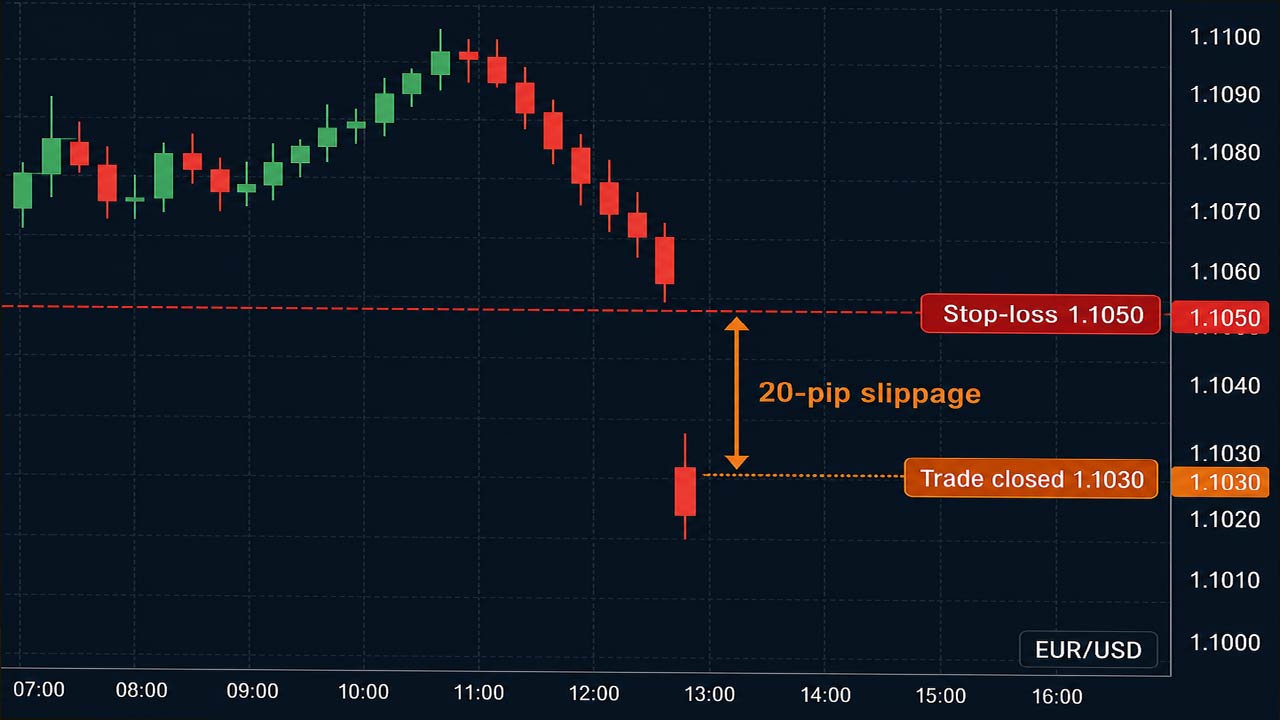
Central-bank decisions, employment data, inflation reports, political events, and weekend gaps can cause sharp moves. Stop-loss orders may also experience slippage, producing a worse exit than requested.
For example, you may place a stop-loss at 1.1050, but a sudden gap could cause the trade to close at 1.1030. On an overleveraged account, that difference may be enough to trigger a margin call or stop-out.
Margin is the capital set aside to support an open position, while leverage determines how much exposure that capital can control. Understanding the difference between margin and leverage makes it easier to see why margin levels fall as losses increase.
Higher Margin Requirements
A provider may increase margin requirements when an instrument becomes more volatile. The same trade then needs more margin, reducing free margin without a change in position size.
This is why checking margin only when you open a trade is not enough. Margin requirements and account equity can both change while positions remain open.
How to Avoid a Margin Call in Forex
1. Calculate Position Size First
Decide how much you are prepared to lose, then calculate position size using your equity and stop-loss distance. Do not choose a large lot size first and force the stop to fit it. Large positions can consume available margin quickly and magnify the effect of small price movements. Understanding lot size in forex trading helps traders select a position size that matches their account and stop-loss distance.
A trade with a wide stop-loss usually requires a smaller position. A trade with a tighter stop may allow a larger position, although the total amount at risk should remain within your limit.
2. Use a Stop-Loss
A stop-loss limits the planned loss if the setup fails. It cannot guarantee an exact exit during gaps or extreme volatility, but it remains an essential risk-control tool. Moving it farther away simply to avoid taking a loss defeats its purpose.
Place the stop where the trade idea is no longer valid. It should be based on market structure and your strategy, not on how much loss you emotionally feel comfortable watching.
3. Keep a Margin Buffer
Opening the largest trade your account allows leaves no breathing room. Maintain enough free margin for normal swings, spread changes, and unexpected volatility.
There is no single safe percentage for every trader. The goal is to remain comfortably above your provider’s warning and stop-out levels.
Seeing that your platform still allows another trade does not mean you should take it. Available margin is a technical limit, not a recommended position size.
Avoiding a margin call requires more than maintaining a high margin level. A structured forex risk management plan should control risk per trade, position size, correlated exposure and maximum daily loss.

4. Monitor Total Exposure
Review risk across the entire account. Several individually small trades can create a large combined loss, especially when they are correlated.
Before adding another position, ask whether it creates new exposure or simply increases a risk you already have. Three trades linked to the same currency can behave like one oversized position.
5. Reduce Risk Around Major Events
Check the economic calendar. When your strategy is not designed for news trading, consider reducing exposure before high-impact announcements.
You should also review tightly margined positions before weekends. Markets can reopen at a different price, and the resulting gap may cause slippage or push the account through its margin threshold.
6. Know the Exact Account Rules
Before trading, check:
How margin is calculated
When warnings are issued
When liquidation begins
Which positions are closed first
Whether requirements can change
Do not depend only on an email warning. Markets can move through several margin levels in seconds.
Margin policies can also appear differently across platforms. A percentage displayed on one trading interface may not be calculated in exactly the same way on another.
7. Control Emotional Trading
Revenge trading, overtrading, unrealistic targets, and adding to losses can all increase exposure. Set daily and overall loss limits before the session and stop when they are reached.
A margin call often starts with a small rule being broken. One oversized trade turns into a moved stop-loss, followed by another trade placed to recover the loss. A written risk plan helps prevent that chain of decisions.
What Should You Do After a Margin Call?
Stop opening new positions and review the account. You usually have two direct options:
Close or reduce positions. This lowers used margin.
Add funds. This increases equity and free margin.
Closing exposure can improve the margin level immediately under normal market conditions. Deposits may take time, and the market may keep moving while a transfer is processed. Adding money also does not repair a poor strategy, so decide whether the existing trades still make sense before risking more capital.
Do not add money automatically just because the platform sends a warning. First review why the account reached that point. If the position was too large or the original trade idea is no longer valid, reducing exposure may be more sensible than adding funds to keep the trade alive.
Final Thoughts
A margin call in forex is a warning that your exposure has become too large for the equity supporting it. The best defense is simple: size trades carefully, use planned exits, maintain free margin, manage combined exposure, and understand the stop-out rules before entering the market.
Pipstone Capital gives traders a structured way to practise those habits through simulated challenges with MT5 and cTrader access, no challenge time limit, no consistency rules, and reward splits of up to 100% on eligible programs. Choose an evaluation that fits your strategy, understand its risk limits, and focus on consistency rather than forcing quick returns.
FAQs
Does a Margin Call Mean My Balance Is Zero?
No. It means your equity is too low relative to the margin supporting your positions. The account may still contain funds, but its open exposure is too large for the remaining equity.
Can a Stop-Loss Prevent Every Margin Call?
No. Gaps and slippage can result in a worse exit. A stop-loss should be combined with sensible position sizing, controlled leverage, and adequate free margin.
Does High Leverage Automatically Cause a Margin Call?
No. Available leverage is not the same as used leverage. Margin problems begin when leverage is used to create more exposure than the account can reasonably support.
Can Depositing Money Fix a Margin Call?
It can improve equity and free margin, but the deposit may not arrive before a closeout. It also puts more capital at risk if the trades keep losing.



What Is a Margin Call in Forex and How Can You Avoid It?
A margin call happens when your forex account no longer has enough equity to support its open positions. It is a warning that losses have reduced your available margin and that some trades may soon be closed automatically.
Margin calls are usually caused by oversized trades, excessive leverage, several positions moving against you, or sudden volatility. Once you understand how margin, equity, and position size work together, the risk becomes easier to control.
For traders developing these habits in a simulated funding environment, Pipstone Capital offers MT5 and cTrader challenges with no time limit, no consistency rules, and reward splits of up to 100% on eligible accounts.
What Is Margin in Forex?
Margin is the money set aside to open and maintain a leveraged trade. It is not a fee, and it is not automatically lost. It acts as collateral while the position remains open.
Suppose you open a $50,000 position with a 2% margin requirement:
Required margin = Position value × Margin requirement
$50,000 × 2% = $1,000
You control a $50,000 position while $1,000 is reserved as margin. However, profit and loss are based on the full position size. That is why an oversized trade can quickly damage a small account.
What Is a Margin Call in Forex?
A margin call occurs when account equity falls to or below the level required to maintain open trades. Equity is your balance plus unrealized profits and minus unrealized losses.
The “call” may be an email, platform alert, account warning, or restriction on opening new trades. In a fast market, there may not be enough time for a warning before positions are closed.
A margin call does not always mean liquidation has started. It means the account has reached a dangerous level. If equity keeps falling and reaches the stop-out level, positions may be closed automatically. Margin calls are closely connected to borrowed market exposure, so traders should first understand what is leverage in forex trading.
Forex Margin Terms to Know
Term | Meaning |
Balance | Account value after closed trades are settled |
Equity | Balance plus or minus unrealized profit and loss |
Used margin | Funds reserved to support open positions |
Free margin | Equity minus used margin |
Margin level | Equity divided by used margin, shown as a percentage |
Margin call level | The point where the account becomes under-margined |
Stop-out level | The point where positions may be closed automatically |
The main formula is:
Margin level (%) = (Equity ÷ Used margin) × 100
A higher margin level means the account generally has more room to absorb losses. A falling level means its remaining cushion is shrinking.
Margin Call Example
Assume your account has:
Balance: $5,000
Used margin: $1,000
Floating loss: $2,500
Equity: $2,500
Your margin level is:
($2,500 ÷ $1,000) × 100 = 250%
Now suppose the loss increases to $4,000. Equity falls to $1,000:
($1,000 ÷ $1,000) × 100 = 100%
If your provider uses a 100% margin-call threshold, the account would now be under-margined. If equity later falls to $500, the margin level becomes 50%. A provider using a 50% stop-out level could begin closing trades.
These figures are only examples. Providers can use different calculations, warning levels, and liquidation policies. Some may also change margin requirements during periods of higher risk.
Margin Call vs. Stop-Out
Margin call | Stop-out |
Warns that equity is too low | Automatically closes positions |
May restrict new trades | Reduces used margin |
Gives you a chance to respond | Can happen rapidly during volatility |
Threshold varies by provider | Liquidation method varies by provider |
The margin call is the warning stage. The stop-out is the action stage. Once liquidation begins, you may no longer control which positions remain open.
Higher leverage reduces the margin required to open a trade, but it can also make oversized positions easier to take. When choosing the best leverage for forex trading, traders should consider account size, strategy and total market exposure.
Why Do Margin Calls Happen?
Oversized Positions
A large trade uses more margin and leaves less room for normal price movement. Even a modest loss can consume most of the account’s free margin.
Excessive Effective Leverage
Maximum leverage is a limit, not a target. What matters is effective leverage: your total exposure compared with your equity. High leverage combined with a small account creates a thin safety buffer.
Too Many Open Trades
Several small positions can create one large risk, especially when they are correlated. Multiple trades based on the same currency view may all lose together.
For example, buying EUR/USD and GBP/USD at the same time may look like two separate trades. However, both positions can depend heavily on the US dollar weakening. If the dollar strengthens, both trades could move against you together.
Holding and Adding to Losing Trades
As an unrealized loss grows, free margin falls. Adding another position because the market “must reverse” can accelerate the problem unless the additional entry was part of a defined risk plan.
Traders often get into trouble when they keep moving their stop-loss or opening larger positions to recover previous losses. Instead of reducing risk, they increase the amount of margin being used while their equity continues to fall.
News, Gaps, and Low Liquidity
Central-bank decisions, employment data, inflation reports, political events, and weekend gaps can cause sharp moves. Stop-loss orders may also experience slippage, producing a worse exit than requested.
For example, you may place a stop-loss at 1.1050, but a sudden gap could cause the trade to close at 1.1030. On an overleveraged account, that difference may be enough to trigger a margin call or stop-out.
Margin is the capital set aside to support an open position, while leverage determines how much exposure that capital can control. Understanding the difference between margin and leverage makes it easier to see why margin levels fall as losses increase.
Higher Margin Requirements
A provider may increase margin requirements when an instrument becomes more volatile. The same trade then needs more margin, reducing free margin without a change in position size.
This is why checking margin only when you open a trade is not enough. Margin requirements and account equity can both change while positions remain open.
How to Avoid a Margin Call in Forex
1. Calculate Position Size First
Decide how much you are prepared to lose, then calculate position size using your equity and stop-loss distance. Do not choose a large lot size first and force the stop to fit it. Large positions can consume available margin quickly and magnify the effect of small price movements. Understanding lot size in forex trading helps traders select a position size that matches their account and stop-loss distance.
A trade with a wide stop-loss usually requires a smaller position. A trade with a tighter stop may allow a larger position, although the total amount at risk should remain within your limit.
2. Use a Stop-Loss
A stop-loss limits the planned loss if the setup fails. It cannot guarantee an exact exit during gaps or extreme volatility, but it remains an essential risk-control tool. Moving it farther away simply to avoid taking a loss defeats its purpose.
Place the stop where the trade idea is no longer valid. It should be based on market structure and your strategy, not on how much loss you emotionally feel comfortable watching.
3. Keep a Margin Buffer
Opening the largest trade your account allows leaves no breathing room. Maintain enough free margin for normal swings, spread changes, and unexpected volatility.
There is no single safe percentage for every trader. The goal is to remain comfortably above your provider’s warning and stop-out levels.
Seeing that your platform still allows another trade does not mean you should take it. Available margin is a technical limit, not a recommended position size.
Avoiding a margin call requires more than maintaining a high margin level. A structured forex risk management plan should control risk per trade, position size, correlated exposure and maximum daily loss.
4. Monitor Total Exposure
Review risk across the entire account. Several individually small trades can create a large combined loss, especially when they are correlated.
Before adding another position, ask whether it creates new exposure or simply increases a risk you already have. Three trades linked to the same currency can behave like one oversized position.
5. Reduce Risk Around Major Events
Check the economic calendar. When your strategy is not designed for news trading, consider reducing exposure before high-impact announcements.
You should also review tightly margined positions before weekends. Markets can reopen at a different price, and the resulting gap may cause slippage or push the account through its margin threshold.
6. Know the Exact Account Rules
Before trading, check:
How margin is calculated
When warnings are issued
When liquidation begins
Which positions are closed first
Whether requirements can change
Do not depend only on an email warning. Markets can move through several margin levels in seconds.
Margin policies can also appear differently across platforms. A percentage displayed on one trading interface may not be calculated in exactly the same way on another.
7. Control Emotional Trading
Revenge trading, overtrading, unrealistic targets, and adding to losses can all increase exposure. Set daily and overall loss limits before the session and stop when they are reached.
A margin call often starts with a small rule being broken. One oversized trade turns into a moved stop-loss, followed by another trade placed to recover the loss. A written risk plan helps prevent that chain of decisions.
What Should You Do After a Margin Call?
Stop opening new positions and review the account. You usually have two direct options:
Close or reduce positions. This lowers used margin.
Add funds. This increases equity and free margin.
Closing exposure can improve the margin level immediately under normal market conditions. Deposits may take time, and the market may keep moving while a transfer is processed. Adding money also does not repair a poor strategy, so decide whether the existing trades still make sense before risking more capital.
Do not add money automatically just because the platform sends a warning. First review why the account reached that point. If the position was too large or the original trade idea is no longer valid, reducing exposure may be more sensible than adding funds to keep the trade alive.
Final Thoughts
A margin call in forex is a warning that your exposure has become too large for the equity supporting it. The best defense is simple: size trades carefully, use planned exits, maintain free margin, manage combined exposure, and understand the stop-out rules before entering the market.
Pipstone Capital gives traders a structured way to practise those habits through simulated challenges with MT5 and cTrader access, no challenge time limit, no consistency rules, and reward splits of up to 100% on eligible programs. Choose an evaluation that fits your strategy, understand its risk limits, and focus on consistency rather than forcing quick returns.
FAQs
Does a Margin Call Mean My Balance Is Zero?
No. It means your equity is too low relative to the margin supporting your positions. The account may still contain funds, but its open exposure is too large for the remaining equity.
Can a Stop-Loss Prevent Every Margin Call?
No. Gaps and slippage can result in a worse exit. A stop-loss should be combined with sensible position sizing, controlled leverage, and adequate free margin.
Does High Leverage Automatically Cause a Margin Call?
No. Available leverage is not the same as used leverage. Margin problems begin when leverage is used to create more exposure than the account can reasonably support.
Can Depositing Money Fix a Margin Call?
It can improve equity and free margin, but the deposit may not arrive before a closeout. It also puts more capital at risk if the trades keep losing.
