


Free Margin vs Used Margin vs Equity in Forex Explained

When you open a forex trading account, the platform displays several numbers: balance, equity, used margin, free margin, and margin level. They may look similar, but each one tells you something different about the health of your account.
Understanding free margin vs used margin is especially important because these figures determine whether you can open another trade, hold your current positions, or face a margin call.
The confusing part is that some of these numbers remain fixed while others change every second. Your balance may stay the same, while your equity and available margin rise or fall as the market moves.
This guide explains what each figure means, how they connect, and how floating profits or losses affect your trading account.
Balance, Equity and Margin in Forex
Before comparing free margin and used margin, you need to understand the basic structure of a forex account.
The most important figures are:
Balance
Equity
Used margin
Free margin
Margin level
These numbers are connected. A change in one figure can affect several others, particularly when you have open trades.
The easiest way to understand them is to begin with your account balance.
What Is Balance in Forex?
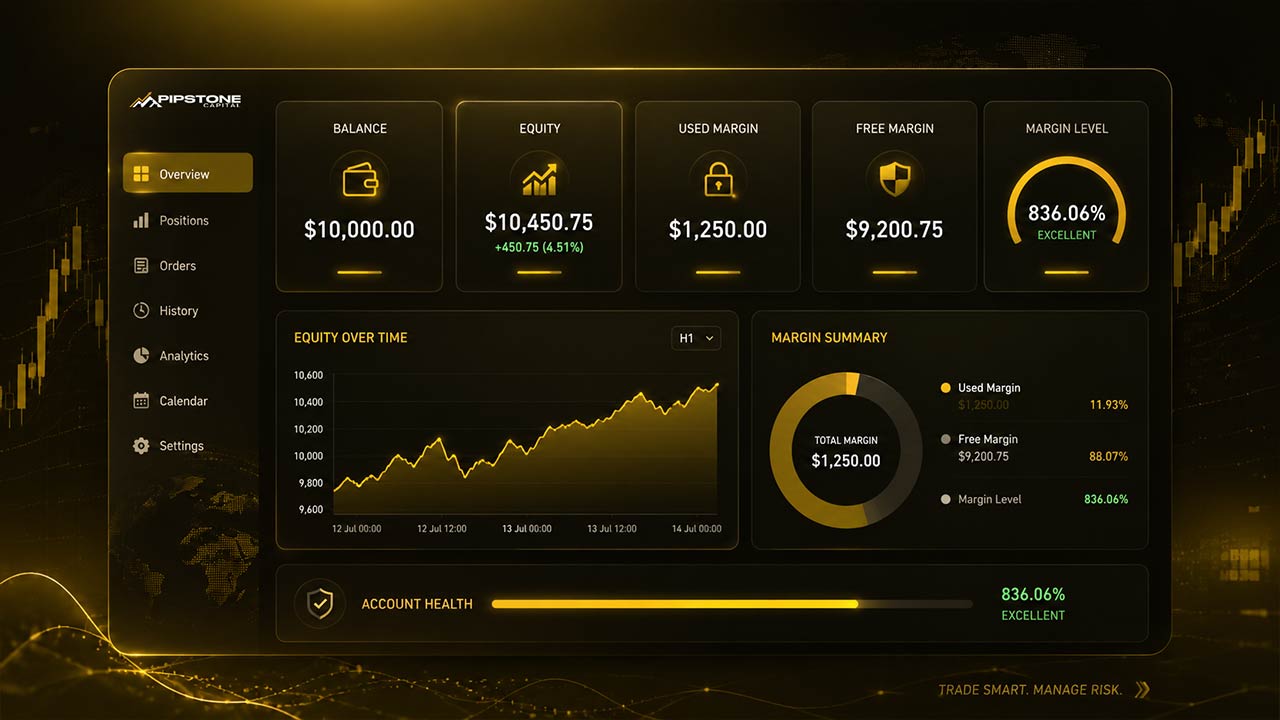
Your balance is the amount of money in your trading account after all closed trades, deposits, withdrawals, fees, and other completed transactions have been recorded.
For example, suppose you deposit $5,000 into your trading account. Before opening any positions, your account balance is $5,000.
You then open a trade and make a $200 profit. Once you close the trade, the profit is added to your balance, increasing it to $5,200.
If you instead close the trade with a $200 loss, your balance becomes $4,800.
The important point is that open trades do not normally change your balance. Their unrealized profits or losses affect your equity instead.
That means your balance can still show $5,000 even when your open positions are currently losing $600. Until those trades are closed, the loss remains floating.

What Is Equity in Forex?
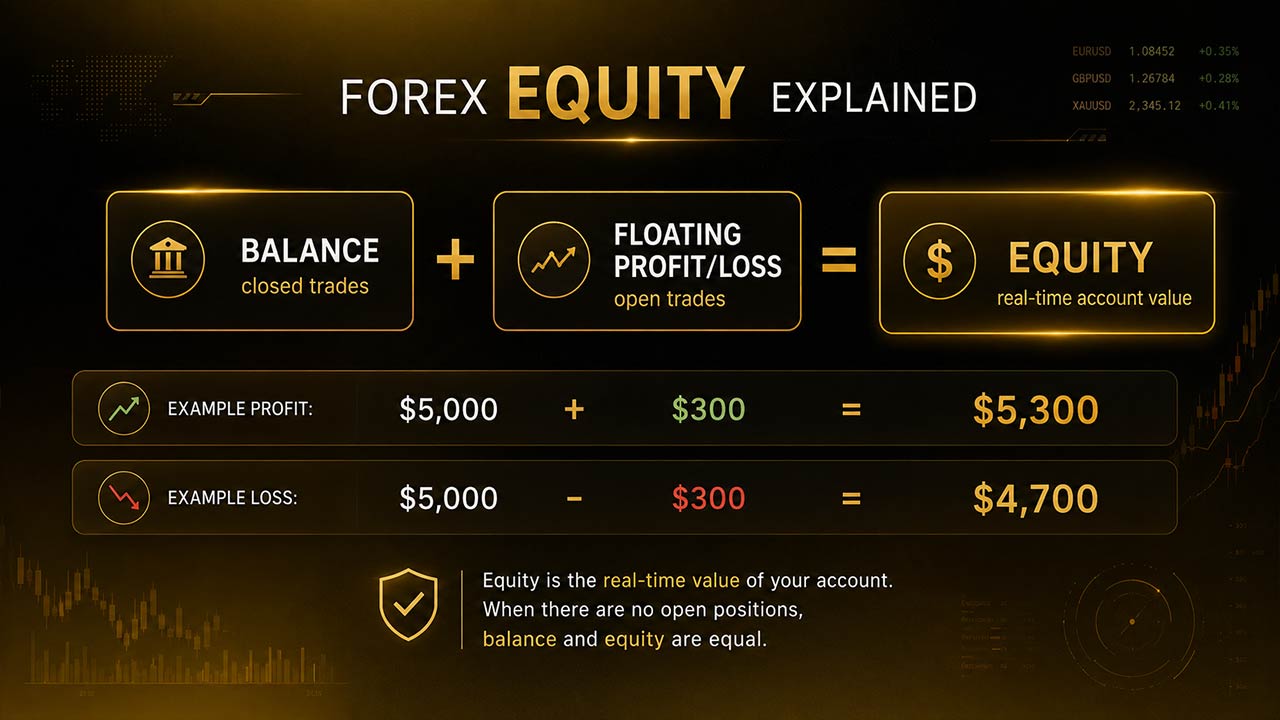
Equity is the real-time value of your trading account.
It includes your balance plus or minus the floating profit or loss from all open positions.
The basic formula is:
Equity = Account balance + Floating profit or loss
Suppose your balance is $5,000 and you have an open trade showing a $300 profit.
Your equity would be:
$5,000 + $300 = $5,300
If the trade were showing a $300 floating loss, your equity would be:
$5,000 - $300 = $4,700
This distinction between equity and margin in forex matters because brokers use equity, rather than balance alone, to measure how much money is currently supporting your open trades.
Your balance shows the result of completed transactions. Equity shows what your account is worth right now.
When you have no open positions, your balance and equity are normally equal.
What Is Used Margin in Forex?
Used margin is the portion of your account equity that the broker sets aside to support your open positions.
It is not a trading fee, and the broker does not permanently remove it from your account. Instead, the amount is reserved while the trade remains open.
Used margin is closely connected to leverage, but the two terms are not interchangeable. Understanding the difference between margin and leverage makes the calculation much clearer.
The amount of used margin depends on factors such as:
The size of the position
The leverage available on the account
The currency pair or instrument
The current market price
The broker’s margin requirements
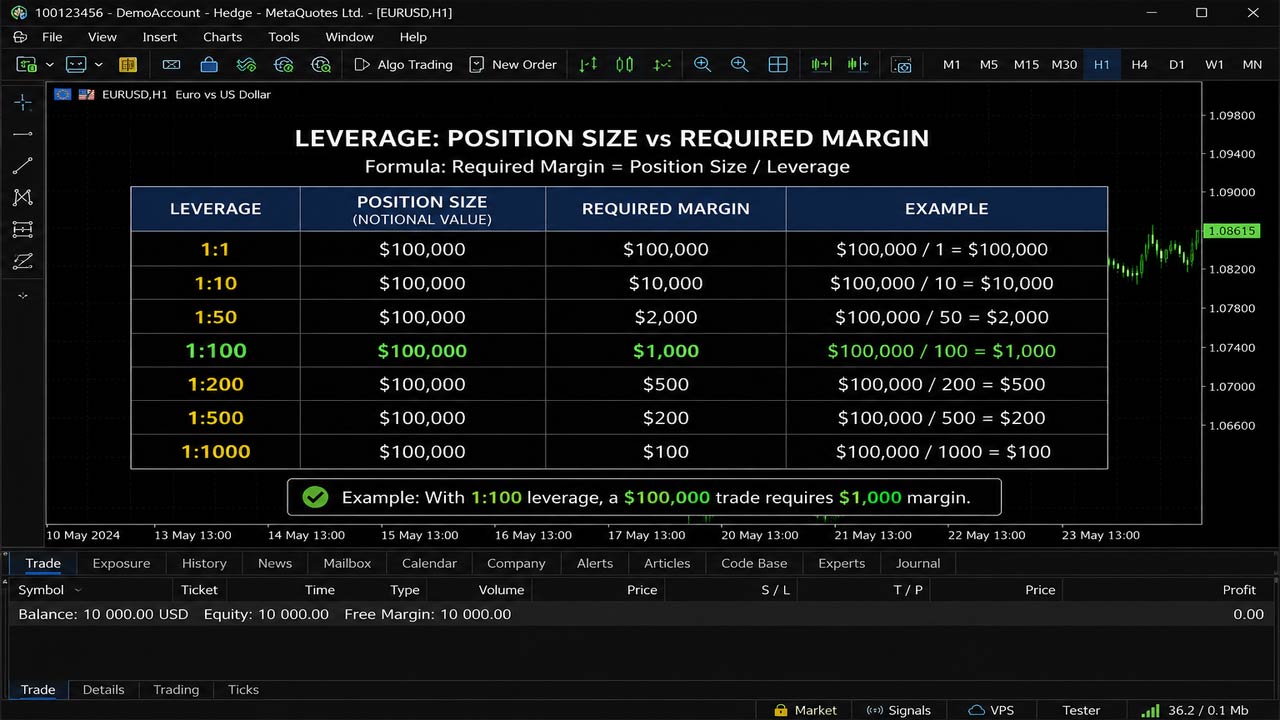
For example, imagine that you open a position worth $100,000 using 1:100 leverage.
The required margin would generally be:
Required margin = Position value ÷ Leverage
$100,000 ÷ 100 = $1,000
In this example, $1,000 becomes used margin while the position is open.
If you open several trades, the required margin for each position is added together. The total becomes your account’s used margin.
Used margin normally increases when you open a larger position. This is why understanding lot size in trading is important, as position size affects pip value, total exposure, and the amount you could gain or lose.
Used margin does not directly increase because a trade moves into a loss. However, the loss reduces your equity and free margin, which makes the used margin a larger burden on the account.
To understand why the required margin changes while the total position value remains the same, it helps to first understand how forex leverage works and how it affects your market exposure.
What Is Free Margin in Forex?
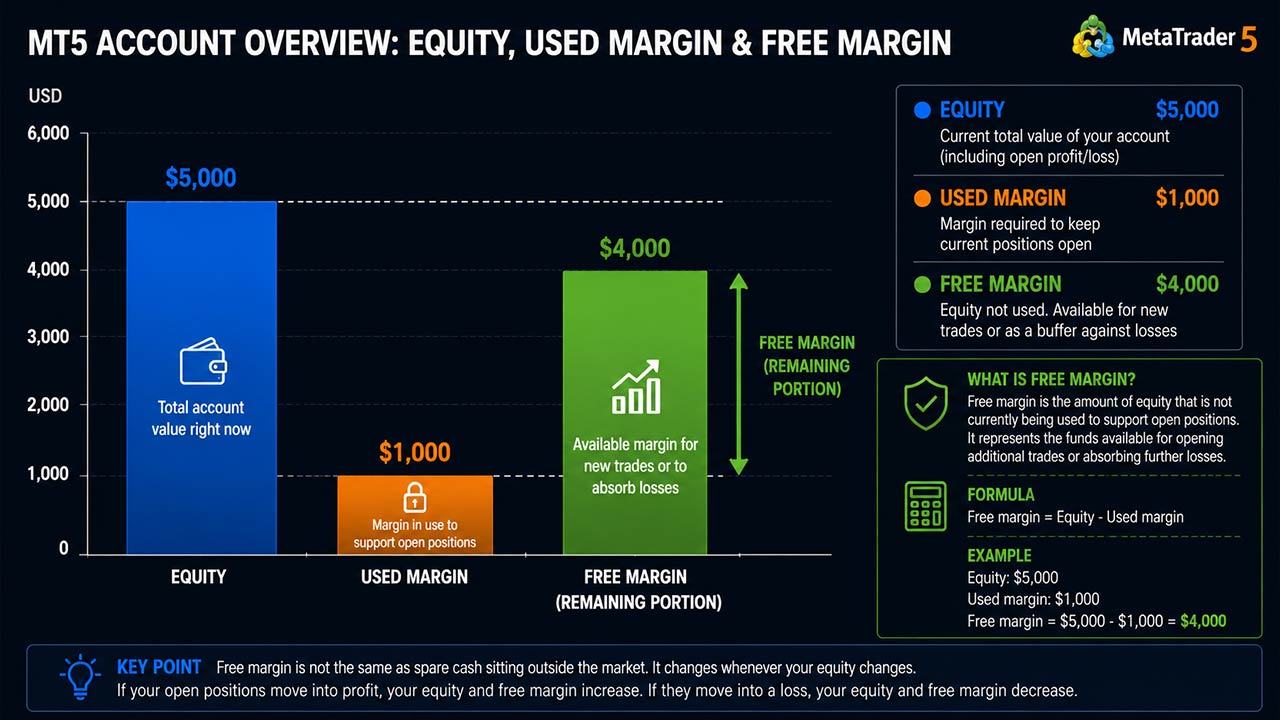
Free margin is the amount of equity that is not currently being used to support open positions.
It may also be described as available margin in forex because it represents the funds available for opening additional trades or absorbing further losses.
The formula is:
Free margin = Equity - Used margin
Suppose your account has:
Balance: $5,000
Equity: $5,000
Used margin: $1,000
Your free margin would be:
$5,000 - $1,000 = $4,000
You could potentially use some of that $4,000 to open another position. It also acts as a buffer against losses on your current trades.
Free margin is not the same as spare cash sitting outside the market. It changes whenever your equity changes.
If your open positions move into profit, your equity and free margin increase. If they move into a loss, your equity and free margin decrease.
The best leverage for forex trading depends on your account size, stop-loss distance, strategy, and ability to control exposure. The highest leverage available is not automatically the most suitable option.
Free Margin vs Used Margin: What Is the Difference?
The main difference between free margin vs used margin is their purpose.
Used margin is already allocated to your open positions. Free margin is the remaining amount available to support new trades or absorb market losses.
Consider an account with $10,000 in equity and $2,000 in used margin.
The free margin is:
$10,000 - $2,000 = $8,000
The $2,000 is supporting existing positions. The remaining $8,000 is still available.
The relationship changes when your open trades gain or lose value.
If the positions develop a floating loss of $3,000, equity falls from $10,000 to $7,000. Assuming the used margin remains $2,000, free margin falls to $5,000.
The account now has:
Balance: $10,000
Equity: $7,000
Used margin: $2,000
Free margin: $5,000
This example shows why looking at balance alone can be misleading. The balance still says $10,000, but only $5,000 remains as available margin after accounting for the floating loss and used margin.
What Is Forex Margin Level?
The forex margin level shows the relationship between your equity and used margin as a percentage.
The formula is:
Margin level = Equity ÷ Used margin × 100
Suppose your equity is $5,000 and your used margin is $1,000.
Your margin level would be:
$5,000 ÷ $1,000 × 100 = 500%
A higher margin level generally means the account has more equity relative to the margin being used.
A falling margin level indicates that the account is under increasing pressure. This can happen because of growing floating losses, larger positions, or additional trades that increase used margin.
Brokers use margin level to decide when to restrict new trades, issue a margin call, or begin closing positions.
The exact margin call and stop-out percentages depend on the broker and account type. Traders should always check these conditions before trading.
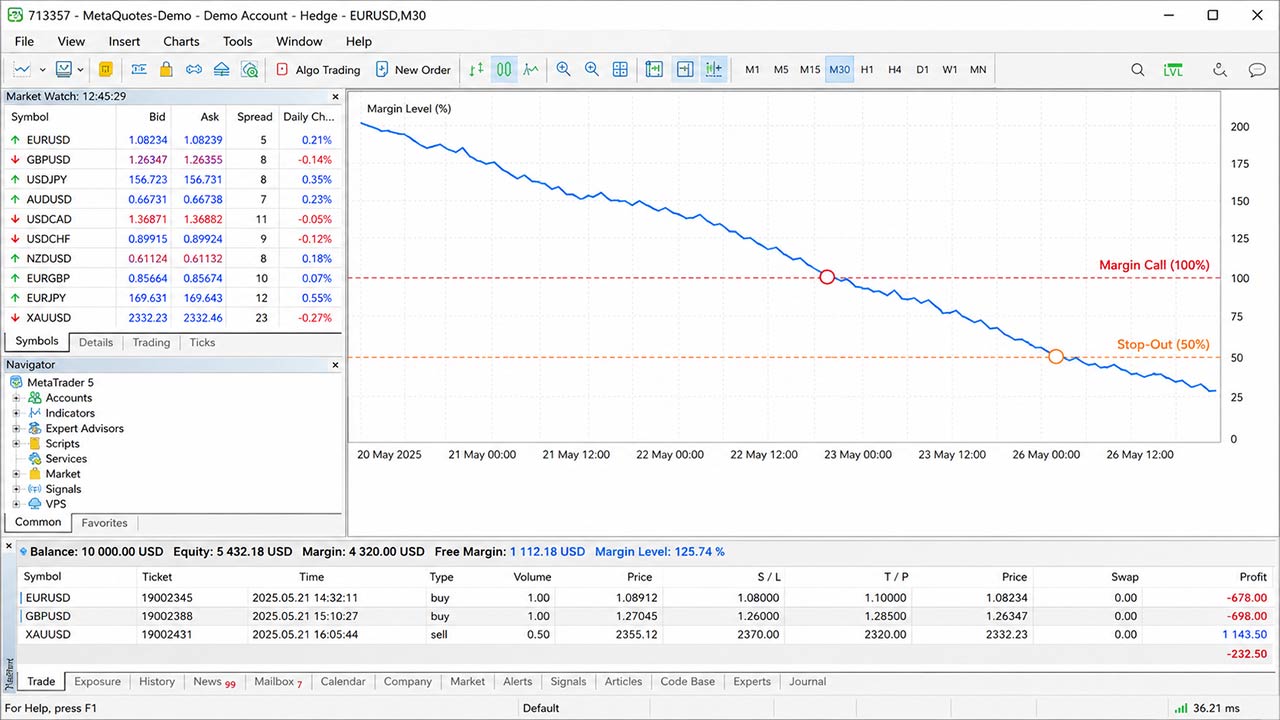
How Floating Losses Affect Each Number
Floating losses are unrealized losses from trades that are still open. They directly affect equity, free margin, and margin level, but they do not immediately change your balance or used margin.
A clear approach to risk management in trading can help limit this pressure by controlling position size, risk per trade, and stop-loss distance.
Imagine you deposit $10,000 and open a position requiring $2,000 in margin.
Before the market moves, your account looks like this:
Balance: $10,000
Equity: $10,000
Used margin: $2,000
Free margin: $8,000
Margin level: 500%
The margin level is calculated as:
$10,000 ÷ $2,000 × 100 = 500%
Now suppose the trade moves against you and develops a $2,500 floating loss.
Your balance remains $10,000 because the position is still open.
Your equity becomes:
$10,000 - $2,500 = $7,500
Your used margin remains $2,000, assuming the broker’s margin requirement has not changed.
Your free margin becomes:
$7,500 - $2,000 = $5,500
Your margin level becomes:
$7,500 ÷ $2,000 × 100 = 375%
Nothing has been deducted from the balance yet, but the account has clearly become weaker. Equity, free margin, and margin level have all fallen.
If the floating loss grows to $7,000, the figures become:
Balance: $10,000
Equity: $3,000
Used margin: $2,000
Free margin: $1,000
Margin level: 150%
At this point, the account has much less room to absorb further losses.
If the position is eventually closed with the $7,000 loss, the floating loss becomes realized. The balance would then fall to $3,000.

How Floating Profits Affect the Account
Floating profits have the opposite effect.
Suppose your balance is $10,000, your used margin is $2,000, and your open trade has a floating profit of $1,500.
Your equity becomes:
$10,000 + $1,500 = $11,500
Your free margin becomes:
$11,500 - $2,000 = $9,500
Your margin level becomes:
$11,500 ÷ $2,000 × 100 = 575%
The floating profit increases the amount of available margin in the forex account. However, the profit is not added to the balance until the trade is closed.
It is also important to remember that floating profits can disappear if the market reverses.
Opening additional positions based only on unrealized profit can increase risk quickly. If the original profitable trade reverses while the new trades also move against you, free margin may fall much faster than expected.
A Complete Free Margin vs Used Margin Example
Consider a trader with a $6,000 account balance.
The trader opens two positions:
Trade one requires $800 in margin
Trade two requires $700 in margin
The total used margin is:
$800 + $700 = $1,500
Before the market moves, the account shows:
Balance: $6,000
Equity: $6,000
Used margin: $1,500
Free margin: $4,500
Margin level: 400%
The margin level is:
$6,000 ÷ $1,500 × 100 = 400%
Now imagine trade one has a floating profit of $300, while trade two has a floating loss of $1,100.
The combined floating result is:
$300 - $1,100 = -$800
Equity becomes:
$6,000 - $800 = $5,200
Free margin becomes:
$5,200 - $1,500 = $3,700
Margin level becomes:
$5,200 ÷ $1,500 × 100 = 346.67%
Although one trade is profitable, the total open-position result is negative. The platform calculates equity using the combined floating profit and loss from all positions.
This is why traders should monitor total account exposure rather than judging each trade separately.
What Happens When Free Margin Reaches Zero?
When free margin reaches zero, all available equity is tied up in used margin and floating losses.
At that point, you usually cannot open another trade. Your account also has little or no capacity to absorb additional losses.
A zero free margin does not always mean the broker will immediately close your positions. Automatic closures normally depend on the broker’s stop-out level, which is based on margin level.
For example, a broker may begin closing positions when the margin level falls to a specified percentage. The broker will usually start with one or more open positions to release used margin and reduce exposure.
Exact procedures vary, so traders should not assume that every broker handles stop-outs in the same way.
Why Margin Level Matters More Than Balance
Many new traders focus mainly on their balance. However, balance does not show the immediate risk created by open positions.
An account may have a balance of $20,000 but only $500 in free margin because of large positions and floating losses.
Another account may have a balance of $5,000 but $4,500 in free margin because the trader is using a much smaller position size.
The second account may have less money but better margin health.
The forex margin level gives a clearer picture because it compares current equity with the margin supporting open trades.
A trader with a high balance can still face a margin call when exposure is too large.
How to Protect Your Free Margin
Protecting free margin starts with controlling position size.
Using the maximum position size allowed by your broker leaves little room for normal market movement. Even a relatively small price change can reduce equity and margin level quickly.
Traders can protect their equity and free margin by defining the maximum acceptable loss before opening a position. Proper stop loss and take profit levels can prevent one uncontrolled trade from placing unnecessary pressure on the account.
It is also important to consider correlation. Opening several trades involving the same currency can create more exposure than it appears.
For example, buying EUR/USD and GBP/USD may place two similar bets against the US dollar. If the dollar strengthens, both positions could move into a loss together.
Monitoring combined exposure helps prevent unexpected drops in available margin.
Common Margin Mistakes
One common mistake is treating free margin as money that must be used. Just because the platform allows another trade does not mean opening it is sensible.
Another mistake is focusing on the broker’s maximum leverage instead of the actual position size. High leverage makes it possible to control a larger position with less used margin, but the profit and loss still depend on the full position value.
Traders also sometimes ignore floating losses because the account balance has not changed. The loss may be unrealized, but its effect on equity, free margin, and margin level is real.
Finally, traders may assume that profitable positions make an account safe. Floating profits can increase equity temporarily, but they can reverse before the trades are closed.
Final Thoughts
Understanding free margin vs used margin helps you see what is really happening inside your forex account.
Balance records completed transactions. Equity shows the account’s current value after floating profits and losses. Used margin supports open positions, while free margin shows how much equity remains available. Margin level measures the relationship between equity and used margin.
The most important lesson is that floating losses matter even before a trade is closed. They reduce equity, available margin, and margin level in real time.
Instead of focusing only on balance, monitor all five account figures together. They provide a much clearer picture of your exposure and how much room your account has before margin pressure becomes a serious problem.
For traders applying these principles with Pipstone Capital, features such as raw spreads, leverage of up to 1:100, news trading, no time limit on challenges, and the ability to scale a simulated account up to $400,000 provide greater flexibility. Traders may also qualify for up to a 100% reward split, with approved rewards processed in an average of eight hours. However, these benefits do not replace disciplined position sizing, controlled exposure, and maintaining enough free margin to handle normal market movement.
Frequently Asked Questions
What is the difference between balance and equity?
Balance includes deposits, withdrawals, and results from closed trades. Equity includes the balance plus or minus the floating profit or loss from open trades.
What is the difference between free margin vs used margin?
Used margin supports positions that are already open. Free margin is the remaining equity available to open additional trades or absorb further losses.
Is free margin the same as available margin in forex?
Yes. Free margin is often called available margin because it shows how much account equity is not currently reserved for open positions.
Can free margin become negative?
Depending on the broker’s platform and margin rules, free margin may become negative during rapid market movement. However, stop-out procedures may begin before or around that stage.
Does a floating loss reduce used margin?
Normally, a floating loss reduces equity, free margin, and margin level. Used margin generally remains tied to the position size and margin requirement, although it can change if market prices or broker requirements change.
What is a good forex margin level?
There is no single percentage that is suitable for every trader. In general, a higher margin level provides more room to absorb losses. Traders should stay well above their broker’s margin call and stop-out thresholds.



Free Margin vs Used Margin vs Equity in Forex Explained
When you open a forex trading account, the platform displays several numbers: balance, equity, used margin, free margin, and margin level. They may look similar, but each one tells you something different about the health of your account.
Understanding free margin vs used margin is especially important because these figures determine whether you can open another trade, hold your current positions, or face a margin call.
The confusing part is that some of these numbers remain fixed while others change every second. Your balance may stay the same, while your equity and available margin rise or fall as the market moves.
This guide explains what each figure means, how they connect, and how floating profits or losses affect your trading account.
Balance, Equity and Margin in Forex
Before comparing free margin and used margin, you need to understand the basic structure of a forex account.
The most important figures are:
Balance
Equity
Used margin
Free margin
Margin level
These numbers are connected. A change in one figure can affect several others, particularly when you have open trades.
The easiest way to understand them is to begin with your account balance.
What Is Balance in Forex?
Your balance is the amount of money in your trading account after all closed trades, deposits, withdrawals, fees, and other completed transactions have been recorded.
For example, suppose you deposit $5,000 into your trading account. Before opening any positions, your account balance is $5,000.
You then open a trade and make a $200 profit. Once you close the trade, the profit is added to your balance, increasing it to $5,200.
If you instead close the trade with a $200 loss, your balance becomes $4,800.
The important point is that open trades do not normally change your balance. Their unrealized profits or losses affect your equity instead.
That means your balance can still show $5,000 even when your open positions are currently losing $600. Until those trades are closed, the loss remains floating.
What Is Equity in Forex?
Equity is the real-time value of your trading account.
It includes your balance plus or minus the floating profit or loss from all open positions.
The basic formula is:
Equity = Account balance + Floating profit or loss
Suppose your balance is $5,000 and you have an open trade showing a $300 profit.
Your equity would be:
$5,000 + $300 = $5,300
If the trade were showing a $300 floating loss, your equity would be:
$5,000 - $300 = $4,700
This distinction between equity and margin in forex matters because brokers use equity, rather than balance alone, to measure how much money is currently supporting your open trades.
Your balance shows the result of completed transactions. Equity shows what your account is worth right now.
When you have no open positions, your balance and equity are normally equal.
What Is Used Margin in Forex?
Used margin is the portion of your account equity that the broker sets aside to support your open positions.
It is not a trading fee, and the broker does not permanently remove it from your account. Instead, the amount is reserved while the trade remains open.
Used margin is closely connected to leverage, but the two terms are not interchangeable. Understanding the difference between margin and leverage makes the calculation much clearer.
The amount of used margin depends on factors such as:
The size of the position
The leverage available on the account
The currency pair or instrument
The current market price
The broker’s margin requirements
For example, imagine that you open a position worth $100,000 using 1:100 leverage.
The required margin would generally be:
Required margin = Position value ÷ Leverage
$100,000 ÷ 100 = $1,000
In this example, $1,000 becomes used margin while the position is open.
If you open several trades, the required margin for each position is added together. The total becomes your account’s used margin.
Used margin normally increases when you open a larger position. This is why understanding lot size in trading is important, as position size affects pip value, total exposure, and the amount you could gain or lose.
Used margin does not directly increase because a trade moves into a loss. However, the loss reduces your equity and free margin, which makes the used margin a larger burden on the account.
To understand why the required margin changes while the total position value remains the same, it helps to first understand how forex leverage works and how it affects your market exposure.
What Is Free Margin in Forex?
Free margin is the amount of equity that is not currently being used to support open positions.
It may also be described as available margin in forex because it represents the funds available for opening additional trades or absorbing further losses.
The formula is:
Free margin = Equity - Used margin
Suppose your account has:
Balance: $5,000
Equity: $5,000
Used margin: $1,000
Your free margin would be:
$5,000 - $1,000 = $4,000
You could potentially use some of that $4,000 to open another position. It also acts as a buffer against losses on your current trades.
Free margin is not the same as spare cash sitting outside the market. It changes whenever your equity changes.
If your open positions move into profit, your equity and free margin increase. If they move into a loss, your equity and free margin decrease.
The best leverage for forex trading depends on your account size, stop-loss distance, strategy, and ability to control exposure. The highest leverage available is not automatically the most suitable option.
Free Margin vs Used Margin: What Is the Difference?
The main difference between free margin vs used margin is their purpose.
Used margin is already allocated to your open positions. Free margin is the remaining amount available to support new trades or absorb market losses.
Consider an account with $10,000 in equity and $2,000 in used margin.
The free margin is:
$10,000 - $2,000 = $8,000
The $2,000 is supporting existing positions. The remaining $8,000 is still available.
The relationship changes when your open trades gain or lose value.
If the positions develop a floating loss of $3,000, equity falls from $10,000 to $7,000. Assuming the used margin remains $2,000, free margin falls to $5,000.
The account now has:
Balance: $10,000
Equity: $7,000
Used margin: $2,000
Free margin: $5,000
This example shows why looking at balance alone can be misleading. The balance still says $10,000, but only $5,000 remains as available margin after accounting for the floating loss and used margin.
What Is Forex Margin Level?
The forex margin level shows the relationship between your equity and used margin as a percentage.
The formula is:
Margin level = Equity ÷ Used margin × 100
Suppose your equity is $5,000 and your used margin is $1,000.
Your margin level would be:
$5,000 ÷ $1,000 × 100 = 500%
A higher margin level generally means the account has more equity relative to the margin being used.
A falling margin level indicates that the account is under increasing pressure. This can happen because of growing floating losses, larger positions, or additional trades that increase used margin.
Brokers use margin level to decide when to restrict new trades, issue a margin call, or begin closing positions.
The exact margin call and stop-out percentages depend on the broker and account type. Traders should always check these conditions before trading.
How Floating Losses Affect Each Number
Floating losses are unrealized losses from trades that are still open. They directly affect equity, free margin, and margin level, but they do not immediately change your balance or used margin.
A clear approach to risk management in trading can help limit this pressure by controlling position size, risk per trade, and stop-loss distance.
Imagine you deposit $10,000 and open a position requiring $2,000 in margin.
Before the market moves, your account looks like this:
Balance: $10,000
Equity: $10,000
Used margin: $2,000
Free margin: $8,000
Margin level: 500%
The margin level is calculated as:
$10,000 ÷ $2,000 × 100 = 500%
Now suppose the trade moves against you and develops a $2,500 floating loss.
Your balance remains $10,000 because the position is still open.
Your equity becomes:
$10,000 - $2,500 = $7,500
Your used margin remains $2,000, assuming the broker’s margin requirement has not changed.
Your free margin becomes:
$7,500 - $2,000 = $5,500
Your margin level becomes:
$7,500 ÷ $2,000 × 100 = 375%
Nothing has been deducted from the balance yet, but the account has clearly become weaker. Equity, free margin, and margin level have all fallen.
If the floating loss grows to $7,000, the figures become:
Balance: $10,000
Equity: $3,000
Used margin: $2,000
Free margin: $1,000
Margin level: 150%
At this point, the account has much less room to absorb further losses.
If the position is eventually closed with the $7,000 loss, the floating loss becomes realized. The balance would then fall to $3,000.
How Floating Profits Affect the Account
Floating profits have the opposite effect.
Suppose your balance is $10,000, your used margin is $2,000, and your open trade has a floating profit of $1,500.
Your equity becomes:
$10,000 + $1,500 = $11,500
Your free margin becomes:
$11,500 - $2,000 = $9,500
Your margin level becomes:
$11,500 ÷ $2,000 × 100 = 575%
The floating profit increases the amount of available margin in the forex account. However, the profit is not added to the balance until the trade is closed.
It is also important to remember that floating profits can disappear if the market reverses.
Opening additional positions based only on unrealized profit can increase risk quickly. If the original profitable trade reverses while the new trades also move against you, free margin may fall much faster than expected.
A Complete Free Margin vs Used Margin Example
Consider a trader with a $6,000 account balance.
The trader opens two positions:
Trade one requires $800 in margin
Trade two requires $700 in margin
The total used margin is:
$800 + $700 = $1,500
Before the market moves, the account shows:
Balance: $6,000
Equity: $6,000
Used margin: $1,500
Free margin: $4,500
Margin level: 400%
The margin level is:
$6,000 ÷ $1,500 × 100 = 400%
Now imagine trade one has a floating profit of $300, while trade two has a floating loss of $1,100.
The combined floating result is:
$300 - $1,100 = -$800
Equity becomes:
$6,000 - $800 = $5,200
Free margin becomes:
$5,200 - $1,500 = $3,700
Margin level becomes:
$5,200 ÷ $1,500 × 100 = 346.67%
Although one trade is profitable, the total open-position result is negative. The platform calculates equity using the combined floating profit and loss from all positions.
This is why traders should monitor total account exposure rather than judging each trade separately.
What Happens When Free Margin Reaches Zero?
When free margin reaches zero, all available equity is tied up in used margin and floating losses.
At that point, you usually cannot open another trade. Your account also has little or no capacity to absorb additional losses.
A zero free margin does not always mean the broker will immediately close your positions. Automatic closures normally depend on the broker’s stop-out level, which is based on margin level.
For example, a broker may begin closing positions when the margin level falls to a specified percentage. The broker will usually start with one or more open positions to release used margin and reduce exposure.
Exact procedures vary, so traders should not assume that every broker handles stop-outs in the same way.
Why Margin Level Matters More Than Balance
Many new traders focus mainly on their balance. However, balance does not show the immediate risk created by open positions.
An account may have a balance of $20,000 but only $500 in free margin because of large positions and floating losses.
Another account may have a balance of $5,000 but $4,500 in free margin because the trader is using a much smaller position size.
The second account may have less money but better margin health.
The forex margin level gives a clearer picture because it compares current equity with the margin supporting open trades.
A trader with a high balance can still face a margin call when exposure is too large.
How to Protect Your Free Margin
Protecting free margin starts with controlling position size.
Using the maximum position size allowed by your broker leaves little room for normal market movement. Even a relatively small price change can reduce equity and margin level quickly.
Traders can protect their equity and free margin by defining the maximum acceptable loss before opening a position. Proper stop loss and take profit levels can prevent one uncontrolled trade from placing unnecessary pressure on the account.
It is also important to consider correlation. Opening several trades involving the same currency can create more exposure than it appears.
For example, buying EUR/USD and GBP/USD may place two similar bets against the US dollar. If the dollar strengthens, both positions could move into a loss together.
Monitoring combined exposure helps prevent unexpected drops in available margin.
Common Margin Mistakes
One common mistake is treating free margin as money that must be used. Just because the platform allows another trade does not mean opening it is sensible.
Another mistake is focusing on the broker’s maximum leverage instead of the actual position size. High leverage makes it possible to control a larger position with less used margin, but the profit and loss still depend on the full position value.
Traders also sometimes ignore floating losses because the account balance has not changed. The loss may be unrealized, but its effect on equity, free margin, and margin level is real.
Finally, traders may assume that profitable positions make an account safe. Floating profits can increase equity temporarily, but they can reverse before the trades are closed.
Final Thoughts
Understanding free margin vs used margin helps you see what is really happening inside your forex account.
Balance records completed transactions. Equity shows the account’s current value after floating profits and losses. Used margin supports open positions, while free margin shows how much equity remains available. Margin level measures the relationship between equity and used margin.
The most important lesson is that floating losses matter even before a trade is closed. They reduce equity, available margin, and margin level in real time.
Instead of focusing only on balance, monitor all five account figures together. They provide a much clearer picture of your exposure and how much room your account has before margin pressure becomes a serious problem.
For traders applying these principles with Pipstone Capital, features such as raw spreads, leverage of up to 1:100, news trading, no time limit on challenges, and the ability to scale a simulated account up to $400,000 provide greater flexibility. Traders may also qualify for up to a 100% reward split, with approved rewards processed in an average of eight hours. However, these benefits do not replace disciplined position sizing, controlled exposure, and maintaining enough free margin to handle normal market movement.
Frequently Asked Questions
What is the difference between balance and equity?
Balance includes deposits, withdrawals, and results from closed trades. Equity includes the balance plus or minus the floating profit or loss from open trades.
What is the difference between free margin vs used margin?
Used margin supports positions that are already open. Free margin is the remaining equity available to open additional trades or absorb further losses.
Is free margin the same as available margin in forex?
Yes. Free margin is often called available margin because it shows how much account equity is not currently reserved for open positions.
Can free margin become negative?
Depending on the broker’s platform and margin rules, free margin may become negative during rapid market movement. However, stop-out procedures may begin before or around that stage.
Does a floating loss reduce used margin?
Normally, a floating loss reduces equity, free margin, and margin level. Used margin generally remains tied to the position size and margin requirement, although it can change if market prices or broker requirements change.
What is a good forex margin level?
There is no single percentage that is suitable for every trader. In general, a higher margin level provides more room to absorb losses. Traders should stay well above their broker’s margin call and stop-out thresholds.
