


The Wrong Trading Style Could Be Failing Your Prop Challenges
Most traders blame bad entries when they fail a funded challenge.
Some blame psychology. Others blame the market.
But in many cases, the real problem is simpler.
They are trading the wrong style for their personality, schedule, and prop firm rules.
A trader who works well under pressure may thrive as a scalper. Another trader may perform far better with swing setups and fewer trades. Yet many funded traders force themselves into styles that do not fit them.
That mismatch leads to overtrading, emotional decisions, and broken risk rules.
In prop trading, your strategy matters. But your trading style matters just as much.

Why Trading Style Matters More in Prop Firms
In regular retail trading, traders mostly answer to themselves.
In prop firms, you trade under strict conditions:
Daily drawdown limits
Maximum overall drawdown
Minimum trading days
Consistency rules
Time pressure
Payout conditions
A style that works on a personal account may completely fail inside a funded environment.
For example, a swing trader holding positions for days may struggle with firms that dislike overnight exposure. A scalper may struggle if execution speed or spread conditions are poor.
This is why experienced funded traders choose prop firms based on compatibility with their trading style, not just account size. Traders preparing for evaluations often start by learning how to choose the right funded account before committing to a challenge model.
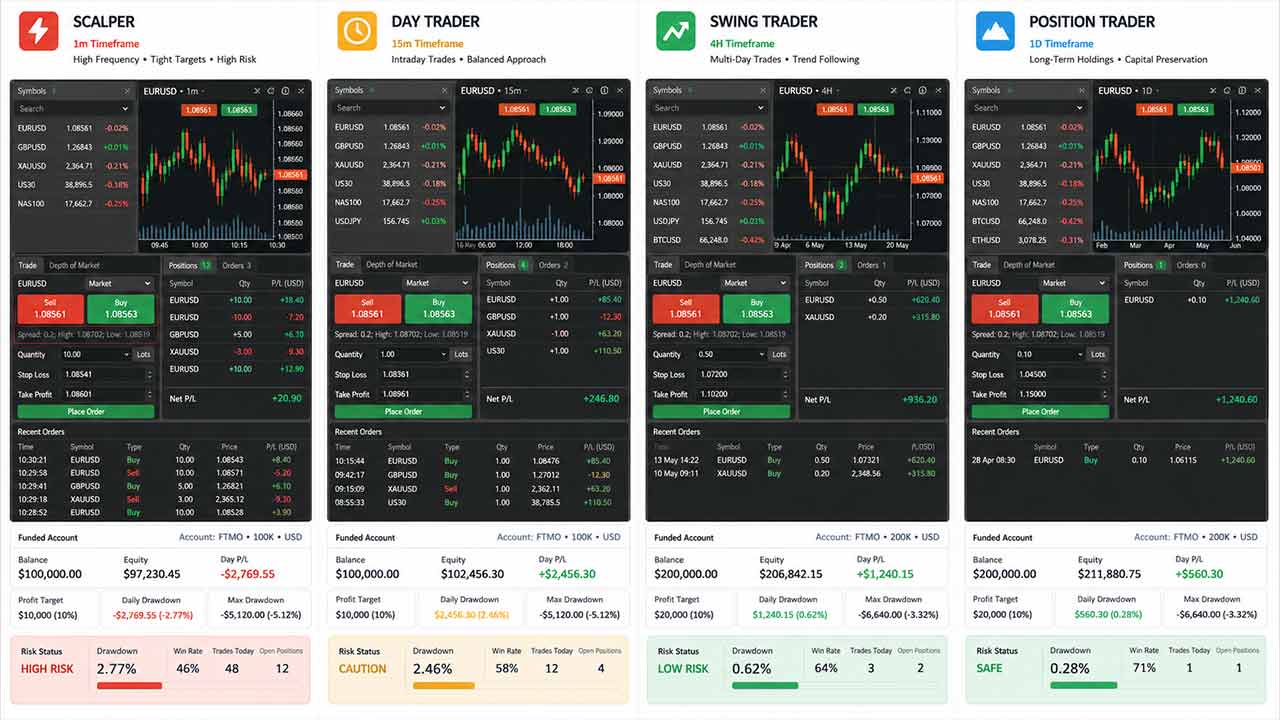
Scalping: Fast Decisions, Fast Pressure
Scalping is one of the most intense trading styles in prop firms.
Scalpers enter and exit trades quickly, often within seconds or minutes. The goal is to capture small market moves repeatedly throughout the session.
This style attracts traders who:
Enjoy fast decision-making
Prefer active market participation
Handle pressure well
Can stay focused for long periods
Scalping can work well in funded accounts because traders avoid overnight exposure and close risk quickly.
But there is a downside.
Fast trading often leads to emotional mistakes. One bad session can destroy a daily drawdown limit in minutes.
Many new funded traders fail because they confuse activity with skill.
More trades do not always mean more profit. Many traders trying to improve execution speed spend time studying different scalping strategies to understand how professional scalpers manage quick market movements without overtrading.
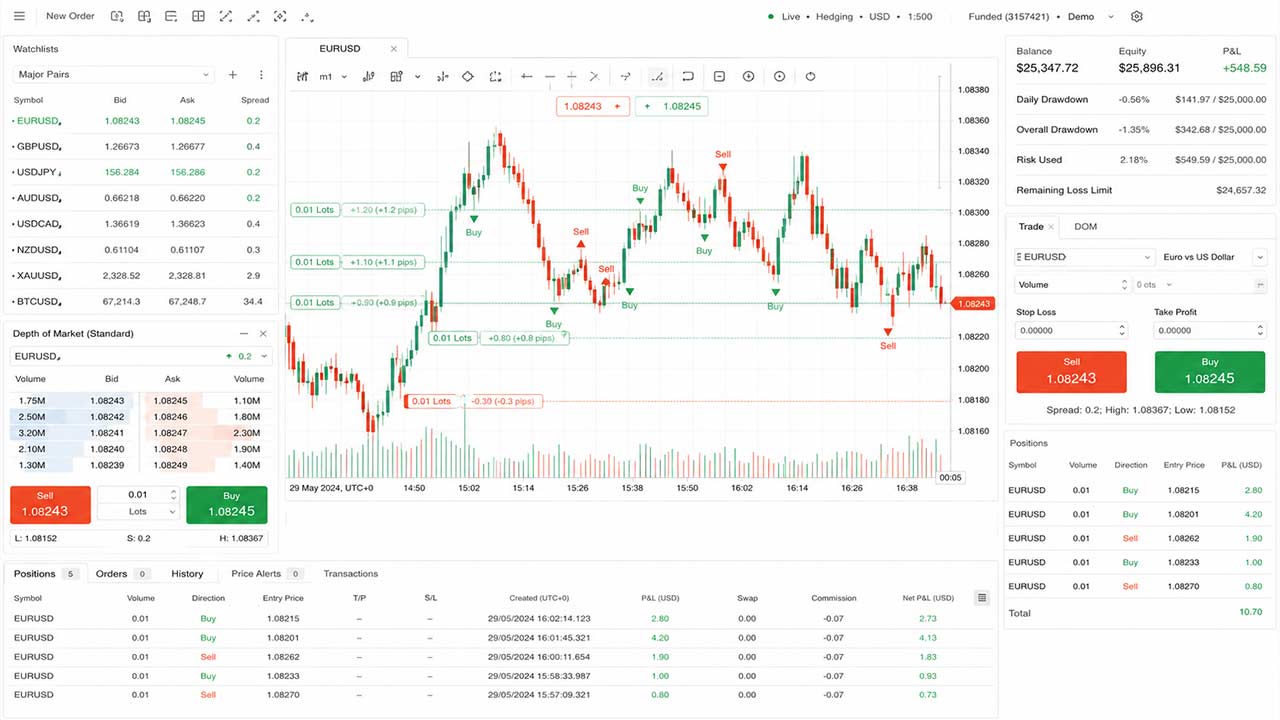
This is where platform conditions matter. Tight spreads, fast execution, and low slippage become extremely important for scalpers trying to protect small profit targets.
Day Trading: The Most Balanced Approach?
Day trading sits between scalping and swing trading.
Trades are usually opened and closed within the same trading day. This style gives traders enough time to analyze setups without the extreme speed of scalping.
Many funded traders prefer day trading because it matches prop firm rules naturally.
It allows traders to:
Avoid overnight risk
Trade major market sessions
Control exposure better
Maintain consistent routines
Day trading also fits traders who have a structured daily schedule.
Instead of staring at charts all day, many successful day traders focus only on specific hours like:
London session
New York open
News releases
Session overlaps
This creates more discipline and reduces random trades.
The problem starts when traders force trades outside their setup window simply to meet profit targets quickly.
That pressure causes many challenge failures.
Swing Trading: Fewer Trades, More Patience
Swing trading is often underestimated in prop trading.
Swing traders hold positions for several days while targeting larger market moves. They trade less frequently but usually focus on higher-quality setups.
This style suits traders who:
Prefer slower analysis
Cannot watch charts all day
Want less emotional stress
Focus on market structure and trends
Swing trading can reduce overtrading significantly.
Instead of taking 20 trades per week, a swing trader may only take three or four carefully planned setups.
But patience becomes the real challenge.
Many traders become uncomfortable holding positions while markets fluctuate temporarily against them.
Some also struggle with firms that apply restrictions around overnight holding or weekend exposure.
Still, swing trading remains one of the cleanest approaches for traders who value quality over frequency.
Position Trading: The Long-Term Mindset Most Traders Ignore
Position trading is the slowest style of all.
These traders may hold positions for weeks or even months based on macro trends, interest rates, or large technical structures.
This style is rare in prop firms because many funded traders chase fast payouts.
But position trading can work extremely well for disciplined traders who understand long-term market behavior.
Position traders care less about small intraday movements and more about the bigger direction.
That means:
Fewer emotional decisions
Lower trading frequency
More focus on macro analysis
Less chart obsession
The biggest issue is psychological.
Many traders become impatient before setups fully develop.
In prop firms, this impatience often pushes traders to abandon their natural style and start overtrading lower timeframes instead.
The Real Reason Many Funded Traders Fail
A trader may have a good strategy and still fail repeatedly.
Why?
Because they are forcing themselves into a style that does not match who they are.
A calm swing trader trying to scalp volatile news sessions will likely struggle emotionally.
A high-energy scalper trying to wait three days for confirmation may become impatient and break rules.
This mismatch creates:
Overtrading
Revenge trading
Inconsistent risk
Emotional entries
Lack of discipline
The best funded traders are usually the ones who fully understand their own behavior.
They know:
How long they can focus
How much stress they handle
How patient they are
How often they should trade
Which environments hurt their performance
That self-awareness matters more than most indicators. Traders who constantly repeat the same mistakes often struggle with discipline, which is why many eventually research why traders fail funded challenges before attempting another evaluation.
Choosing the Right Prop Firm for Your Style
Not every prop firm supports every trading style equally.
Some firms are built for aggressive short-term traders. Others give more flexibility for slower approaches.
Before joining a challenge, traders should check:
Overnight holding rules
News trading policies
Drawdown structure
Time limits
Platform execution quality
Minimum trading day requirements
A strong trader-firm match can reduce unnecessary pressure immediately.
For example, traders who prefer flexibility may lean toward firms that offer:
No time limits
Higher payout splits
Fewer consistency restrictions
Multiple account models
This gives traders more room to follow their natural process instead of forcing unrealistic performance targets.
The Best Trading Style Is the One You Can Repeat Consistently
There is no perfect trading style.
Scalping is not automatically better than swing trading.
Swing trading is not automatically safer than day trading.
The best trading style is simply the one you can execute consistently without emotional breakdowns.
Most funded traders fail because they constantly switch styles after losses. Building consistency usually starts with understanding how to pass a funded challenge while sticking to one repeatable process instead of changing strategies every week.
One week they scalp. The next week they swing trade. Then they try news trading after watching social media profits.
That cycle destroys consistency.
Successful funded traders usually simplify things:
One trading style
One risk model
One clear process
One repeatable routine
Consistency beats excitement in prop trading.
Every time.
Traders who want more flexibility often look for funded challenges that match their natural trading style instead of forcing unrealistic rules. Prop Firms like Pipstone Capital attract attention because of features like no time limits, fast payouts, and trading conditions designed to help traders scale properly.
FAQs
Which trading style is best for funded traders?
There is no single best style. The right one depends on your personality, schedule, and ability to manage risk consistently.
Is scalping harder in prop firms?
Scalping can be harder because daily drawdown limits leave very little room for mistakes.
Do prop firms allow swing trading?
Some do, but traders should always check overnight and weekend holding rules before joining.
Why do traders fail funded challenges?
Most traders fail because of poor risk management, overtrading, and switching strategies too often.



The Wrong Trading Style Could Be Failing Your Prop Challenges
Most traders blame bad entries when they fail a funded challenge.
Some blame psychology. Others blame the market.
But in many cases, the real problem is simpler.
They are trading the wrong style for their personality, schedule, and prop firm rules.
A trader who works well under pressure may thrive as a scalper. Another trader may perform far better with swing setups and fewer trades. Yet many funded traders force themselves into styles that do not fit them.
That mismatch leads to overtrading, emotional decisions, and broken risk rules.
In prop trading, your strategy matters. But your trading style matters just as much.
Why Trading Style Matters More in Prop Firms
In regular retail trading, traders mostly answer to themselves.
In prop firms, you trade under strict conditions:
Daily drawdown limits
Maximum overall drawdown
Minimum trading days
Consistency rules
Time pressure
Payout conditions
A style that works on a personal account may completely fail inside a funded environment.
For example, a swing trader holding positions for days may struggle with firms that dislike overnight exposure. A scalper may struggle if execution speed or spread conditions are poor.
This is why experienced funded traders choose prop firms based on compatibility with their trading style, not just account size. Traders preparing for evaluations often start by learning how to choose the right funded account before committing to a challenge model.
Scalping: Fast Decisions, Fast Pressure
Scalping is one of the most intense trading styles in prop firms.
Scalpers enter and exit trades quickly, often within seconds or minutes. The goal is to capture small market moves repeatedly throughout the session.
This style attracts traders who:
Enjoy fast decision-making
Prefer active market participation
Handle pressure well
Can stay focused for long periods
Scalping can work well in funded accounts because traders avoid overnight exposure and close risk quickly.
But there is a downside.
Fast trading often leads to emotional mistakes. One bad session can destroy a daily drawdown limit in minutes.
Many new funded traders fail because they confuse activity with skill.
More trades do not always mean more profit. Many traders trying to improve execution speed spend time studying different scalping strategies to understand how professional scalpers manage quick market movements without overtrading.
This is where platform conditions matter. Tight spreads, fast execution, and low slippage become extremely important for scalpers trying to protect small profit targets.
Day Trading: The Most Balanced Approach?
Day trading sits between scalping and swing trading.
Trades are usually opened and closed within the same trading day. This style gives traders enough time to analyze setups without the extreme speed of scalping.
Many funded traders prefer day trading because it matches prop firm rules naturally.
It allows traders to:
Avoid overnight risk
Trade major market sessions
Control exposure better
Maintain consistent routines
Day trading also fits traders who have a structured daily schedule.
Instead of staring at charts all day, many successful day traders focus only on specific hours like:
London session
New York open
News releases
Session overlaps
This creates more discipline and reduces random trades.
The problem starts when traders force trades outside their setup window simply to meet profit targets quickly.
That pressure causes many challenge failures.
Swing Trading: Fewer Trades, More Patience
Swing trading is often underestimated in prop trading.
Swing traders hold positions for several days while targeting larger market moves. They trade less frequently but usually focus on higher-quality setups.
This style suits traders who:
Prefer slower analysis
Cannot watch charts all day
Want less emotional stress
Focus on market structure and trends
Swing trading can reduce overtrading significantly.
Instead of taking 20 trades per week, a swing trader may only take three or four carefully planned setups.
But patience becomes the real challenge.
Many traders become uncomfortable holding positions while markets fluctuate temporarily against them.
Some also struggle with firms that apply restrictions around overnight holding or weekend exposure.
Still, swing trading remains one of the cleanest approaches for traders who value quality over frequency.
Position Trading: The Long-Term Mindset Most Traders Ignore
Position trading is the slowest style of all.
These traders may hold positions for weeks or even months based on macro trends, interest rates, or large technical structures.
This style is rare in prop firms because many funded traders chase fast payouts.
But position trading can work extremely well for disciplined traders who understand long-term market behavior.
Position traders care less about small intraday movements and more about the bigger direction.
That means:
Fewer emotional decisions
Lower trading frequency
More focus on macro analysis
Less chart obsession
The biggest issue is psychological.
Many traders become impatient before setups fully develop.
In prop firms, this impatience often pushes traders to abandon their natural style and start overtrading lower timeframes instead.
The Real Reason Many Funded Traders Fail
A trader may have a good strategy and still fail repeatedly.
Why?
Because they are forcing themselves into a style that does not match who they are.
A calm swing trader trying to scalp volatile news sessions will likely struggle emotionally.
A high-energy scalper trying to wait three days for confirmation may become impatient and break rules.
This mismatch creates:
Overtrading
Revenge trading
Inconsistent risk
Emotional entries
Lack of discipline
The best funded traders are usually the ones who fully understand their own behavior.
They know:
How long they can focus
How much stress they handle
How patient they are
How often they should trade
Which environments hurt their performance
That self-awareness matters more than most indicators. Traders who constantly repeat the same mistakes often struggle with discipline, which is why many eventually research why traders fail funded challenges before attempting another evaluation.
Choosing the Right Prop Firm for Your Style
Not every prop firm supports every trading style equally.
Some firms are built for aggressive short-term traders. Others give more flexibility for slower approaches.
Before joining a challenge, traders should check:
Overnight holding rules
News trading policies
Drawdown structure
Time limits
Platform execution quality
Minimum trading day requirements
A strong trader-firm match can reduce unnecessary pressure immediately.
For example, traders who prefer flexibility may lean toward firms that offer:
No time limits
Higher payout splits
Fewer consistency restrictions
Multiple account models
This gives traders more room to follow their natural process instead of forcing unrealistic performance targets.
The Best Trading Style Is the One You Can Repeat Consistently
There is no perfect trading style.
Scalping is not automatically better than swing trading.
Swing trading is not automatically safer than day trading.
The best trading style is simply the one you can execute consistently without emotional breakdowns.
Most funded traders fail because they constantly switch styles after losses. Building consistency usually starts with understanding how to pass a funded challenge while sticking to one repeatable process instead of changing strategies every week.
One week they scalp. The next week they swing trade. Then they try news trading after watching social media profits.
That cycle destroys consistency.
Successful funded traders usually simplify things:
One trading style
One risk model
One clear process
One repeatable routine
Consistency beats excitement in prop trading.
Every time.
Traders who want more flexibility often look for funded challenges that match their natural trading style instead of forcing unrealistic rules. Prop Firms like Pipstone Capital attract attention because of features like no time limits, fast payouts, and trading conditions designed to help traders scale properly.
FAQs
Which trading style is best for funded traders?
There is no single best style. The right one depends on your personality, schedule, and ability to manage risk consistently.
Is scalping harder in prop firms?
Scalping can be harder because daily drawdown limits leave very little room for mistakes.
Do prop firms allow swing trading?
Some do, but traders should always check overnight and weekend holding rules before joining.
Why do traders fail funded challenges?
Most traders fail because of poor risk management, overtrading, and switching strategies too often.
