


Forex vs Stock Trading: Which Is More Profitable in 2026?

Many traders ask the same question before opening their first account. In the forex vs stock trading debate, traders want to know which market offers better profit potential in 2026.
The answer depends on how you trade, how much time you have, and how much risk you can handle. Both markets can produce strong returns. Both can also drain an account fast when traders use poor risk control.
In 2026, forex and stock markets remain highly active. Global inflation, interest rate changes, AI growth, and political tensions continue to create price swings across both markets. Traders now have more tools, faster platforms, and easier access than ever before. Still, profit does not come from access alone. It comes from skill, timing, and discipline.
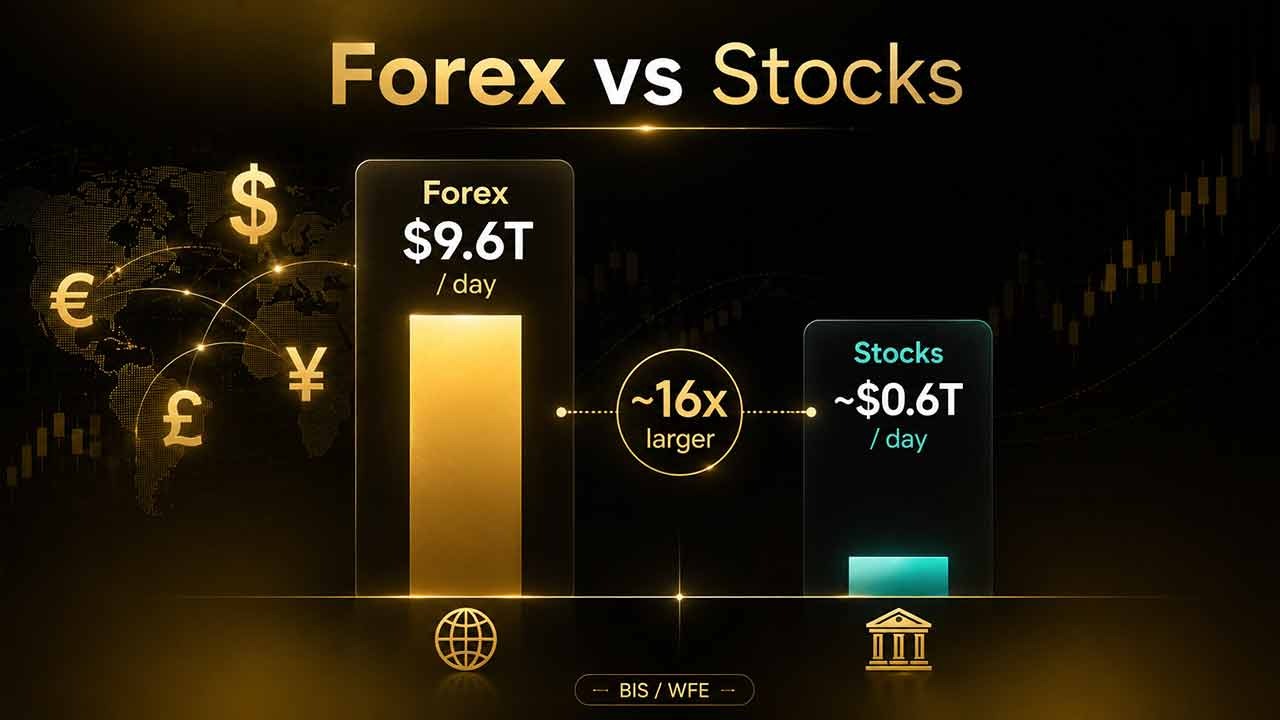
According to the Bank for International Settlements (BIS), the forex market handled around $9.6 trillion in daily trading volume in April 2025, up from $7.5 trillion in 2022. That makes it the largest financial market in the world. At the same time, stock markets continue to attract long-term investors and active traders looking for growth in tech, energy, AI, and healthcare sectors.
Both markets offer profit opportunities in 2026. The real question in forex vs stock trading is which one fits your goals, schedule, and risk level better.
What Is Forex Trading?
Forex trading means buying one currency while selling another. Traders use currency pairs such as EUR/USD, GBP/USD, and USD/JPY.
The forex market runs 24 hours a day during weekdays. Trading moves across the Asian, London, and New York sessions. This gives traders more flexibility compared to stock exchanges with fixed opening hours.
Forex prices move because of:
Interest rate decisions
Inflation reports
Central bank comments
Economic data
Political events
Global risk sentiment
Major currency pairs usually have high liquidity and tight spreads. This allows traders to enter and exit positions quickly.
Many forex traders focus on short-term trades. Some hold trades for minutes, while others stay in positions for days or weeks.
Many new traders also ask whether the market can realistically generate income over time. This guide on is forex trading profitable explains what affects long-term results and why risk management matters.
What Is Stock Trading?
Stock trading means buying and selling shares of companies. Traders can invest in firms such as Apple, Nvidia, Tesla, or Amazon.
Stock prices move based on:
Company earnings
Product launches
AI growth
Sector demand
Economic conditions
Investor sentiment
Unlike forex, stocks give traders exposure to individual companies rather than currencies.
Some traders focus on short-term stock moves. Others hold shares for years to build long-term wealth. Many investors also earn from dividends.
In 2026, AI companies continue to drive strong attention in stock markets. Tech stocks remain highly active, though price swings have become larger due to competition and high valuations.

Forex vs Stock Trading: Which Market Has Higher Profit Potential?
Both markets can be profitable. The difference comes from trading style and market behavior.
Forex often attracts traders looking for:
Frequent setups
Fast price movement
Lower starting capital
High liquidity
More trading hours
Stocks often attract traders looking for:
Long-term growth
Company ownership
Sector investing
Dividend income
Slower trade pacing
Forex can produce faster short-term gains because currency pairs move every day and traders often use margin. Small price moves can create larger returns on smaller accounts.
At the same time, that same speed increases risk. A bad trade in forex can damage an account quickly when position sizing is poor.
Stocks usually move slower than forex majors. Still, single stocks can produce huge moves after earnings reports or major news. Nvidia, for example, saw massive growth during the AI boom over the past few years.
When trading forex vs stocks, the better market depends on how you trade, how much time you have, and the level of risk you can handle.
Forex Trading Pros in 2026
High Liquidity
Forex remains the most liquid market in the world. Major pairs often have low spreads and fast execution.
This matters for active traders. Fast entries and exits become easier during high-volume sessions.
24-Hour Market Access
Forex traders can trade almost any time during weekdays. This helps people who cannot trade during standard stock market hours.
London and New York session overlap still creates some of the strongest price movement in 2026.
Easier to Short the Market
Every forex trade involves buying one currency and selling another. Traders can profit from rising and falling markets without extra restrictions.
This makes forex attractive during uncertain economic periods.
Lower Starting Capital
Many brokers allow traders to start with smaller accounts. This makes forex easier to access for beginners.
Still, low capital does not remove risk. Most beginner losses come from oversized trades and poor discipline.
Some traders also compare prop firms and retail brokers before choosing how they want to trade forex. This breakdown of prop firms vs retail trading brokers explains the key differences, funding structure, and trading conditions.
Stock Trading Pros in 2026
Strong Long-Term Growth
Stocks have a long history of building wealth over time. Large companies can grow for years while increasing share value.
Investors who bought strong tech stocks during major growth periods often saw major returns.
Company Ownership
Stock traders own shares in businesses. This creates a different mindset compared to short-term forex speculation.
Many traders prefer investing in sectors they understand well.
Dividend Income
Some stocks pay regular dividends. This gives investors another income source besides price growth.
Forex does not provide the same type of ownership benefit.
Sector Opportunities
Stocks allow traders to focus on industries such as:
AI
Energy
Defense
Healthcare
Robotics
Semiconductor companies
In 2026, AI infrastructure and chip companies continue to remain major areas of interest.
Which Market Is More Volatile in 2026?
Both markets can become volatile, but volatility works differently.
Forex volatility usually increases around:
Federal Reserve meetings
Inflation data
Nonfarm payroll reports
Geopolitical tensions
Central bank decisions
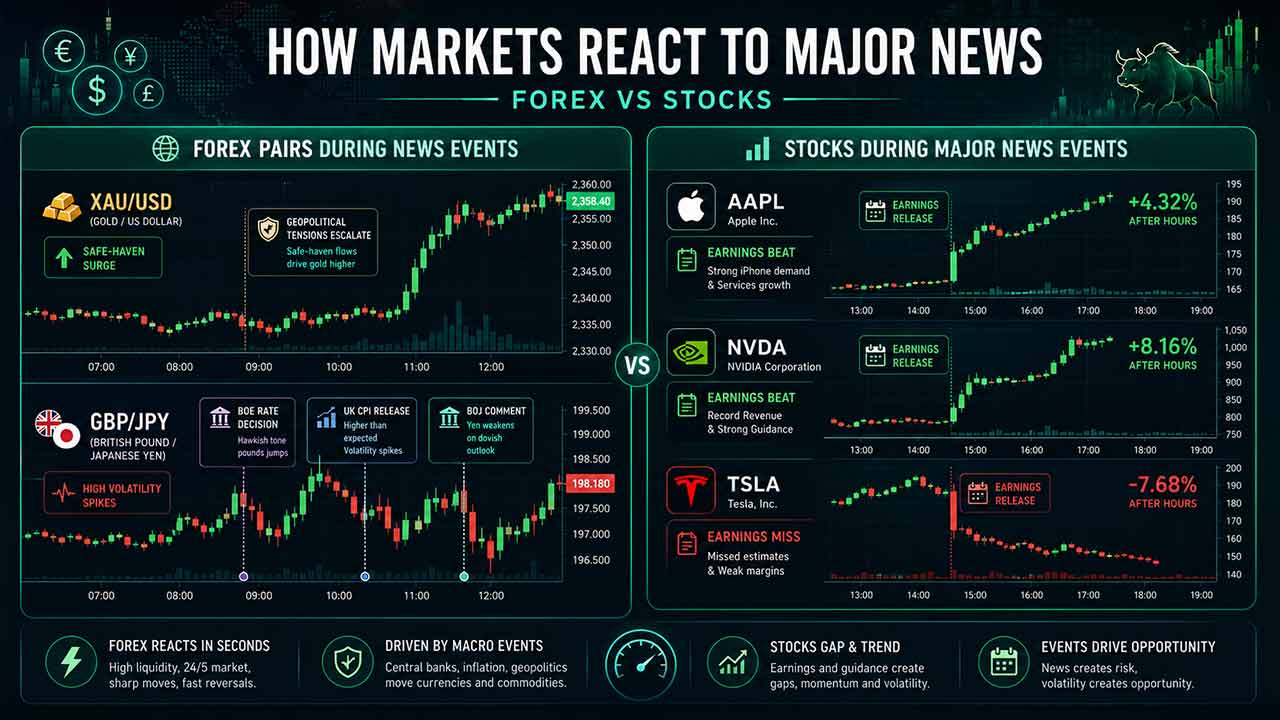
Currency pairs like GBP/JPY and XAU/USD often show strong movement during major news releases.
Stocks become volatile during:
Earnings season
Product launches
AI news
Economic slowdowns
Interest rate concerns
Single stocks can move far more aggressively than forex pairs. A company can lose 15% to 20% in one day after weak earnings.
Forex majors usually move in smaller percentage ranges. Traders often rely on position sizing and margin to increase exposure.
Forex vs Stock Trading for Beginners
Forex looks easier at first because traders can start with small accounts. The market also has fewer instruments compared to stocks.
Many forex beginners mainly focus on:
EUR/USD
GBP/USD
USD/JPY
XAU/USD
Stocks require traders to track many companies and sectors. This can feel overwhelming early on.
Still, forex can become dangerous for beginners because of overtrading and poor risk control. Fast price movement often pushes new traders into emotional decisions.
Stocks may suit beginners better when taking a slower long-term approach.
A lot of beginners also underestimate how much starting capital matters in forex. This guide on how much money you need to start forex trading breaks down realistic account expectations and risk sizing for new traders.
Trading Costs Comparison
Forex trading costs usually come from spreads and commissions.
Major currency pairs often have very low spreads because of high liquidity.
Stock trading costs depend on:
Broker fees
Spread size
Exchange fees
Market conditions
Many modern brokers now offer commission-free stock trading. Still, active stock traders may face higher costs during volatile periods.
Forex remains cheaper for many day traders because of tighter spreads and deeper liquidity.
Trading Forex vs Stocks: Which Takes More Time?
Forex suits traders who want active market participation.
Many forex traders spend time:
Watching charts
Tracking economic news
Monitoring sessions
Managing short-term trades
Stock investors can often take a slower approach. Some investors only review portfolios weekly or monthly.
Day trading stocks still requires strong attention during market hours.
Forex generally demands faster decision-making because markets move continuously across global sessions.
The Role of AI and Technology in 2026
AI tools continue shaping both forex and stock trading in 2026.
Traders now use:
AI market scanners
Trading bots
News tracking tools
Sentiment analysis
Pattern recognition systems
Institutional firms also rely heavily on algorithmic trading.
At the same time, retail traders now have access to tools that were once limited to large firms.
Technology improves speed and analysis, but it does not remove risk. Traders still need discipline and proper strategy execution.
Common Mistakes Traders Make
Many traders lose money in both markets because they:
Risk too much on one trade
Trade without a plan
Chase losses
Ignore stop losses
Overtrade during volatile sessions
A 2025 report from several major brokers showed that a large percentage of retail CFD traders still lose money due to poor risk management.
Profitability depends more on consistency than market choice.
Forex vs Stocks: Which Is More Profitable in 2026?
Forex may produce faster short-term opportunities because of liquidity, trading hours, and constant market movement.
Still, many traders enter the market with unrealistic income goals. This article on how much forex traders make monthly explains what impacts trading income and why consistency matters more than chasing large wins.
Stocks may produce stronger long-term wealth building through company growth and dividends.
Short-term traders often prefer forex because of speed and flexibility.
Long-term investors often prefer stocks because of ownership and sector growth.
Neither market guarantees profits. Skilled traders can succeed in both.
Many experienced traders even combine both markets. They trade forex short term while building long-term stock portfolios.
Traders looking to focus more on forex often join prop firms to access larger capital without risking large personal deposits. Pipstone Capital gives traders access to funding up to $400,000, fast execution, raw spreads, no time limit on challenges, and up to 90% profit splits. This gives active forex traders more room to scale while trading real market conditions.
In 2026, both forex and stock trading remain highly active. The real edge does not come from picking the “perfect” market. It comes from discipline, strong risk control, and staying consistent over time
FAQs: Forex vs Stock Trading
Is forex trading more profitable than stocks?
Forex can create more short-term trade setups because the market stays active around the clock. Stocks usually move slower, but strong companies can grow for years and build bigger long-term returns. In forex vs stocks which is more profitable, the answer usually depends on trading style and risk management.
Is forex riskier than stock trading?
Forex can feel more intense because prices move quickly and many traders use margin. One bad trade can hurt an account fast when risk is too high.
Can beginners trade forex in 2026?
Yes. A lot of beginners start with forex because they can trade smaller account sizes and focus on a few major pairs. Still, learning risk management matters more than trying to make fast profits.
Do professional traders trade forex or stocks?
Some traders stick to forex because of the daily movement and long trading hours. Others prefer stocks because they like following companies and holding trades longer. Many experienced traders use both markets.



Forex vs Stock Trading: Which Is More Profitable in 2026?
Many traders ask the same question before opening their first account. In the forex vs stock trading debate, traders want to know which market offers better profit potential in 2026.
The answer depends on how you trade, how much time you have, and how much risk you can handle. Both markets can produce strong returns. Both can also drain an account fast when traders use poor risk control.
In 2026, forex and stock markets remain highly active. Global inflation, interest rate changes, AI growth, and political tensions continue to create price swings across both markets. Traders now have more tools, faster platforms, and easier access than ever before. Still, profit does not come from access alone. It comes from skill, timing, and discipline.
According to the Bank for International Settlements (BIS), the forex market handled around $9.6 trillion in daily trading volume in April 2025, up from $7.5 trillion in 2022. That makes it the largest financial market in the world. At the same time, stock markets continue to attract long-term investors and active traders looking for growth in tech, energy, AI, and healthcare sectors.
Both markets offer profit opportunities in 2026. The real question in forex vs stock trading is which one fits your goals, schedule, and risk level better.
What Is Forex Trading?
Forex trading means buying one currency while selling another. Traders use currency pairs such as EUR/USD, GBP/USD, and USD/JPY.
The forex market runs 24 hours a day during weekdays. Trading moves across the Asian, London, and New York sessions. This gives traders more flexibility compared to stock exchanges with fixed opening hours.
Forex prices move because of:
Interest rate decisions
Inflation reports
Central bank comments
Economic data
Political events
Global risk sentiment
Major currency pairs usually have high liquidity and tight spreads. This allows traders to enter and exit positions quickly.
Many forex traders focus on short-term trades. Some hold trades for minutes, while others stay in positions for days or weeks.
Many new traders also ask whether the market can realistically generate income over time. This guide on is forex trading profitable explains what affects long-term results and why risk management matters.
What Is Stock Trading?
Stock trading means buying and selling shares of companies. Traders can invest in firms such as Apple, Nvidia, Tesla, or Amazon.
Stock prices move based on:
Company earnings
Product launches
AI growth
Sector demand
Economic conditions
Investor sentiment
Unlike forex, stocks give traders exposure to individual companies rather than currencies.
Some traders focus on short-term stock moves. Others hold shares for years to build long-term wealth. Many investors also earn from dividends.
In 2026, AI companies continue to drive strong attention in stock markets. Tech stocks remain highly active, though price swings have become larger due to competition and high valuations.
Forex vs Stock Trading: Which Market Has Higher Profit Potential?
Both markets can be profitable. The difference comes from trading style and market behavior.
Forex often attracts traders looking for:
Frequent setups
Fast price movement
Lower starting capital
High liquidity
More trading hours
Stocks often attract traders looking for:
Long-term growth
Company ownership
Sector investing
Dividend income
Slower trade pacing
Forex can produce faster short-term gains because currency pairs move every day and traders often use margin. Small price moves can create larger returns on smaller accounts.
At the same time, that same speed increases risk. A bad trade in forex can damage an account quickly when position sizing is poor.
Stocks usually move slower than forex majors. Still, single stocks can produce huge moves after earnings reports or major news. Nvidia, for example, saw massive growth during the AI boom over the past few years.
When trading forex vs stocks, the better market depends on how you trade, how much time you have, and the level of risk you can handle.
Forex Trading Pros in 2026
High Liquidity
Forex remains the most liquid market in the world. Major pairs often have low spreads and fast execution.
This matters for active traders. Fast entries and exits become easier during high-volume sessions.
24-Hour Market Access
Forex traders can trade almost any time during weekdays. This helps people who cannot trade during standard stock market hours.
London and New York session overlap still creates some of the strongest price movement in 2026.
Easier to Short the Market
Every forex trade involves buying one currency and selling another. Traders can profit from rising and falling markets without extra restrictions.
This makes forex attractive during uncertain economic periods.
Lower Starting Capital
Many brokers allow traders to start with smaller accounts. This makes forex easier to access for beginners.
Still, low capital does not remove risk. Most beginner losses come from oversized trades and poor discipline.
Some traders also compare prop firms and retail brokers before choosing how they want to trade forex. This breakdown of prop firms vs retail trading brokers explains the key differences, funding structure, and trading conditions.
Stock Trading Pros in 2026
Strong Long-Term Growth
Stocks have a long history of building wealth over time. Large companies can grow for years while increasing share value.
Investors who bought strong tech stocks during major growth periods often saw major returns.
Company Ownership
Stock traders own shares in businesses. This creates a different mindset compared to short-term forex speculation.
Many traders prefer investing in sectors they understand well.
Dividend Income
Some stocks pay regular dividends. This gives investors another income source besides price growth.
Forex does not provide the same type of ownership benefit.
Sector Opportunities
Stocks allow traders to focus on industries such as:
AI
Energy
Defense
Healthcare
Robotics
Semiconductor companies
In 2026, AI infrastructure and chip companies continue to remain major areas of interest.
Which Market Is More Volatile in 2026?
Both markets can become volatile, but volatility works differently.
Forex volatility usually increases around:
Federal Reserve meetings
Inflation data
Nonfarm payroll reports
Geopolitical tensions
Central bank decisions
Currency pairs like GBP/JPY and XAU/USD often show strong movement during major news releases.
Stocks become volatile during:
Earnings season
Product launches
AI news
Economic slowdowns
Interest rate concerns
Single stocks can move far more aggressively than forex pairs. A company can lose 15% to 20% in one day after weak earnings.
Forex majors usually move in smaller percentage ranges. Traders often rely on position sizing and margin to increase exposure.
Forex vs Stock Trading for Beginners
Forex looks easier at first because traders can start with small accounts. The market also has fewer instruments compared to stocks.
Many forex beginners mainly focus on:
EUR/USD
GBP/USD
USD/JPY
XAU/USD
Stocks require traders to track many companies and sectors. This can feel overwhelming early on.
Still, forex can become dangerous for beginners because of overtrading and poor risk control. Fast price movement often pushes new traders into emotional decisions.
Stocks may suit beginners better when taking a slower long-term approach.
A lot of beginners also underestimate how much starting capital matters in forex. This guide on how much money you need to start forex trading breaks down realistic account expectations and risk sizing for new traders.
Trading Costs Comparison
Forex trading costs usually come from spreads and commissions.
Major currency pairs often have very low spreads because of high liquidity.
Stock trading costs depend on:
Broker fees
Spread size
Exchange fees
Market conditions
Many modern brokers now offer commission-free stock trading. Still, active stock traders may face higher costs during volatile periods.
Forex remains cheaper for many day traders because of tighter spreads and deeper liquidity.
Trading Forex vs Stocks: Which Takes More Time?
Forex suits traders who want active market participation.
Many forex traders spend time:
Watching charts
Tracking economic news
Monitoring sessions
Managing short-term trades
Stock investors can often take a slower approach. Some investors only review portfolios weekly or monthly.
Day trading stocks still requires strong attention during market hours.
Forex generally demands faster decision-making because markets move continuously across global sessions.
The Role of AI and Technology in 2026
AI tools continue shaping both forex and stock trading in 2026.
Traders now use:
AI market scanners
Trading bots
News tracking tools
Sentiment analysis
Pattern recognition systems
Institutional firms also rely heavily on algorithmic trading.
At the same time, retail traders now have access to tools that were once limited to large firms.
Technology improves speed and analysis, but it does not remove risk. Traders still need discipline and proper strategy execution.
Common Mistakes Traders Make
Many traders lose money in both markets because they:
Risk too much on one trade
Trade without a plan
Chase losses
Ignore stop losses
Overtrade during volatile sessions
A 2025 report from several major brokers showed that a large percentage of retail CFD traders still lose money due to poor risk management.
Profitability depends more on consistency than market choice.
Forex vs Stocks: Which Is More Profitable in 2026?
Forex may produce faster short-term opportunities because of liquidity, trading hours, and constant market movement.
Still, many traders enter the market with unrealistic income goals. This article on how much forex traders make monthly explains what impacts trading income and why consistency matters more than chasing large wins.
Stocks may produce stronger long-term wealth building through company growth and dividends.
Short-term traders often prefer forex because of speed and flexibility.
Long-term investors often prefer stocks because of ownership and sector growth.
Neither market guarantees profits. Skilled traders can succeed in both.
Many experienced traders even combine both markets. They trade forex short term while building long-term stock portfolios.
Traders looking to focus more on forex often join prop firms to access larger capital without risking large personal deposits. Pipstone Capital gives traders access to funding up to $400,000, fast execution, raw spreads, no time limit on challenges, and up to 90% profit splits. This gives active forex traders more room to scale while trading real market conditions.
In 2026, both forex and stock trading remain highly active. The real edge does not come from picking the “perfect” market. It comes from discipline, strong risk control, and staying consistent over time
FAQs: Forex vs Stock Trading
Is forex trading more profitable than stocks?
Forex can create more short-term trade setups because the market stays active around the clock. Stocks usually move slower, but strong companies can grow for years and build bigger long-term returns. In forex vs stocks which is more profitable, the answer usually depends on trading style and risk management.
Is forex riskier than stock trading?
Forex can feel more intense because prices move quickly and many traders use margin. One bad trade can hurt an account fast when risk is too high.
Can beginners trade forex in 2026?
Yes. A lot of beginners start with forex because they can trade smaller account sizes and focus on a few major pairs. Still, learning risk management matters more than trying to make fast profits.
Do professional traders trade forex or stocks?
Some traders stick to forex because of the daily movement and long trading hours. Others prefer stocks because they like following companies and holding trades longer. Many experienced traders use both markets.
