


Prop Firm Leverage: How Does It Really Work?

Prop firm leverage is one of the first numbers traders notice when comparing funded accounts.
You may see ratios such as 1:30, 1:50, or 1:100. Higher numbers can look better at first.
But the largest ratio does not always give you the best trading conditions.
Leverage tells you how much market exposure your account can control. It does not tell you how much you should risk.
That difference matters even more when trading with a prop firm.
Funded accounts often have strict loss limits. A position that seems small can still breach those rules quickly.
This guide gives you forex prop firm leverage explained without making it harder than needed.
You will learn how leverage works, how margin fits in, and what really limits your position size.
What Is Prop Firm Leverage?
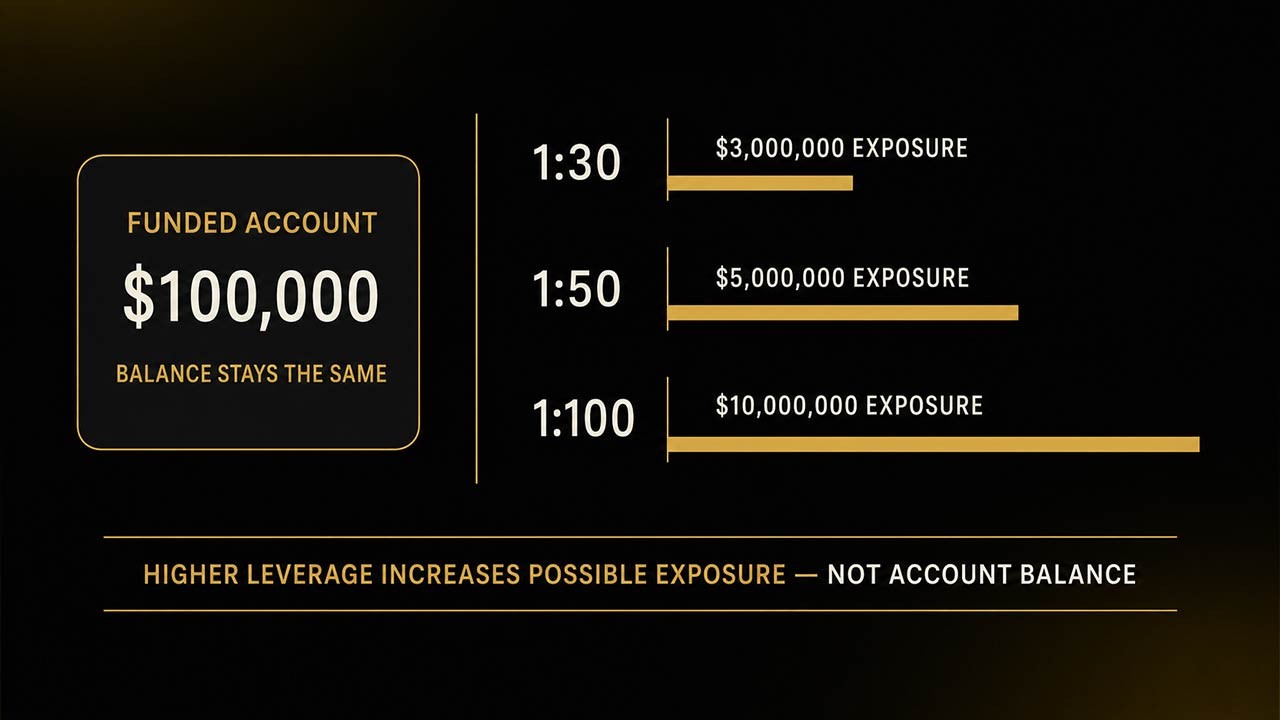
Prop firm leverage is the ratio between your account funds and the position size you can control.
Suppose a funded account offers 1:100 leverage.
In simple terms, every $1 of available margin can control up to $100 in market exposure.
A trader does not receive 100 times more cash in their account.
The ratio only changes how much margin is needed to open a position.
Here is a simple example.
A $100,000 account using 1:100 leverage can support large positions with less margin.
That does not mean the trader should use the full buying power.
Most funded traders should think of leverage as a limit, not a target.
How Does Leverage Work in a Funded Account?
The basic idea is similar to leverage with a retail forex broker.
The main difference comes from the rules around the funded account.
A prop firm may give you access to high buying power. It may also set strict drawdown limits.
That means your real freedom comes from two separate factors:
How much position size the account allows
How much loss the account rules allow
The second point often matters more.
Imagine two traders both receive a $100,000 funded account with 1:100 leverage.
Trader A opens smaller positions and risks $500 on each trade.
Trader B uses much larger positions and risks several thousand dollars.
Both have the same leverage.
Their chance of breaking the account rules is completely different.
This is why leverage in funded accounts should always be viewed alongside risk limits.

Prop Firm Leverage vs Margin
Leverage and margin are closely linked, but they are not the same thing.
Leverage tells you the buying power available.
Margin tells you how much of your account gets set aside for a trade.
Higher leverage usually means less margin is needed for the same position.
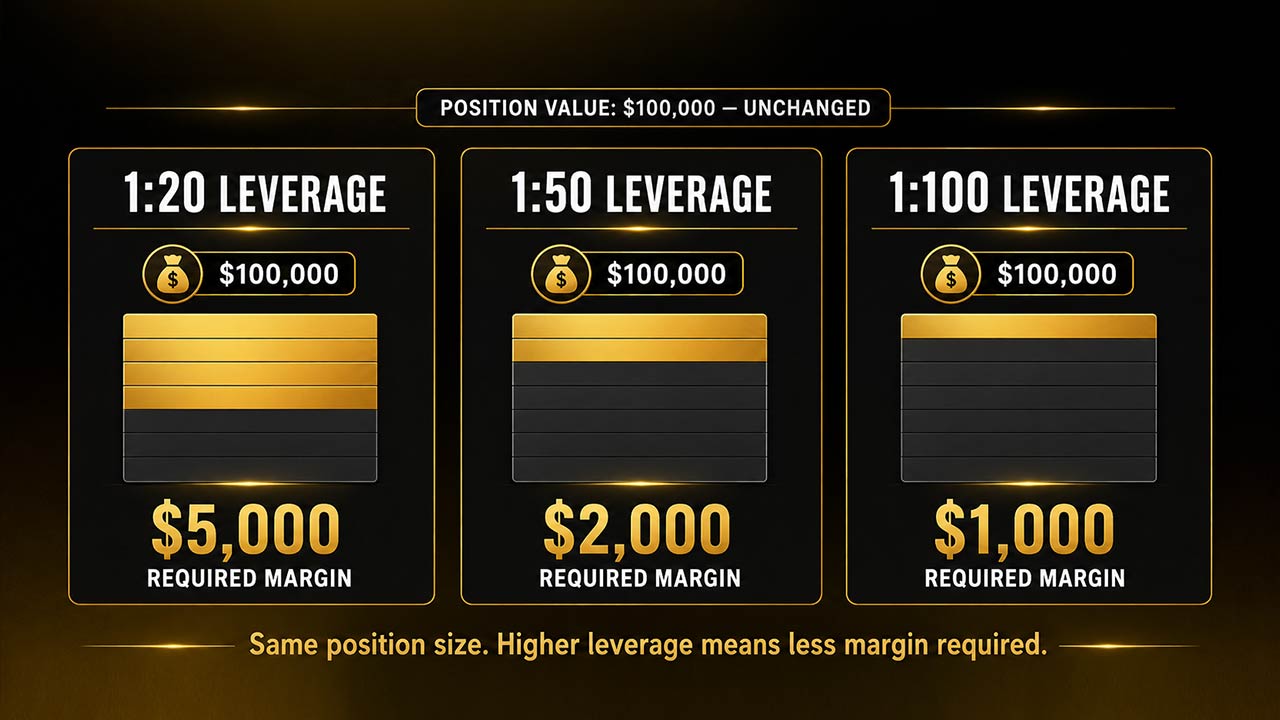
For example, imagine a position worth $100,000.
At 1:100 leverage, the required margin would be about $1,000.
At 1:50 leverage, that same position would require about $2,000.
At 1:20 leverage, it would require about $5,000.
The position itself is still worth $100,000.
Only the margin needed to hold that trade has changed.
This point causes a lot of confusion.
Lower margin does not mean lower trading risk.
Your gain or loss still depends on the size of your position and price movement.
Advertised Leverage Is Not Always Usable Leverage
This is one of the most important parts of prop firm leverage.
A firm might advertise 1:100 leverage.
That does not mean every trader can safely trade at the full 1:100 level.
Your real position size may be limited by other account rules.
These can include:
Daily loss limits
Maximum drawdown
Maximum lot size
Risk limits per trade
Limits for certain assets
Open position restrictions
This creates a difference between advertised leverage and usable leverage.
Suppose your account allows enough margin for a very large EUR/USD position.
The trade may still be far too risky for your drawdown limit.
You could technically open the position.
That does not mean the account can safely handle the loss if price moves against you.
The account rules often become the true limit before margin does.

Why Drawdown Matters More Than Maximum Leverage
Prop traders should pay close attention to drawdown.
Your trading account may have enough margin to open another position.
But your remaining loss allowance may say otherwise.
Assume a funded account has $100,000 in starting funds.
Now imagine you only have $2,000 of room before reaching a loss limit.
Opening a trade with $1,500 of possible risk would use most of that room.
Your margin level might still look healthy.
Your account risk would not.
This is why successful funded trading is not about using maximum buying power.
It is about keeping enough room for losing trades, spreads, and normal price swings.
A strong risk plan should come before position size.
Ask yourself these questions before opening a trade:
How much can I lose on this setup?
Where will my stop loss sit?
How much drawdown room remains?
Are other open trades exposed to the same market move?
Will a news event increase price swings?
These questions are more useful than asking, “How much can I open?”
How Position Size Changes the Risk
Leverage gives you access to a position.
Position size determines how strongly price movement affects your account.
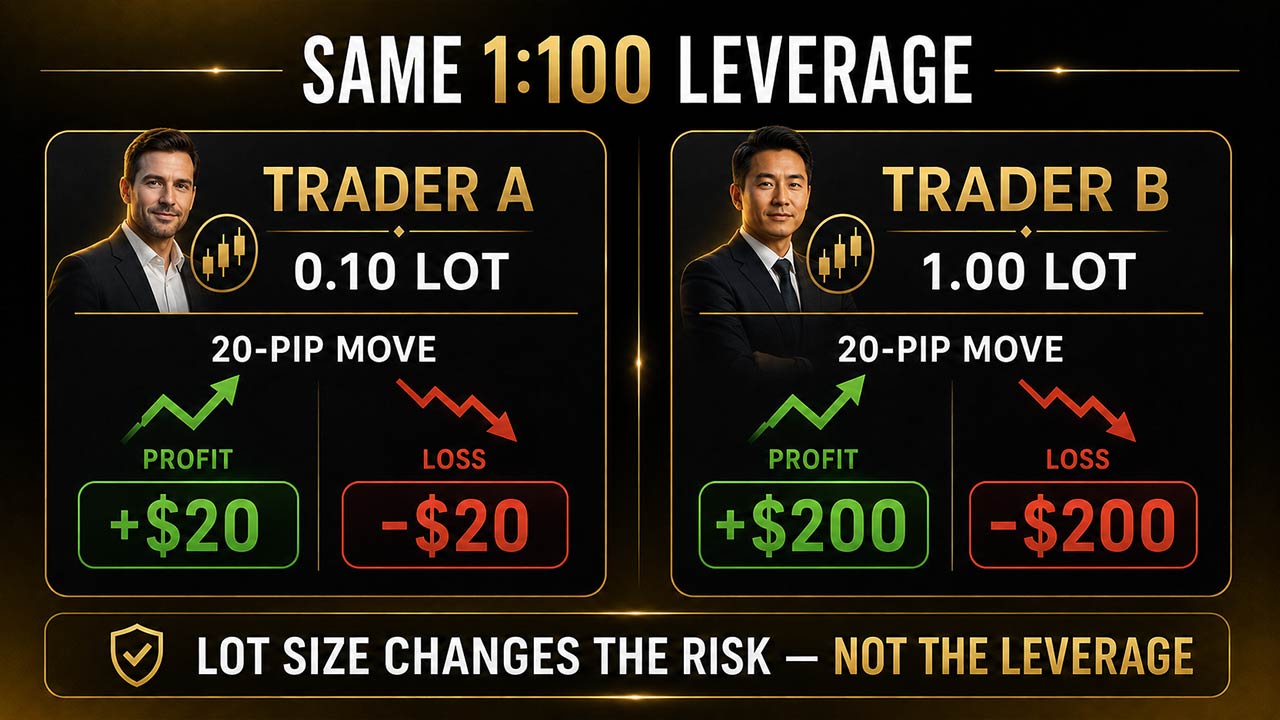
Suppose two traders both use 1:100 leverage.
One opens 0.50 lots.
The other opens 5.00 lots.
The second trader has ten times more exposure.
A similar market move will create a much larger gain or loss.
This is why high leverage does not automatically mean high risk.
High leverage gives you the ability to take more risk.
Your position size decides whether you actually do it.
The stop-loss distance matters too.
A five-lot position with a wide stop can create a large account loss.
Even a smaller position can become risky when the stop is placed too far away.
Position size, stop distance, and pip value need to work together.
Is Higher Prop Firm Leverage Better?
Higher prop firm leverage can be useful, but it is not always better.
It gives traders more freedom when managing margin.
This can help certain trading styles.
A scalper may open and close several short-term trades during the day.
A day trader may need more available margin across several setups.
Higher leverage can make those trades easier to manage.
But there is a clear downside.
More buying power makes it easier to oversize positions.
One aggressive trade can consume a large part of your drawdown allowance.
Higher leverage can also encourage traders to focus on profits instead of risk.
That mindset can become expensive during losing periods.
Lower leverage has its own limits.
You may need more margin to hold each trade.
That can reduce how many positions you can keep open at once.
Neither option is automatically better.
The best ratio depends on your strategy, trade size, and risk plan.
How Different Trading Styles Use Leverage
Different traders need different amounts of buying power.
Scalpers
Scalpers often target small price moves.
They may use larger positions because each target is relatively close.
Access to more margin can help, but strict risk control remains vital.
Day Traders
Day traders usually close positions before the trading day ends.
They may hold several short-term setups across different forex pairs.
Higher buying power can give them more room to manage those trades.
Swing Traders
Swing traders can hold positions for several days.
Their stops may also be wider than a scalper's stops.
That often means position size must be smaller.
A swing trader may not need the highest available leverage.
News Traders
Major economic news can cause sharp price moves and slippage.
Large exposure during these periods can increase losses very quickly.
Reducing position size can help keep risk under control.

Does Higher Leverage Increase Your Profit?
Not by itself.
Changing account leverage does not automatically change your profit.
Your profit comes from your position size and the market's price movement.
Imagine you open one standard lot of EUR/USD.
The trade behaves the same whether your account offers 1:50 or 1:100 leverage.
The difference is how much margin gets locked to hold that position.
If you use higher leverage to open a larger trade, your profit could increase.
Your possible loss increases at the same time.
That is the part traders should never ignore.
More available buying power only creates more capacity.
It does not improve your setup or increase your chance of winning.
How Much Prop Firm Leverage Should You Actually Use?
There is no single ratio that fits every trader.
Start with your trade risk rather than your maximum available buying power.
A simple process looks like this:
Choose how much account value you can risk.
Find the price level where your trade idea fails.
Measure the distance to your stop loss.
Calculate a position size based on that distance.
Check the required margin before opening the trade.
Confirm the loss still fits the prop firm's rules.
This approach works in the right order.
Risk comes first.
Position size comes second.
Margin comes after that.
Maximum leverage should be one of the final checks.
Many traders do the opposite.
They look at available buying power and choose the largest trade the account accepts.
That puts the account rules at risk before the trade even begins.
Common Prop Firm Leverage Mistakes
Access to more buying power can make simple mistakes much more costly.
Watch for these common problems.
Using Maximum Buying Power
You do not need to use all the leverage available.
Leave room for market movement and future trades.
Ignoring Drawdown
Your margin may look fine while your loss limit is getting dangerously close.
Always track both numbers.
Opening Too Many Linked Trades
EUR/USD, GBP/USD, and gold can sometimes react strongly to the same dollar move.
Several positions may act like one large trade.
Increasing Size After Losses
Trying to win back money quickly often leads to larger mistakes.
Keep your risk rules the same after a losing trade.
Forgetting About Volatility
A position size that works during calm markets may become risky during major news.
Adjust your trade size when market conditions change.
Prop Firm Leverage Is a Tool, Not a Trading Plan
Prop firm leverage gives you more control over how account capital gets used.
It can lower margin needs and give you room to manage several positions.
But it does not replace a sound risk plan.
The most important number is rarely the maximum ratio shown on the account.
Your real limits come from position size, stop distance, drawdown, and account rules.
A trader using 1:100 leverage carefully can take less risk than someone using 1:30 badly.
That is why funded traders should stop asking how much leverage they can use.
A better question is how much exposure their account can safely handle.
At Pipstone Capital, a trader-first prop firm built around competitive leverage, fair evaluation rules, fast payouts, and scaling opportunities, we encourage traders to focus on risk-first decision-making rather than chasing the largest possible position size.
Use your buying power when your setup calls for it. Protect your account when it does not.
That is how prop firm leverage should really work.
FAQs
1. Does higher prop firm leverage mean higher risk?
Not directly. Risk depends on position size, not leverage.
2. Can I use full leverage in a funded account?
Usually no. Drawdown and risk rules limit real usage.
3. What is more important than leverage?
Risk per trade and drawdown control.
4. Does leverage affect profit?
Only indirectly through position size.
5. What leverage is best for beginners?
Lower to moderate leverage with strict risk limits.



Prop Firm Leverage: How Does It Really Work?
Prop firm leverage is one of the first numbers traders notice when comparing funded accounts.
You may see ratios such as 1:30, 1:50, or 1:100. Higher numbers can look better at first.
But the largest ratio does not always give you the best trading conditions.
Leverage tells you how much market exposure your account can control. It does not tell you how much you should risk.
That difference matters even more when trading with a prop firm.
Funded accounts often have strict loss limits. A position that seems small can still breach those rules quickly.
This guide gives you forex prop firm leverage explained without making it harder than needed.
You will learn how leverage works, how margin fits in, and what really limits your position size.
What Is Prop Firm Leverage?
Prop firm leverage is the ratio between your account funds and the position size you can control.
Suppose a funded account offers 1:100 leverage.
In simple terms, every $1 of available margin can control up to $100 in market exposure.
A trader does not receive 100 times more cash in their account.
The ratio only changes how much margin is needed to open a position.
Here is a simple example.
A $100,000 account using 1:100 leverage can support large positions with less margin.
That does not mean the trader should use the full buying power.
Most funded traders should think of leverage as a limit, not a target.
How Does Leverage Work in a Funded Account?
The basic idea is similar to leverage with a retail forex broker.
The main difference comes from the rules around the funded account.
A prop firm may give you access to high buying power. It may also set strict drawdown limits.
That means your real freedom comes from two separate factors:
How much position size the account allows
How much loss the account rules allow
The second point often matters more.
Imagine two traders both receive a $100,000 funded account with 1:100 leverage.
Trader A opens smaller positions and risks $500 on each trade.
Trader B uses much larger positions and risks several thousand dollars.
Both have the same leverage.
Their chance of breaking the account rules is completely different.
This is why leverage in funded accounts should always be viewed alongside risk limits.
Prop Firm Leverage vs Margin
Leverage and margin are closely linked, but they are not the same thing.
Leverage tells you the buying power available.
Margin tells you how much of your account gets set aside for a trade.
Higher leverage usually means less margin is needed for the same position.
For example, imagine a position worth $100,000.
At 1:100 leverage, the required margin would be about $1,000.
At 1:50 leverage, that same position would require about $2,000.
At 1:20 leverage, it would require about $5,000.
The position itself is still worth $100,000.
Only the margin needed to hold that trade has changed.
This point causes a lot of confusion.
Lower margin does not mean lower trading risk.
Your gain or loss still depends on the size of your position and price movement.
Advertised Leverage Is Not Always Usable Leverage
This is one of the most important parts of prop firm leverage.
A firm might advertise 1:100 leverage.
That does not mean every trader can safely trade at the full 1:100 level.
Your real position size may be limited by other account rules.
These can include:
Daily loss limits
Maximum drawdown
Maximum lot size
Risk limits per trade
Limits for certain assets
Open position restrictions
This creates a difference between advertised leverage and usable leverage.
Suppose your account allows enough margin for a very large EUR/USD position.
The trade may still be far too risky for your drawdown limit.
You could technically open the position.
That does not mean the account can safely handle the loss if price moves against you.
The account rules often become the true limit before margin does.
Why Drawdown Matters More Than Maximum Leverage
Prop traders should pay close attention to drawdown.
Your trading account may have enough margin to open another position.
But your remaining loss allowance may say otherwise.
Assume a funded account has $100,000 in starting funds.
Now imagine you only have $2,000 of room before reaching a loss limit.
Opening a trade with $1,500 of possible risk would use most of that room.
Your margin level might still look healthy.
Your account risk would not.
This is why successful funded trading is not about using maximum buying power.
It is about keeping enough room for losing trades, spreads, and normal price swings.
A strong risk plan should come before position size.
Ask yourself these questions before opening a trade:
How much can I lose on this setup?
Where will my stop loss sit?
How much drawdown room remains?
Are other open trades exposed to the same market move?
Will a news event increase price swings?
These questions are more useful than asking, “How much can I open?”
How Position Size Changes the Risk
Leverage gives you access to a position.
Position size determines how strongly price movement affects your account.
Suppose two traders both use 1:100 leverage.
One opens 0.50 lots.
The other opens 5.00 lots.
The second trader has ten times more exposure.
A similar market move will create a much larger gain or loss.
This is why high leverage does not automatically mean high risk.
High leverage gives you the ability to take more risk.
Your position size decides whether you actually do it.
The stop-loss distance matters too.
A five-lot position with a wide stop can create a large account loss.
Even a smaller position can become risky when the stop is placed too far away.
Position size, stop distance, and pip value need to work together.
Is Higher Prop Firm Leverage Better?
Higher prop firm leverage can be useful, but it is not always better.
It gives traders more freedom when managing margin.
This can help certain trading styles.
A scalper may open and close several short-term trades during the day.
A day trader may need more available margin across several setups.
Higher leverage can make those trades easier to manage.
But there is a clear downside.
More buying power makes it easier to oversize positions.
One aggressive trade can consume a large part of your drawdown allowance.
Higher leverage can also encourage traders to focus on profits instead of risk.
That mindset can become expensive during losing periods.
Lower leverage has its own limits.
You may need more margin to hold each trade.
That can reduce how many positions you can keep open at once.
Neither option is automatically better.
The best ratio depends on your strategy, trade size, and risk plan.
How Different Trading Styles Use Leverage
Different traders need different amounts of buying power.
Scalpers
Scalpers often target small price moves.
They may use larger positions because each target is relatively close.
Access to more margin can help, but strict risk control remains vital.
Day Traders
Day traders usually close positions before the trading day ends.
They may hold several short-term setups across different forex pairs.
Higher buying power can give them more room to manage those trades.
Swing Traders
Swing traders can hold positions for several days.
Their stops may also be wider than a scalper's stops.
That often means position size must be smaller.
A swing trader may not need the highest available leverage.
News Traders
Major economic news can cause sharp price moves and slippage.
Large exposure during these periods can increase losses very quickly.
Reducing position size can help keep risk under control.
Does Higher Leverage Increase Your Profit?
Not by itself.
Changing account leverage does not automatically change your profit.
Your profit comes from your position size and the market's price movement.
Imagine you open one standard lot of EUR/USD.
The trade behaves the same whether your account offers 1:50 or 1:100 leverage.
The difference is how much margin gets locked to hold that position.
If you use higher leverage to open a larger trade, your profit could increase.
Your possible loss increases at the same time.
That is the part traders should never ignore.
More available buying power only creates more capacity.
It does not improve your setup or increase your chance of winning.
How Much Prop Firm Leverage Should You Actually Use?
There is no single ratio that fits every trader.
Start with your trade risk rather than your maximum available buying power.
A simple process looks like this:
Choose how much account value you can risk.
Find the price level where your trade idea fails.
Measure the distance to your stop loss.
Calculate a position size based on that distance.
Check the required margin before opening the trade.
Confirm the loss still fits the prop firm's rules.
This approach works in the right order.
Risk comes first.
Position size comes second.
Margin comes after that.
Maximum leverage should be one of the final checks.
Many traders do the opposite.
They look at available buying power and choose the largest trade the account accepts.
That puts the account rules at risk before the trade even begins.
Common Prop Firm Leverage Mistakes
Access to more buying power can make simple mistakes much more costly.
Watch for these common problems.
Using Maximum Buying Power
You do not need to use all the leverage available.
Leave room for market movement and future trades.
Ignoring Drawdown
Your margin may look fine while your loss limit is getting dangerously close.
Always track both numbers.
Opening Too Many Linked Trades
EUR/USD, GBP/USD, and gold can sometimes react strongly to the same dollar move.
Several positions may act like one large trade.
Increasing Size After Losses
Trying to win back money quickly often leads to larger mistakes.
Keep your risk rules the same after a losing trade.
Forgetting About Volatility
A position size that works during calm markets may become risky during major news.
Adjust your trade size when market conditions change.
Prop Firm Leverage Is a Tool, Not a Trading Plan
Prop firm leverage gives you more control over how account capital gets used.
It can lower margin needs and give you room to manage several positions.
But it does not replace a sound risk plan.
The most important number is rarely the maximum ratio shown on the account.
Your real limits come from position size, stop distance, drawdown, and account rules.
A trader using 1:100 leverage carefully can take less risk than someone using 1:30 badly.
That is why funded traders should stop asking how much leverage they can use.
A better question is how much exposure their account can safely handle.
At Pipstone Capital, a trader-first prop firm built around competitive leverage, fair evaluation rules, fast payouts, and scaling opportunities, we encourage traders to focus on risk-first decision-making rather than chasing the largest possible position size.
Use your buying power when your setup calls for it. Protect your account when it does not.
That is how prop firm leverage should really work.
FAQs
1. Does higher prop firm leverage mean higher risk?
Not directly. Risk depends on position size, not leverage.
2. Can I use full leverage in a funded account?
Usually no. Drawdown and risk rules limit real usage.
3. What is more important than leverage?
Risk per trade and drawdown control.
4. Does leverage affect profit?
Only indirectly through position size.
5. What leverage is best for beginners?
Lower to moderate leverage with strict risk limits.
