


How Funded Traders Handle Volatile Oil Market Moves
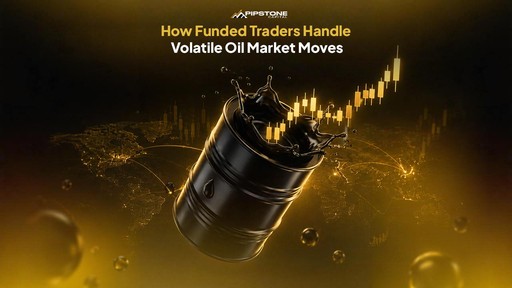
Oil trading attracts traders for one reason: volatility.
Crude oil can move aggressively within minutes after geopolitical headlines, inventory reports, OPEC decisions, or unexpected supply disruptions. For funded traders, that volatility creates opportunity, but it also creates serious risk.
Many traders enter oil markets expecting fast profits without understanding how quickly volatility can destroy a funded account.
A single oversized position during an unstable oil session can violate daily drawdown rules before the trader has time to react.
This is why experienced funded traders approach oil differently.
They do not trade volatility emotionally. They manage exposure carefully and focus on surviving unstable market conditions first.
Why Oil Becomes Dangerous on Funded Accounts
Oil does not behave like most forex pairs.
Crude oil reacts aggressively to:
geopolitical tensions
supply disruptions
OPEC announcements
EIA inventory reports
inflation expectations
global recession fears
According to the U.S. Energy Information Administration, OPEC supply conditions and production disruptions can significantly affect oil price volatility.
These catalysts can create explosive movements very quickly.
A calm session can suddenly turn into a massive volatility spike within seconds.
Recent EIA market outlook data also showed crude oil volatility increasing sharply during periods of geopolitical supply stress.
For funded traders, this becomes dangerous because prop firm rules stay fixed even when market conditions become unstable.
The market may suddenly move 100 to 200 points aggressively while the trader still has the same drawdown limit.
This is why risk management matters more in oil trading than excitement.
The Biggest Mistake Oil Traders Make
Most traders think losing trades are the biggest problem.
Usually, the real problem is oversized exposure.
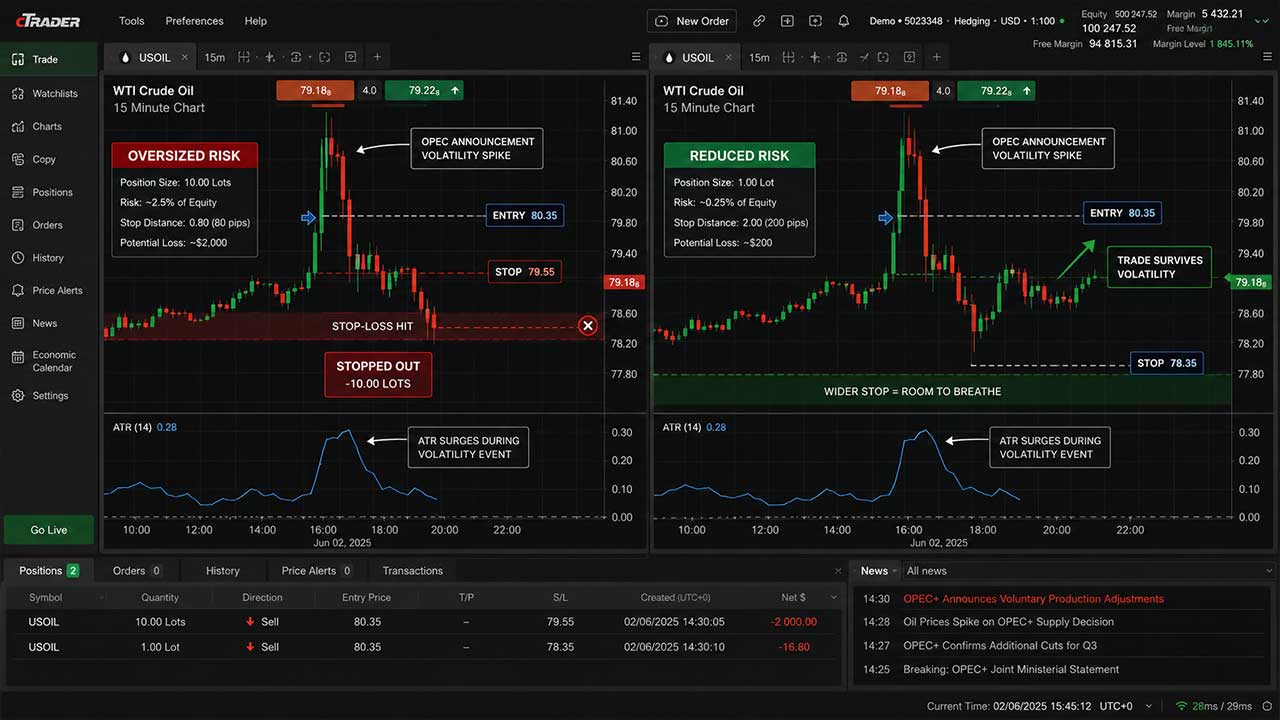
Many traders increase lot size during oil volatility because larger candles create the illusion of bigger opportunity.
But volatility also increases:
slippage
spread expansion
emotional decision-making
stop-loss instability
A trader can have a good market bias and still lose the funded account because risk becomes too large for the environment.
Experienced funded traders understand that volatility should change position size immediately.
They do not use the same exposure during unstable conditions.
Volatility Should Control Position Size
Professional funded traders adapt risk constantly.
Beginners often focus too heavily on profit potential.
Experienced traders focus on exposure.
Oil volatility changes rapidly depending on:
market sentiment
geopolitical headlines
inventory data
liquidity conditions
trading sessions
This is why professional traders reduce lot sizes when volatility expands.
The goal is not maximizing one trade.
The goal is keeping the account alive long enough to produce consistent payouts.
Why Overtrading Oil Destroys Accounts
Oil moves fast, which creates emotional pressure.
After missing one large move, traders often begin forcing entries.
This usually leads to:
revenge trading
impulsive scalping
oversized recovery trades
abandoning trade plans
Volatility becomes even more dangerous during New York session overlaps when liquidity and momentum increase.
The traders who survive funded accounts usually trade less than expected.
They wait for:
clean structure
strong confirmation
controlled volatility
favorable risk-to-reward conditions
Sometimes avoiding a trade is the smartest decision.
Trading Oil News the Wrong Way
Many funded traders lose accounts trying to catch explosive oil news moves.
The biggest catalysts usually include:
EIA crude oil inventory reports
OPEC production decisions
Middle East geopolitical headlines
unexpected supply disruptions
inflation and interest rate expectations
The problem is not the opportunity.
The problem is unstable execution.
During major oil volatility:
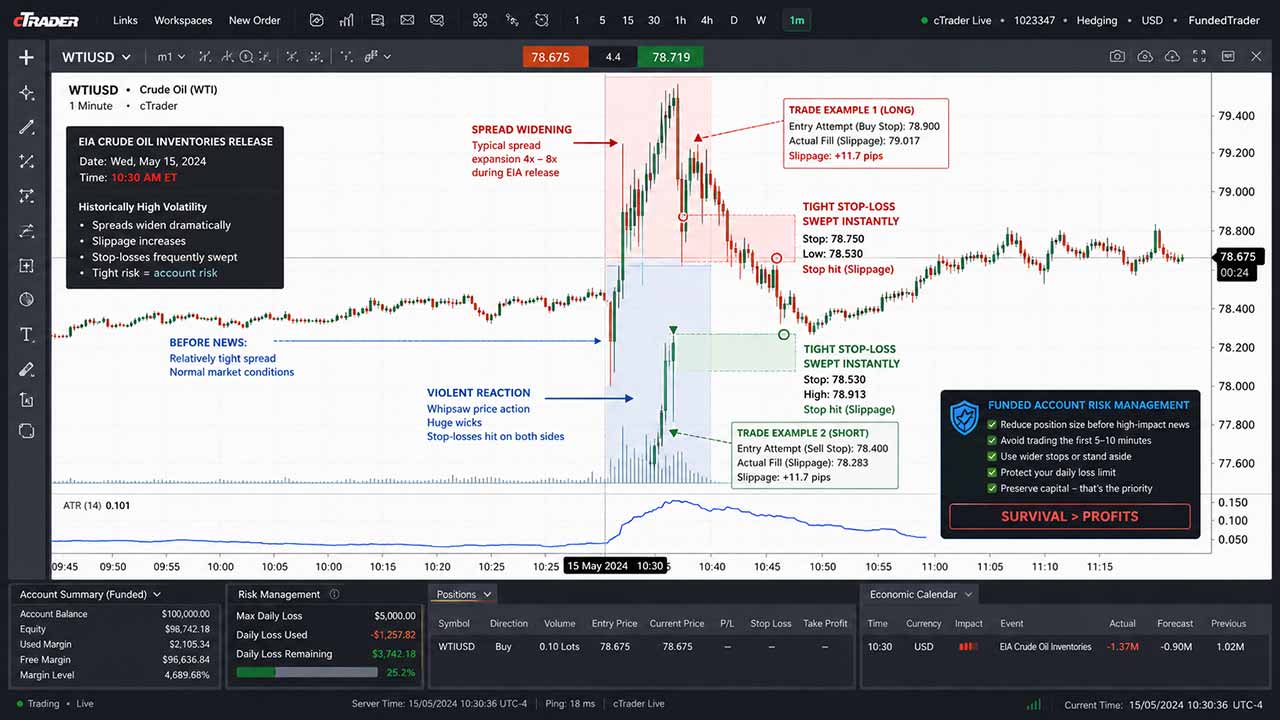
spreads widen aggressively
slippage increases
candles become unpredictable
liquidity can disappear temporarily
A perfect setup can fail instantly.
This is why experienced funded traders often reduce risk heavily during major announcements.
Protecting the account matters more than catching every move.
Why Drawdown Management Matters More Than Win Rate
A lot of traders obsess over high win rates.
But funded trading usually rewards consistency more than aggression.
A trader can survive with:
moderate win rates
smaller gains
controlled exposure
stable execution
What destroys funded accounts is repeated deep drawdowns.
This is why experienced traders focus heavily on risk management in prop trading instead of chasing aggressive short-term gains during volatile oil sessions.
Oil volatility punishes emotional trading very quickly.
One oversized trade during a volatile session can erase several days of progress.
This is why experienced funded traders focus heavily on preserving equity.
Low-drawdown trading keeps accounts alive longer.
Session Timing Changes Oil Volatility
Oil volatility changes throughout the trading day.
Certain sessions naturally create stronger movement because of liquidity and institutional participation.
London and New York sessions usually create the largest moves.
Inventory reports and major US economic releases can increase volatility dramatically.
Understanding timing helps traders avoid random entries.
Many funded traders lose accounts because they trade unstable conditions emotionally instead of waiting for structure.
Professional traders usually focus on high-quality windows where volatility becomes cleaner and easier to manage.
Correlated Exposure Is a Hidden Risk
One major mistake oil traders make is stacking correlated positions.
For example, traders may simultaneously hold:
WTI positions
Brent crude positions
CAD-related trades
energy-sector exposure
They believe these are separate trades.
In reality, they are often heavily connected.
When oil volatility spikes unexpectedly, all positions can move against the trader together.
Experienced funded traders manage total exposure instead of viewing trades individually.
This helps reduce sudden drawdown pressure.
Emotional Trading During Oil Volatility
Oil markets create emotional urgency because moves happen quickly.
Large candles often make traders feel like they are missing opportunities.
This creates:
fear of missing out
impulsive entries
emotional exits
revenge trading behavior
The danger becomes even worse after several winning trades.
Overconfidence is one of the fastest ways to lose a funded account.
Even traders with strong technical skills can struggle once emotions begin influencing decisions during volatile sessions. In many cases, why traders lose funded accounts comes down more to discipline breakdowns than strategy itself.
Traders begin increasing size because they feel comfortable during volatility.
Then one unexpected reversal wipes out progress.
This is why disciplined traders stay mechanically consistent regardless of recent wins or losses.
Why Small Losses Matter in Oil Trading
Many traders try too hard to avoid taking losses.
That mindset usually creates bigger problems.
Professional funded traders accept small controlled losses as part of the process.
The real danger begins when traders:
move stop losses emotionally
average into losing trades
refuse to exit bad positions
overtrade after losses
Oil volatility becomes extremely dangerous once discipline disappears.
A small controlled loss protects the account.
A large emotional loss can instantly violate prop firm rules.
One Good Trade Is Better Than Constant Exposure
Many successful funded traders do not trade every oil movement.
Some only take one or two quality setups per session.
This works well because oil already provides enough volatility.
A single structured setup with:
clean confirmation
controlled risk
stable execution can outperform multiple emotional trades.
Professional traders focus on quality instead of activity.
They understand that survival matters more than excitement.
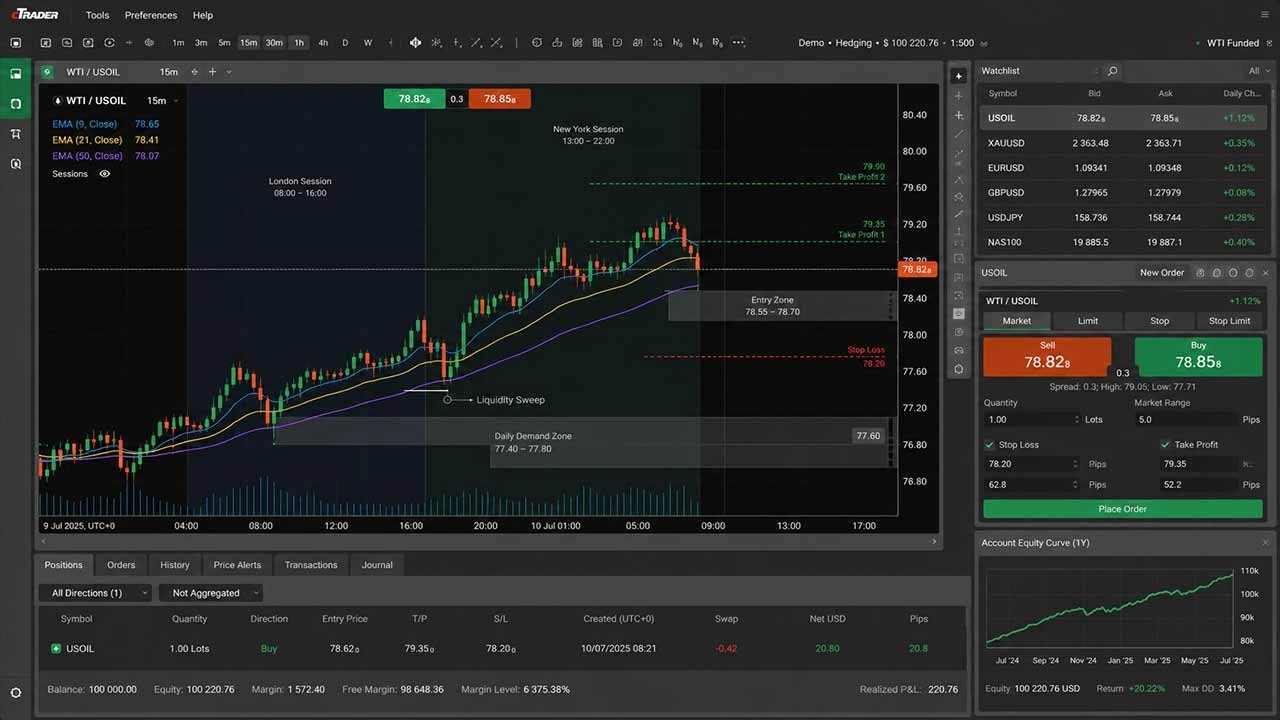
Technology and Execution Matter During Oil Volatility
Execution quality becomes extremely important in fast-moving oil markets.
Poor execution conditions can increase:
slippage
delayed entries
spread costs
stop-loss inconsistencies
This is why many traders look for firms offering:
fast execution
stable platforms
tight spreads
reliable order processing
During high-volatility oil sessions, execution quality directly affects drawdown management.
Building a Low-Drawdown Oil Trading Approach
Low-drawdown trading does not mean avoiding volatility completely.
It means managing exposure intelligently enough to survive unstable conditions.
A sustainable oil trading approach usually includes:
smaller position sizing
strict stop losses
session awareness
reduced emotional trading
limited trades per day
adapting to volatility conditions
The traders who survive funded accounts long-term are usually the traders who remain calm during unstable sessions.
They focus on protecting the account before chasing profits.
Final Thoughts
Oil volatility creates opportunity, but it also exposes weak risk management very quickly.
Most funded traders do not fail because they completely lack strategy. They fail because discipline disappears once volatility increases.
The traders who survive funded trading long-term understand that protecting capital is part of the strategy. Managing volatile oil markets successfully comes down to adapting risk during unstable conditions, respecting drawdown limits, controlling emotional decisions, and focusing on consistency instead of excitement.
That mindset is what keeps funded accounts alive.
For traders looking to trade oil under real market conditions, Pipstone Capital forex prop firm offers funded accounts up to $400,000 with raw spreads, fast execution, and no time limit on challenges.
FAQs
Why is oil trading risky on funded accounts?
Oil can move aggressively during news events, which increases drawdown risk quickly.
What causes the biggest oil market moves?
OPEC decisions, inventory reports, geopolitical tensions, and supply disruptions.
Do funded traders reduce lot size during oil volatility?
Yes. Many traders lower exposure during unstable market conditions.
Is overtrading common in oil markets?
Yes. Fast volatility often causes emotional entries and revenge trading.



How Funded Traders Handle Volatile Oil Market Moves
Oil trading attracts traders for one reason: volatility.
Crude oil can move aggressively within minutes after geopolitical headlines, inventory reports, OPEC decisions, or unexpected supply disruptions. For funded traders, that volatility creates opportunity, but it also creates serious risk.
Many traders enter oil markets expecting fast profits without understanding how quickly volatility can destroy a funded account.
A single oversized position during an unstable oil session can violate daily drawdown rules before the trader has time to react.
This is why experienced funded traders approach oil differently.
They do not trade volatility emotionally. They manage exposure carefully and focus on surviving unstable market conditions first.
Why Oil Becomes Dangerous on Funded Accounts
Oil does not behave like most forex pairs.
Crude oil reacts aggressively to:
geopolitical tensions
supply disruptions
OPEC announcements
EIA inventory reports
inflation expectations
global recession fears
According to the U.S. Energy Information Administration, OPEC supply conditions and production disruptions can significantly affect oil price volatility.
These catalysts can create explosive movements very quickly.
A calm session can suddenly turn into a massive volatility spike within seconds.
Recent EIA market outlook data also showed crude oil volatility increasing sharply during periods of geopolitical supply stress.
For funded traders, this becomes dangerous because prop firm rules stay fixed even when market conditions become unstable.
The market may suddenly move 100 to 200 points aggressively while the trader still has the same drawdown limit.
This is why risk management matters more in oil trading than excitement.
The Biggest Mistake Oil Traders Make
Most traders think losing trades are the biggest problem.
Usually, the real problem is oversized exposure.
Many traders increase lot size during oil volatility because larger candles create the illusion of bigger opportunity.
But volatility also increases:
slippage
spread expansion
emotional decision-making
stop-loss instability
A trader can have a good market bias and still lose the funded account because risk becomes too large for the environment.
Experienced funded traders understand that volatility should change position size immediately.
They do not use the same exposure during unstable conditions.
Volatility Should Control Position Size
Professional funded traders adapt risk constantly.
Beginners often focus too heavily on profit potential.
Experienced traders focus on exposure.
Oil volatility changes rapidly depending on:
market sentiment
geopolitical headlines
inventory data
liquidity conditions
trading sessions
This is why professional traders reduce lot sizes when volatility expands.
The goal is not maximizing one trade.
The goal is keeping the account alive long enough to produce consistent payouts.
Why Overtrading Oil Destroys Accounts
Oil moves fast, which creates emotional pressure.
After missing one large move, traders often begin forcing entries.
This usually leads to:
revenge trading
impulsive scalping
oversized recovery trades
abandoning trade plans
Volatility becomes even more dangerous during New York session overlaps when liquidity and momentum increase.
The traders who survive funded accounts usually trade less than expected.
They wait for:
clean structure
strong confirmation
controlled volatility
favorable risk-to-reward conditions
Sometimes avoiding a trade is the smartest decision.
Trading Oil News the Wrong Way
Many funded traders lose accounts trying to catch explosive oil news moves.
The biggest catalysts usually include:
EIA crude oil inventory reports
OPEC production decisions
Middle East geopolitical headlines
unexpected supply disruptions
inflation and interest rate expectations
The problem is not the opportunity.
The problem is unstable execution.
During major oil volatility:
spreads widen aggressively
slippage increases
candles become unpredictable
liquidity can disappear temporarily
A perfect setup can fail instantly.
This is why experienced funded traders often reduce risk heavily during major announcements.
Protecting the account matters more than catching every move.
Why Drawdown Management Matters More Than Win Rate
A lot of traders obsess over high win rates.
But funded trading usually rewards consistency more than aggression.
A trader can survive with:
moderate win rates
smaller gains
controlled exposure
stable execution
What destroys funded accounts is repeated deep drawdowns.
This is why experienced traders focus heavily on risk management in prop trading instead of chasing aggressive short-term gains during volatile oil sessions.
Oil volatility punishes emotional trading very quickly.
One oversized trade during a volatile session can erase several days of progress.
This is why experienced funded traders focus heavily on preserving equity.
Low-drawdown trading keeps accounts alive longer.
Session Timing Changes Oil Volatility
Oil volatility changes throughout the trading day.
Certain sessions naturally create stronger movement because of liquidity and institutional participation.
London and New York sessions usually create the largest moves.
Inventory reports and major US economic releases can increase volatility dramatically.
Understanding timing helps traders avoid random entries.
Many funded traders lose accounts because they trade unstable conditions emotionally instead of waiting for structure.
Professional traders usually focus on high-quality windows where volatility becomes cleaner and easier to manage.
Correlated Exposure Is a Hidden Risk
One major mistake oil traders make is stacking correlated positions.
For example, traders may simultaneously hold:
WTI positions
Brent crude positions
CAD-related trades
energy-sector exposure
They believe these are separate trades.
In reality, they are often heavily connected.
When oil volatility spikes unexpectedly, all positions can move against the trader together.
Experienced funded traders manage total exposure instead of viewing trades individually.
This helps reduce sudden drawdown pressure.
Emotional Trading During Oil Volatility
Oil markets create emotional urgency because moves happen quickly.
Large candles often make traders feel like they are missing opportunities.
This creates:
fear of missing out
impulsive entries
emotional exits
revenge trading behavior
The danger becomes even worse after several winning trades.
Overconfidence is one of the fastest ways to lose a funded account.
Even traders with strong technical skills can struggle once emotions begin influencing decisions during volatile sessions. In many cases, why traders lose funded accounts comes down more to discipline breakdowns than strategy itself.
Traders begin increasing size because they feel comfortable during volatility.
Then one unexpected reversal wipes out progress.
This is why disciplined traders stay mechanically consistent regardless of recent wins or losses.
Why Small Losses Matter in Oil Trading
Many traders try too hard to avoid taking losses.
That mindset usually creates bigger problems.
Professional funded traders accept small controlled losses as part of the process.
The real danger begins when traders:
move stop losses emotionally
average into losing trades
refuse to exit bad positions
overtrade after losses
Oil volatility becomes extremely dangerous once discipline disappears.
A small controlled loss protects the account.
A large emotional loss can instantly violate prop firm rules.
One Good Trade Is Better Than Constant Exposure
Many successful funded traders do not trade every oil movement.
Some only take one or two quality setups per session.
This works well because oil already provides enough volatility.
A single structured setup with:
clean confirmation
controlled risk
stable execution can outperform multiple emotional trades.
Professional traders focus on quality instead of activity.
They understand that survival matters more than excitement.
Technology and Execution Matter During Oil Volatility
Execution quality becomes extremely important in fast-moving oil markets.
Poor execution conditions can increase:
slippage
delayed entries
spread costs
stop-loss inconsistencies
This is why many traders look for firms offering:
fast execution
stable platforms
tight spreads
reliable order processing
During high-volatility oil sessions, execution quality directly affects drawdown management.
Building a Low-Drawdown Oil Trading Approach
Low-drawdown trading does not mean avoiding volatility completely.
It means managing exposure intelligently enough to survive unstable conditions.
A sustainable oil trading approach usually includes:
smaller position sizing
strict stop losses
session awareness
reduced emotional trading
limited trades per day
adapting to volatility conditions
The traders who survive funded accounts long-term are usually the traders who remain calm during unstable sessions.
They focus on protecting the account before chasing profits.
Final Thoughts
Oil volatility creates opportunity, but it also exposes weak risk management very quickly.
Most funded traders do not fail because they completely lack strategy. They fail because discipline disappears once volatility increases.
The traders who survive funded trading long-term understand that protecting capital is part of the strategy. Managing volatile oil markets successfully comes down to adapting risk during unstable conditions, respecting drawdown limits, controlling emotional decisions, and focusing on consistency instead of excitement.
That mindset is what keeps funded accounts alive.
For traders looking to trade oil under real market conditions, Pipstone Capital forex prop firm offers funded accounts up to $400,000 with raw spreads, fast execution, and no time limit on challenges.
FAQs
Why is oil trading risky on funded accounts?
Oil can move aggressively during news events, which increases drawdown risk quickly.
What causes the biggest oil market moves?
OPEC decisions, inventory reports, geopolitical tensions, and supply disruptions.
Do funded traders reduce lot size during oil volatility?
Yes. Many traders lower exposure during unstable market conditions.
Is overtrading common in oil markets?
Yes. Fast volatility often causes emotional entries and revenge trading.
