


What Is Max Overall Loss? Simple Prop Trading Guide
If you trade with a prop firm, one rule controls everything: max overall loss. It defines how much your account can drop before it is closed, and once you hit that level, there is no recovery or second chance. Many traders pay more attention to daily limits, but this rule is the one that usually ends accounts over time.
Understanding it clearly will change how you manage risk, place trades, and protect your capital.
What max overall loss really means
Max overall loss is the total amount your account can lose from its starting balance. It does not reset each day, and it does not care how long it takes to reach that level. From the moment you start trading, every loss moves you closer to that limit.
You can think of it as a fixed boundary that your account cannot cross. Once your equity falls below that point, the account is breached and trading stops.
Simple example to understand it
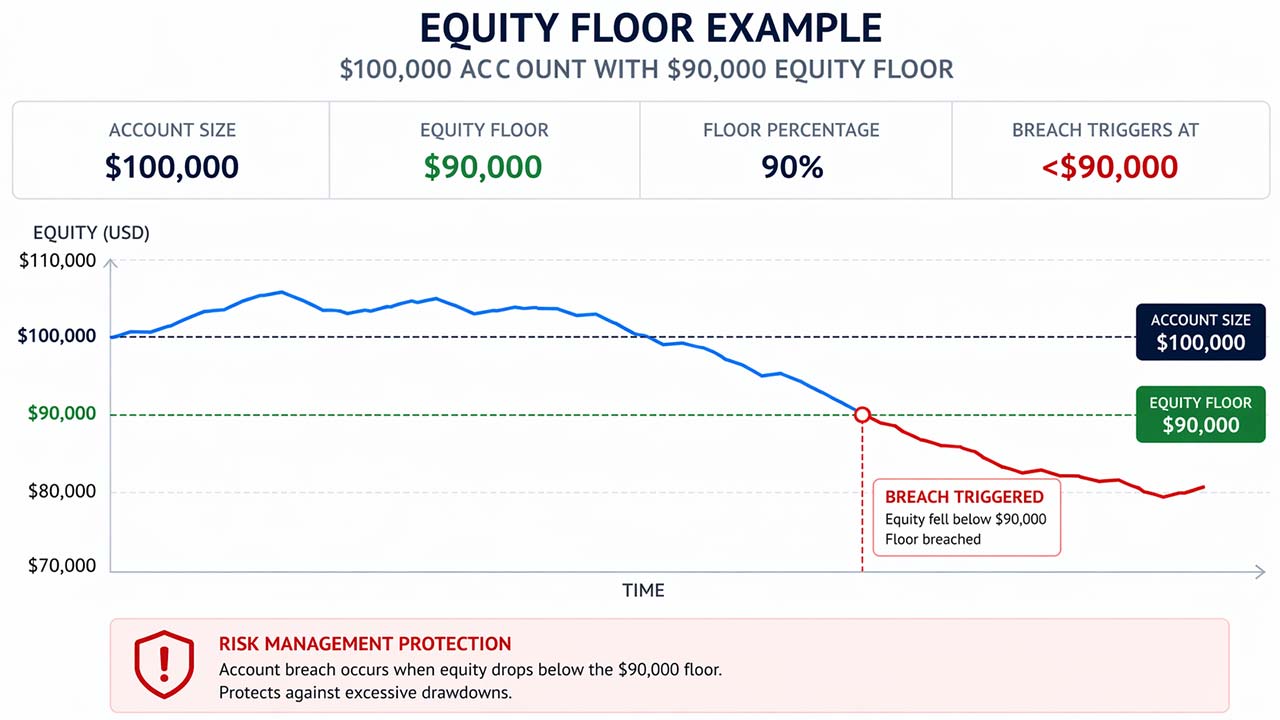
Let’s say you start with a $100,000 account and the max overall loss is set at 10%. That means the total loss allowed is $10,000, and your equity must stay above $90,000 at all times.
If your account drops to $89,900, even for a moment during an open trade, the rule is broken and the account is closed. It does not matter if the trade later moves back into profit, because the breach already happened.

Why equity matters more than balance
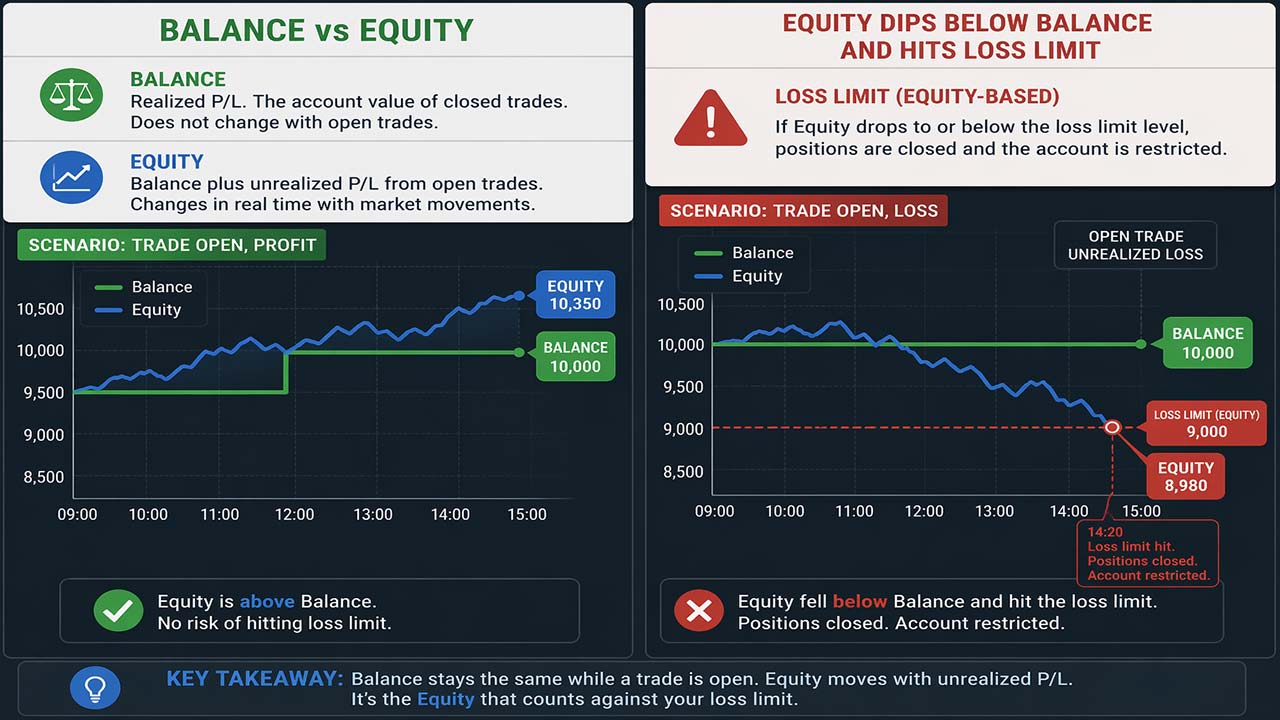
One of the biggest mistakes traders make is focusing only on closed trades. In prop trading, the rule is based on equity, which includes both your balance and any open positions.
This means that floating losses count toward your limit. If you have a large open trade that moves against you, your equity can drop quickly and trigger the loss rule before you even close the position.
Because of this, you always need to monitor your real-time equity, not just your account balance.
Max overall loss vs max daily loss
These two rules often get confused, but they serve different purposes and work together to control risk.
Max daily loss limits how much you can lose in a single day, and it resets at the start of a new trading day. It is designed to prevent short bursts of heavy losses.
Max overall loss, on the other hand, tracks your total drawdown over time. It does not reset and continues to count every loss from the beginning of your account.
A trader can follow daily limits perfectly and still fail the account slowly by building up losses across multiple days. That is why both rules must be respected at the same time.
You can also learn more about how to pass a prop firm challenge and stay within rules by following a structured approach in a prop firm challenge guide.
How traders usually fail this rule
Most accounts are not lost in one trade. The failure builds gradually through a series of small mistakes that stack over time.
A trader may start with a few small losses, then try to recover them quickly by increasing risk. As losses continue, pressure builds, and decision-making becomes worse. Eventually, one larger loss or a series of poor trades pushes the account below the allowed limit.
This pattern is common because traders focus on recovery instead of control. The rule punishes that behavior.
Fixed vs trailing max overall loss
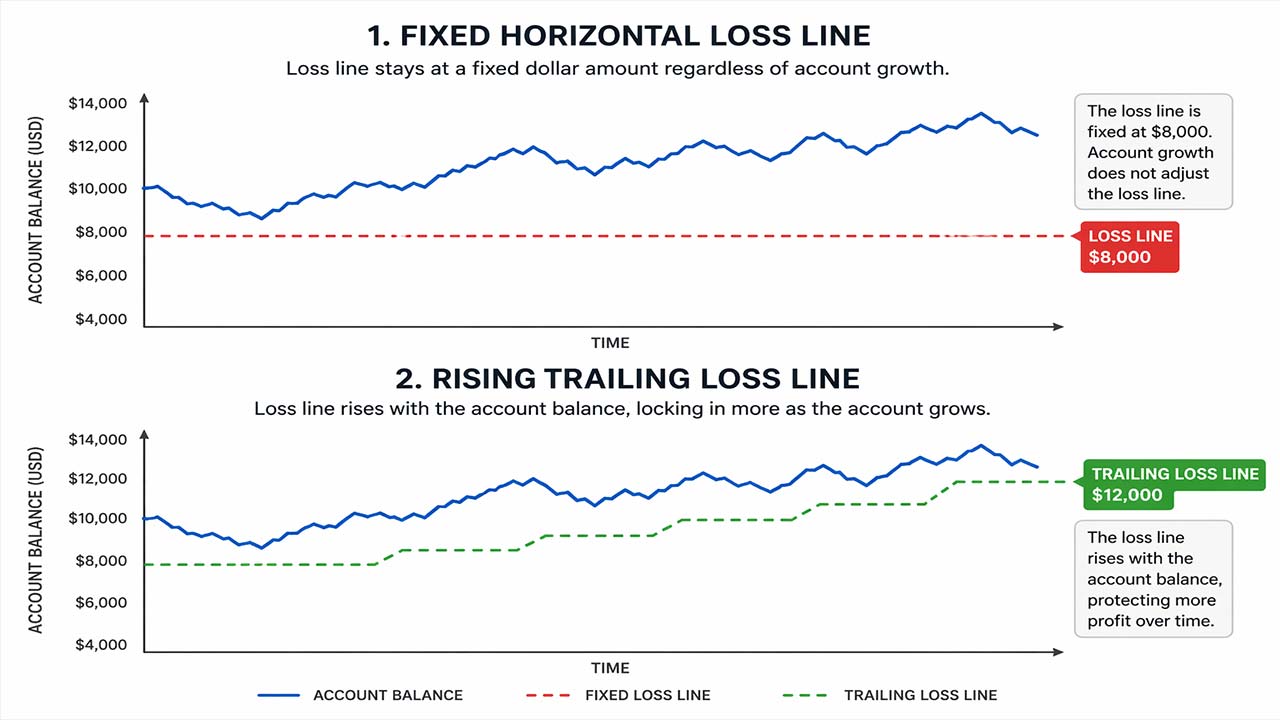
Prop firms use two main types of max overall loss, and understanding the difference is important.
Fixed max overall loss
With a fixed limit, the loss threshold stays the same regardless of your account growth. If you start with $100,000 and have a $10,000 loss limit, your floor remains at $90,000 even if your account grows.
This setup gives you more breathing room as you make profits, because your downside limit does not move.
Trailing max overall loss
A trailing limit moves with your account as it grows. As you make profits and reach new highs, the loss threshold rises with you.
For example, if your account grows from $100,000 to $105,000, your new loss floor may move up to $95,000. This protects the firm’s capital and locks in part of your gains, but it also reduces how much you can afford to lose afterward.
Many traders find this version harder to manage because the margin for error shrinks as the account grows.
Why this rule exists
From the firm’s side, the rule is there to control risk and prevent large account losses. From the trader’s side, it forces discipline and better decision-making.
Without this limit, many traders would continue trading through losses without control. The rule creates a clear boundary that stops that behavior and encourages consistency over time. If you are new to this model, it helps to understand how funded forex accounts work and why firms apply these rules.
How this rule shapes your trading
Max overall loss is not just a rule you check occasionally. It directly affects how you trade every day, from position sizing to how often you enter the market.
You cannot trade aggressively without thinking about how close you are to the limit. Every trade must fit within a larger plan that protects your account from long-term drawdown.
Key areas it affects
Position size
Your risk per trade must stay controlled. If your total allowed loss is 10%, risking 2% or 3% per trade leaves very little room for error. A few losing trades in a row can push you close to the limit quickly.
Most consistent traders stay within 0.5% to 1% risk per trade to avoid that problem. A solid funded account trading plan can help you stay consistent with this approach.
Trade frequency
Taking too many trades increases your exposure to loss. Even if each trade has a small risk, multiple trades in a short period can add up and push your drawdown higher.
Being selective with entries helps protect your account over time.
Recovery behavior
Trying to recover losses quickly is one of the biggest risks. After a losing streak, many traders increase their position size or take lower-quality setups. This often leads to deeper losses and faster account failure.
A slower, steady approach is safer and more sustainable.
Drawdown awareness
You need to know your current drawdown at all times. If your limit is 10% and you are already down 6% or 7%, your focus should shift from making profit to protecting what remains.
Trading aggressively at that stage usually leads to failure.
A smarter way to manage your risk
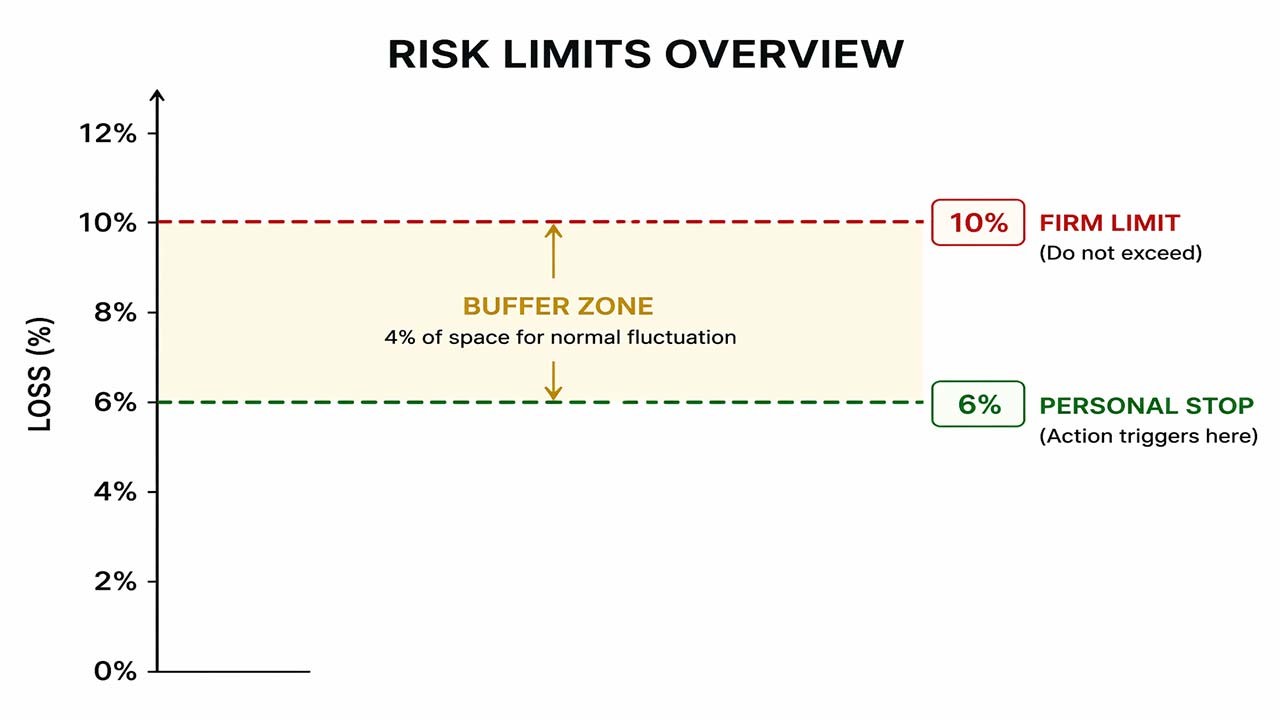
One of the best habits you can build is setting a personal loss limit below the firm’s rule. This creates a safety buffer and reduces the chance of hitting the hard limit.
For example, if the firm allows a 10% total loss, you can decide to stop trading once you reach 6% or 7%. This gives you time to step back, review your trades, and avoid emotional decisions.
This approach keeps you in control instead of reacting under pressure. Strong risk management in forex proprietary trading is what keeps accounts alive over the long term.
Practical rules to stay safe
To manage max overall loss properly, you need a few simple habits that you follow every day.
Risk a small percentage per trade so that losses do not add up too quickly. Avoid revenge trading after losses, because that behavior leads to poor decisions. Keep track of your total drawdown so you always know how close you are to the limit.
When you have a bad day or week, reduce your activity and focus on stability. Over time, consistency matters more than trying to win big in a short period.
Common mistakes traders make
Many traders fail because they underestimate how quickly losses can build up.
Ignoring floating losses is a major issue, since open trades can push your equity below the limit. Increasing risk after losses is another common mistake that speeds up account failure. Some traders also become overconfident after a winning streak and start taking unnecessary risks.
Not tracking your drawdown is another problem. If you do not know where you stand, you cannot manage your risk properly.
What happens when you hit the limit
When your equity drops below the max overall loss level, the account is breached and trading stops immediately. There is no reset or second chance within the same account.
At that point, you would need to start over with a new challenge or funded account. This is why protecting your drawdown is more important than chasing profits.
The real takeaway
Max overall loss is a test of discipline, not just a rule to follow. It checks whether you can manage risk over time, stay patient during losses, and avoid emotional decisions.
Traders who respect this rule tend to last longer and build steady growth. Those who ignore it often see their accounts end faster than expected.
Final thoughts
Max overall loss defines how long you stay in the market. If you respect it and build your strategy around it, you give yourself a real chance to grow your account over time.
If you ignore it, losses will build slowly until one moment ends everything. Treat it as your main guardrail and let it guide how you trade each day. At a best prop firm like Pipstone Capital, you get up to 90% profit split, fast payouts within 24 hours, and real trading conditions designed to help you pass, stay funded, and scale.
FAQs
What is a good max overall loss percentage?
Most prop firms set this between 8% and 12%. A lower percentage means less room for mistakes, while a higher one gives more flexibility but still requires control.
Can I recover after hitting max overall loss?
No. Once your equity drops below the limit, the account is breached and closed. You would need to start again with a new account or challenge.
Does max overall loss include open trades?
Yes, it is based on equity, not just closed trades. Floating losses from open positions count toward the limit and can trigger a breach.
Is max overall loss the same as drawdown?
It is a type of drawdown limit. The difference is that it is fixed by the prop firm and acts as a hard stop that ends the account if reached.
How can I avoid hitting max overall loss?
Keep your risk per trade low, avoid overtrading, and track your total drawdown daily. Setting a personal stop below the firm’s limit also helps protect your account.



What Is Max Overall Loss? Simple Prop Trading Guide
If you trade with a prop firm, one rule controls everything: max overall loss. It defines how much your account can drop before it is closed, and once you hit that level, there is no recovery or second chance. Many traders pay more attention to daily limits, but this rule is the one that usually ends accounts over time.
Understanding it clearly will change how you manage risk, place trades, and protect your capital.
What max overall loss really means
Max overall loss is the total amount your account can lose from its starting balance. It does not reset each day, and it does not care how long it takes to reach that level. From the moment you start trading, every loss moves you closer to that limit.
You can think of it as a fixed boundary that your account cannot cross. Once your equity falls below that point, the account is breached and trading stops.
Simple example to understand it
Let’s say you start with a $100,000 account and the max overall loss is set at 10%. That means the total loss allowed is $10,000, and your equity must stay above $90,000 at all times.
If your account drops to $89,900, even for a moment during an open trade, the rule is broken and the account is closed. It does not matter if the trade later moves back into profit, because the breach already happened.
Why equity matters more than balance
One of the biggest mistakes traders make is focusing only on closed trades. In prop trading, the rule is based on equity, which includes both your balance and any open positions.
This means that floating losses count toward your limit. If you have a large open trade that moves against you, your equity can drop quickly and trigger the loss rule before you even close the position.
Because of this, you always need to monitor your real-time equity, not just your account balance.
Max overall loss vs max daily loss
These two rules often get confused, but they serve different purposes and work together to control risk.
Max daily loss limits how much you can lose in a single day, and it resets at the start of a new trading day. It is designed to prevent short bursts of heavy losses.
Max overall loss, on the other hand, tracks your total drawdown over time. It does not reset and continues to count every loss from the beginning of your account.
A trader can follow daily limits perfectly and still fail the account slowly by building up losses across multiple days. That is why both rules must be respected at the same time.
You can also learn more about how to pass a prop firm challenge and stay within rules by following a structured approach in a prop firm challenge guide.
How traders usually fail this rule
Most accounts are not lost in one trade. The failure builds gradually through a series of small mistakes that stack over time.
A trader may start with a few small losses, then try to recover them quickly by increasing risk. As losses continue, pressure builds, and decision-making becomes worse. Eventually, one larger loss or a series of poor trades pushes the account below the allowed limit.
This pattern is common because traders focus on recovery instead of control. The rule punishes that behavior.
Fixed vs trailing max overall loss
Prop firms use two main types of max overall loss, and understanding the difference is important.
Fixed max overall loss
With a fixed limit, the loss threshold stays the same regardless of your account growth. If you start with $100,000 and have a $10,000 loss limit, your floor remains at $90,000 even if your account grows.
This setup gives you more breathing room as you make profits, because your downside limit does not move.
Trailing max overall loss
A trailing limit moves with your account as it grows. As you make profits and reach new highs, the loss threshold rises with you.
For example, if your account grows from $100,000 to $105,000, your new loss floor may move up to $95,000. This protects the firm’s capital and locks in part of your gains, but it also reduces how much you can afford to lose afterward.
Many traders find this version harder to manage because the margin for error shrinks as the account grows.
Why this rule exists
From the firm’s side, the rule is there to control risk and prevent large account losses. From the trader’s side, it forces discipline and better decision-making.
Without this limit, many traders would continue trading through losses without control. The rule creates a clear boundary that stops that behavior and encourages consistency over time. If you are new to this model, it helps to understand how funded forex accounts work and why firms apply these rules.
How this rule shapes your trading
Max overall loss is not just a rule you check occasionally. It directly affects how you trade every day, from position sizing to how often you enter the market.
You cannot trade aggressively without thinking about how close you are to the limit. Every trade must fit within a larger plan that protects your account from long-term drawdown.
Key areas it affects
Position size
Your risk per trade must stay controlled. If your total allowed loss is 10%, risking 2% or 3% per trade leaves very little room for error. A few losing trades in a row can push you close to the limit quickly.
Most consistent traders stay within 0.5% to 1% risk per trade to avoid that problem. A solid funded account trading plan can help you stay consistent with this approach.
Trade frequency
Taking too many trades increases your exposure to loss. Even if each trade has a small risk, multiple trades in a short period can add up and push your drawdown higher.
Being selective with entries helps protect your account over time.
Recovery behavior
Trying to recover losses quickly is one of the biggest risks. After a losing streak, many traders increase their position size or take lower-quality setups. This often leads to deeper losses and faster account failure.
A slower, steady approach is safer and more sustainable.
Drawdown awareness
You need to know your current drawdown at all times. If your limit is 10% and you are already down 6% or 7%, your focus should shift from making profit to protecting what remains.
Trading aggressively at that stage usually leads to failure.
A smarter way to manage your risk
One of the best habits you can build is setting a personal loss limit below the firm’s rule. This creates a safety buffer and reduces the chance of hitting the hard limit.
For example, if the firm allows a 10% total loss, you can decide to stop trading once you reach 6% or 7%. This gives you time to step back, review your trades, and avoid emotional decisions.
This approach keeps you in control instead of reacting under pressure. Strong risk management in forex proprietary trading is what keeps accounts alive over the long term.
Practical rules to stay safe
To manage max overall loss properly, you need a few simple habits that you follow every day.
Risk a small percentage per trade so that losses do not add up too quickly. Avoid revenge trading after losses, because that behavior leads to poor decisions. Keep track of your total drawdown so you always know how close you are to the limit.
When you have a bad day or week, reduce your activity and focus on stability. Over time, consistency matters more than trying to win big in a short period.
Common mistakes traders make
Many traders fail because they underestimate how quickly losses can build up.
Ignoring floating losses is a major issue, since open trades can push your equity below the limit. Increasing risk after losses is another common mistake that speeds up account failure. Some traders also become overconfident after a winning streak and start taking unnecessary risks.
Not tracking your drawdown is another problem. If you do not know where you stand, you cannot manage your risk properly.
What happens when you hit the limit
When your equity drops below the max overall loss level, the account is breached and trading stops immediately. There is no reset or second chance within the same account.
At that point, you would need to start over with a new challenge or funded account. This is why protecting your drawdown is more important than chasing profits.
The real takeaway
Max overall loss is a test of discipline, not just a rule to follow. It checks whether you can manage risk over time, stay patient during losses, and avoid emotional decisions.
Traders who respect this rule tend to last longer and build steady growth. Those who ignore it often see their accounts end faster than expected.
Final thoughts
Max overall loss defines how long you stay in the market. If you respect it and build your strategy around it, you give yourself a real chance to grow your account over time.
If you ignore it, losses will build slowly until one moment ends everything. Treat it as your main guardrail and let it guide how you trade each day. At a best prop firm like Pipstone Capital, you get up to 90% profit split, fast payouts within 24 hours, and real trading conditions designed to help you pass, stay funded, and scale.
FAQs
What is a good max overall loss percentage?
Most prop firms set this between 8% and 12%. A lower percentage means less room for mistakes, while a higher one gives more flexibility but still requires control.
Can I recover after hitting max overall loss?
No. Once your equity drops below the limit, the account is breached and closed. You would need to start again with a new account or challenge.
Does max overall loss include open trades?
Yes, it is based on equity, not just closed trades. Floating losses from open positions count toward the limit and can trigger a breach.
Is max overall loss the same as drawdown?
It is a type of drawdown limit. The difference is that it is fixed by the prop firm and acts as a hard stop that ends the account if reached.
How can I avoid hitting max overall loss?
Keep your risk per trade low, avoid overtrading, and track your total drawdown daily. Setting a personal stop below the firm’s limit also helps protect your account.
